Events & Promotions
|
|

GMAT Club Daily Prep
Thank you for using the timer - this advanced tool can estimate your performance and suggest more practice questions. We have subscribed you to Daily Prep Questions via email.
Customized
for You
Track
Your Progress
Practice
Pays
Not interested in getting valuable practice questions and articles delivered to your email? No problem, unsubscribe here.
 Sep 21
07:00 PM EDT
-10:00 PM EDT
Boost your GMAT score in less than one month in a live online class + 6 months access to TTP OnDemand video courses included!


 16 Sep 2014, 00:58
Kudos
Bookmarks
If a point is randomly chosen inside a circle with a radius of \(r\), what is the probability that the distance from this point to the center of the circle will be larger than \(\frac{r}{2}\)? (The area of a circle is \(\pi r^2\).)
A. \(\frac{1}{2}\)
B. \(\frac{3}{4}\)
C. \(\frac{7}{8}\)
D. \(\frac{1}{4}r^2\)
E. \(\frac{3}{4}r^2\)
A. \(\frac{1}{2}\)
B. \(\frac{3}{4}\)
C. \(\frac{7}{8}\)
D. \(\frac{1}{4}r^2\)
E. \(\frac{3}{4}r^2\)
16 Sep 2014, 00:58
Kudos
Bookmarks
Official Solution:
If a point is randomly chosen inside a circle with a radius of \(r\), what is the probability that the distance from this point to the center of the circle will be larger than \(\frac{r}{2}\)? (The area of a circle is \(\pi r^2\).)
A. \(\frac{1}{2}\)
B. \(\frac{3}{4}\)
C. \(\frac{7}{8}\)
D. \(\frac{1}{4}r^2\)
E. \(\frac{3}{4}r^2\)
In order for a point to be farther than \(\frac{r}{2}\) from the center, it must fall within the region enclosed by the circumferences of two circles: one with a radius of \(r\) and the other with a radius of \(\frac{r}{2}\):
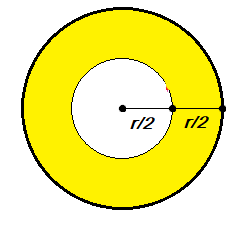
The probability we seek is the ratio of the area of this region to the area of the larger circle. The area of the region can be calculated as follows: Area of the region = \(\pi r^2 - \pi \left(\frac{r}{2}\right)^2 = \frac{3}{4} \pi r^2\). The area of the larger circle is \(\pi r^2\). Thus, the ratio equals \(\frac{3}{4}\).
Note that this is not a Geometry question. While it uses basic knowledge of lines and figures, it is a Probability question. There are 8 questions within GMAT Prep Focus Edition that use similar principles. Here is one example.
Answer: B
If a point is randomly chosen inside a circle with a radius of \(r\), what is the probability that the distance from this point to the center of the circle will be larger than \(\frac{r}{2}\)? (The area of a circle is \(\pi r^2\).)
A. \(\frac{1}{2}\)
B. \(\frac{3}{4}\)
C. \(\frac{7}{8}\)
D. \(\frac{1}{4}r^2\)
E. \(\frac{3}{4}r^2\)
In order for a point to be farther than \(\frac{r}{2}\) from the center, it must fall within the region enclosed by the circumferences of two circles: one with a radius of \(r\) and the other with a radius of \(\frac{r}{2}\):
The probability we seek is the ratio of the area of this region to the area of the larger circle. The area of the region can be calculated as follows: Area of the region = \(\pi r^2 - \pi \left(\frac{r}{2}\right)^2 = \frac{3}{4} \pi r^2\). The area of the larger circle is \(\pi r^2\). Thus, the ratio equals \(\frac{3}{4}\).
Note that this is not a Geometry question. While it uses basic knowledge of lines and figures, it is a Probability question. There are 8 questions within GMAT Prep Focus Edition that use similar principles. Here is one example.
Answer: B
General Discussion

 23 Aug 2017, 19:48
Kudos
Bookmarks
I think this is a high-quality question and I agree with explanation.