Events & Promotions
|
|

GMAT Club Daily Prep
Thank you for using the timer - this advanced tool can estimate your performance and suggest more practice questions. We have subscribed you to Daily Prep Questions via email.
Customized
for You
Track
Your Progress
Practice
Pays
Not interested in getting valuable practice questions and articles delivered to your email? No problem, unsubscribe here.
 Aug 27
10:00 AM EDT
-11:00 AM EDT
We’ve worked incredibly hard to build TTP into the best test prep experience possible, and it would mean a lot to us to win Newsweek’s 2026 Readers’ Choice Award for Best Test Prep. If TTP has helped you, we’d be incredibly grateful for your vote. Sep 04
10:00 AM PDT
-11:00 AM PDT
What does test anxiety really look like on the GMAT? For many test takers, it does not look like a panic attack. Instead, it shows up as brain fog, rereading, negative comparisons, mental noise.... Sep 06
09:30 AM EDT
-12:30 PM EST
Top scores are possible when you enroll in a powerful EA course, taught live online + 6 months access to TTP OnDemand video courses included! Perfect class schedule and easy course access for working professionals. Class starts Sept. 6, 9:30am-12:30pm EST- Sep 09
07:00 AM PDT
-10:00 AM PDT
Meet AdComs and explore top Master’s programs - MiM, MiF, MSc, MSBA and more. - Application Fee Waivers - Free 1-Week of GMAT Club Tests: - Master's Application Toolkit - Grand Prize Giveaway  Sep 15
07:00 PM EDT
-09:00 PM EST
Elite scores are possible when you enroll in a powerful GMAT course, taught live online + 6 months access to TTP OnDemand video courses included! Class starts Tues/Thurs Sept. 15, 2026 - Nov. 15, 2027, 7:00pm-9:00pm EST Sep 21
08:00 PM EDT
-10:00 PM EDT
Elite scores are possible when you enroll in a powerful GMAT course, taught live online + 6 months access to TTP OnDemand video courses included! Class starts Tues/Thurs Oct. 13, 2026 - Jan. 7, 2027, 8:00pm-10:00pm EST


 22 Nov 2021, 05:50
Kudos
Bookmarks
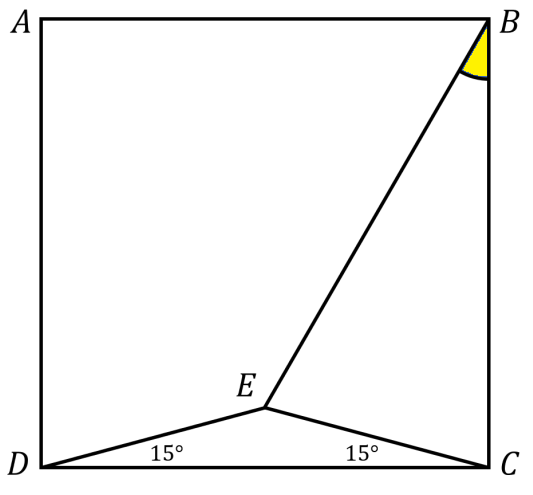
In the square ABCD shown above, what is the measure of an yellow angle ?
A. \(15°\)
B. \(20°\)
C. \(25°\)
D. \(30°\)
E. \(45°\)
22 Nov 2021, 05:50
Kudos
Bookmarks
Official Solution:
In the square ABCD shown above, what is the measure of an yellow angle ?
A. \(15°\)
B. \(20°\)
C. \(25°\)
D. \(30°\)
E. \(45°\)
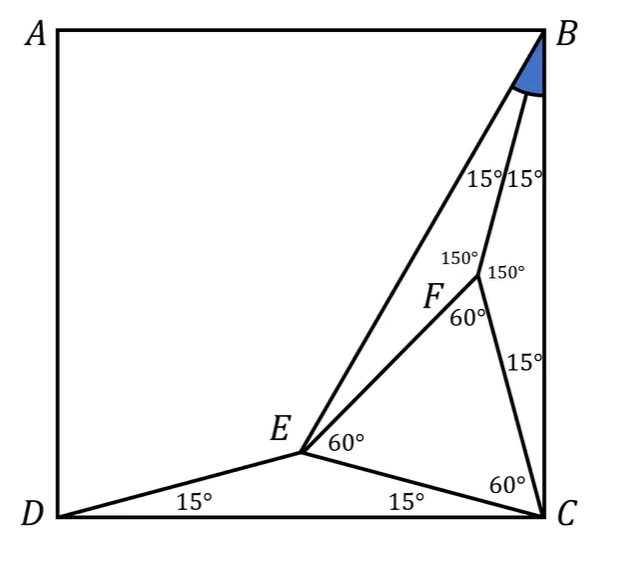
Construct triangle BFC congruent to triangle DEC on side BC (simply put draw triangle BFC on BC the same way DEC is drawn on DC). Notice that \(\angle BFC =180°-(15°+15°)=150°\).
Since BFC and DEC are congruent, then \(CE = CF\).
Since \(\angle DCE = \angle BCF = 15°\), then \(\angle ECF = 90°-(\angle DCE + \angle BCF) = 60°\)
Thus, triangle EFC is isosceles (\(CE = CF\)) and \(\angle ECF =60°\), which means that triangle EFC is equilateral and all its angles are \(60°\).
Next, since the sum of the angles around point F must be \(360°\), then \(\angle BFE = 360° - (\angle BFC + \angle CFE)=360° - (150° + 60°)=150°\)
Now, consider triangles EFB and CFB. In these triangles, two sides and angle between them are equal (BF is shared side, FC = FE because EFC is equilateral, and \(\angle BFE = \angle BFC=150°\), thus EFB and CFB are congruent.
Finally, since EFB and CFB are congruent, then \(\angle FBC=\angle FBE=15°\) and therefore, \(\angle CBE = \angle FBC+\angle FBE=30°\)
Answer: D
In the square ABCD shown above, what is the measure of an yellow angle ?
A. \(15°\)
B. \(20°\)
C. \(25°\)
D. \(30°\)
E. \(45°\)
Construct triangle BFC congruent to triangle DEC on side BC (simply put draw triangle BFC on BC the same way DEC is drawn on DC). Notice that \(\angle BFC =180°-(15°+15°)=150°\).
Since BFC and DEC are congruent, then \(CE = CF\).
Since \(\angle DCE = \angle BCF = 15°\), then \(\angle ECF = 90°-(\angle DCE + \angle BCF) = 60°\)
Thus, triangle EFC is isosceles (\(CE = CF\)) and \(\angle ECF =60°\), which means that triangle EFC is equilateral and all its angles are \(60°\).
Next, since the sum of the angles around point F must be \(360°\), then \(\angle BFE = 360° - (\angle BFC + \angle CFE)=360° - (150° + 60°)=150°\)
Now, consider triangles EFB and CFB. In these triangles, two sides and angle between them are equal (BF is shared side, FC = FE because EFC is equilateral, and \(\angle BFE = \angle BFC=150°\), thus EFB and CFB are congruent.
Finally, since EFB and CFB are congruent, then \(\angle FBC=\angle FBE=15°\) and therefore, \(\angle CBE = \angle FBC+\angle FBE=30°\)
Answer: D





