Events & Promotions
|
|

GMAT Club Daily Prep
Thank you for using the timer - this advanced tool can estimate your performance and suggest more practice questions. We have subscribed you to Daily Prep Questions via email.
Customized
for You
Track
Your Progress
Practice
Pays
Not interested in getting valuable practice questions and articles delivered to your email? No problem, unsubscribe here.
 Sep 21
07:00 PM EDT
-10:00 PM EDT
Boost your GMAT score in less than one month in a live online class + 6 months access to TTP OnDemand video courses included!


 01 Dec 2021, 07:59
Kudos
Bookmarks
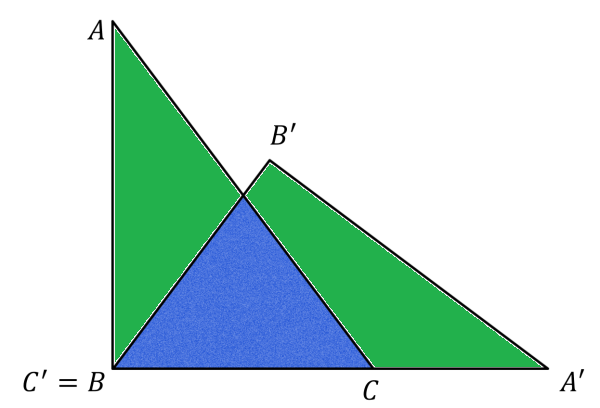
Right triangle ABC, right angled at B, is rotated clockwise, so that vertex B is at B', vertex A is at A' and vertex C is at C', as shown above. What is the ratio of the area of two green regions to the area of blue region?
A. \(1:1\)
B. \(2:1\)
C. \(3:1\)
D. \(4:1\)
E. \(5:1\)
01 Dec 2021, 07:59
Kudos
Bookmarks
Official Solution:
Right triangle ABC, right angled at B, is rotated clockwise, so that vertex B is at B', vertex A is at A' and vertex C is at C', as shown above. What is the ratio of the area of two green regions to the area of blue region?
A. \(1:1\)
B. \(2:1\)
C. \(3:1\)
D. \(4:1\)
E. \(5:1\)
First of all, notice that (blue region) + (green region on the left) = (triangle ABC) and (blue region) + (green region on the right) = (triangle A'B'C'). Since triangles ABC and A'B'C' are congruent, then (green region on the left) = (green region on the right).
Now, consider triangle DBC below:
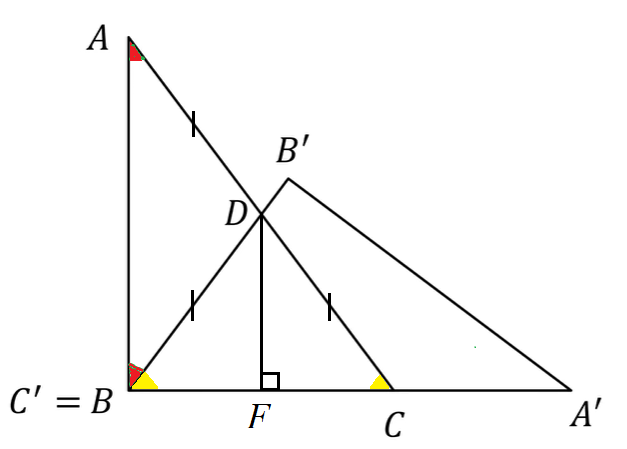
In that triangle \(\angle ACB = \angle A'C'B'\) (those yellow angles are the same angle just rotated), so \(DB = DC\).
Notice that (yellow angle at C) + (red angle at A) is 90° AND (yellow angle at B) + (red angle at B) is also 90°, so two red angles are equal. This means that \(DA=DB\) (D is the midpoint of AC).
Drop perpendicular from D to BC. Triangles ABC and DFC are similar (because all their angles are equal) and DC is half of AC, thus DF is also half of AB.
The bases of triangles ABC and DFC are the same (BC) and the height of ABCt (AB) is twice that of the height of DBC (DF), so the area of ABC is twice the area of DBC. Thus, the area of ADB (green region on the left) is equal to the area of DBC (blue region)
We know that the green regions are equal, so the ratio of the area of two green regions to the area of blue region is \(2:1\)
Answer: B
Right triangle ABC, right angled at B, is rotated clockwise, so that vertex B is at B', vertex A is at A' and vertex C is at C', as shown above. What is the ratio of the area of two green regions to the area of blue region?
A. \(1:1\)
B. \(2:1\)
C. \(3:1\)
D. \(4:1\)
E. \(5:1\)
First of all, notice that (blue region) + (green region on the left) = (triangle ABC) and (blue region) + (green region on the right) = (triangle A'B'C'). Since triangles ABC and A'B'C' are congruent, then (green region on the left) = (green region on the right).
Now, consider triangle DBC below:
In that triangle \(\angle ACB = \angle A'C'B'\) (those yellow angles are the same angle just rotated), so \(DB = DC\).
Notice that (yellow angle at C) + (red angle at A) is 90° AND (yellow angle at B) + (red angle at B) is also 90°, so two red angles are equal. This means that \(DA=DB\) (D is the midpoint of AC).
Drop perpendicular from D to BC. Triangles ABC and DFC are similar (because all their angles are equal) and DC is half of AC, thus DF is also half of AB.
The bases of triangles ABC and DFC are the same (BC) and the height of ABCt (AB) is twice that of the height of DBC (DF), so the area of ABC is twice the area of DBC. Thus, the area of ADB (green region on the left) is equal to the area of DBC (blue region)
We know that the green regions are equal, so the ratio of the area of two green regions to the area of blue region is \(2:1\)
Answer: B



