Events & Promotions
|
|

GMAT Club Daily Prep
Thank you for using the timer - this advanced tool can estimate your performance and suggest more practice questions. We have subscribed you to Daily Prep Questions via email.
Customized
for You
Track
Your Progress
Practice
Pays
Not interested in getting valuable practice questions and articles delivered to your email? No problem, unsubscribe here.
 Sep 24
08:00 AM EDT
-08:30 AM EDT
Meet Tuck at an informal student or staff-hosted coffee chat in a city near you! Sep 26
01:00 PM EDT
-04:00 PM EDT
Top scores are possible when you enroll in a powerful GMAT course, taught live online + 6 months access to TTP OnDemand video courses included. Class starts Saturdays Sept. 26, 2026 - Dec. 19, 2026, 1:00pm-4:00pm ES Sep 29
11:00 AM EDT
-01:00 PM EDT
" Description: Top scores are possible when you enroll in a powerful GMAT course, taught live online + 6 months access to TTP OnDemand video courses included! Class starts Tues/Thur Sept. 29, 2026 - Dec. 3, 2026, 11:00am-1:00pm EST Oct 01
07:00 AM BST
-08:00 AM GMT
Welcome to the GMAT Club's Free Interview Prep Event for Top MBA Programs! Buy tickets - Virtual series that’s all set to equip you to -excel in your MBA interviews.


 09 Dec 2021, 05:44
Kudos
Bookmarks
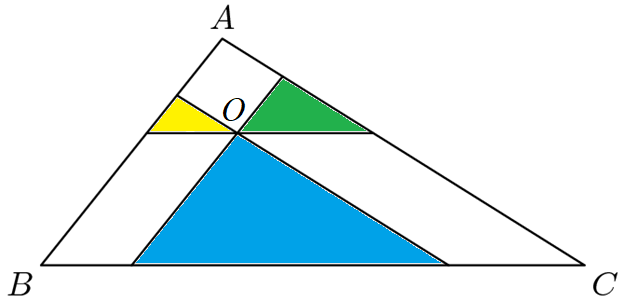
In a triangle ABC, three lines intersect at point O, each parallel to one side of the triangle. If the yellow, green, and blue regions have areas of 1, 4, and 9, respectively, what is the area of triangle ABC? (Note: The figure is not drawn to scale.)
A. \(24\)
B. \(28\)
C. \(32\)
D. \(36\)
E. \(54\)
09 Dec 2021, 05:44
Kudos
Bookmarks
Official Solution:
In a triangle ABC, three lines intersect at point O, each parallel to one side of the triangle. If the yellow, green, and blue regions have areas of 1, 4, and 9, respectively, what is the area of triangle ABC? (Note: The figure is not drawn to scale.)
A. \(24\)
B. \(28\)
C. \(32\)
D. \(36\)
E. \(54\)
Since all three sides in each of the three triangles are parallel to one another, these triangles are similar to each other.
In similar triangles, if the sides are in the ratio \(\frac{m}{n}\), the areas of the triangles are in the ratio \((\frac{m}{n})^2\). Since the ratio of the areas of the triangles is 1:4:9, the ratio of their corresponding sides must be \(1:2:3\). Therefore, if the base of the yellow triangle is \(x\), the base of the green triangle is 2x, and the base of the blue triangle is 3x.
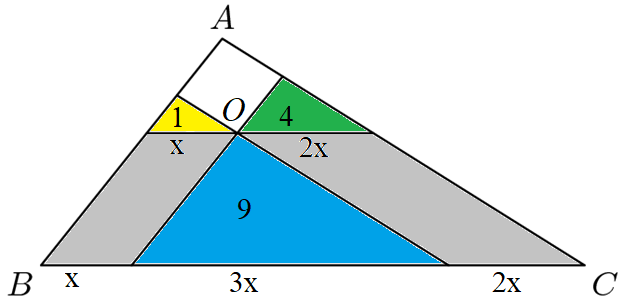
Next, the two gray figures in the image above are parallelograms, so their opposite sides are equal, making the base of triangle ABC equal to \(x + 3x + 2x = 6x\).
Triangle ABC is also similar to the blue triangle, and since the ratio of their bases is \(6x:3x = 2:1\), the ratio of their areas must be \(4:1\).
Lastly, as the area of the blue triangle is 9, the area of triangle ABC is \(4 * 9 = 36\).
Answer: D
In a triangle ABC, three lines intersect at point O, each parallel to one side of the triangle. If the yellow, green, and blue regions have areas of 1, 4, and 9, respectively, what is the area of triangle ABC? (Note: The figure is not drawn to scale.)
A. \(24\)
B. \(28\)
C. \(32\)
D. \(36\)
E. \(54\)
Since all three sides in each of the three triangles are parallel to one another, these triangles are similar to each other.
In similar triangles, if the sides are in the ratio \(\frac{m}{n}\), the areas of the triangles are in the ratio \((\frac{m}{n})^2\). Since the ratio of the areas of the triangles is 1:4:9, the ratio of their corresponding sides must be \(1:2:3\). Therefore, if the base of the yellow triangle is \(x\), the base of the green triangle is 2x, and the base of the blue triangle is 3x.
Next, the two gray figures in the image above are parallelograms, so their opposite sides are equal, making the base of triangle ABC equal to \(x + 3x + 2x = 6x\).
Triangle ABC is also similar to the blue triangle, and since the ratio of their bases is \(6x:3x = 2:1\), the ratio of their areas must be \(4:1\).
Lastly, as the area of the blue triangle is 9, the area of triangle ABC is \(4 * 9 = 36\).
Answer: D
 19 Apr 2023, 20:47
Kudos
Bookmarks
Are we saying that the sides of the blue triangle is similar to that of ABC on the same grounds as we did before? i.e - They have parallel sides.




