Events & Promotions
|
|

GMAT Club Daily Prep
Thank you for using the timer - this advanced tool can estimate your performance and suggest more practice questions. We have subscribed you to Daily Prep Questions via email.
Customized
for You
Track
Your Progress
Practice
Pays
Not interested in getting valuable practice questions and articles delivered to your email? No problem, unsubscribe here.
 Sep 15
07:00 PM EDT
-09:00 PM EST
Elite scores are possible when you enroll in a powerful GMAT course, taught live online + 6 months access to TTP OnDemand video courses included! Class starts Tues/Thurs Sept. 15, 2026 - Nov. 15, 2027, 7:00pm-9:00pm EST Sep 21
07:00 PM EDT
-10:00 PM EDT
Boost your GMAT score in less than one month in a live online class + 6 months access to TTP OnDemand video courses included!


 Updated on: 05 Mar 2026, 21:52
The first few times I did MSRs, I thought the goal was to read every tab like it was some sacred document and memorize half the numbers before even looking at the questions. Five minutes later I had learned a lot of completely useless information and lost imp time. Eventually I realized MSR is less about reading everything and more about knowing where things are and not panicking when the tabs started getting dense. Once I started focusing on key details, I started seeing better accuracy with improved time management.
Let me showcase it with an official example. Here, we have 3 tabs marked in bold -
Ten-Year Plan:
As part of a collaborative ten-year plan involving technology upgrades, program development, and remodeling, four art museums—in Country X: the Arts Institute, City Museum, and Blake Museum; and in Country Y: the Davis Institute—will be closed for remodeling, one at a time, during a continuous seven-year period. For three of the four successive closings (labeled Periods I, II, III, and IV), the duration is to be two calendar years each. Other than during the seven years of successive closings, none of the four museums is to be closed during the ten-year period.
The plan stipulates that during the seven-year remodeling, each museum, during its period of closure and only then, will lend just one of its collections to one of the other three museums; when it reopens, it will immediately get its loaned collection back. No other borrowing or lending of art works by the museums is to occur during the ten years.
Constraints:
Time constraints:
• The Arts Institute can be closed either for Period III or for Period IV but no earlier.
• City Museum will close for just one calendar year.
Loan constraints:
• The Blake Museum will borrow only collections of 20 works or less.
• The Blake Museum will accept loan collections for a full two-year period only.
• The Davis Institute, in Country Y, will not borrow collections explicitly devoted only to Country X artists
Notes:
Arts -> Period 3/4
City -> 1 yr
Blake -> Not accept from City and <20 coll
Davis -> No X artists
Collections:
The table below lists the titles of the available collections, indicating, for each collection, the type of artworks (paintings, sculpture, manuscripts, or tapestries) in the collection and, in most cases, the historical period (e.g., ancient, medieval, sixteenth century). Only collections with titles mentioning artists of a particular country consist exclusively of works by such artists.
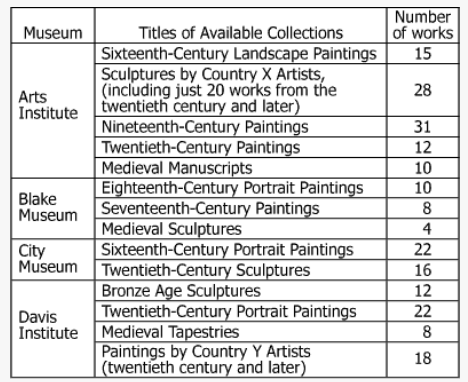
Just hover over numbers to get a grasp on what the title sounds like and rough estimate of numbers
The initial read should not take more than about three minutes in total, roughly a minute per tab, since most of the information is fairly straightforward. By that point, you should already assume that at least one of the questions may be time-consuming and could take a minute or two more than average. So while reading, it helps to double down on noting constraints and exceptions, because those are usually the conditions you will be juggling when you start solving the questions.
Q1. Suppose the Davis Institute lends its Bronze Age Sculptures collection and immediately following its two-year closure period reopens with a special exhibition of sculpture, including the Bronze Age Sculptures collection and another sculpture collection borrowed under the ten-year plan. Given this and the information in the tabs, for each of the following sequences of closings for Periods I, II, III, and IV, respectively, select Yes if the sequence is possible. Otherwise, select No.
What do we know about Davis? - No X artists and from the question we know that it can't be the last one closing and it needs a sculpture
Blake-Davis-Arts-City => Arts has sculpture but from artists X so it doesn't count => NO
Davis-City-Blake-Arts => YES
City-Blake-Arts-Davis => NO
This should take up on avg 1.5 mins
Q2. The Davis Institute's curator is contemplating a proposal to close the museum in Period I and then, in Periods II and III, to borrow a medieval collection and a sixteenth-century collection (one collection per period, and in either order). To determine which museum would lend the medieval collection, which one of the following would it most help the curator to know?
sixteenth-century => Arts/City
medieval collection => Arts/Blake
What are the constraints we are talking about here? Blake can lend in Period 2 or Arts/Blake can lend in Period 3
If we know that Arts/Blake is closed in Period 4 then we can say for sure that the collection comes from the other. It's difficult to come out with this condition on the spot, so it would be better to quickly eliminate options on this one.
A. That the City Museum will be closed in Period II => Period 3 is still wide open
B. That the Arts Institute will be closed in Period IV => Spot on
C. That the Davis Institute will lend its Medieval Tapestries collection to the Blake Museum in Period I => Period 3 is still wide open
D. That the City Museum will be open in Period III => Period 3 is still wide open
E. That the Arts Institute will be open in Period II => Period 3 is still wide open
This might take you 2 mins, if you go through each options slowly, but remember you need to have the condition/constraint quite clear on top of your mind.
Q3. The Blake Museum wishes to borrow a collection that consists of the same type of artworks as does one or more of its own collections. For each of the following, select Yes if, given the information provided, the indicated collection could be loaned to the museum and would satisfy the museum's wish. Otherwise, select No.
What does Blake have? - Paintings and Sculptures and what are the conditions for Blake? - Not accept from City and <20 coll
Sixteenth-Century Landscape Paintings from the Arts Institute => satisfies our conditions so yes
Paintings by Country Y Artists from the Davis Institute => satisfies our conditions so yes
Twentieth-Century Sculptures from the City Museum => doesn't satisfy the condition so no
Should take max 1.5 mins to answer this.
We are looking at total time somewhere around -> 3 + 1.5 + 2 + 1.5 = ~8mins
And this is one of the hard ones in the official list.
If you analyze your practice attempt closely, you will realize that timing starts the moment you begin reading the prompt. You need to get quick at spotting key data points and moving to the questions without getting lost in the middle. MSRs are very different from RCs. In RC, you can afford to be a bit slow upfront and recover time while answering. With MSRs, some questions themselves can take time, so it is better to sense that early rather than discovering it after the question appears and your timer is already sprinting in its own race.
One thing to keep in mind while attempting every MSR is that you should know exactly what you are looking for when you answer a question. Most mistakes here are not because the question is extremely hard. It is usually a small condition missed somewhere. If you know what the question is asking and where the data sits, you often save time because you are not re-reading everything.
You can take light notes while reading or build a mental map. Both work. The data will not always sit in one tab, so remember where things exist even if you do not memorize every detail. Your main goal while reading tabs is to map what data exists and where, not to memorize every number like you are preparing for a quiz show. Spending too much time trying to remember everything can backfire, especially if none of it gets tested.
In the example here, the reading was manageable but the conditions in the questions needed more care. The other common type is the opposite. You may get a heavy read with lots of data but do not panic in that situation. If the read is dense, there is a good chance the questions will be easier. If you follow the right approach, you should still aim for roughly an eight minute window per MSR set. That is the benchmark you are working with.
So whenever you practice, do not just ask if you got the question right. Ask yourself if you read only what was needed within the right time. Ask if you mapped where the data was. Ask if you knew exactly what you were looking for when answering. If the answer is yes, you are on track. If not, then practice it, because the timer will definitely remind you on test day. DI is not known for being very forgiving when it comes to time management.
Let me showcase it with an official example. Here, we have 3 tabs marked in bold -
Ten-Year Plan:
As part of a collaborative ten-year plan involving technology upgrades, program development, and remodeling, four art museums—in Country X: the Arts Institute, City Museum, and Blake Museum; and in Country Y: the Davis Institute—will be closed for remodeling, one at a time, during a continuous seven-year period. For three of the four successive closings (labeled Periods I, II, III, and IV), the duration is to be two calendar years each. Other than during the seven years of successive closings, none of the four museums is to be closed during the ten-year period.
The plan stipulates that during the seven-year remodeling, each museum, during its period of closure and only then, will lend just one of its collections to one of the other three museums; when it reopens, it will immediately get its loaned collection back. No other borrowing or lending of art works by the museums is to occur during the ten years.
Constraints:
Time constraints:
• The Arts Institute can be closed either for Period III or for Period IV but no earlier.
• City Museum will close for just one calendar year.
Loan constraints:
• The Blake Museum will borrow only collections of 20 works or less.
• The Blake Museum will accept loan collections for a full two-year period only.
• The Davis Institute, in Country Y, will not borrow collections explicitly devoted only to Country X artists
Notes:
Arts -> Period 3/4
City -> 1 yr
Blake -> Not accept from City and <20 coll
Davis -> No X artists
Collections:
The table below lists the titles of the available collections, indicating, for each collection, the type of artworks (paintings, sculpture, manuscripts, or tapestries) in the collection and, in most cases, the historical period (e.g., ancient, medieval, sixteenth century). Only collections with titles mentioning artists of a particular country consist exclusively of works by such artists.
Just hover over numbers to get a grasp on what the title sounds like and rough estimate of numbers
The initial read should not take more than about three minutes in total, roughly a minute per tab, since most of the information is fairly straightforward. By that point, you should already assume that at least one of the questions may be time-consuming and could take a minute or two more than average. So while reading, it helps to double down on noting constraints and exceptions, because those are usually the conditions you will be juggling when you start solving the questions.
Q1. Suppose the Davis Institute lends its Bronze Age Sculptures collection and immediately following its two-year closure period reopens with a special exhibition of sculpture, including the Bronze Age Sculptures collection and another sculpture collection borrowed under the ten-year plan. Given this and the information in the tabs, for each of the following sequences of closings for Periods I, II, III, and IV, respectively, select Yes if the sequence is possible. Otherwise, select No.
What do we know about Davis? - No X artists and from the question we know that it can't be the last one closing and it needs a sculpture
Blake-Davis-Arts-City => Arts has sculpture but from artists X so it doesn't count => NO
Davis-City-Blake-Arts => YES
City-Blake-Arts-Davis => NO
This should take up on avg 1.5 mins
Q2. The Davis Institute's curator is contemplating a proposal to close the museum in Period I and then, in Periods II and III, to borrow a medieval collection and a sixteenth-century collection (one collection per period, and in either order). To determine which museum would lend the medieval collection, which one of the following would it most help the curator to know?
sixteenth-century => Arts/City
medieval collection => Arts/Blake
What are the constraints we are talking about here? Blake can lend in Period 2 or Arts/Blake can lend in Period 3
If we know that Arts/Blake is closed in Period 4 then we can say for sure that the collection comes from the other. It's difficult to come out with this condition on the spot, so it would be better to quickly eliminate options on this one.
A. That the City Museum will be closed in Period II => Period 3 is still wide open
B. That the Arts Institute will be closed in Period IV => Spot on
C. That the Davis Institute will lend its Medieval Tapestries collection to the Blake Museum in Period I => Period 3 is still wide open
D. That the City Museum will be open in Period III => Period 3 is still wide open
E. That the Arts Institute will be open in Period II => Period 3 is still wide open
This might take you 2 mins, if you go through each options slowly, but remember you need to have the condition/constraint quite clear on top of your mind.
Q3. The Blake Museum wishes to borrow a collection that consists of the same type of artworks as does one or more of its own collections. For each of the following, select Yes if, given the information provided, the indicated collection could be loaned to the museum and would satisfy the museum's wish. Otherwise, select No.
What does Blake have? - Paintings and Sculptures and what are the conditions for Blake? - Not accept from City and <20 coll
Sixteenth-Century Landscape Paintings from the Arts Institute => satisfies our conditions so yes
Paintings by Country Y Artists from the Davis Institute => satisfies our conditions so yes
Twentieth-Century Sculptures from the City Museum => doesn't satisfy the condition so no
Should take max 1.5 mins to answer this.
We are looking at total time somewhere around -> 3 + 1.5 + 2 + 1.5 = ~8mins
And this is one of the hard ones in the official list.
If you analyze your practice attempt closely, you will realize that timing starts the moment you begin reading the prompt. You need to get quick at spotting key data points and moving to the questions without getting lost in the middle. MSRs are very different from RCs. In RC, you can afford to be a bit slow upfront and recover time while answering. With MSRs, some questions themselves can take time, so it is better to sense that early rather than discovering it after the question appears and your timer is already sprinting in its own race.
One thing to keep in mind while attempting every MSR is that you should know exactly what you are looking for when you answer a question. Most mistakes here are not because the question is extremely hard. It is usually a small condition missed somewhere. If you know what the question is asking and where the data sits, you often save time because you are not re-reading everything.
You can take light notes while reading or build a mental map. Both work. The data will not always sit in one tab, so remember where things exist even if you do not memorize every detail. Your main goal while reading tabs is to map what data exists and where, not to memorize every number like you are preparing for a quiz show. Spending too much time trying to remember everything can backfire, especially if none of it gets tested.
In the example here, the reading was manageable but the conditions in the questions needed more care. The other common type is the opposite. You may get a heavy read with lots of data but do not panic in that situation. If the read is dense, there is a good chance the questions will be easier. If you follow the right approach, you should still aim for roughly an eight minute window per MSR set. That is the benchmark you are working with.
So whenever you practice, do not just ask if you got the question right. Ask yourself if you read only what was needed within the right time. Ask if you mapped where the data was. Ask if you knew exactly what you were looking for when answering. If the answer is yes, you are on track. If not, then practice it, because the timer will definitely remind you on test day. DI is not known for being very forgiving when it comes to time management.
Moderator: