Events & Promotions
| Last visit was: 26 Sep 2026, 21:55 |
It is currently 26 Sep 2026, 21:55 |
|
|

GMAT Club Daily Prep
Thank you for using the timer - this advanced tool can estimate your performance and suggest more practice questions. We have subscribed you to Daily Prep Questions via email.
Customized
for You
Track
Your Progress
Practice
Pays
Not interested in getting valuable practice questions and articles delivered to your email? No problem, unsubscribe here.
 Sep 28
07:00 PM EDT
-10:00 PM EDT
Boost your GMAT score in less than one month in a live online class + 6 months access to TTP OnDemand video courses included! Class starts Mon, Tues, Wed, Thur, Fri Sept. 28, 2026 - Oct. 16, 2027, 7:00pm-10:00pm EST Sep 29
11:00 AM EDT
-01:00 PM EDT
" Description: Top scores are possible when you enroll in a powerful GMAT course, taught live online + 6 months access to TTP OnDemand video courses included! Class starts Tues/Thur Sept. 29, 2026 - Dec. 3, 2026, 11:00am-1:00pm EST Oct 01
07:00 AM BST
-08:00 AM GMT
Welcome to the GMAT Club's Free Interview Prep Event for Top MBA Programs! Buy tickets - Virtual series that’s all set to equip you to -excel in your MBA interviews. Oct 03
01:00 PM EDT
-04:00 PM EDT
Top scores are possible when you enroll in a powerful GMAT course, taught live online + 6 months access to TTP OnDemand video courses included! Class starts Saturdays Oct. 3, 2026 - Dec. 26, 2026, 1:00pm-4:00pm EST

 09 Oct 2023, 03:57
Kudos
Bookmarks


C
Be sure to select an answer first to save it in the Error Log before revealing the correct answer (OA)!
Difficulty:
 55%
(hard)
55%
(hard)
Question Stats:
78% (02:52) correct 22%
(03:16)
wrong
based on 1263
sessions
22%
(03:16)
wrong
based on 1263
sessions
History
Date
Time
Result
Not Attempted Yet
Of the 45 households in a certain neighborhood, 28 subscribe to Newspaper Q, 17 subscribe to Newspaper R, 12 subscribe to Newspaper S, 7 subscribe to both Q and R, 8 subscribe to both Q and S, and 9 subscribe to both R and S. The number of households who subscribe to all three newspapers is equal to the number of households who subscribe to none of the three newspapers. If 39 of the households subscribe to at least one of the three newspapers, how many households subscribe to only one of the newspapers?
A) 15
B) 21
C) 27
D) 33
E) 46
A) 15
B) 21
C) 27
D) 33
E) 46
Question exposed a gap?
Take sectional Adaptive Quant, Verbal, or DI tests on GMAT Club and review the detailed score report.
Get started →

 24 Jan 2024, 17:15
Kudos
Bookmarks
Of the 45 households in a certain neighborhood, 28 subscribe to Newspaper Q, 17 subscribe to Newspaper R, 12 subscribe to Newspaper S, 7 subscribe to both Q and R, 8 subscribe to both Q and S, and 9 subscribe to both R and S. The number of households who subscribe to all three newspapers is equal to the number of households who subscribe to none of the three newspapers. If 39 of the households subscribe to at least one of the three newspapers, how many households subscribe to only one of the newspapers?
We don't need to draw a Venn diagram to answer this question. If we understand the math, we can answer the question by simply doing the math on the sheet or in our heads.
However, for the purpose of illustrating what's going on, I'll use a Venn diagram.
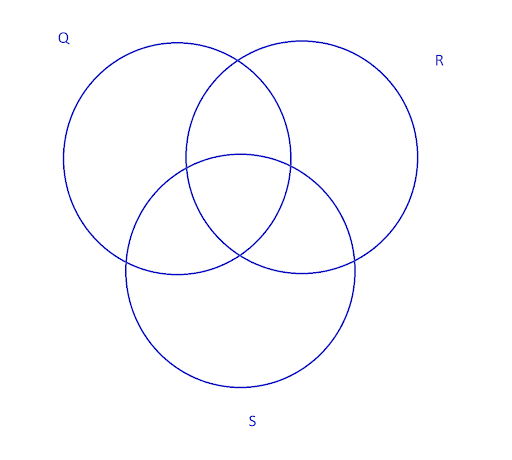
We can start with three circles to represent the sets of households that subscribe to the three newspapers.
Then, we work our way from the center outward, starting with the households that subscribe to all three newspapers.
The passage says, "The number of households who subscribe to all three newspapers is equal to the number of households who subscribe to none of the three newspapers." So, we know that the number that subscribe to all three is the following:
Households That Subscribe to None = All Households - Households That Subscribe to at Least One = 45 - 39 = 6.
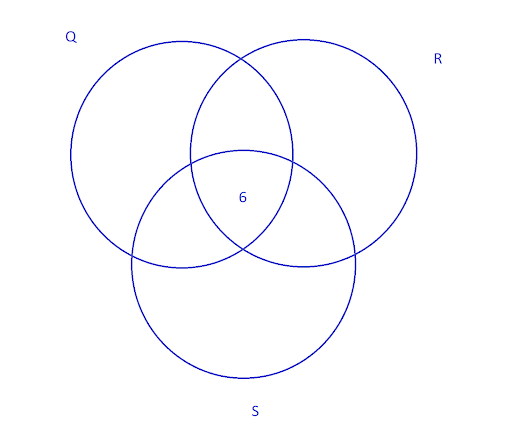
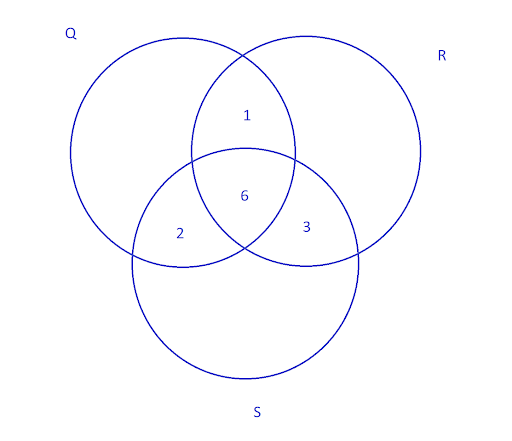
Then, to find the number that subscribe to two but not all three, we subtract 6 from each number of households that subscribe to two.
Q and R only = 7 - 6 = 1
Q and S only = 8 - 6 = 2
R and S only = 9 - 6 = 3
Finally, to find the number that subscribe to one newspaper only, we subtract the numbers already in each circle from the total number that subscribe to each newspaper.
Q only = 28 - (2 + 6 + 1) = 19
R only = 17 - (1 + 6 + 3) = 7
S only = 12 - (2 + 6 + 3) = 1
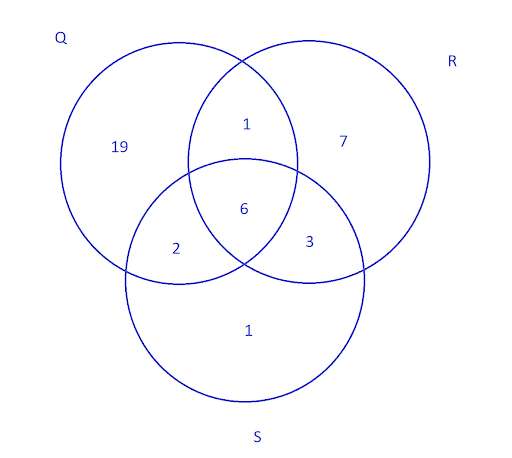
Then, the total number of households that subscribe to only one newspaper is Q only + R only + S only = 19 + 7 + 1 = 27
A) 15
B) 21
C) 27
D) 33
E) 46
Correct answer: C
We don't need to draw a Venn diagram to answer this question. If we understand the math, we can answer the question by simply doing the math on the sheet or in our heads.
However, for the purpose of illustrating what's going on, I'll use a Venn diagram.
We can start with three circles to represent the sets of households that subscribe to the three newspapers.
Then, we work our way from the center outward, starting with the households that subscribe to all three newspapers.
The passage says, "The number of households who subscribe to all three newspapers is equal to the number of households who subscribe to none of the three newspapers." So, we know that the number that subscribe to all three is the following:
Households That Subscribe to None = All Households - Households That Subscribe to at Least One = 45 - 39 = 6.
Then, to find the number that subscribe to two but not all three, we subtract 6 from each number of households that subscribe to two.
Q and R only = 7 - 6 = 1
Q and S only = 8 - 6 = 2
R and S only = 9 - 6 = 3
Finally, to find the number that subscribe to one newspaper only, we subtract the numbers already in each circle from the total number that subscribe to each newspaper.
Q only = 28 - (2 + 6 + 1) = 19
R only = 17 - (1 + 6 + 3) = 7
S only = 12 - (2 + 6 + 3) = 1
Then, the total number of households that subscribe to only one newspaper is Q only + R only + S only = 19 + 7 + 1 = 27
A) 15
B) 21
C) 27
D) 33
E) 46
Correct answer: C
 07 Apr 2024, 06:56
Kudos
Bookmarks
yrozenblum
First notice that we are given that out of 45, 39 households subscribe to at least one of the three newspapers. This means 6 households subscribe to none. This also means 6 susbcribe to all three (since "The number of households who subscribe to all three newspapers is equal to the number of households who subscribe to none of the three newspapers")
Those that subscribe to 2 or more newspapers = 7 + 8 + 9 - 2*6 = 12
Why do we subtract 6 twice? Because it is counted each time in 7, 8 and 9. We need to count it only once.
Since 39 households subscribe to at least one of the three newspapers, if we subtract from this the number that subscribe to at least 2 or more, we will get the number that subscribe to only 1 newspaper.
Those that subscribe to only 1 newspaper = 39 - 12 = 27
Answer (C)
General Discussion
 09 Oct 2023, 05:20
Kudos
Bookmarks
yrozenblum
7 subscribe to both Q and R : x+y=7
8 subscribe to both Q and S : y+z=8
9 subscribe to both R and S : w+y=9
If 39 of the households subscribe to at least one of the three newspapers then 6 households subscribe to none of them
The number of households who subscribe to all three newspapers is equal to the number of households who subscribe to none of the three newspapers
y=6
x=1 ; z=2 ; w= 3
households who subscribe to only Q : 28-x-y-z =19
households who subscribe to only R : 17-w-y-x =7
households who subscribe to only S : 12-z-y-w =1
Number of households that subscribe to only one of the newspapers is 19+7+1=27