Events & Promotions
|
|

GMAT Club Daily Prep
Thank you for using the timer - this advanced tool can estimate your performance and suggest more practice questions. We have subscribed you to Daily Prep Questions via email.
Customized
for You
Track
Your Progress
Practice
Pays
Not interested in getting valuable practice questions and articles delivered to your email? No problem, unsubscribe here.
 Sep 27
01:30 AM EDT
-02:30 AM EDT
At one point, she believed GMAT wasn’t for her. After scoring 595, self-doubt crept in and she questioned her potential. But instead of quitting, she made the right strategic changes. The result? A remarkable comeback to 695. Check out how Saakshi did it. Sep 26
12:30 AM EDT
-01:30 AM EDT
Struggling to find the right strategies to score a 99 %ile on GMAT Focus? Riya (GMAT 715) boosted her score by 100-points in just 15 days! Discover how the right mentorship, tailored strategies, and an unwavering mindset can transform your GMAT prep. Sep 26
06:00 PM PDT
-07:00 PM PDT
Free- full-length test + 15 concept videos + 150+ short videos + study plan! Sep 28
07:00 PM EDT
-10:00 PM EDT
Boost your GMAT score in less than one month in a live online class + 6 months access to TTP OnDemand video courses included! Class starts Mon, Tues, Wed, Thur, Fri Sept. 28, 2026 - Oct. 16, 2027, 7:00pm-10:00pm EST Sep 29
11:00 AM EDT
-01:00 PM EDT
" Description: Top scores are possible when you enroll in a powerful GMAT course, taught live online + 6 months access to TTP OnDemand video courses included! Class starts Tues/Thur Sept. 29, 2026 - Dec. 3, 2026, 11:00am-1:00pm EST Oct 01
07:00 AM BST
-08:00 AM GMT
Welcome to the GMAT Club's Free Interview Prep Event for Top MBA Programs! Buy tickets - Virtual series that’s all set to equip you to -excel in your MBA interviews. Oct 03
01:00 PM EDT
-04:00 PM EDT
Top scores are possible when you enroll in a powerful GMAT course, taught live online + 6 months access to TTP OnDemand video courses included! Class starts Saturdays Oct. 3, 2026 - Dec. 26, 2026, 1:00pm-4:00pm EST


 11 May 2020, 19:55
Kudos
Bookmarks
[GMAT math practice question]
(Geometry) The figure shows a square ABCD, and point E is on the extension with DE = 6 and CE = 10. What is the area of △BCE?
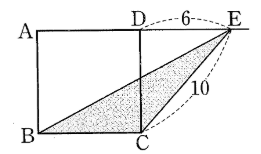
5.6PS.png [ 17.09 KiB | Viewed 4086 times ]
A. 20
B. 24
C. 30
D. 32
E. 40
=>
Since CD^2 = 10^2 - 6^2 = 64, we have CD = 8.
Then the base BC of the triangle is 8, and its height is 8 as well.
Thus, the area of the triangle is (1/2)8*8 = 32.
Therefore, D is the answer.
Answer: D
(Geometry) The figure shows a square ABCD, and point E is on the extension with DE = 6 and CE = 10. What is the area of △BCE?
Attachment:
5.6PS.png [ 17.09 KiB | Viewed 4086 times ]
A. 20
B. 24
C. 30
D. 32
E. 40
=>
Since CD^2 = 10^2 - 6^2 = 64, we have CD = 8.
Then the base BC of the triangle is 8, and its height is 8 as well.
Thus, the area of the triangle is (1/2)8*8 = 32.
Therefore, D is the answer.
Answer: D
 13 May 2020, 09:47
Kudos
Bookmarks
Is the trend relevant even today?
18 May 2020, 20:46
Kudos
Bookmarks
[GMAT math practice question]
(Algebra) p, q, r, and s are integers. s and t are two roots of x^2 + px + q = 0 where q is a prime number. What the value of p + q?
1) s and t are consecutive integers.
2) p is positive.
=>
Forget conventional ways of solving math questions. For DS problems, the VA (Variable Approach) method is the quickest and easiest way to find the answer without actually solving the problem. Remember that equal numbers of variables and independent equations ensure a solution.
Visit https://www.mathrevolution.com/gmat/lesson for details.
The first step of the VA (Variable Approach) method is to modify the original condition and the question. We then recheck the question. We should simplify conditions if necessary.
Since we have 2 variables (p and q) and 0 equations, C is most likely the answer. So, we should consider conditions 1) & 2) together first. After comparing the number of variables and the number of equations, we can save time by considering conditions 1) & 2) together first.
Conditions 1) & 2)
Assume t = s + 1 from condition 1).
Then we have x^2 + px + q = (x - s)(x - t) = (x - s)(x - (s + 1)) = x^2 – (2s + 1)x + s(s + 1) = 0 and p = -(2s + 1), q = s(s + 1).
Since q = s(s + 1) is a product of two consecutive integers, q is an even number, and the unique even prime is 2. So, we have q = 2.
Then we have s(s + 1) = 2, s^2 + s = 2 or s^2 + s - 2 = (s + 2)(s - 1) = 0. We have s = -2 or s = 1.
Then we have p = -(2s + 1) = -(-3) = 3 for s = -2 or p = -(2s + 1) = -3 for s = 1.
Since p is positive, we have p = 3 and p + q = 5.
Since both conditions together yield a unique solution, they are sufficient.
Therefore, C is the answer.
Answer: C
Normally, in problems which require 2 equations, such as those in which the original conditions include 2 variables, or 3 variables and 1 equation, or 4 variables and 2 equations, each of conditions 1) and 2) provide an additional equation. In these problems, the two key possibilities are that C is the answer (with probability 70%), and E is the answer (with probability 25%). Thus, there is only a 5% chance that A, B, or D is the answer. This occurs in common mistake types 3 and 4. Since C (both conditions together are sufficient) is the most likely answer, we save time by first checking whether conditions 1) and 2) are sufficient, when taken together. Obviously, there may be cases in which the answer is A, B, D, or E, but if conditions 1) and 2) are NOT sufficient when taken together, the answer must be E.
(Algebra) p, q, r, and s are integers. s and t are two roots of x^2 + px + q = 0 where q is a prime number. What the value of p + q?
1) s and t are consecutive integers.
2) p is positive.
=>
Forget conventional ways of solving math questions. For DS problems, the VA (Variable Approach) method is the quickest and easiest way to find the answer without actually solving the problem. Remember that equal numbers of variables and independent equations ensure a solution.
Visit https://www.mathrevolution.com/gmat/lesson for details.
The first step of the VA (Variable Approach) method is to modify the original condition and the question. We then recheck the question. We should simplify conditions if necessary.
Since we have 2 variables (p and q) and 0 equations, C is most likely the answer. So, we should consider conditions 1) & 2) together first. After comparing the number of variables and the number of equations, we can save time by considering conditions 1) & 2) together first.
Conditions 1) & 2)
Assume t = s + 1 from condition 1).
Then we have x^2 + px + q = (x - s)(x - t) = (x - s)(x - (s + 1)) = x^2 – (2s + 1)x + s(s + 1) = 0 and p = -(2s + 1), q = s(s + 1).
Since q = s(s + 1) is a product of two consecutive integers, q is an even number, and the unique even prime is 2. So, we have q = 2.
Then we have s(s + 1) = 2, s^2 + s = 2 or s^2 + s - 2 = (s + 2)(s - 1) = 0. We have s = -2 or s = 1.
Then we have p = -(2s + 1) = -(-3) = 3 for s = -2 or p = -(2s + 1) = -3 for s = 1.
Since p is positive, we have p = 3 and p + q = 5.
Since both conditions together yield a unique solution, they are sufficient.
Therefore, C is the answer.
Answer: C
Normally, in problems which require 2 equations, such as those in which the original conditions include 2 variables, or 3 variables and 1 equation, or 4 variables and 2 equations, each of conditions 1) and 2) provide an additional equation. In these problems, the two key possibilities are that C is the answer (with probability 70%), and E is the answer (with probability 25%). Thus, there is only a 5% chance that A, B, or D is the answer. This occurs in common mistake types 3 and 4. Since C (both conditions together are sufficient) is the most likely answer, we save time by first checking whether conditions 1) and 2) are sufficient, when taken together. Obviously, there may be cases in which the answer is A, B, D, or E, but if conditions 1) and 2) are NOT sufficient when taken together, the answer must be E.