Events & Promotions
| Last visit was: 06 Sep 2026, 02:03 |
It is currently 06 Sep 2026, 02:03 |
|
|

GMAT Club Daily Prep
Thank you for using the timer - this advanced tool can estimate your performance and suggest more practice questions. We have subscribed you to Daily Prep Questions via email.
Customized
for You
Track
Your Progress
Practice
Pays
Not interested in getting valuable practice questions and articles delivered to your email? No problem, unsubscribe here.
 Sep 06
09:30 AM EDT
-12:30 PM EST
Top scores are possible when you enroll in a powerful EA course, taught live online + 6 months access to TTP OnDemand video courses included! Perfect class schedule and easy course access for working professionals. Class starts Sundays Sept. 6, 2026. Sep 07
12:01 AM PDT
-11:59 PM PDT
On the 7th, GMAT Club Tests will be Free! Including all the Quizzes, Questions, and Tests. 12 AM - 11:59 PM PDT Sep 07
12:30 AM EDT
-01:30 AM EDT
Tejas studied hard but kept repeating the same mistakes. After 3 attempts at 645, a focused 4-week strategy helped him identify and fix what was holding him back—leading to a 695 with just 12–15 hours of study per week. Sep 02
01:00 PM EDT
-11:59 PM EDT
Take 30% off all study plans with code COURSEWORK - Expires on Monday 9/7 Sep 04
01:30 AM EDT
-02:30 AM EDT
This Labor Day, turn your hard work into real score gains. From 615→715 in 15 days to 705 in 30 days, our students prove what's possible with personalized, expert guidance. Save up to 25% on 1-on-1 tutoring. Sep 04
10:00 AM EDT
-11:59 PM EDT
We’ve worked incredibly hard to build TTP into the best test prep experience possible, and it would mean a lot to us to win Newsweek’s 2026 Readers’ Choice Award for Best Test Prep. If TTP has helped you, we’d be incredibly grateful for your vote.- Sep 07
10:00 AM PDT
-11:00 AM PDT
A complete walkthrough of GMAT Club’s free 12-week GMAT study plan: what you study each week, how progress and goals are tracked, how the error log works, and how your practice unlocks paid tools at no cost. - Sep 09
07:00 AM PDT
-10:00 AM PDT
Meet AdComs and explore top Master’s programs - MiM, MiF, MSc, MSBA and more. - Application Fee Waivers - Free 1-Week of GMAT Club Tests: - Master's Application Toolkit - Grand Prize Giveaway - Sep 09
10:00 AM PDT
-11:00 AM PDT
Three MBA applications. Three rejections. No interview invites. A year later, Aman was admitted to Cambridge Judge, SMU, and IMD. In this episode of MBA Admit Stories, Aman shares how he rebuilt his MBA application...  Sep 10
08:00 PM PDT
-09:00 PM PDT
Free- full-length test + 15 concept videos + 150+ short videos + study plan! Sep 15
07:00 PM EDT
-09:00 PM EST
Elite scores are possible when you enroll in a powerful GMAT course, taught live online + 6 months access to TTP OnDemand video courses included! Class starts Tues/Thurs Sept. 15, 2026 - Nov. 15, 2027, 7:00pm-9:00pm EST Sep 21
08:00 PM EDT
-10:00 PM EDT
Boost your GMAT score in less than one month in a live online class + 6 months access to TTP OnDemand video courses included! Class starts Mon, Tues, Wed, Thur, Fri Sept. 21, 2026 - Oct. 9, 2027, 7:00pm-10:00pm EST

 01 Feb 2013, 05:22
Kudos
Bookmarks
Hello all,
Its time announce the winner of 'Best Approach' competition. We received quite a few entries for this competition at a different forum. Clearly, Fameatop is winner.
The diligence shown by him is praiseworthy. Kudos, and congratulations to Fameatop!
Out of 3 approaches, experts chose Approach 3- Observation Method as the BEST approach. It scores in most of the parameters of selection.
1. Efficient - Since this approach is based on observation, logic, and inference, it is truly efficient.
2. Concept - This approach applies concepts of a. Observation of limited data set, and b. Inference of new mean
3. Least calculation intensive - The approach smartly tackles calculation of limited data set mean with an application of arithmetic sequence concept.
Fameatop is rewarded with an e-GMAT IR course, free for 6 months.
We will soon post 5 approaches from e-GMAT. You can also rate those approaches based on above 3 parameters.
Cheers!
e-GMAT team
Its time announce the winner of 'Best Approach' competition. We received quite a few entries for this competition at a different forum. Clearly, Fameatop is winner.
The diligence shown by him is praiseworthy. Kudos, and congratulations to Fameatop!
Out of 3 approaches, experts chose Approach 3- Observation Method as the BEST approach. It scores in most of the parameters of selection.
1. Efficient - Since this approach is based on observation, logic, and inference, it is truly efficient.
2. Concept - This approach applies concepts of a. Observation of limited data set, and b. Inference of new mean
3. Least calculation intensive - The approach smartly tackles calculation of limited data set mean with an application of arithmetic sequence concept.
Fameatop is rewarded with an e-GMAT IR course, free for 6 months.
We will soon post 5 approaches from e-GMAT. You can also rate those approaches based on above 3 parameters.
Cheers!
e-GMAT team
01 Feb 2013, 21:14
Kudos
Bookmarks
Hello all,
Here are few approaches that we think would be applicable to this particular question. Please pick best approach as per you, and why you think so.
Approach 1 - Computational Approach
Current Mean = Sum of all 13 data/13 = 185/13=14.23;
New Mean = (Sum of all 13 data + 5+19)/15 = 209/15= 13.53;
Mean decreases instead of increasing. Answer is NO.
Approach 2 - Smart Computational Approach
To get the value of current mean, we need to sum all 13 datasets, an approach that is time consuming.
Let’s make some observations. Observe Lawn Tennis column when arranged in ascending order.
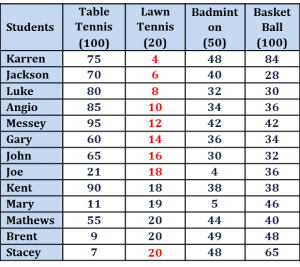
There are 9 data points- 4, 6, 8…..20 as highlighted in red color. These data points form a series with equal interval. So their sum is equal to middle-most value*9= 12*9= 108.
Now, Current Mean = Sum of all 13 data points/13 = (Sum of all 9 data points + 18+19+20+20)/13 = (108+77)/13=185/13=14.23;
New Mean = (Sum of all 13 data points + 5+19)/15 = 209/15= 13.53;
Mean decreases rather than increasing. Answer is NO.
Approach 3 - Logical computational approach
Calculation of current mean is done in same manner as is done in approach 2.
We find that current mean is 14.23, which is greater than the mean (12) of Manish and Imran [(5+19)/2=12].
What will be the new mean of after inclusion of Manish and Imran?
Mean fundamental
Mean of a dataset cannot be less than the least value (Here it is ‘12’) and more than the highest value (Here it is ’14.23’). It will lie in between (do not read- Mid value). This implies that the new mean after inclusion of Manish and Imran will be less than 14.23.
So mean decreases rather than increases.
Approach 4 - Logical approach
Mean of 2 new values added= (5+19)/2=12
Current Mean of 13 data points is not known.
We need to deduce whether the new mean increases ?
New mean > Current mean, only and only if current mean < 12 (Mean of the 2 new values). Because if current mean > 12, the lower value 12 will pull the current mean towards it, and in that scenario, new mean will be less than the current mean
So we need to find whether the current mean < 12 or not?
Say current mean = x.
To answer the question, we need to know if the current mean increases by at least 2 points or not when the two data points are included?
So Is New mean > x+2?
We can form a mathematical equation as below

There are 13 data points & 2 new inclusions - so total 15 data points for new mean
Upon solving, we get x ≤ -3. This means to get an increment of 2 over the current mean, current mean has to be at the max. -3.
Well, -3 is an absurd value since the mean of given data set cannot be this value.
Mean fundamental
Mean of a dataset cannot less than the least value (Here it is ‘4’- Karren’s score), and more than highest value (Here it is ‘20’- Stacey’s score). So the answer is NO.
Approach 5 - Inference approach
Inference through New mean
For new mean to absorb an increment of minimum 2 points over the current mean, the current mean has to be much less than 12, because after an increment of 2 or more points, new mean MUST be less than 12.
Let’s observe what could be the probable value of current mean?
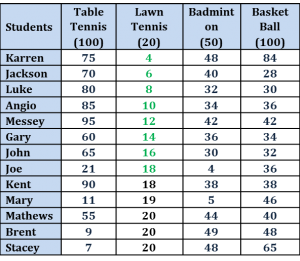
Let’s look at the Lawn tennis column. From Karren till Joe, there are total 8 data points. Their mean would be equal to median, because they have an equal interval of 2 points successively.
Now, the median of these 8 data points is 11 [(10+12)/2]. So mean would also be equal to 11. Rest of the data points are much higher than 11, so current mean would be more than 11. We already concluded earlier that new mean MUST be less than 12. If current mean is more than 11, then after an increment of 2, it can never be less than 12. So the answer is NO.
Hope this helps build your fundamentals. Do attempt challenging MSR question posted today.
-Shalabh
Here are few approaches that we think would be applicable to this particular question. Please pick best approach as per you, and why you think so.
Approach 1 - Computational Approach
Current Mean = Sum of all 13 data/13 = 185/13=14.23;
New Mean = (Sum of all 13 data + 5+19)/15 = 209/15= 13.53;
Mean decreases instead of increasing. Answer is NO.
Approach 2 - Smart Computational Approach
To get the value of current mean, we need to sum all 13 datasets, an approach that is time consuming.
Let’s make some observations. Observe Lawn Tennis column when arranged in ascending order.
There are 9 data points- 4, 6, 8…..20 as highlighted in red color. These data points form a series with equal interval. So their sum is equal to middle-most value*9= 12*9= 108.
Now, Current Mean = Sum of all 13 data points/13 = (Sum of all 9 data points + 18+19+20+20)/13 = (108+77)/13=185/13=14.23;
New Mean = (Sum of all 13 data points + 5+19)/15 = 209/15= 13.53;
Mean decreases rather than increasing. Answer is NO.
Approach 3 - Logical computational approach
Calculation of current mean is done in same manner as is done in approach 2.
We find that current mean is 14.23, which is greater than the mean (12) of Manish and Imran [(5+19)/2=12].
What will be the new mean of after inclusion of Manish and Imran?
Mean fundamental
Mean of a dataset cannot be less than the least value (Here it is ‘12’) and more than the highest value (Here it is ’14.23’). It will lie in between (do not read- Mid value). This implies that the new mean after inclusion of Manish and Imran will be less than 14.23.
So mean decreases rather than increases.
Approach 4 - Logical approach
Mean of 2 new values added= (5+19)/2=12
Current Mean of 13 data points is not known.
We need to deduce whether the new mean increases ?
New mean > Current mean, only and only if current mean < 12 (Mean of the 2 new values). Because if current mean > 12, the lower value 12 will pull the current mean towards it, and in that scenario, new mean will be less than the current mean
So we need to find whether the current mean < 12 or not?
Say current mean = x.
To answer the question, we need to know if the current mean increases by at least 2 points or not when the two data points are included?
So Is New mean > x+2?
We can form a mathematical equation as below
There are 13 data points & 2 new inclusions - so total 15 data points for new mean
Upon solving, we get x ≤ -3. This means to get an increment of 2 over the current mean, current mean has to be at the max. -3.
Well, -3 is an absurd value since the mean of given data set cannot be this value.
Mean fundamental
Mean of a dataset cannot less than the least value (Here it is ‘4’- Karren’s score), and more than highest value (Here it is ‘20’- Stacey’s score). So the answer is NO.
Approach 5 - Inference approach
Inference through New mean
For new mean to absorb an increment of minimum 2 points over the current mean, the current mean has to be much less than 12, because after an increment of 2 or more points, new mean MUST be less than 12.
Let’s observe what could be the probable value of current mean?
Let’s look at the Lawn tennis column. From Karren till Joe, there are total 8 data points. Their mean would be equal to median, because they have an equal interval of 2 points successively.
Now, the median of these 8 data points is 11 [(10+12)/2]. So mean would also be equal to 11. Rest of the data points are much higher than 11, so current mean would be more than 11. We already concluded earlier that new mean MUST be less than 12. If current mean is more than 11, then after an increment of 2, it can never be less than 12. So the answer is NO.
Hope this helps build your fundamentals. Do attempt challenging MSR question posted today.
-Shalabh
Updated on: 31 Oct 2019, 00:02
Originally posted by egmat on 09 Feb 2013, 00:17.
Last edited by Sajjad1994 on 31 Oct 2019, 00:02, edited 1 time in total.
Last edited by Sajjad1994 on 31 Oct 2019, 00:02, edited 1 time in total.
Updated - Complete topic (197).
Kudos
Bookmarks

It’s been 6+ months since the launch of Integrated Reasoning section. With scores from 105K+exams, GMAC has enough data to conduct some preliminary analysis to evaluate the value that Integrated Reasoning section adds. Read below for some key takeaways from the reports.
Key takeaways:
1. The correlation of IR with GMAT Total is .55. In other words, Quant, Verbal, and IR are all measuring something related, yet also different.
2. IR score is important because, other things being equal, the test takers demonstrating more skill in this area within each range can be expected to be better students.
3. 85% of current students and alumni find IR skills to be very relevant and useful in the work place. Similarly, nearly all (97%) of the employers surveyed said the skills—such as the ability to integrate, organize, combine, and synthesize information—were important.
4. IR and Admissions: The biggest value is that IR is an additional data point. It assesses information that we don't currently capture in the admissions process. I think it is going to make our process more complete. We're going to be able to make better decisions because we have that additional set of data that is so relevant to what students are going to do in the MBA curriculum, but also in their careers – Quote from Tuck.
e-GMAT has launched the world’s most comprehensive IR course that contains 35+ concepts, 120+ original questions, and 2 full length IR mock tests. The course allows an average GMAT test taker to master the section in less than 12 hours. Click hereto know more.
[youtube]https://www.youtube.com/watch?v=cr_jC5BD99c[/youtube]
Attachments
 IR and admissions.pdf [53.55 KiB]
Downloaded 674 times
IR - 6 months after launch.pdf [87.98 KiB]
Downloaded 850 times
11 Feb 2013, 15:30
Kudos
Bookmarks
Till I read this announcement, I was of the same opinion as Sachin and Carcass. However, the findings of this report surprised me (were some sort of an eye opener too). Traditionally, GMAT has served two purposes:
1. It has been taken as a predictor of the student's performance in B-school.
2. It is a symbol of prestige. Schools flaunt their mean and median GMAT scores as a proxy for prestige/selectivity.
Having completed an MBA, I can vouch that the skills tested on the GMAT IR are at least as relevant for B-School (and post B-school) success as the skills tested in the quant and verbal section. The IR skills are probably more important in schools such as Stern, Duke etc. (finance focused schools). The trend with big data will make these skills important again in fields such as Marketing.
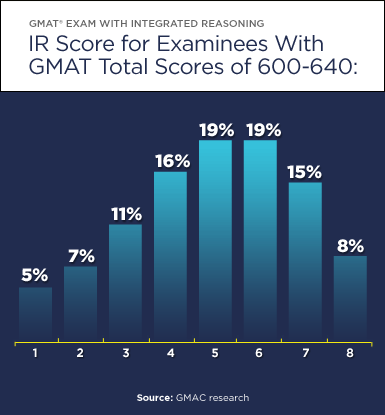
Lets understand GMAC's findings. The stats have proven that regardless of your GMAT score, the IR score has a distribution. This probably means that even those who score 750, a good percentage of them (half of them if you go by the stats) do not score well on the IR. Considering that the skills tested on IR are important to academic and professional success, I believe that it is possible that schools will start considering them seriously.
Lets fast forward a few months and go to September'2014 - the year when the first batch that was tested on IR completes their first year. I bet that schools will start taking IR more seriously if GMAC can prove that there is a much higher likelihood that a student with a GMAT score of 650 and with an IR score of 7 or higher is likely to perform better than one with a GMAT score of 700 and an IR score of 6 or lower (Remember IR has low correlation with Quant and Verbal Scores).
So yes, IR may not be as important right now, but it could be very important in a year from now.
-Rajat
1. It has been taken as a predictor of the student's performance in B-school.
2. It is a symbol of prestige. Schools flaunt their mean and median GMAT scores as a proxy for prestige/selectivity.
Having completed an MBA, I can vouch that the skills tested on the GMAT IR are at least as relevant for B-School (and post B-school) success as the skills tested in the quant and verbal section. The IR skills are probably more important in schools such as Stern, Duke etc. (finance focused schools). The trend with big data will make these skills important again in fields such as Marketing.
Why are GMAC's findings interesting?
Lets understand GMAC's findings. The stats have proven that regardless of your GMAT score, the IR score has a distribution. This probably means that even those who score 750, a good percentage of them (half of them if you go by the stats) do not score well on the IR. Considering that the skills tested on IR are important to academic and professional success, I believe that it is possible that schools will start considering them seriously.
Lets fast forward a few months and go to September'2014 - the year when the first batch that was tested on IR completes their first year. I bet that schools will start taking IR more seriously if GMAC can prove that there is a much higher likelihood that a student with a GMAT score of 650 and with an IR score of 7 or higher is likely to perform better than one with a GMAT score of 700 and an IR score of 6 or lower (Remember IR has low correlation with Quant and Verbal Scores).
So yes, IR may not be as important right now, but it could be very important in a year from now.
-Rajat







