Last visit was: 26 Sep 2026, 16:27 It is currently 26 Sep 2026, 16:27
Close
GMAT Club Daily Prep
Thank you for using the timer - this advanced tool can estimate your performance and suggest more practice questions. We have subscribed you to Daily Prep Questions via email.

Customized
for You

we will pick new questions that match your level based on your Timer History

Track
Your Progress

every week, we’ll send you an estimated GMAT score based on your performance

Practice
Pays

we will pick new questions that match your level based on your Timer History
Not interested in getting valuable practice questions and articles delivered to your email? No problem, unsubscribe here.
Close
Request Expert Reply
Confirm Cancel
User avatar
parkhydel
Joined: 03 Jun 2019
Last visit: 04 Feb 2026
Posts: 273
Own Kudos:
Given Kudos: 70
Posts: 273
Kudos: 25,920
 [367]
17
Kudos
Add Kudos
349
Bookmarks
Bookmark this Post
Most Helpful Reply
User avatar
manasp35
Joined: 18 Jan 2024
Last visit: 23 Jun 2024
Posts: 24
Own Kudos:
88
 [53]
Given Kudos: 29
Posts: 24
Kudos: 88
 [53]
32
Kudos
Add Kudos
20
Bookmarks
Bookmark this Post
User avatar
KarishmaB
Joined: 16 Oct 2010
Last visit: 25 Sep 2026
Posts: 16,669
Own Kudos:
81,549
 [45]
Given Kudos: 492
Location: Pune, India
Expert
Expert reply
Active GMAT Club Expert! Tag them with @ followed by their username for a faster response.
Posts: 16,669
Kudos: 81,549
 [45]
33
Kudos
Add Kudos
12
Bookmarks
Bookmark this Post
General Discussion
User avatar
ashutosh_73
Joined: 19 Jan 2018
Last visit: 30 Oct 2024
Posts: 214
Own Kudos:
2,204
 [1]
Given Kudos: 86
Location: India
Posts: 214
Kudos: 2,204
 [1]
Kudos
Add Kudos
Bookmarks
Bookmark this Post
KarishmaB chetan2u Bunuel

For Day-2:
Nasal drainage = 60%
Sore throat = almost 50%
Cough = 38%
Fever = 15 %

If i have to calculate ''one or fewer'' for Day-2, how do i do it? Is the below process correct?

One of fewer = [1 - (ONLY 2 + ONLY 3 + ONLY 4 )symptoms]
Only TWO: ((0.6 x .50) + (0.60 x 38) +(0.60 x 0.15) + (0.50 x 0.38) + (0.50 x 0.15) +(0.38 x 0.15))
Only THREE: Likewise taken 3 at a time
Only Four: (0.60 x 0.50 x 0.38 x 0.15)­

Moreover, how would you attempt this question?
User avatar
manasp35
Joined: 18 Jan 2024
Last visit: 23 Jun 2024
Posts: 24
Own Kudos:
88
 [1]
Given Kudos: 29
Posts: 24
Kudos: 88
 [1]
1
Kudos
Add Kudos
Bookmarks
Bookmark this Post
 
Quote:
For Day-2:
Nasal drainage = 60%
Sore throat = almost 50%
Cough = 38%
Fever = 15 %

If i have to calculate ''one or fewer'' for Day-2, how do i do it? Is the below process correct?

One of fewer = [1 - (ONLY 2 + ONLY 3 + ONLY 4 )symptoms]
Only TWO: ((0.6 x .50) + (0.60 x 38) +(0.60 x 0.15) + (0.50 x 0.38) + (0.50 x 0.15) +(0.38 x 0.15))
Only THREE: Likewise taken 3 at a time
Only Four: (0.60 x 0.50 x 0.38 x 0.15)­

Moreover, how would you attempt this question?
­Only TWO equation is not correct. 
((0.6 x .50) + (0.60 x 38) +(0.60 x 0.15) + (0.50 x 0.38) + (0.50 x 0.15) +(0.38 x 0.15))
While writing 0.6. x .50,
If I am right, you are considering cases when there is ONLY nasal & sore throat. Instead of 0.6 x 0.5 , it should be 0.6 x .5 x .62 x .85 
ONLY nasal & sore throat = (have nasal) x (have sore throat) x (DON'T HAVE cough) X (DON'T HAVE fever)

Meanwhile I will not approach this question this way as it would be too much calculation. I have given solution above with id "manasp35". Let me know if you have any doubts.  
User avatar
ruis
Joined: 17 Sep 2023
Last visit: 03 Nov 2024
Posts: 127
Own Kudos:
837
 [10]
Given Kudos: 526
Posts: 127
Kudos: 837
 [10]
8
Kudos
Add Kudos
2
Bookmarks
Bookmark this Post
Official answer:
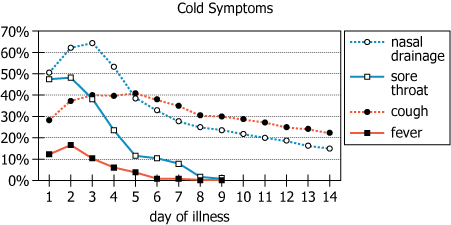
On Day 9, the lines for fever and sore throat stop. This means that, for each of these symptoms, there is less than a 1% chance that someone with a cold will have the symptom beyond Day 9. Therefore, on Day 10, the chance, p, that someone with a cold will have at least one of these symptoms is less than 2%, and they will have at most two (that is, two or fewer of the remaining symptoms). Also, from p < 0.02, it follows that 1 − p > 0.98. Thus, the probability is greater than 0.98 that someone with a cold will have two or fewer of the four symptoms on Day 10.
User avatar
Freddy12
Joined: 23 Dec 2023
Last visit: 21 Dec 2025
Posts: 26
Own Kudos:
Given Kudos: 307
GMAT Focus 1: 655 Q90 V81 DI77
GMAT 1: 600 Q47 V27
GMAT Focus 1: 655 Q90 V81 DI77
GMAT 1: 600 Q47 V27
Posts: 26
Kudos: 16
Kudos
Add Kudos
Bookmarks
Bookmark this Post
KarishmaB


We need higher than 98% probability of something. That is as good as certainty, including certainty.

What am I almost certain about? Am I certain that on Day 2, a person will have at least 1 symptom? No. On Day 2, there is 62% probability of nasal drainage, 49% of sore throat, 38% of cough and 16% of fever. What if all other probabilities lie within the circle of nasal drainage? That is the same 62% people see other symptoms also? Then the probability of a person showing at least one symptom will be 62% only.

But what I am certain about is that at Day 10, a person can show at most 2 symptoms. For the other 2 symptoms, the probability is less than 1%. Even if I assume it to be almost 1% and different set of people show the third and fourth symptoms, still there is a more than 98% probability that a person shows 2 or fewer symptoms on Day 10.

ANSWER: two or fewer symptoms on Day 10

­
­KarishmaB can you explain why "Only Two symptoms" is incorrect for Day 10?
User avatar
KarishmaB
Joined: 16 Oct 2010
Last visit: 25 Sep 2026
Posts: 16,669
Own Kudos:
81,549
 [2]
Given Kudos: 492
Location: Pune, India
Expert
Expert reply
Active GMAT Club Expert! Tag them with @ followed by their username for a faster response.
Posts: 16,669
Kudos: 81,549
 [2]
2
Kudos
Add Kudos
Bookmarks
Bookmark this Post
Freddy12


­KarishmaB can you explain why "Only Two symptoms" is incorrect for Day 10?

On Day 10, there is about 20% chance of nasal drainage and about 30% chance of cough. ­So a person would have at most 2 symptoms. He can have 1 or 0 symptoms too. Hence 'Exactly two' is not correct. After all, there is only 20% chance of nasal drainage and only 30% chance of having cough on day10.
User avatar
zoezhuyan
Joined: 17 Sep 2016
Last visit: 11 Nov 2024
Posts: 378
Own Kudos:
Given Kudos: 147
Posts: 378
Kudos: 96
Kudos
Add Kudos
Bookmarks
Bookmark this Post
dear KarishmaB, @chetan2u


I am afraid I did get what the graph says.

say on day 10, the chance of getting sore throat is 21%, that of getting cough is 29%
IMO , the chance of getting either sore throat or cough or both is most 29%


ANSWER: two or fewer symptoms on Day 10, which confused me a lot

­would you experts explain further ?

have a nice day
User avatar
KarishmaB
Joined: 16 Oct 2010
Last visit: 25 Sep 2026
Posts: 16,669
Own Kudos:
81,549
 [2]
Given Kudos: 492
Location: Pune, India
Expert
Expert reply
Active GMAT Club Expert! Tag them with @ followed by their username for a faster response.
Posts: 16,669
Kudos: 81,549
 [2]
Kudos
Add Kudos
2
Bookmarks
Bookmark this Post
zoezhuyan
dear KarishmaB, @chetan2u


I am afraid I did get what the graph says.

say on day 10, the chance of getting sore throat is 21%, that of getting cough is 29%
IMO , the chance of getting either sore throat or cough or both is most 29%


ANSWER: two or fewer symptoms on Day 10, which confused me a lot

­would you experts explain further ?

have a nice day

On Day 10

chance of getting -

nasal drainage is 21%
cough is 29%
sore throat is about 0% (less than 1)
fever is about 0% (less than 1)

What is the probability of getting 3 or more of the given symptoms? Since chance of both sore throat and fever is about 0, chance of getting 3 or all 4 symptoms is about 0.
This means that chance of getting 2 or 1 or 0 symptoms is almost 100% i.e. more than 98%. So almost certainly one would have either 0 or 1 or at most 2 symptoms. The chance of a third symptom is almost 0 so having 3 or more symptoms will be very rare.

Hence the answer is chance of "2 or fewer" is more than 98%.
User avatar
SmileAndSolve
Joined: 25 Aug 2024
Last visit: 25 Sep 2026
Posts: 86
Own Kudos:
52
 [2]
Given Kudos: 348
Location: India
Concentration: Strategy, Entrepreneurship
GPA: 4
Products:
Posts: 86
Kudos: 52
 [2]
2
Kudos
Add Kudos
Bookmarks
Bookmark this Post
Required: Probability for someone WITH cold >= 0.98
element = Number of symptoms.
Hence, Probability ("Num of symptoms" being two or less) on day 10 = almost 100%.
Don't get confused by extra data. It is NOT probability of cold BUT probability of number of symptoms.
User avatar
UDEMYtutorJackson
Joined: 06 Aug 2014
Last visit: 07 Jan 2025
Posts: 7
Own Kudos:
17
 [2]
Given Kudos: 1
GMAT 1: 760 Q50 V44
GMAT 1: 760 Q50 V44
Posts: 7
Kudos: 17
 [2]
2
Kudos
Add Kudos
Bookmarks
Bookmark this Post
This would be true only if we know that the symptoms occuring are independent events which is not given in the question.

So we may not be able to calculate ONLY TWO , ONLY THREE, ONLY FOUR for this question with the information provided. We can try to find the maximum probability of exactly 2 events occuring but for that this question will become a Linear Programming Problem ( which is not required / out of scope I would say )

BEST WAY TO SOLVE - If we think about the probabilities as venn diagrams , then we can side step thinking about wheather the events are dependent or independent. We just need to think about minimising overlaps and maximising overlaps , and in this way we can get ranges for any probability and eliminate wrong options / indetify the correct option.
manasp35

Quote:
For Day-2:
Nasal drainage = 60%
Sore throat = almost 50%
Cough = 38%
Fever = 15 %

If i have to calculate ''one or fewer'' for Day-2, how do i do it? Is the below process correct?

One of fewer = [1 - (ONLY 2 + ONLY 3 + ONLY 4 )symptoms]
Only TWO: ((0.6 x .50) + (0.60 x 38) +(0.60 x 0.15) + (0.50 x 0.38) + (0.50 x 0.15) +(0.38 x 0.15))
Only THREE: Likewise taken 3 at a time
Only Four: (0.60 x 0.50 x 0.38 x 0.15)­

Moreover, how would you attempt this question?
­Only TWO equation is not correct.
((0.6 x .50) + (0.60 x 38) +(0.60 x 0.15) + (0.50 x 0.38) + (0.50 x 0.15) +(0.38 x 0.15))
While writing 0.6. x .50,
If I am right, you are considering cases when there is ONLY nasal & sore throat. Instead of 0.6 x 0.5 , it should be 0.6 x .5 x .62 x .85
ONLY nasal & sore throat = (have nasal) x (have sore throat) x (DON'T HAVE cough) X (DON'T HAVE fever)

Meanwhile I will not approach this question this way as it would be too much calculation. I have given solution above with id "manasp35". Let me know if you have any doubts.
User avatar
agrasan
Joined: 18 Jan 2024
Last visit: 17 Aug 2026
Posts: 687
Own Kudos:
Given Kudos: 6,706
Location: India
Posts: 687
Kudos: 198
Kudos
Add Kudos
Bookmarks
Bookmark this Post
Thanks KarishmaB

Is it "Two or Fewer" because sore throat can be a part of cough?

KarishmaB

We need higher than 98% probability of something. That is as good as certainty, including certainty.

What am I almost certain about? Am I certain that on Day 2, a person will have at least 1 symptom? No. On Day 2, there is 62% probability of nasal drainage, 49% of sore throat, 38% of cough and 16% of fever. What if all other probabilities lie within the circle of nasal drainage? That is the same 62% people see other symptoms also? Then the probability of a person showing at least one symptom will be 62% only.

But what I am certain about is that at Day 10, a person can show at most 2 symptoms. For the other 2 symptoms, the probability is less than 1%. Even if I assume it to be almost 1% and different set of people show the third and fourth symptoms, still there is a more than 98% probability that a person shows 2 or fewer symptoms on Day 10.

ANSWER: two or fewer symptoms on Day 10

­
User avatar
cheshire
User avatar
DI Forum Moderator
Joined: 26 Jun 2025
Last visit: 18 Sep 2025
Posts: 254
Own Kudos:
Given Kudos: 34
Posts: 254
Kudos: 315
Kudos
Add Kudos
Bookmarks
Bookmark this Post
It's because after day 10 those are the only two symptoms remaining on the graph. The fact that they usually correspond with each other is outside the scope of the question.
agrasan
Thanks KarishmaB

Is it "Two or Fewer" because sore throat can be a part of cough?


User avatar
egmat
User avatar
e-GMAT Representative
Joined: 02 Nov 2011
Last visit: 25 Sep 2026
Posts: 6,369
Own Kudos:
33,963
 [2]
Given Kudos: 716
GMAT Date: 08-19-2020
Expert
Expert reply
Active GMAT Club Expert! Tag them with @ followed by their username for a faster response.
Posts: 6,369
Kudos: 33,963
 [2]
1
Kudos
Add Kudos
1
Bookmarks
Bookmark this Post
I can see why this graph interpretation question might be tricky - you need to connect the probability concept with what the graph is actually showing you. Let me walk you through this step-by-step.

Understanding What We're Looking For

The question asks us to find when the probability is greater than 0.98 (or 98%) that someone with a cold will have a certain number of symptoms. Let's think about what this means: we need to be almost certain about how many symptoms a person has.

Key Insight from the Graph

Notice how the problem tells us something crucial: "lines for certain symptoms do not continue past a certain day because the chance that someone will have those symptoms beyond that day is less than 1%." This is your golden clue!

When a line disappears from the graph, it means that symptom has become extremely rare (less than 1% chance).

Step-by-Step Solution

Step 1: Let's track what happens to each symptom by looking at the graph:
- Fever (squares): disappears around day 6-7
- Sore throat (hollow squares): disappears around day 8-9
- Nasal drainage (circles): continues through day 14
- Cough (dots): continues through day 14

Step 2: Now, check day 10 specifically:
- Nasal drainage: still present (around 22%)
- Cough: still present (around 29%)
- Sore throat: gone (below 1%)
- Fever: gone (below 1%)

Step 3: Here's the key reasoning:
On day 10, since sore throat and fever have probabilities less than 1%, the chance someone has either of these is practically zero. That means the maximum number of symptoms someone can realistically have is 2 (just nasal drainage and/or cough).

The probability of having more than 2 symptoms is less than 2% (since that would require having a symptom with less than 1% chance). Therefore, the probability of having "two or fewer" symptoms is greater than 98% (or 0.98).

Answer: Two or fewer symptoms on day 10

Notice how we didn't need "exactly two" because someone might have just one symptom or even zero symptoms. And "one or fewer" would be too restrictive since having two symptoms is still quite possible.

---

You can check out the step-by-step solution on Neuron by e-GMAT to master the systematic approach for interpreting probability graphs and learn the framework that applies to all similar data interpretation questions. You can also explore other GMAT official questions with detailed solutions on Neuron for structured practice here.
User avatar
MarkGMATMentor
Joined: 24 Jul 2018
Last visit: 26 Sep 2026
Posts: 107
Own Kudos:
Given Kudos: 40
Location: United States (CA)
GMAT 1: 790 Q51 V50
Expert
Expert reply
Active GMAT Club Expert! Tag them with @ followed by their username for a faster response.
GMAT 1: 790 Q51 V50
Posts: 107
Kudos: 67
Kudos
Add Kudos
Bookmarks
Bookmark this Post
Data Insights problems like this, where the two sub-questions are closely linked and you must use the answer choices to solve, are potentially confusing and can suck up a lot of time. They can be solved efficiently by matching the data to the question and picking the easier blank before trying the choices.

Match the Data:
The question asks about a probability higher than 98% -- a very high probability. How does this match with the data? Nothing in the graph is even over 70%.

But remember, a greater than 98% probability of something happening is the same as a less than 2% probability of something NOT happening. And that is very close to both sore throat and fever after day 9, since we’re told that after the lines stop the chance is less than 1%. You have a match.

Pick the Easier Blank:
With that data match in mind, take a look at the answer choices. What you DON’T want to do is start trying random combinations of choices – with 4 possibilities for the first blank and 3 possibilities for the second blank, you’d have 12 possible combinations to try.

Instead, pick the easier blank to start with. Here, the second blank is easier. Not only does it have fewer answer choices, but it also will allow you to analyze each scenario (day 2, day 6, and day 10) one at a time if needed.

Try the Choices:
You’ve already deduced that the data matches the question most closely after day 9, so day 10 is the logical one to try first. On day 10, two of the symptoms (sore throat and fever) have virtually disappeared from the graph, while two others (nasal drainage and cough) have a reasonable chance of showing as symptoms.

But they are both in the 20 – 30% range, so they don’t have to be symptoms either. Someone on day 10 could have no symptoms, one symptom, or two symptoms, but they’re highly unlikely to have three or more symptoms. Thus, “two or fewer” is correct for the second blank. You don't even need to try the other choices.

By solving smartly, this potentially overwhelming problem becomes very manageable. On all Data Insights problems (other than Data Sufficiency), first match the data to the question. And on a two-blank DI problem where you must use the answer choices together to solve, start with the easier blank, using any deductions you've made to narrow down your choices.

Note that this pattern can be found in both Graphics Interpretation and Two Part Analysis questions.
User avatar
MrMaxMan
Joined: 13 Jul 2026
Last visit: 22 Sep 2026
Posts: 67
Own Kudos:
Given Kudos: 54
Posts: 67
Kudos: 2
Kudos
Add Kudos
Bookmarks
Bookmark this Post
"Greater than .98" is almost 100% sure.
At a glance, without any math we can be sure that the probability at day 10 of having 2 or fewer is very high since 2 of our symptoms dropped off to 0%.
If you're in a rush you can be fairly sure this is right.
If you want to do the math you can but, trying to calculate over 98% for the next likely spot which would be having 2 or more on day 2 is possible but less likely than the day 10 option.
parkhydel


For each of four symptoms, the graph shows the percentage chances that someone will have that symptom on each day of the 2 weeks after first developing a cold. The lines for certain symptoms do not continue past a certain day because the chance that someone will have those symptoms beyond that day is less than 1%.

Select the options from the drop-down menus that create the statement that is most strongly supported by the information provided.

It can be determined from the graph that the probability is greater than 0.98 that someone with a cold will have of the four symptoms on day ­.

ID: 700216
Moderators:
Math Expert
113941 posts
DI Forum Moderator
409 posts