Events & Promotions
|
|

GMAT Club Daily Prep
Thank you for using the timer - this advanced tool can estimate your performance and suggest more practice questions. We have subscribed you to Daily Prep Questions via email.
Customized
for You
Track
Your Progress
Practice
Pays
Not interested in getting valuable practice questions and articles delivered to your email? No problem, unsubscribe here.
 Sep 28
07:00 PM EDT
-10:00 PM EDT
Boost your GMAT score in less than one month in a live online class + 6 months access to TTP OnDemand video courses included! Class starts Mon, Tues, Wed, Thur, Fri Sept. 28, 2026 - Oct. 16, 2027, 7:00pm-10:00pm EST Sep 29
11:00 AM EDT
-01:00 PM EDT
" Description: Top scores are possible when you enroll in a powerful GMAT course, taught live online + 6 months access to TTP OnDemand video courses included! Class starts Tues/Thur Sept. 29, 2026 - Dec. 3, 2026, 11:00am-1:00pm EST Oct 01
07:00 AM BST
-08:00 AM GMT
Welcome to the GMAT Club's Free Interview Prep Event for Top MBA Programs! Buy tickets - Virtual series that’s all set to equip you to -excel in your MBA interviews. Oct 03
01:00 PM EDT
-04:00 PM EDT
Top scores are possible when you enroll in a powerful GMAT course, taught live online + 6 months access to TTP OnDemand video courses included! Class starts Saturdays Oct. 3, 2026 - Dec. 26, 2026, 1:00pm-4:00pm EST


 26 May 2026, 21:25
Kudos
Bookmarks
RohanNewDelhi
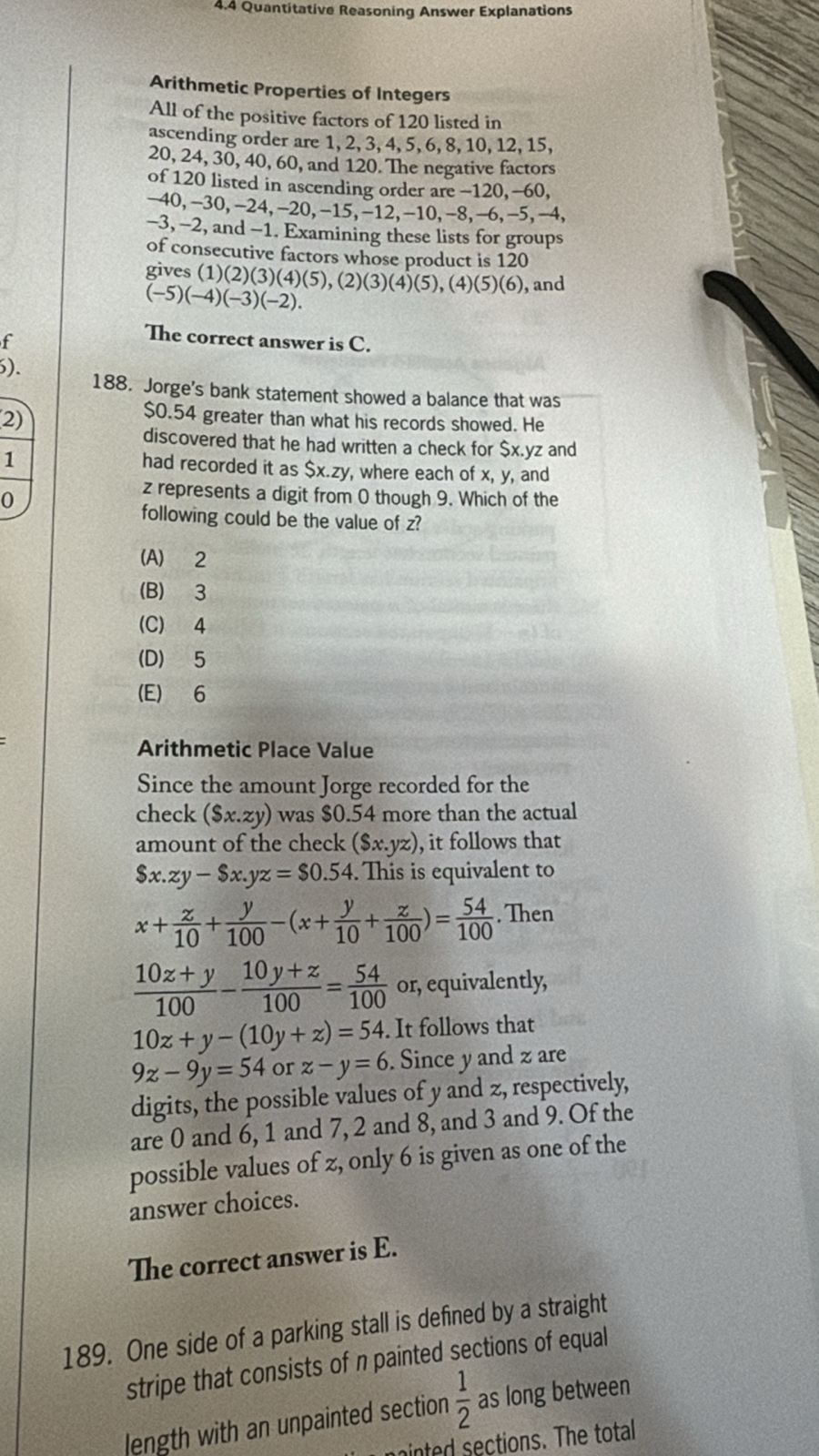
This question is discussed in detail here: https://gmatclub.com/forum/jorge-s-bank ... 22418.html Hope it helps.
P.S. OG solutions are generally not very helpful, so it is better to check the solutions posted in the corresponding GMAT Club topics.
26 May 2026, 21:35
Kudos
Bookmarks
| Problem Solving Butler: May 2026 | ||
| May 27 | PS 1 | PS 2 |
_______________________
PS 1
In how many ways can 5 different balls be distributed among 3 children such that each child gets at least one ball?
A. 540
B. 360
C. 240
D. 180
E. 150
_______________________
PS 2
If |3 – x| < x + 5, which of the following must be true about x?
I. x > -2
II. x < 2
III. x > -1
A. I only
B. II only
C. I and II only
D. I and III only
E. I, II, and III
26 May 2026, 21:37
Kudos
Bookmarks
| Critical Reasoning Butler: May 2026 | ||
| May 27 | CR 1 | CR 2 |
____________________
CR 1
Insurance Agent: Unlike most of our competitors, People Care Insurance offers employee incentives based on customer satisfaction rather than on sales numbers, meaning our salespeople have no incentive to sell the most expensive coverage package and have every incentive to meet your unique needs. Thus, when you buy insurance from us, you can be sure that you are not paying for coverage that you do not need.
Which of the following would, if true, most weaken the insurance agent’s reasoning?
A. Some cheaper coverage packages actually offer better coverage than do the more expensive ones.
B. Salespeople with a financial incentive to make higher sales typically provide more attentive service than do other salespeople.
C. People Care Insurance does not sell any basic coverage packages.
D. People Care Insurance is often understaffed, making it difficult for clients to fully discuss their concerns and options.
E. Ancillary benefits that come with less expensive coverage packages can be worth nearly as much as the package itself.
____________________
CR 2
Which of the following most logically completes the argument below?
The atmosphere exerts less pressure as altitude rises above sea level. Since the boiling point of all liquids decreases alongside air pressure, those who have scaled Everest have reported that water boils very quickly at the peak. The boiling point of water at any given pressure can be determined and the pressure for any altitude can be mathematically calculated. Therefore, physicists can determine the boiling point of water at the summit of Everest, since _______.
A. air pressure at sea level is higher than air pressure above sea level
B. air currents sometimes carry pressure from lower points in the atmosphere to higher points
C. the exact height of the summit is known
D. air pressure cannot be directly measured anywhere in the atmosphere
E. the boiling point of water is higher at sea level than it is above sea level