Events & Promotions
|
|

GMAT Club Daily Prep
Thank you for using the timer - this advanced tool can estimate your performance and suggest more practice questions. We have subscribed you to Daily Prep Questions via email.
Customized
for You
Track
Your Progress
Practice
Pays
Not interested in getting valuable practice questions and articles delivered to your email? No problem, unsubscribe here.
 Sep 15
07:00 PM EDT
-09:00 PM EST
Elite scores are possible when you enroll in a powerful GMAT course, taught live online + 6 months access to TTP OnDemand video courses included! Class starts Tues/Thurs Sept. 15, 2026 - Nov. 15, 2027, 7:00pm-9:00pm EST Sep 21
07:00 PM EDT
-10:00 PM EDT
Boost your GMAT score in less than one month in a live online class + 6 months access to TTP OnDemand video courses included! Class starts Mon, Tues, Wed, Thur, Fri Sept. 21, 2026 - Oct. 9, 2027, 7:00pm-10:00pm EST

 31 Aug 2021, 14:09
Kudos
Bookmarks
Most GMAT test takers dream of scoring 700+, and August 2021 has been a record month in that regard. More than 50 GMAT Club members reported 700+ scores in GMAT Club’s review section (50 published). This is significant for two reasons. First - the number of 700+ scores reported in the month of August has gone up 3X (vs. 2019). Second, this growth indicates that scoring a 700+ has become much more predictable for dedicated students. This article outlines how four factors - 1) Student’s grit and honesty, 2) Scalable methods, 3) AI and Analytics, and 4) Dedicated guidance by GMAT Strategy Experts – enable such success.
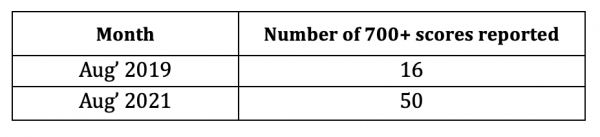
Table 1: Comparing # of 700+ scores reported in 2019 and 2021 (all partners)
As evidence, we also present two case studies that showcase these elements. Furthermore, this article outlines how we can better this number.
1.1 WHY IS THIS ACHIEVEMENT SIGNIFICANT?
Let me start by stating two things – not everyone who takes a preparation course or reads a book is successful on the GMAT, and the achievement in August is not the pinnacle of success. We still have a long way to go (read the last section).
1.1.1 Comparing Aug 2019, Aug 2020, and Aug 2021
The chart below compares the number of 700+ scores by GMAT Club partners for the month of August. While only a fraction of students reports their results (see chart 1 below) on GMAT Club, and different GMAT prep companies are limited by the number of students they cater to, this table shows the extent to which they have helped students score 700+ in the last 12 months.
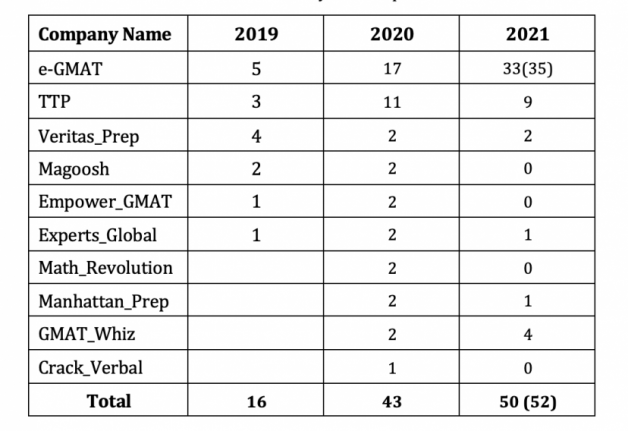
Table 2: Comparing scores delivered by various partners. Note, the number in the bracket indicates approved but yet to be published reviews.
For e-GMAT, this has been a planned effort driven by four key innovations – Quant 2.0, Scholaranium 2.2, xPERT AI, and our LMP program. Not only that, while we (e-GMAT) have been known for our Verbal prowess, Quant 2.0 has allowed us to deliver more Q49+ scores since April of 2021. Similarly, Scholaranium 2.2 has allowed us to deliver more V37+ scores (80th percentile threshold) since May 2021 (its release date). The chart below shows number of students scoring 700 or higher our SIGma-X mock test. While there are macro factors built in to this chart, new products and services have also had their share of impact.
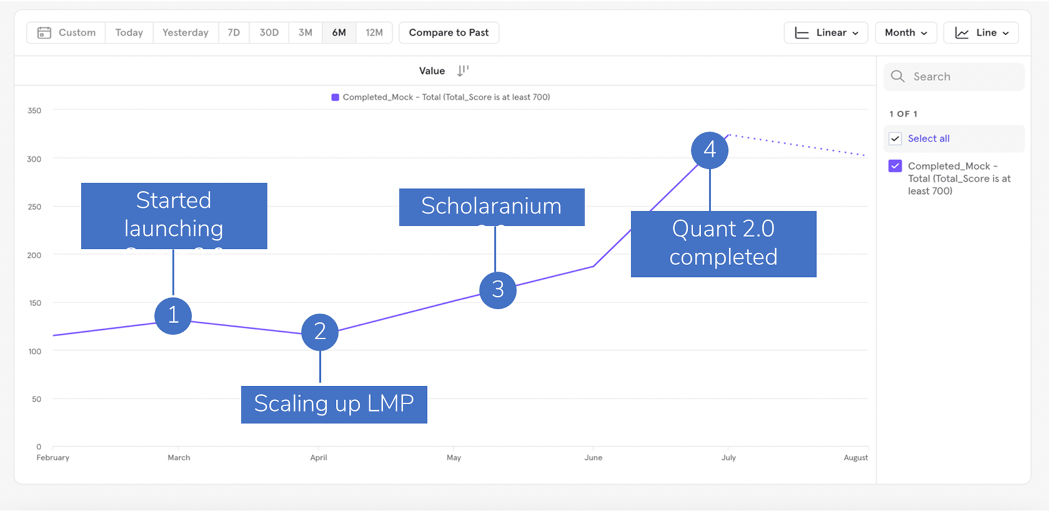
Fig 1: Trend plot showing # of 700+ scores on SIGma-X mocks (internal metric) and how they align with significant product releases.
1.2 HOW AI AND ANALYTICS MAKE SUCCESS MORE PREDICTABLE
At e-GMAT, we have always focused on building scalable methods – methods that are based on solid logic and that can be applied to every question regardless of its difficulty level. Once these methods became the foundation of our detailed courses, we faced many challenges, a few of which are outlined below:
AI and its application for enabling GMAT Success
The classical definition of AI is where machines can emulate human thoughts and functions, while machine learning (often considered a subset of AI) uses past or training data to create decision making algorithms. In the classical sense, AI replaces human decision-making (or guidance in the GMAT context).
However, in our experience, in the context of learning, there are many scenarios in which an AI-based system can make better decisions than a human. For example, while building a personalized study plan, an AI-based system can provide a much better estimate of the time a student will need to improve from 30th percentile to 90th percentile in CR since it can look at a trifecta of factors such as:
Here is a case of a student who had just 13 days before her test and wanted to score a V40. Based on the feedback we received from AI, we pushed her to invest 8 hours per day instead of the 5 she was initially planning to invest in. As a result, she was able to improve from V28 to V41 in less than 2 weeks.
Similarly, while watching an interactive video, embedded analytics, using a combination of post-assessment quizzes and time spent in various sections, can identify whether a student has learned to the required proficiency. In the event the student falters (i.e., a low score in post-assessment quizzes), AI can give feedback to revise specific parts of the lesson. It can also pick new challenges to evaluate the student. In fact, most of our students, especially those who score high, act on this feedback and revise the recommended concepts in real-time. This video illustrates a simplified version of one such implementation.
What does it take to build AI and Analytics?
Writing algorithms (whether heuristics based on ML) and building an analytics system are both extremely rewarding (from a student success standpoint) and very hard. The key challenge is to separate the signal from the noise and discard cases where there is too much noise. To do that, you need data, and to get data, you need to build every subsystem.
For example, when we pioneered the xlearn activity in Quant 2.0, we had to build our own video player. xLearn is a compound activity that contains multiple videos, multiple quizzes, and multiple interactions. To evaluate user learning, we needed user interaction data every 5 seconds, and most third-party video players would not easily send us individual user-level data with the desired fidelity or that tells us which chapter the user watched multiple times, or which one did he skip. A few that did were either super expensive (our courses start at $199) or were not as scalable. Hence, we invested 7 man-months of engineering effort to create our own video player.
1.3 TWO CASE STUDIES
As I mentioned before, scalable success is an outcome of four factors –
We say that the first two are essential factors while the other two are catalysts, implying that they enable a much higher proportion of diligent students to be successful. These two cases illustrate these points.
1.3.1 Shubham – AI identifies false positives
Shubham came to us with a starting score of 720. He had a target score of 750. Even though Shubham had 84th percentile in CR, he was extremely honest by admitting that his real ability in CR was much lower, indirectly indicating that the 720 score on his last attempt was actually an inflated score.
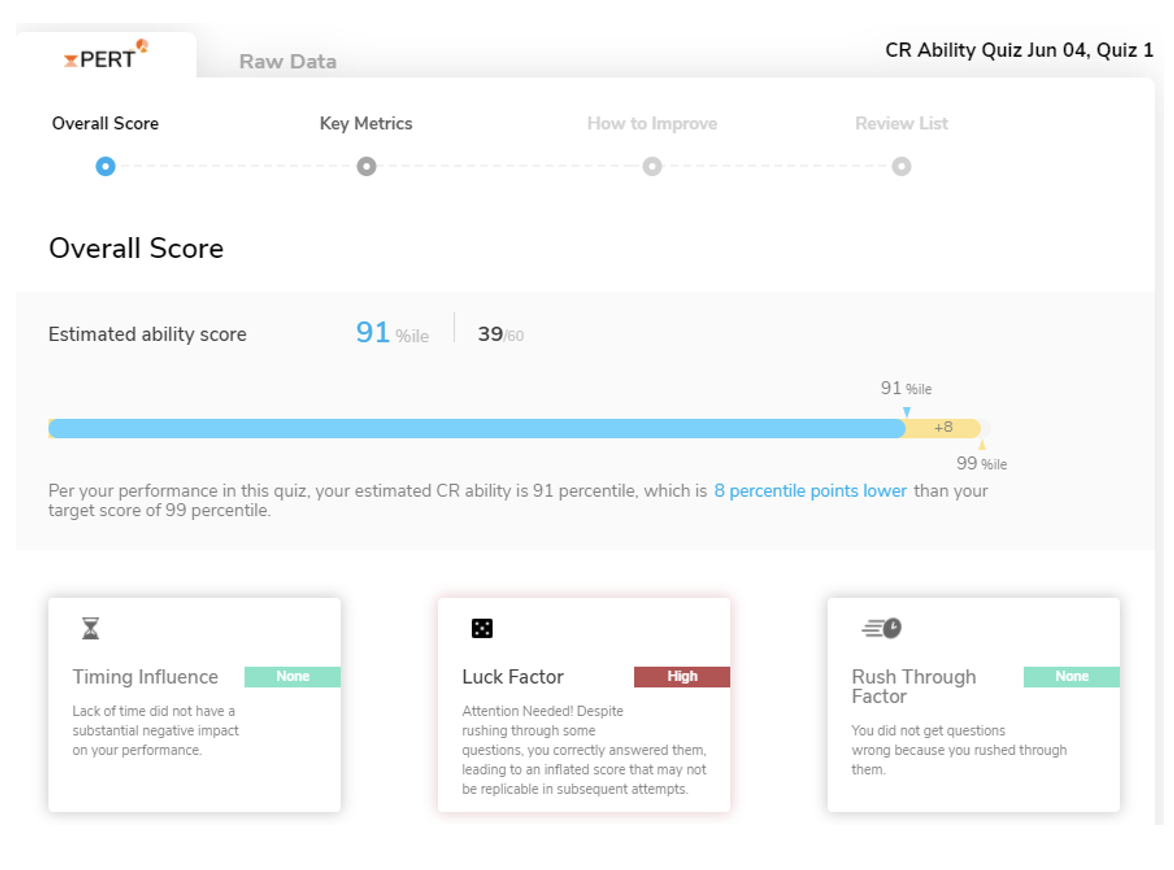
To evaluate his true ability, we gave him a CR ability quiz. To our surprise, he scored 91st percentile. However, comparing his timing with that of 5000 other students who had answered the same set of questions correctly, xPERT AI identified that there was significant luck involved. In addition, it also indicated significant gaps in Inference, Strengthen, Assumption questions.
As a result, we created a plan according to which he would go through all the files from these 3 modules and only Application & Practice Files for the other modules. We did this so that he can learn the CR process of pre-thinking first and then learn how to apply it to different kinds of CR questions. The impact of this plan was clearly visible in the next 5 days.
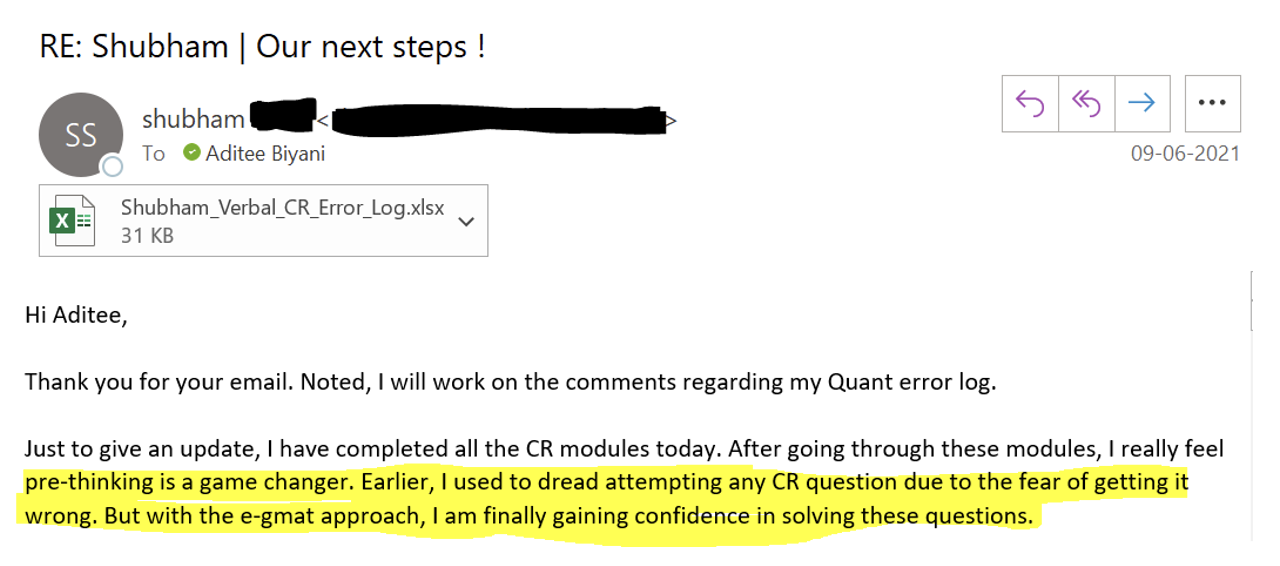
Leveraging Analytics improve to Q50
While Shubham already had a Q49, his ESR showed gaps in DS type questions, WP, Geometry. We recommended that Shubham attempt Ability Quizzes in each to identify the specific weaknesses in WP & Geometry and work through them. Within a day, Aditee (e-GMAT mentor) was able to identify the following weaknesses:
Again, the plan was to fix these issues at the very core. He went through the DS module from Quant Basics course along with these specific modules from WP & Geometry courses and then cemented his learnings.
1.3.2 Case 2 – 640 (Q48, V30) to 740 (Q51, V38)
Ameet (name changed) was an old student who had initially purchased the course in Sep 2019. He did not extend the course and took the test in Aug 2020. Since he did not have access to the course before his first attempt, he practiced from various sources, including GMAT Club. The result – 660 with a Q49, V30.
Realizing his mistake, he purchased the course again in April 2021. He went through the course again for two months and took a mock test. While he scored 720, Ameet was honest enough to know that he got lucky and was not confident of his answers. He reached out to us. Archit (one of the strategy experts) identified the same using data in SC. He also noticed that while Ameet had completed the course, he had failed to do Cementing or Test Readiness (Stages 2 &3).
Refinement plan - Verbal
Archit advised that Ameet stop doing mocks and do Stage 2 (cementing) and Stage 3 in SC, CR, and RC. Specific cementing quizzes with predefined success metrics gave Ameet a target to achieve. In addition, we educated him on Behavioral Error Log and gave him a template for the same. His metrics improved drastically.
Refinement plan – Quant
Ameet was already at the 60th percentile in Quant. His first SIGma-X mock revealed that
Ameet went through the entire Arithmetic course. Also, since the e-GMAT Quant course has Atomic Learning Paths, the platform recommended that he only attempt the relevant portion of the course. Post that, Ameet completed stage 2 in Arithmetic and Stage 3 in Algebra/Geo.
1.4 SUCCESS REQUIRES BOTH ESSENTIAL AND NON-ESSENTIAL ELEMENTS
These two case studies demonstrate that a student needs to be honest with himself and needs to learn scalable methods (not tricks) to score 720+. They also demonstrate how AI and analytics enable personalized learning to ensure that students spend their time learning the content that helps them improve (Analytics helped Shubham personalize the CR course, while xPERT personalized Alg/Geo for Ameet). Similarly, purpose-built AI and analytics enable more and more students to be more confident while making decisions as well as track their improvement. Overall, while a student needs to be diligent to be successful (700+ score), AI, Analytics, and enable students to score higher (730+ scores) in much less time.
1.5 BUILDING THE FUTURE
As e-GMAT re-defined GMAT prep with its many innovations and achieved its initial goal – to help diligent students ace the GMAT – the team adopted a new goal: to create a platform that is more personalized, more engaging, and more interactive than a private tutor. In pursuit of this goal, the teams at e-GMAT are working on integrating enhanced gamification with the platform, delivering timely feedback to help students pre-empt and avoid pitfalls, and increasing human interaction by introducing personalized live sessions.
Ten years after the company was founded, the passion to help young professionals realize their MBA dreams has only intensified. The team is committed to continuing to develop first-of-its-kind innovations to help every single member of the e-GMAT community achieve his or her MBA dream, and we’re working hard to achieve this goal.
Table 1: Comparing # of 700+ scores reported in 2019 and 2021 (all partners)
1.1 WHY IS THIS ACHIEVEMENT SIGNIFICANT?
Let me start by stating two things – not everyone who takes a preparation course or reads a book is successful on the GMAT, and the achievement in August is not the pinnacle of success. We still have a long way to go (read the last section).
1.1.1 Comparing Aug 2019, Aug 2020, and Aug 2021
The chart below compares the number of 700+ scores by GMAT Club partners for the month of August. While only a fraction of students reports their results (see chart 1 below) on GMAT Club, and different GMAT prep companies are limited by the number of students they cater to, this table shows the extent to which they have helped students score 700+ in the last 12 months.
Table 2: Comparing scores delivered by various partners. Note, the number in the bracket indicates approved but yet to be published reviews.
For e-GMAT, this has been a planned effort driven by four key innovations – Quant 2.0, Scholaranium 2.2, xPERT AI, and our LMP program. Not only that, while we (e-GMAT) have been known for our Verbal prowess, Quant 2.0 has allowed us to deliver more Q49+ scores since April of 2021. Similarly, Scholaranium 2.2 has allowed us to deliver more V37+ scores (80th percentile threshold) since May 2021 (its release date). The chart below shows number of students scoring 700 or higher our SIGma-X mock test. While there are macro factors built in to this chart, new products and services have also had their share of impact.
Fig 1: Trend plot showing # of 700+ scores on SIGma-X mocks (internal metric) and how they align with significant product releases.
1.2 HOW AI AND ANALYTICS MAKE SUCCESS MORE PREDICTABLE
At e-GMAT, we have always focused on building scalable methods – methods that are based on solid logic and that can be applied to every question regardless of its difficulty level. Once these methods became the foundation of our detailed courses, we faced many challenges, a few of which are outlined below:
- 1. How to adapt the courses to student’s starting abilities?
2. How to give a student reliable preparation time estimate?
3. How to track whether the student is learning concepts and applications?
4. How to track a student’s improvement in a pristine environment, i.e., without forcing him to take mocks?
5. How to define areas of specific weaknesses in the last stage of preparation?
6. How to track that improvement?
AI and its application for enabling GMAT Success
The classical definition of AI is where machines can emulate human thoughts and functions, while machine learning (often considered a subset of AI) uses past or training data to create decision making algorithms. In the classical sense, AI replaces human decision-making (or guidance in the GMAT context).
However, in our experience, in the context of learning, there are many scenarios in which an AI-based system can make better decisions than a human. For example, while building a personalized study plan, an AI-based system can provide a much better estimate of the time a student will need to improve from 30th percentile to 90th percentile in CR since it can look at a trifecta of factors such as:
1. The length of the course
2. The time that other successful students with similar starting ability needed and,
3. The intensity factor for someone investing 2/3 hours per day vs. someone who invests 8 hours per day.
Here is a case of a student who had just 13 days before her test and wanted to score a V40. Based on the feedback we received from AI, we pushed her to invest 8 hours per day instead of the 5 she was initially planning to invest in. As a result, she was able to improve from V28 to V41 in less than 2 weeks.
Similarly, while watching an interactive video, embedded analytics, using a combination of post-assessment quizzes and time spent in various sections, can identify whether a student has learned to the required proficiency. In the event the student falters (i.e., a low score in post-assessment quizzes), AI can give feedback to revise specific parts of the lesson. It can also pick new challenges to evaluate the student. In fact, most of our students, especially those who score high, act on this feedback and revise the recommended concepts in real-time. This video illustrates a simplified version of one such implementation.
What does it take to build AI and Analytics?
Writing algorithms (whether heuristics based on ML) and building an analytics system are both extremely rewarding (from a student success standpoint) and very hard. The key challenge is to separate the signal from the noise and discard cases where there is too much noise. To do that, you need data, and to get data, you need to build every subsystem.
For example, when we pioneered the xlearn activity in Quant 2.0, we had to build our own video player. xLearn is a compound activity that contains multiple videos, multiple quizzes, and multiple interactions. To evaluate user learning, we needed user interaction data every 5 seconds, and most third-party video players would not easily send us individual user-level data with the desired fidelity or that tells us which chapter the user watched multiple times, or which one did he skip. A few that did were either super expensive (our courses start at $199) or were not as scalable. Hence, we invested 7 man-months of engineering effort to create our own video player.
1.3 TWO CASE STUDIES
As I mentioned before, scalable success is an outcome of four factors –
- 1) Student’s grit and honesty (essential)
2) Scalable methods (essential)
3) AI and Analytics (catalyst)
4) Dedicated guidance by GMAT Strategy Experts (catalyst)
We say that the first two are essential factors while the other two are catalysts, implying that they enable a much higher proportion of diligent students to be successful. These two cases illustrate these points.
1.3.1 Shubham – AI identifies false positives
Quote:
Shubham came to us with a starting score of 720. He had a target score of 750. Even though Shubham had 84th percentile in CR, he was extremely honest by admitting that his real ability in CR was much lower, indirectly indicating that the 720 score on his last attempt was actually an inflated score.
To evaluate his true ability, we gave him a CR ability quiz. To our surprise, he scored 91st percentile. However, comparing his timing with that of 5000 other students who had answered the same set of questions correctly, xPERT AI identified that there was significant luck involved. In addition, it also indicated significant gaps in Inference, Strengthen, Assumption questions.
Leveraging Analytics improve to Q50
While Shubham already had a Q49, his ESR showed gaps in DS type questions, WP, Geometry. We recommended that Shubham attempt Ability Quizzes in each to identify the specific weaknesses in WP & Geometry and work through them. Within a day, Aditee (e-GMAT mentor) was able to identify the following weaknesses:
- 1. WP – Time & Work, Savings & Interest
2. Geometry – Triangles, Rectangular solids, Polygons, Rectangles, Squares, Coordinate Geometry
Again, the plan was to fix these issues at the very core. He went through the DS module from Quant Basics course along with these specific modules from WP & Geometry courses and then cemented his learnings.
Quote:
1.3.2 Case 2 – 640 (Q48, V30) to 740 (Q51, V38)
Quote:
Ameet (name changed) was an old student who had initially purchased the course in Sep 2019. He did not extend the course and took the test in Aug 2020. Since he did not have access to the course before his first attempt, he practiced from various sources, including GMAT Club. The result – 660 with a Q49, V30.
Realizing his mistake, he purchased the course again in April 2021. He went through the course again for two months and took a mock test. While he scored 720, Ameet was honest enough to know that he got lucky and was not confident of his answers. He reached out to us. Archit (one of the strategy experts) identified the same using data in SC. He also noticed that while Ameet had completed the course, he had failed to do Cementing or Test Readiness (Stages 2 &3).
Refinement plan - Verbal
Archit advised that Ameet stop doing mocks and do Stage 2 (cementing) and Stage 3 in SC, CR, and RC. Specific cementing quizzes with predefined success metrics gave Ameet a target to achieve. In addition, we educated him on Behavioral Error Log and gave him a template for the same. His metrics improved drastically.
Refinement plan – Quant
Ameet was already at the 60th percentile in Quant. His first SIGma-X mock revealed that
- 1) His overall score was Q47, rather than Q48
2) He had a very specific weakness in Arithmetic (50th percentile).
3) He was much better in Alg/Geo.
Ameet went through the entire Arithmetic course. Also, since the e-GMAT Quant course has Atomic Learning Paths, the platform recommended that he only attempt the relevant portion of the course. Post that, Ameet completed stage 2 in Arithmetic and Stage 3 in Algebra/Geo.
Quote:
1.4 SUCCESS REQUIRES BOTH ESSENTIAL AND NON-ESSENTIAL ELEMENTS
These two case studies demonstrate that a student needs to be honest with himself and needs to learn scalable methods (not tricks) to score 720+. They also demonstrate how AI and analytics enable personalized learning to ensure that students spend their time learning the content that helps them improve (Analytics helped Shubham personalize the CR course, while xPERT personalized Alg/Geo for Ameet). Similarly, purpose-built AI and analytics enable more and more students to be more confident while making decisions as well as track their improvement. Overall, while a student needs to be diligent to be successful (700+ score), AI, Analytics, and enable students to score higher (730+ scores) in much less time.
1.5 BUILDING THE FUTURE
As e-GMAT re-defined GMAT prep with its many innovations and achieved its initial goal – to help diligent students ace the GMAT – the team adopted a new goal: to create a platform that is more personalized, more engaging, and more interactive than a private tutor. In pursuit of this goal, the teams at e-GMAT are working on integrating enhanced gamification with the platform, delivering timely feedback to help students pre-empt and avoid pitfalls, and increasing human interaction by introducing personalized live sessions.
Ten years after the company was founded, the passion to help young professionals realize their MBA dreams has only intensified. The team is committed to continuing to develop first-of-its-kind innovations to help every single member of the e-GMAT community achieve his or her MBA dream, and we’re working hard to achieve this goal.
Moderator:






