Events & Promotions
|
|

GMAT Club Daily Prep
Thank you for using the timer - this advanced tool can estimate your performance and suggest more practice questions. We have subscribed you to Daily Prep Questions via email.
Customized
for You
Track
Your Progress
Practice
Pays
Not interested in getting valuable practice questions and articles delivered to your email? No problem, unsubscribe here.
 Aug 27
10:00 AM EDT
-11:00 AM EDT
We’ve worked incredibly hard to build TTP into the best test prep experience possible, and it would mean a lot to us to win Newsweek’s 2026 Readers’ Choice Award for Best Test Prep. If TTP has helped you, we’d be incredibly grateful for your vote. Sep 04
10:00 AM PDT
-11:00 AM PDT
What does test anxiety really look like on the GMAT? For many test takers, it does not look like a panic attack. Instead, it shows up as brain fog, rereading, negative comparisons, mental noise.... Sep 06
09:30 AM EDT
-12:30 PM EST
Top scores are possible when you enroll in a powerful EA course, taught live online + 6 months access to TTP OnDemand video courses included! Perfect class schedule and easy course access for working professionals. Class starts Sundays Sept. 6, 2026.- Sep 07
12:01 AM PDT
-11:59 PM PDT
On the 7th, GMAT Club Tests will be Free! Including all the Quizzes, Questions, and Tests. 12 AM - 11:59 PM PDT - Sep 09
07:00 AM PDT
-10:00 AM PDT
Meet AdComs and explore top Master’s programs - MiM, MiF, MSc, MSBA and more. - Application Fee Waivers - Free 1-Week of GMAT Club Tests: - Master's Application Toolkit - Grand Prize Giveaway  Sep 15
07:00 PM EDT
-09:00 PM EST
Elite scores are possible when you enroll in a powerful GMAT course, taught live online + 6 months access to TTP OnDemand video courses included! Class starts Tues/Thurs Sept. 15, 2026 - Nov. 15, 2027, 7:00pm-9:00pm EST Sep 21
08:00 PM EDT
-10:00 PM EDT
Boost your GMAT score in less than one month in a live online class + 6 months access to TTP OnDemand video courses included! Class starts Mon, Tues, Wed, Thur, Fri Sept. 21, 2026 - Oct. 9, 2027, 7:00pm-10:00pm EST


 12 Jun 2014, 05:33
Kudos
Bookmarks
Hi all,
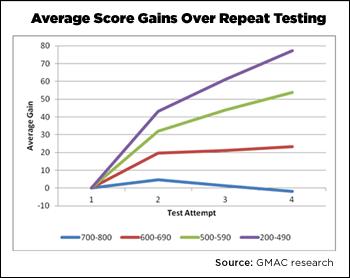
I've taken the GMAT twice and am considering whether I should take it a 3rd time. I've been researching a bit on retake statistics and came across some different data. Can anyone help me better understand how to read the data below?
For example, if the first attempt was in the 500-590 range, then the second attempt has an average gain of around 30 pts. For the third attempt, does it mean that I can expect around another 45 pts on top of my 2nd take or does that mean around 45 pts from my first take?
In the same vein, if the first attempt was in the 700-800 range, the average gain on second attempt is around 8 pts. Then on the fourth attempt is it negative versus the 3rd attempt or what?
Any insights on how to read this data or any other retake statistics would be highly appreciated. Thanks!
https://www.mba.com/us/the-gmat-blog-hub ... sting.aspx
I've taken the GMAT twice and am considering whether I should take it a 3rd time. I've been researching a bit on retake statistics and came across some different data. Can anyone help me better understand how to read the data below?
For example, if the first attempt was in the 500-590 range, then the second attempt has an average gain of around 30 pts. For the third attempt, does it mean that I can expect around another 45 pts on top of my 2nd take or does that mean around 45 pts from my first take?
In the same vein, if the first attempt was in the 700-800 range, the average gain on second attempt is around 8 pts. Then on the fourth attempt is it negative versus the 3rd attempt or what?
Any insights on how to read this data or any other retake statistics would be highly appreciated. Thanks!
https://www.mba.com/us/the-gmat-blog-hub ... sting.aspx
 12 Jun 2014, 11:52
Kudos
Bookmarks
wit
Dear wit,
I'm happy to respond.

First of all, I will recommend this article:
https://magoosh.com/gmat/2013/should-i-retake-the-gmat/
I will point out a few things. It verges on the ridiculous to retake the GMAT when one's first score is already 700+. That is simply asking for trouble. Remember, as always with statistics, these are raw averages. An average of 8 points means, for example, that while a sizable portion of students in this zone gained 10, 20, or 30 points, some people dropped 50 or 100 points. One of the HUGE mistakes of reading statistics is to think of the average as exact predictions.
The chart is not particularly clear on this point, but it seems to indicate that, on say the third retake, a 45 point increase from the first take, not from the the more recent second take, the first retake. Think about it. On average, people do about the same. On average, people don't make wild jumps from one retake to the next. The Law of Diminishing Returns is in full effect here. Once again, do not make the mistake of assuming that an average for the population is a prediction for you in particular. Saying that, after the third retake, folks are 45 points up, on average, from their first test means that there are some individuals who are up 100 or 150, and others who are down 50 or 100, and you could be anywhere in that spread if you are not careful. It would be a terribly naive mistake to assume that this average increase is more or less guaranteed for you personally.
I think the HUGE mistake that so many people do on a retake is: in studying for the retake, they do approximately more of the same. If the student just goes back, and more-or-less repeats his procedure, perhaps with a new question source or new test-prep book, then there's no reason necessarily that the student will see any improvement at all, and perhaps with chance fluctuations, will even see a drop. If you really want to see radical improvement, you need to make radical changes, not only in your materials, but most important, in your mindset, in your entire approach and engagement with the material. Most people are not ready to make radical changes, especially to their mindset, so they don't see radical improvement.
I will say: Magoosh offers a score guarantee for which you would qualify:
https://gmat.magoosh.com/score-guarantee
Part of the requirement for that score guarantee is that the student watch the explanation video for each and every question she got wrong. That's a level of engagement with one's mistakes that many people don't do on their own, and it contributes to the score increase that Magoosh customers see.
Here's a practice SC question:
https://gmat.magoosh.com/questions/3604
Here's a practice DS question:
https://gmat.magoosh.com/questions/1004
When you submit your answer, the following page will have the explanation video. Each Magoosh question has its own VE, for accelerated learning.
Does all this make sense?
Mike
22 Jun 2014, 02:19
Kudos
Bookmarks
Hi Mike,
Thanks for your feedback.
Actually, I am already a Magoosh member and used it during my retake preparation. I went from 530 Q35 V27 to 570 Q39 V30. This increase was quite in line with the average retake statistics which is why I was particularly interested in understanding the chart for average score gains on a 3rd retake. Realistically, I think I would have to work super hard to reach a ceiling of low 600s and even that is not guaranteed.
Do you have any advice for taking the GMAT a third time? A note is that during my retake preparation I studied for 3 months following the 3 month plan for beginners but got only around halfway through as I wanted to be thorough with the material. For me, I felt like I would have had to go really fast to cover all the material in 3 months. So I basically decided to go at a thorough pace for me and focus on quality over quantity. In hindsight, perhaps that was not the correct strategy as I didn't get a 50 point improvement. So for example, do you think I should continue with the material or try something different?
Thanks for your feedback.
Actually, I am already a Magoosh member and used it during my retake preparation. I went from 530 Q35 V27 to 570 Q39 V30. This increase was quite in line with the average retake statistics which is why I was particularly interested in understanding the chart for average score gains on a 3rd retake. Realistically, I think I would have to work super hard to reach a ceiling of low 600s and even that is not guaranteed.
Do you have any advice for taking the GMAT a third time? A note is that during my retake preparation I studied for 3 months following the 3 month plan for beginners but got only around halfway through as I wanted to be thorough with the material. For me, I felt like I would have had to go really fast to cover all the material in 3 months. So I basically decided to go at a thorough pace for me and focus on quality over quantity. In hindsight, perhaps that was not the correct strategy as I didn't get a 50 point improvement. So for example, do you think I should continue with the material or try something different?





