Events & Promotions
|
|

GMAT Club Daily Prep
Thank you for using the timer - this advanced tool can estimate your performance and suggest more practice questions. We have subscribed you to Daily Prep Questions via email.
Customized
for You
Track
Your Progress
Practice
Pays
Not interested in getting valuable practice questions and articles delivered to your email? No problem, unsubscribe here.
 Sep 21
07:00 PM EDT
-10:00 PM EDT
Boost your GMAT score in less than one month in a live online class + 6 months access to TTP OnDemand video courses included!

 Updated on: 28 Jan 2024, 04:55
Originally posted by filippocarta01 on 01 Nov 2023, 12:08.
Last edited by Bunuel on 28 Jan 2024, 04:55, edited 2 times in total.
Last edited by Bunuel on 28 Jan 2024, 04:55, edited 2 times in total.
Kudos
Bookmarks


C
Be sure to select an answer first to save it in the Error Log before revealing the correct answer (OA)!
Difficulty:
 45%
(medium)
45%
(medium)
Question Stats:
78% (02:16) correct 22%
(02:46)
wrong
based on 977
sessions
22%
(02:46)
wrong
based on 977
sessions
History
Date
Time
Result
Not Attempted Yet
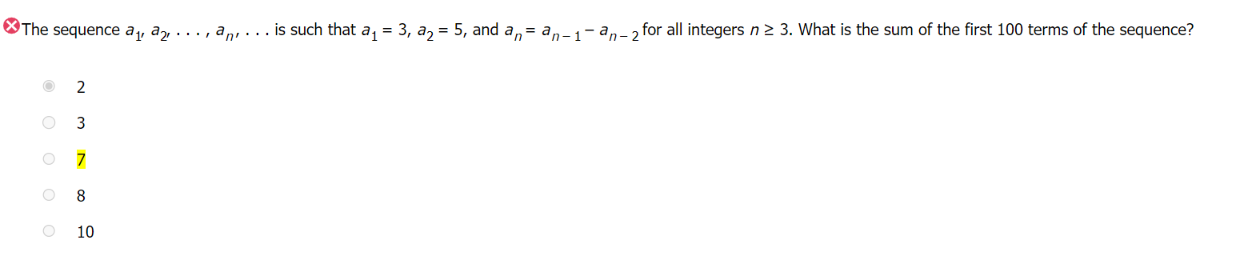
The sequence \(a_1\), \(a_2\), ..., \(a_n\), ... is such that \(a_1 = 3\), \(a_2 = 5\), and \(a_n = a_{n-1} - a_{n-2}\) for all integers \(n ≥ 3\). What is the sum of the first 100 terms of the sequence?
(A) 2
(B) 3
(C) 7
(D) 8
(E) 10
2024-01-28_15-48-33.png [ 29.05 KiB | Viewed 13991 times ]
(A) 2
(B) 3
(C) 7
(D) 8
(E) 10
Attachment:
2024-01-28_15-48-33.png [ 29.05 KiB | Viewed 13991 times ]
Pro tip:
Combine official questions for familiarity with GMAT Club Tests for analytics and tougher Focus-level practice so the real exam feels manageable.
Explore →
 01 Nov 2023, 12:49
Kudos
Bookmarks
filippocarta01
Let's write few terms of the sequence to establish a pattern
\(a_1 = 3\)
\(a_2 = 5\)
\(a_3 = 5 - 3 = 2\)
\(a_4 = 2 - 5 = -3\)
\(a_5 = -3 - 2 = -5\)
\(a_c = -5 + 3 = -2\)
\(a_6 = -2 + 5 = 3\)
\(a_7 = 3 + 2 = 5\)
.
.
So, we can see the pattern repeating after every \(6^{\text{th}}\) term.
Sum of the first 6 terms = \(3 + 5 + 2 - 3 - 5 -2 = 0\)
\(100 = 6*16 + 4\)
Hence, the sum of the first 96 terms = 0
\(a_{97} = 3\)
\(a_{98} = 5\)
\(a_{99} = 2\)
\(a_{100} = -3\)
Sum of the first 100 terms = \(3 + 5 + 2 - 3 = 7\)
Option C
General Discussion
01 Nov 2023, 13:19
Kudos
Bookmarks
gmatophobia
I don't get why the sixth term in the pattern is Ac and not A6.
Thank you very much