Events & Promotions
|
|

GMAT Club Daily Prep
Thank you for using the timer - this advanced tool can estimate your performance and suggest more practice questions. We have subscribed you to Daily Prep Questions via email.
Customized
for You
Track
Your Progress
Practice
Pays
Not interested in getting valuable practice questions and articles delivered to your email? No problem, unsubscribe here.
 Sep 15
07:00 PM EDT
-09:00 PM EST
Elite scores are possible when you enroll in a powerful GMAT course, taught live online + 6 months access to TTP OnDemand video courses included! Class starts Tues/Thurs Sept. 15, 2026 - Nov. 15, 2027, 7:00pm-9:00pm EST Sep 18
08:00 PM PDT
-09:00 PM PDT
Video explanations + diagnosis of 10 weakest areas + 150+ short videos + study plan! Sep 21
07:00 PM EDT
-10:00 PM EDT
Boost your GMAT score in less than one month in a live online class + 6 months access to TTP OnDemand video courses included! Class starts Mon, Tues, Wed, Thur, Fri Sept. 21, 2026 - Oct. 9, 2027, 7:00pm-10:00pm EST


 22 May 2021, 21:12
Kudos
Bookmarks
When taking most tests, we'd be happy to see a question that we find easy to answer. An easy question can represent a little break from seeing difficult questions or some easy points on the board. However, since the GMAT is computer adaptive, GMAT test-takers often dread the sight of an easy question, because we've all heard that, if we get GMAT questions correct, we see harder questions, and that, if we get GMAT questions incorrect, the test presents us with easier questions. So, GMAT test-takers often perceive a relatively easy question as a sign that they have missed one or more of the questions they recently saw.
Here's the thing though, while the GMAT is computer adaptive, and while we will for sure see easy questions if we get a bunch of questions incorrect, there are some good reasons not to worry at all if we see an easy question or two.
For one thing, the truth is that, even if we're consistently getting questions correct, the difficulty of the questions we see will fluctuate, a lot. For instance, a super tricky coordinate geometry question can be followed by a rather easy rates question. The test just works that way.
Here's an image from an ESR from a GMAT on which the test-taker got every quant question correct. Notice that the average difficulty actually went down at the end of the section.
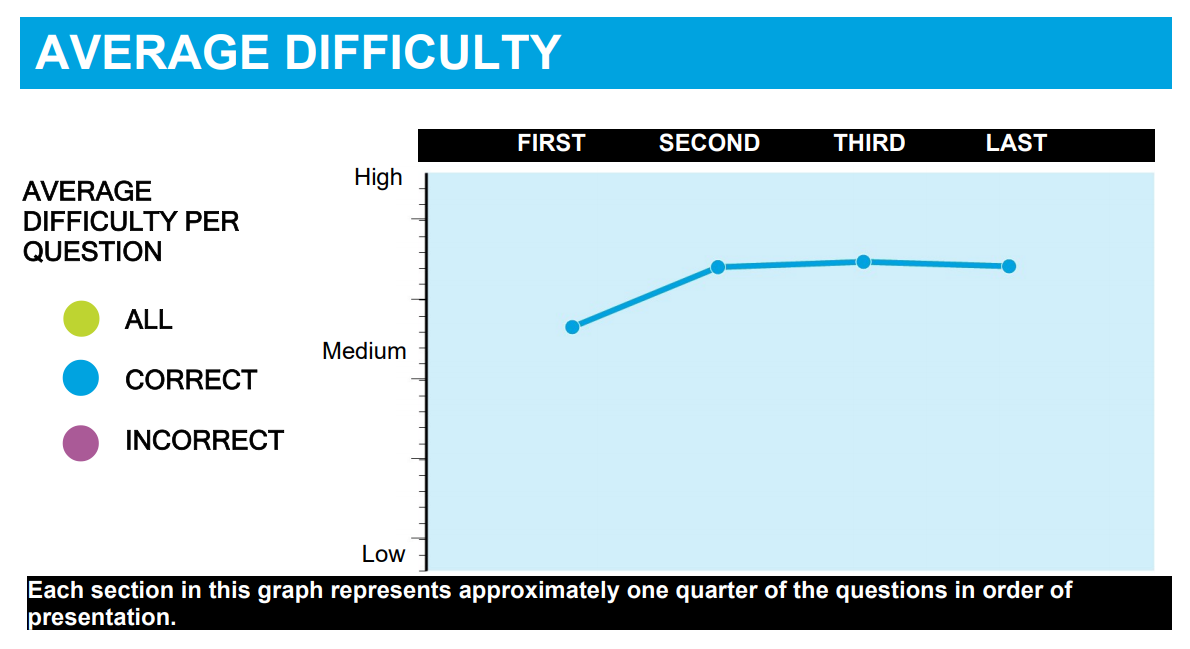
Now, the blue line marks the average difficulty of the questions. So, the test-taker who took that test was seeing questions of a variety of difficulty levels, including some very high difficulty questions. At the same time, in order for the average difficulty of the questions to have been in the medium-high range, some of the questions must have been significantly easier than medium-high difficulty. So, we can see that, even in getting every question correct, that test-taker was seeing some relatively easy questions. Thus, one reason not to worry about seeing an easy question is that, regardless of how we're doing, we'll see questions of varying difficulty levels.
A second reason not to worry about seeing easy questions is that what's difficult for most people may not be difficult for you. For instance, often what makes a GMAT question difficult is not complexity; it's a trick of some sort. So, one thing that can happen is that, for whatever reason, you easily see the trick of a tricky question that many people miss, and you readily answer it. As a result, you could get the impression that you just saw an easy question, even though the GMAT considered it a hard question. So, you can see that, in worrying about seeing an "easy" question, you may be way off base.
Finally, the GMAT includes experimental questions, and of course, since those questions are experimental, when those questions are added to your test, they haven't been rated and are not presented via the use of the computer-adaptive algorithm. So, you could, for instance, in the middle of scoring V51 see the easiest Critical Reasoning question in the entire question bank - and that question certainly would not be a sign that you have missed anything.
So, you can see that, the presence of an easy question on the GMAT can be totally meaningless and have nothing to do with how you have been performing on the test.
Of course, even if seeing an easy question were a sign that you had missed one or more previous questions, it still wouldn't be worth worrying about. After all, worrying about previous questions won't do anything for your score. At the same time, in case you still found it difficult not to worry if you see an easy question, now it's even more clear that worrying about the difficulty level of the questions you are seeing is a complete waste of time.
Here's the thing though, while the GMAT is computer adaptive, and while we will for sure see easy questions if we get a bunch of questions incorrect, there are some good reasons not to worry at all if we see an easy question or two.
For one thing, the truth is that, even if we're consistently getting questions correct, the difficulty of the questions we see will fluctuate, a lot. For instance, a super tricky coordinate geometry question can be followed by a rather easy rates question. The test just works that way.
Here's an image from an ESR from a GMAT on which the test-taker got every quant question correct. Notice that the average difficulty actually went down at the end of the section.
Now, the blue line marks the average difficulty of the questions. So, the test-taker who took that test was seeing questions of a variety of difficulty levels, including some very high difficulty questions. At the same time, in order for the average difficulty of the questions to have been in the medium-high range, some of the questions must have been significantly easier than medium-high difficulty. So, we can see that, even in getting every question correct, that test-taker was seeing some relatively easy questions. Thus, one reason not to worry about seeing an easy question is that, regardless of how we're doing, we'll see questions of varying difficulty levels.
A second reason not to worry about seeing easy questions is that what's difficult for most people may not be difficult for you. For instance, often what makes a GMAT question difficult is not complexity; it's a trick of some sort. So, one thing that can happen is that, for whatever reason, you easily see the trick of a tricky question that many people miss, and you readily answer it. As a result, you could get the impression that you just saw an easy question, even though the GMAT considered it a hard question. So, you can see that, in worrying about seeing an "easy" question, you may be way off base.
Finally, the GMAT includes experimental questions, and of course, since those questions are experimental, when those questions are added to your test, they haven't been rated and are not presented via the use of the computer-adaptive algorithm. So, you could, for instance, in the middle of scoring V51 see the easiest Critical Reasoning question in the entire question bank - and that question certainly would not be a sign that you have missed anything.
So, you can see that, the presence of an easy question on the GMAT can be totally meaningless and have nothing to do with how you have been performing on the test.
Of course, even if seeing an easy question were a sign that you had missed one or more previous questions, it still wouldn't be worth worrying about. After all, worrying about previous questions won't do anything for your score. At the same time, in case you still found it difficult not to worry if you see an easy question, now it's even more clear that worrying about the difficulty level of the questions you are seeing is a complete waste of time.
Moderator:






