Last visit was: 23 Apr 2026, 02:41 It is currently 23 Apr 2026, 02:41
Close
GMAT Club Daily Prep
Thank you for using the timer - this advanced tool can estimate your performance and suggest more practice questions. We have subscribed you to Daily Prep Questions via email.

Customized
for You

we will pick new questions that match your level based on your Timer History

Track
Your Progress

every week, we’ll send you an estimated GMAT score based on your performance

Practice
Pays

we will pick new questions that match your level based on your Timer History
Not interested in getting valuable practice questions and articles delivered to your email? No problem, unsubscribe here.
Close
Request Expert Reply
Confirm Cancel
User avatar
saintforlife
Joined: 09 Nov 2012
Last visit: 27 Feb 2015
Posts: 61
Own Kudos:
660
 [92]
Given Kudos: 40
Posts: 61
Kudos: 660
 [92]
12
Kudos
Add Kudos
80
Bookmarks
Bookmark this Post
Most Helpful Reply
User avatar
Bunuel
User avatar
Math Expert
Joined: 02 Sep 2009
Last visit: 23 Apr 2026
Posts: 109,763
Own Kudos:
Given Kudos: 105,850
Products:
Expert
Expert reply
Active GMAT Club Expert! Tag them with @ followed by their username for a faster response.
Posts: 109,763
Kudos: 810,727
 [24]
11
Kudos
Add Kudos
13
Bookmarks
Bookmark this Post
User avatar
honchos
Joined: 17 Apr 2013
Last visit: 30 Aug 2021
Posts: 358
Own Kudos:
2,489
 [8]
Given Kudos: 298
Status:Verbal Forum Moderator
Location: India
GMAT 1: 710 Q50 V36
GMAT 2: 750 Q51 V41
GMAT 3: 790 Q51 V49
GPA: 3.3
GMAT 3: 790 Q51 V49
Posts: 358
Kudos: 2,489
 [8]
8
Kudos
Add Kudos
Bookmarks
Bookmark this Post
General Discussion
User avatar
Bunuel
User avatar
Math Expert
Joined: 02 Sep 2009
Last visit: 23 Apr 2026
Posts: 109,763
Own Kudos:
Given Kudos: 105,850
Products:
Expert
Expert reply
Active GMAT Club Expert! Tag them with @ followed by their username for a faster response.
Posts: 109,763
Kudos: 810,727
Kudos
Add Kudos
Bookmarks
Bookmark this Post
honchos
I believe E should be the answer.

Y= mx + c C=0, since line will pass through 0,0

Y = MX

M depends upon the sign of Y, From (1) and (2), Y can be negative or positive, Not sure hence E.

The question asks whether the slope is less than 1. The correct answer is C.
User avatar
honchos
Joined: 17 Apr 2013
Last visit: 30 Aug 2021
Posts: 358
Own Kudos:
2,489
 [1]
Given Kudos: 298
Status:Verbal Forum Moderator
Location: India
GMAT 1: 710 Q50 V36
GMAT 2: 750 Q51 V41
GMAT 3: 790 Q51 V49
GPA: 3.3
GMAT 3: 790 Q51 V49
Posts: 358
Kudos: 2,489
 [1]
Kudos
Add Kudos
1
Bookmarks
Bookmark this Post
Bunuel
honchos
I believe E should be the answer.

Y= mx + c C=0, since line will pass through 0,0

Y = MX

M depends upon the sign of Y, From (1) and (2), Y can be negative or positive, Not sure hence E.

The question asks whether the slope is less than 1. The correct answer is C.

M = Y/X, X is always positive but Y may be Positive or negative, so slope may be +ve or -ve... Hence E

M: stands for line's slope
User avatar
Bunuel
User avatar
Math Expert
Joined: 02 Sep 2009
Last visit: 23 Apr 2026
Posts: 109,763
Own Kudos:
Given Kudos: 105,850
Products:
Expert
Expert reply
Active GMAT Club Expert! Tag them with @ followed by their username for a faster response.
Posts: 109,763
Kudos: 810,727
Kudos
Add Kudos
Bookmarks
Bookmark this Post
honchos
Bunuel
honchos
I believe E should be the answer.

Y= mx + c C=0, since line will pass through 0,0

Y = MX

M depends upon the sign of Y, From (1) and (2), Y can be negative or positive, Not sure hence E.

The question asks whether the slope is less than 1. The correct answer is C.

M = Y/X, X is always positive but Y may be Positive or negative, so slope may be +ve or -ve... Hence E

[b]M[/b]: stands for line's slope

We are NOT asked whether the slope is negative, we are asked whether the slope is less than 1.
User avatar
honchos
Joined: 17 Apr 2013
Last visit: 30 Aug 2021
Posts: 358
Own Kudos:
Given Kudos: 298
Status:Verbal Forum Moderator
Location: India
GMAT 1: 710 Q50 V36
GMAT 2: 750 Q51 V41
GMAT 3: 790 Q51 V49
GPA: 3.3
GMAT 3: 790 Q51 V49
Posts: 358
Kudos: 2,489
Kudos
Add Kudos
Bookmarks
Bookmark this Post
Got it my bad, misinterpreted the question.
avatar
pradeepram
Joined: 07 Apr 2013
Last visit: 17 May 2018
Posts: 28
Own Kudos:
Given Kudos: 64
Location: United States
WE:Information Technology (Computer Software)
Posts: 28
Kudos: 10
Kudos
Add Kudos
Bookmarks
Bookmark this Post
Isn't it possible that the circle touches the origin and the radius and the center ( the center lies on the x axis and there is no y co-ordinate for it) of the circle is same ?
User avatar
Bunuel
User avatar
Math Expert
Joined: 02 Sep 2009
Last visit: 23 Apr 2026
Posts: 109,763
Own Kudos:
810,727
 [1]
Given Kudos: 105,850
Products:
Expert
Expert reply
Active GMAT Club Expert! Tag them with @ followed by their username for a faster response.
Posts: 109,763
Kudos: 810,727
 [1]
1
Kudos
Add Kudos
Bookmarks
Bookmark this Post
pradeepram
Isn't it possible that the circle touches the origin and the radius and the center ( the center lies on the x axis and there is no y co-ordinate for it) of the circle is same ?

If center of the circle is on the x-axis the y-coordinate of the center is 0. In this case the slope of the line will be 0 (since the line would be horizontal), so still less than 1.

Also, the circle cannot pass through the origin, because we are told that "the circle intersects the x-axis at two different [u]positive[/u] coordinates".
avatar
pradeepram
Joined: 07 Apr 2013
Last visit: 17 May 2018
Posts: 28
Own Kudos:
Given Kudos: 64
Location: United States
WE:Information Technology (Computer Software)
Posts: 28
Kudos: 10
Kudos
Add Kudos
Bookmarks
Bookmark this Post
Thanks Bunuel.

I considered this option for statement 1 alone. Since this is one of the possibilities, we could also take this into consideration for statement 1 right ?
User avatar
abhinav11
Joined: 04 Sep 2012
Last visit: 02 Apr 2016
Posts: 114
Own Kudos:
Given Kudos: 27
Kudos
Add Kudos
Bookmarks
Bookmark this Post
Bunuel
A circle is drawn on a coordinate plane. If a line is drawn through the origin and the center of that circle, is the line’s slope less than 1?

(1) No point on the circle has a negative x-coordinate. This implies that the center of the circle is either in I or IV quadrant AND the x coordinate of the center is greater than the radius of this circle. Still not sufficient. Consider the cases below:
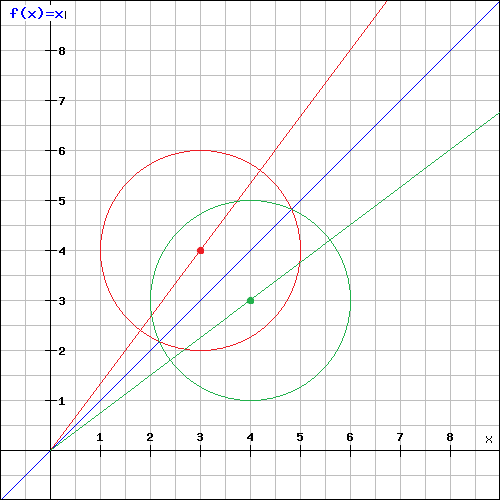
Attachment:
Untitled.png
Not sufficient.

(2) The circle intersects the x-axis at two different positive coordinates. This implies that the distance from the center to the x-axis is less than the radius:
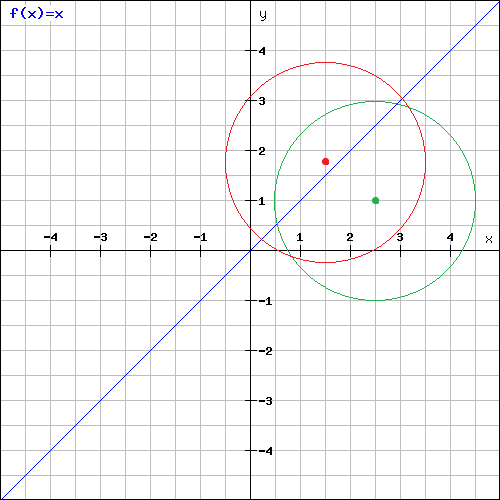
Attachment:
Untitled2.png
Not sufficient.

(1)+(2) We know that the center is either in I or IV quadrant. We also know that the x coordinate of the center is greater than the radius of this circle and the distance from the center to the x-axis is less than the radius. This implies that the center is below line y=x, which means that the slope of a line passing origin and the center is less than 1. Sufficient.

Answer: C.

Hi Bunuel,

As always great explanation, Just one question you said as the center is below line y=x , means that slope of a line is less than 1 how do you come to that conclusion??

I am sorry I am weak in Co-ordinate geometry so pardon me if I am missing any basic Formulae for Slope ..

Regards,
Abhinav
User avatar
amitbharadwaj7
Joined: 01 Sep 2012
Last visit: 23 Aug 2014
Posts: 39
Own Kudos:
Given Kudos: 60
Status:Joining Cranfield Sep 2014
Concentration: Technology, General Management
GMAT 1: 530 Q50 V14
GMAT 2: 630 Q48 V29
WE:Engineering (Energy)
Products:
GMAT 2: 630 Q48 V29
Posts: 39
Kudos: 159
Kudos
Add Kudos
Bookmarks
Bookmark this Post
abhinav11
Bunuel
A circle is drawn on a coordinate plane. If a line is drawn through the origin and the center of that circle, is the line’s slope less than 1?

(1) No point on the circle has a negative x-coordinate. This implies that the center of the circle is either in I or IV quadrant AND the x coordinate of the center is greater than the radius of this circle. Still not sufficient. Consider the cases below:
Attachment:
Untitled.png
Not sufficient.

(2) The circle intersects the x-axis at two different positive coordinates. This implies that the distance from the center to the x-axis is less than the radius:
Attachment:
Untitled2.png
Not sufficient.

(1)+(2) We know that the center is either in I or IV quadrant. We also know that the x coordinate of the center is greater than the radius of this circle and the distance from the center to the x-axis is less than the radius. This implies that the center is below line y=x, which means that the slope of a line passing origin and the center is less than 1. Sufficient.

Answer: C.

Hi Bunuel,

As always great explanation, Just one question you said as the center is below line y=x , means that slope of a line is less than 1 how do you come to that conclusion??

I am sorry I am weak in Co-ordinate geometry so pardon me if I am missing any basic Formulae for Slope ..

Regards,
Abhinav

Dear Abhinav;

The standard equation of the line is y= mx + c, It is given that the line passes through origin, so coordinate will be (0, 0). To satisfy the condition given i.e. (0,0), you will find the modified equation as y= mx

now the question is asking whether m < 1.

if you assume m=1, you will find a straight line y = x, you will find this line bisects (45 deg) the first quadrant, try to solve the question by drawing, you will understand it much better. in equation y = x, each value of y is equal to x

Now coming to question, for m to be less than 1, if you shift the center of circle below the line y= x, then in new equation of line y=mx, for every value of y, you will have greater corresponding value of x, which indeed is the condition we are looking for y / x < 1.

Similarly, if you shift the center of circle above the line y=x, then in new equation of line y=mx, for every value of y, you will lower corresponding value of x.

If you did not get what I am trying to explain, try to draw this and you will understand.
User avatar
bsahil
Joined: 23 Dec 2012
Last visit: 13 May 2014
Posts: 32
Own Kudos:
Given Kudos: 42
Status:Waiting for Decisions
Location: India
Sahil: Bansal
GMAT 1: 570 Q49 V20
GMAT 2: 690 Q49 V34
GPA: 3
WE:Information Technology (Computer Software)
GMAT 2: 690 Q49 V34
Posts: 32
Kudos: 219
Kudos
Add Kudos
Bookmarks
Bookmark this Post
Bunuel
A circle is drawn on a coordinate plane. If a line is drawn through the origin and the center of that circle, is the line’s slope less than 1?

(1) No point on the circle has a negative x-coordinate. This implies that the center of the circle is either in I or IV quadrant AND the x coordinate of the center is greater than the radius of this circle. Still not sufficient. Consider the cases below:
Attachment:
Untitled.png
Not sufficient.

(2) The circle intersects the x-axis at two different positive coordinates. This implies that the distance from the center to the x-axis is less than the radius:
Attachment:
Untitled2.png
Not sufficient.

(1)+(2) We know that the center is either in I or IV quadrant. We also know that the x coordinate of the center is greater than the radius of this circle and the distance from the center to the x-axis is less than the radius. This implies that the center is below line y=x, which means that the slope of a line passing origin and the center is less than 1. Sufficient.

Answer: C.


Hi Bunuel,

Please explain the point " the x coordinate of the center is greater than the radius of this circle", which you have derived from statement 1

Thanks,
Sahil
User avatar
anu1706
Joined: 15 Jul 2012
Last visit: 13 Jun 2020
Posts: 34
Own Kudos:
Given Kudos: 7
Posts: 34
Kudos: 116
Kudos
Add Kudos
Bookmarks
Bookmark this Post
Bunuel
A circle is drawn on a coordinate plane. If a line is drawn through the origin and the center of that circle, is the line’s slope less than 1?

(1) No point on the circle has a negative x-coordinate. This implies that the center of the circle is either in I or IV quadrant AND the x coordinate of the center is greater than the radius of this circle. Still not sufficient. Consider the cases below:
Attachment:
Untitled.png
Not sufficient.

(2) The circle intersects the x-axis at two different positive coordinates. This implies that the distance from the center to the x-axis is less than the radius:
Attachment:
Untitled2.png
Not sufficient.

(1)+(2) We know that the center is either in I or IV quadrant. We also know that the x coordinate of the center is greater than the radius of this circle and the distance from the center to the x-axis is less than the radius. This implies that the center is below line y=x, which means that the slope of a line passing origin and the center is less than 1. Sufficient.

Answer: C.

Can this be proven algebracilly, Second I have not understood your statement "AND the x coordinate of the center is greater than the radius of this circle". and also this statement ". This implies that the distance from the center to the x-axis is less than the radius"
Please help and tell how to approach the problem as there will be no graphs available in the test...
User avatar
anu1706
Joined: 15 Jul 2012
Last visit: 13 Jun 2020
Posts: 34
Own Kudos:
Given Kudos: 7
Posts: 34
Kudos: 116
Kudos
Add Kudos
Bookmarks
Bookmark this Post
A circle is drawn on a coordinate plane. If a line is drawn through the origin and the center of that circle, is the line’s slope less than 1?

(1) No point on the circle has a negative x-coordinate.

(2) The circle intersects the x-axis at two different positive coordinates.

Can this be proven algebraically, Second I have not understood your statement "AND the x coordinate of the center is greater than the radius of this circle". and also this statement ". This implies that the distance from the center to the x-axis is less than the radius"
Please help and tell how to approach the problem….
avatar
AIMGMAT770
Joined: 10 Aug 2013
Last visit: 12 Jul 2024
Posts: 11
Own Kudos:
Given Kudos: 2
Location: United States
Posts: 11
Kudos: 158
Kudos
Add Kudos
Bookmarks
Bookmark this Post
Bunuel
A circle is drawn on a coordinate plane. If a line is drawn through the origin and the center of that circle, is the line’s slope less than 1?

(1) No point on the circle has a negative x-coordinate. This implies that the center of the circle is either in I or IV quadrant AND the x coordinate of the center is greater than the radius of this circle. Still not sufficient. Consider the cases below:
Attachment:
Untitled.png
Not sufficient.

(2) The circle intersects the x-axis at two different positive coordinates. This implies that the distance from the center to the x-axis is less than the radius:
Attachment:
Untitled2.png
Not sufficient.

(1)+(2) We know that the center is either in I or IV quadrant. We also know that the x coordinate of the center is greater than the radius of this circle and the distance from the center to the x-axis is less than the radius. This implies that the center is below line y=x, which means that the slope of a line passing origin and the center is less than 1. Sufficient.

Answer: C.

Is there any other way of doing this question.When I'm considering both together.I am not able to confidently visualize it.
avatar
Pranjal3107
avatar
Current Student
Joined: 13 Apr 2020
Last visit: 06 Jul 2022
Posts: 133
Own Kudos:
Given Kudos: 1,709
Location: India
GMAT 1: 710 Q45 V41
GPA: 3
GMAT 1: 710 Q45 V41
Posts: 133
Kudos: 18
Kudos
Add Kudos
Bookmarks
Bookmark this Post
anu1706
Bunuel
A circle is drawn on a coordinate plane. If a line is drawn through the origin and the center of that circle, is the line’s slope less than 1?

(1) No point on the circle has a negative x-coordinate. This implies that the center of the circle is either in I or IV quadrant AND the x coordinate of the center is greater than the radius of this circle. Still not sufficient. Consider the cases below:
Attachment:
Untitled.png
Not sufficient.

(2) The circle intersects the x-axis at two different positive coordinates. This implies that the distance from the center to the x-axis is less than the radius:
Attachment:
Untitled2.png
Not sufficient.

(1)+(2) We know that the center is either in I or IV quadrant. We also know that the x coordinate of the center is greater than the radius of this circle and the distance from the center to the x-axis is less than the radius. This implies that the center is below line y=x, which means that the slope of a line passing origin and the center is less than 1. Sufficient.

Answer: C.

Can this be proven algebracilly, Second I have not understood your statement "AND the x coordinate of the center is greater than the radius of this circle". and also this statement ". This implies that the distance from the center to the x-axis is less than the radius"
Please help and tell how to approach the problem as there will be no graphs available in the test...


I also have the same doubts. Can someone please explain ?
User avatar
Sneha2021
Joined: 20 Dec 2020
Last visit: 10 Jun 2025
Posts: 294
Own Kudos:
Given Kudos: 522
Location: India
Posts: 294
Kudos: 38
Kudos
Add Kudos
Bookmarks
Bookmark this Post
I will try to explain why (1)+(2) is sufficient
Let take a,b coordinate of the center of the circle
If the line has slope = 1, this means a=b (slope = b/a). The only case when a=b when the circle touches both x and y axis.
To satisfy both statements, the circle must have two x-intercepts, and must either be tangent to the y-axis or not intersect the y-axis at all.
1st Case - In which the circle is tangent to the y-axis—the value of a is equal to the circle’s radius, but the value of b is less than the radius. That is, a > b so the line’s slope b/a must be less than 1.
2nd Case - a is greater than the circle’s radius, while b is still less than that radius. Therefore, the slope b/a is also less than 1 in this case.
The slope has to be less than 1 in all cases satisfying both statements.
User avatar
frankgraves
Joined: 15 Dec 2020
Last visit: 10 Sep 2021
Posts: 33
Own Kudos:
Given Kudos: 19
Posts: 33
Kudos: 21
Kudos
Add Kudos
Bookmarks
Bookmark this Post
I just got it, "slope less than 1" means the same with "gradient of the line is less than that of y=x".
Thanks Bunuel !
avatar
ChiaLee
Joined: 20 Jun 2021
Last visit: 20 Sep 2024
Posts: 1
Given Kudos: 160
Posts: 1
Kudos: 0
Kudos
Add Kudos
Bookmarks
Bookmark this Post
Hi Bunuel!

Can you please explain what these highlighted parts mean? How do you come to these conclusions? I am unable to solve this question.

Thanks.

[quote="Bunuel"]A circle is drawn on a coordinate plane. If a line is drawn through the origin and the center of that circle, is the line’s slope less than 1?

(1) No point on the circle has a negative x-coordinate. This implies that the center of the circle is either in I or IV quadrant AND the x coordinate of the center is greater than the radius of this circle. Still not sufficient. Consider the cases below:


Not sufficient.

(2) The circle intersects the x-axis at two different positive coordinates. This implies that the distance from the center to the x-axis is less than the radius


Not sufficient.

(1)+(2) We know that the center is either in I or IV quadrant. We also know that the x coordinate of the center is greater than the radius of this circle and the distance from the center to the x-axis is less than the radius. This implies that the center is below line y=x, which means that the slope of a line passing origin and the center is less than 1. Sufficient.

Answer: C.
 1   2   
Moderators:
Math Expert
109763 posts
498 posts
212 posts