Events & Promotions
|
|

GMAT Club Daily Prep
Thank you for using the timer - this advanced tool can estimate your performance and suggest more practice questions. We have subscribed you to Daily Prep Questions via email.
Customized
for You
Track
Your Progress
Practice
Pays
Not interested in getting valuable practice questions and articles delivered to your email? No problem, unsubscribe here.
 Sep 27
01:30 AM EDT
-02:30 AM EDT
At one point, she believed GMAT wasn’t for her. After scoring 595, self-doubt crept in and she questioned her potential. But instead of quitting, she made the right strategic changes. The result? A remarkable comeback to 695. Check out how Saakshi did it. Sep 26
12:30 AM EDT
-01:30 AM EDT
Struggling to find the right strategies to score a 99 %ile on GMAT Focus? Riya (GMAT 715) boosted her score by 100-points in just 15 days! Discover how the right mentorship, tailored strategies, and an unwavering mindset can transform your GMAT prep. Sep 26
06:00 PM PDT
-07:00 PM PDT
Free- full-length test + 15 concept videos + 150+ short videos + study plan! Sep 28
07:00 PM EDT
-10:00 PM EDT
Boost your GMAT score in less than one month in a live online class + 6 months access to TTP OnDemand video courses included! Class starts Mon, Tues, Wed, Thur, Fri Sept. 28, 2026 - Oct. 16, 2027, 7:00pm-10:00pm EST Sep 29
11:00 AM EDT
-01:00 PM EDT
" Description: Top scores are possible when you enroll in a powerful GMAT course, taught live online + 6 months access to TTP OnDemand video courses included! Class starts Tues/Thur Sept. 29, 2026 - Dec. 3, 2026, 11:00am-1:00pm EST Oct 01
07:00 AM BST
-08:00 AM GMT
Welcome to the GMAT Club's Free Interview Prep Event for Top MBA Programs! Buy tickets - Virtual series that’s all set to equip you to -excel in your MBA interviews. Oct 03
01:00 PM EDT
-04:00 PM EDT
Top scores are possible when you enroll in a powerful GMAT course, taught live online + 6 months access to TTP OnDemand video courses included! Class starts Saturdays Oct. 3, 2026 - Dec. 26, 2026, 1:00pm-4:00pm EST

 09 Mar 2024, 12:01
Kudos
Bookmarks
Question 1


D
Be sure to select an answer first to save it in the Error Log before revealing the correct answer (OA)!
Difficulty:
 45%
(medium)
45%
(medium)
Question Stats:
59% (02:35) correct 41%
(02:52) wrong
based on 1525
sessions
41%
(02:52) wrong
based on 1525
sessions
History
Date
Time
Result
Not Attempted Yet
Question 2
B
Be sure to select an answer first to save it in the Error Log before revealing the correct answer (OA)!
Difficulty:
25%
(medium)
Question Stats:
70% (01:04) correct 30%
(01:11) wrong
based on 1517
sessions
History
Date
Time
Result
Not Attempted Yet
Question 3
A
Be sure to select an answer first to save it in the Error Log before revealing the correct answer (OA)!
Difficulty:
 95%
(hard)
95%
(hard)
Question Stats:
35% (01:35) correct 65%
(01:44) wrong
based on 1455
sessions
History
Date
Time
Result
Not Attempted Yet
GMAT-Club-Forum-flqxt1ty.png [ 127.69 KiB | Viewed 7622 times ]
GMAT-Club-Forum-olewkkaq.png [ 55.26 KiB | Viewed 7620 times ]

GMAT-Club-Forum-locgsjli.png [ 69.53 KiB | Viewed 7642 times ]
GMAT-Club-Forum-kgpeo31n.png [ 50.4 KiB | Viewed 7613 times ]
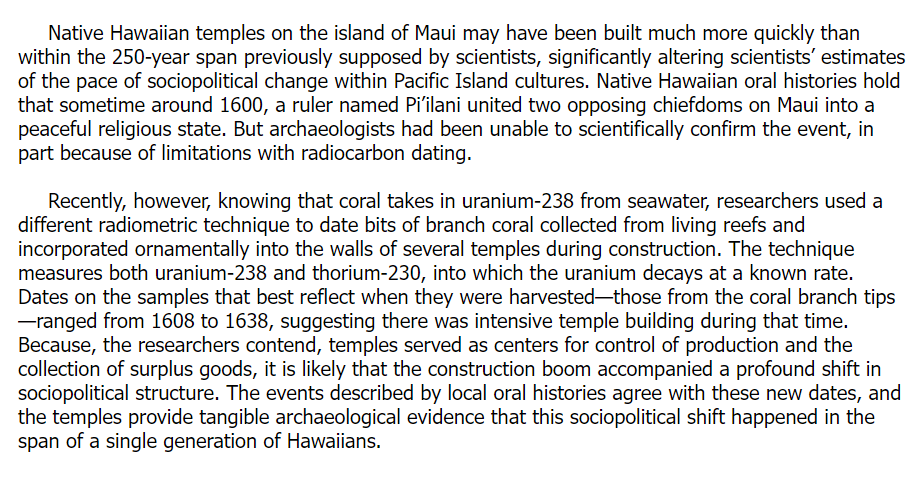
Native Hawaiian temples on the island of Maui may have been built much more quickly than within the 250-year span previously supposed by scientists, significantly altering scientists’ estimates of the pace of sociopolitical change within Pacific Island cultures. Native Hawaiian oral histories hold that sometime around 1600, a ruler named Pi’ilani united two opposing chiefdoms on Maui into a peaceful religious state. But archaeologists had been unable to scientifically confirm the event, in part because of limitations with radiocarbon dating.
Recently, however, knowing that coral takes in uranium-238 from seawater, researchers used a different radiometric technique to date bits of branch coral collected from living reefs and incorporated ornamentally into the walls of several temples during construction. The technique measures both uranium-238 and thorium-230, into which the uranium decays at a known rate. Dates on the samples that best reflect when they were harvested—those from the coral branch tips —ranged from 1608 to 1638, suggesting there was intensive temple building during that time. Because, the researchers contend, temples served as centers for control of production and the collection of surplus goods, it is likely that the construction boom accompanied a profound shift in sociopolitical structure. The events described by local oral histories agree with these new dates, and the temples provide tangible archaeological evidence that this sociopolitical shift happened in the span of a single generation of Hawaiians.
Recently, however, knowing that coral takes in uranium-238 from seawater, researchers used a different radiometric technique to date bits of branch coral collected from living reefs and incorporated ornamentally into the walls of several temples during construction. The technique measures both uranium-238 and thorium-230, into which the uranium decays at a known rate. Dates on the samples that best reflect when they were harvested—those from the coral branch tips —ranged from 1608 to 1638, suggesting there was intensive temple building during that time. Because, the researchers contend, temples served as centers for control of production and the collection of surplus goods, it is likely that the construction boom accompanied a profound shift in sociopolitical structure. The events described by local oral histories agree with these new dates, and the temples provide tangible archaeological evidence that this sociopolitical shift happened in the span of a single generation of Hawaiians.
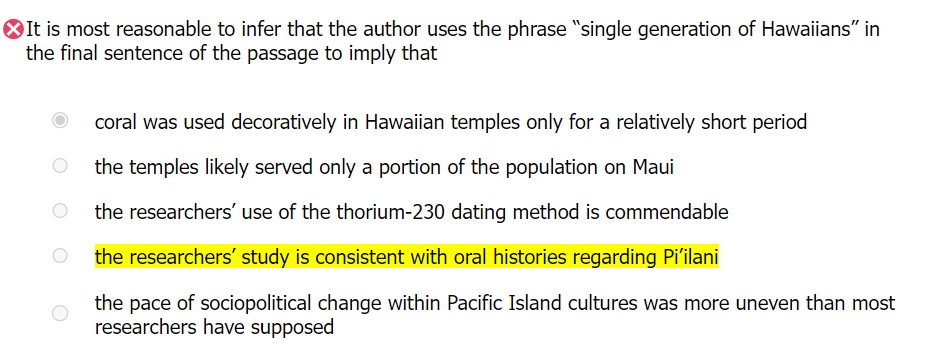
1. It is most reasonable to infer that the author uses the phrase "single generation of Hawaiians" in the final sentence of the passage to imply that
A. coral was used decoratively in Hawaiian temples only for a relatively short period
B. the temples likely served only a portion of the population on Maui
C. the researchers’ use of the thorium-230 dating method is commendable
D. the researchers’ study is consistent with oral histories regarding Pi’ilani
E. the pace of sociopolitical change within Pacific Island cultures was more uneven than most researchers have supposed
A. coral was used decoratively in Hawaiian temples only for a relatively short period
B. the temples likely served only a portion of the population on Maui
C. the researchers’ use of the thorium-230 dating method is commendable
D. the researchers’ study is consistent with oral histories regarding Pi’ilani
E. the pace of sociopolitical change within Pacific Island cultures was more uneven than most researchers have supposed
2. Which of the following most accurately expresses the main point of the passage?
A. New evidence found by researchers demonstrates that the sociopolitical reforms in a particular region were short lived.
B. Recent scientific research supports oral histories and has improved scientists’ understanding of human history in a particular region.
C. Oral histories in a particular region have prompted researchers to question previous research into the sociopolitical history of the region.
D. Researchers searching for new evidence regarding the history of social change in a particular region have turned to oral histories from the region.
E. Researchers are using an innovative dating technique to study the social history of a particular region.
A. New evidence found by researchers demonstrates that the sociopolitical reforms in a particular region were short lived.
B. Recent scientific research supports oral histories and has improved scientists’ understanding of human history in a particular region.
C. Oral histories in a particular region have prompted researchers to question previous research into the sociopolitical history of the region.
D. Researchers searching for new evidence regarding the history of social change in a particular region have turned to oral histories from the region.
E. Researchers are using an innovative dating technique to study the social history of a particular region.
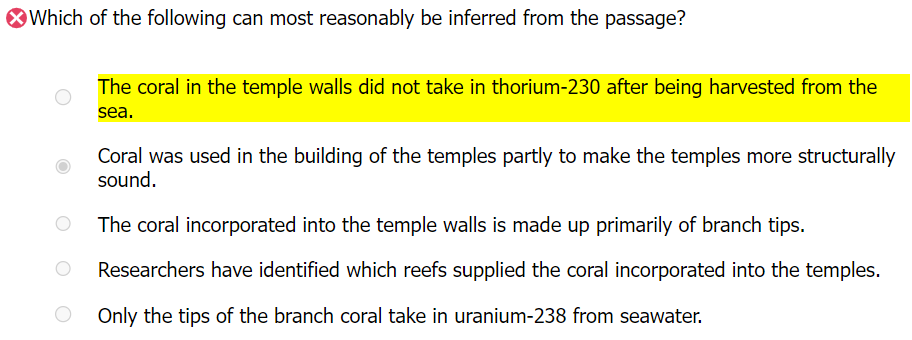
3. Which of the following can most reasonably be inferred from the passage?
A. The coral in the temple walls did not take in thorium-230 after being harvested from the sea.
B. Coral was used in the building of the temples partly to make the temples more structurally sound.
C. The coral incorporated into the temple walls is made up primarily of branch tips.
D. Researchers have identified which reefs supplied the coral incorporated into the temples.
E. Only the tips of the branch coral take in uranium-238 from seawater.
A. The coral in the temple walls did not take in thorium-230 after being harvested from the sea.
B. Coral was used in the building of the temples partly to make the temples more structurally sound.
C. The coral incorporated into the temple walls is made up primarily of branch tips.
D. Researchers have identified which reefs supplied the coral incorporated into the temples.
E. Only the tips of the branch coral take in uranium-238 from seawater.
Attachment:
GMAT-Club-Forum-flqxt1ty.png [ 127.69 KiB | Viewed 7622 times ]
Attachment:
GMAT-Club-Forum-olewkkaq.png [ 55.26 KiB | Viewed 7620 times ]
Attachment:
GMAT-Club-Forum-locgsjli.png [ 69.53 KiB | Viewed 7642 times ]
Attachment:
GMAT-Club-Forum-kgpeo31n.png [ 50.4 KiB | Viewed 7613 times ]
Trying to understand why the right answer is right?
GMAT Club Tests explanations walk through concepts, shortcuts, and common traps on many questions.
See how →


Question 3
Quote:
We're told that the coral takes in uranium-238 from seawater and that the uranium decays into thorium-230. There's nothing in the passage suggesting that coral takes in thorium-230 directly, either before or after harvesting.
Is it possible that the coral in the temple walls DID take in thorium-230 after being harvested from the sea? Sure. There's nothing in the passage to prove that it didn't. But if that were in fact the case, why would the researchers use a radiometric dating technique that relies on thorium-230 measurements?
And again, we're told that the thorium-230 comes from the uranium, so (A) is reasonable to infer and should be kept.
More importantly, we can eliminate the other options. Here, have another:
Quote:
We're told that bits of branch coral were incorporated ornamentally into the temple walls, but the passage doesn't say anything about using the coral for a structural purpose. (B) is out.
Quote:
The branch tips were used by the researcher because those are the samples whose dates "best reflect when they were harvested".
But that doesn't tell us anything about the relative proportion of coral branch tips to other coral parts used in the temple walls. For all we know, branch tips represented only a small proportion of the coral used. Regardless, the researchers used the branch tips because -- for whatever reason -- the harvest dating of the branch tips is more reliable. (C) is out.
Quote:
The passage doesn't say anything about identifying the specific living reefs that supplied the coral found in the temple walls, so (D) is out.
Quote:
Again, the branch tips were used by researchers because they yield the most accurate harvest dates. That doesn't mean that the other parts of the coral do NOT take in uranium-238. Maybe they do, maybe they don't. But the passage doesn't tell us either way, so (E) is out.
(A) is the best option.
Question 1
Question 1 asks why the author included a particular detail of the passage. To understand this kind of thing, it's important to look at the bigger picture. Why did the author write each paragraph, and the passage as a whole? Answering this will allow you to see the purpose of a smaller detail.
So, why did the author write each paragraph?
In the first paragraph, the author suggests that a longish timeline of temple-building may be wrong, but says that scientists haven't been able to confirm one way or the other. Perhaps the 250-year span of temple building is incorrect, and the actual timeline matches up with oral reports of a big change sometime around 1600. We just don't know.
In the second paragraph, the author provides evidence to confirm the shorter timeline, which matches up with oral reports from the native population.
With this bigger picture in mind, why did the author use the phrase "single generation of Hawaiians" in the final line? Well, a single generation is a short period of time. So, this language is there to show that the new studies and the oral histories match up well -- both indicate that the changes occurred within a short period of time.
That aligns nicely with (D): "the researchers’ study is consistent with oral histories regarding Pi’ilani."
(D) is the correct answer to question 1.
I hope that helps!