Last visit was: 20 Apr 2026, 19:12 It is currently 20 Apr 2026, 19:12
Close
GMAT Club Daily Prep
Thank you for using the timer - this advanced tool can estimate your performance and suggest more practice questions. We have subscribed you to Daily Prep Questions via email.

Customized
for You

we will pick new questions that match your level based on your Timer History

Track
Your Progress

every week, we’ll send you an estimated GMAT score based on your performance

Practice
Pays

we will pick new questions that match your level based on your Timer History
Not interested in getting valuable practice questions and articles delivered to your email? No problem, unsubscribe here.
Close
Request Expert Reply
Confirm Cancel
User avatar
Dream009
Joined: 05 Nov 2024
Last visit: 13 Mar 2026
Posts: 276
Own Kudos:
98
 [8]
Given Kudos: 60
Location: India
Concentration: Strategy, Leadership
GMAT Focus 1: 615 Q82 V79 DI80
GRE 1: Q30 V50
GPA: 84
WE:General Management (Consulting)
Products:
GMAT Focus 1: 615 Q82 V79 DI80
GRE 1: Q30 V50
Posts: 276
Kudos: 98
 [8]
3
Kudos
Add Kudos
5
Bookmarks
Bookmark this Post
User avatar
Dream009
Joined: 05 Nov 2024
Last visit: 13 Mar 2026
Posts: 276
Own Kudos:
98
 [2]
Given Kudos: 60
Location: India
Concentration: Strategy, Leadership
GMAT Focus 1: 615 Q82 V79 DI80
GRE 1: Q30 V50
GPA: 84
WE:General Management (Consulting)
Products:
GMAT Focus 1: 615 Q82 V79 DI80
GRE 1: Q30 V50
Posts: 276
Kudos: 98
 [2]
2
Kudos
Add Kudos
Bookmarks
Bookmark this Post
User avatar
backlogger
Joined: 29 Sep 2025
Last visit: 19 Nov 2025
Posts: 1
Own Kudos:
3
 [3]
Posts: 1
Kudos: 3
 [3]
3
Kudos
Add Kudos
Bookmarks
Bookmark this Post
User avatar
Mehta17
Joined: 08 Oct 2024
Last visit: 04 Jan 2026
Posts: 17
Own Kudos:
10
 [1]
Given Kudos: 41
Posts: 17
Kudos: 10
 [1]
1
Kudos
Add Kudos
Bookmarks
Bookmark this Post
first highlighted part can be treated as finding (as in newspaper) vs judgement
User avatar
riri3026
Joined: 28 Apr 2024
Last visit: 29 Mar 2026
Posts: 21
Own Kudos:
6
 [1]
Given Kudos: 32
Posts: 21
Kudos: 6
 [1]
1
Kudos
Add Kudos
Bookmarks
Bookmark this Post
I was really confused between options A and E.

Can someone help me understand the difference between A. The first is a position that the argument as a whole seeks to oppose; and E. The first is a finding whose implication is the issue in the argument; ?
As the latter parts of the question are same, this is where the confusion lies.
avatar
Akshat_verma_25
Joined: 26 Jan 2024
Last visit: 18 Apr 2026
Posts: 69
Own Kudos:
Given Kudos: 62
Products:
Posts: 69
Kudos: 59
Kudos
Add Kudos
Bookmarks
Bookmark this Post
Last statement is main conclusion, eliminate BCD, now A and E, argument is not opposing its position, hence we get E as correct answer.
User avatar
Vaidehi06surya
Joined: 07 Feb 2025
Last visit: 08 Oct 2025
Posts: 5
Own Kudos:
1
 [1]
Given Kudos: 3
Posts: 5
Kudos: 1
 [1]
1
Kudos
Add Kudos
Bookmarks
Bookmark this Post
can you tell me why its not a judgement (D)but only the main conclusion (E)
avatar
Akshat_verma_25
Joined: 26 Jan 2024
Last visit: 18 Apr 2026
Posts: 69
Own Kudos:
59
 [1]
Given Kudos: 62
Products:
Posts: 69
Kudos: 59
 [1]
1
Kudos
Add Kudos
Bookmarks
Bookmark this Post
Some arguments are more complex and contain more than one conclusion. In this case, the first bolded statement — “I don’t see the point in these Pemberley real estate advertisements in London newspapers” — is clearly an opinion by Mr. P. The last statement — “These real estate advertisements are certainly a waste of money” — is also an opinion.

For these kinds of arguments, I like to use the Because–Therefore test: Because _____, therefore ____.

Now, let’s apply it to the two statements and see which one works as the main conclusion:
  1. Because “I don’t see the point in these Pemberley real estate advertisements in London newspapers,” therefore “These real estate advertisements are certainly a waste of money.”
    – This seems to follow the author’s line of reasoning more naturally.
  2. Because “These real estate advertisements are certainly a waste of money,” therefore “I don’t see the point in these Pemberley real estate advertisements in London newspapers.”
    – I feel skeptical about this one.

Hence, the main conclusion of this argument is: “These real estate advertisements are certainly a waste of money.”
Now, let’s tackle the answer choices. I can quickly eliminate B, C, and E because in those, the second bolded statement is not treated as the main conclusion. Coming to option A: “The first is a position that the argument opposes.” Honestly, that doesn’t fit at all. The whole point of the argument is that Mr. P is criticizing the advertising strategy — saying they’re wasting money and advertising in the wrong place.

So, by process of elimination, I’d select E as the correct answer.
One might argue that it’s not explicitly stated whether the first statement is a secondary conclusion, but that’s fine by me. Maybe the test maker wants to see if I’ll get confused or if I’ll stick to logical analysis and arrive at the correct answer.

Vaidehi06surya
can you tell me why its not a judgement (D)but only the main conclusion (E)
User avatar
egmat
User avatar
e-GMAT Representative
Joined: 02 Nov 2011
Last visit: 11 Apr 2026
Posts: 5,632
Own Kudos:
33,427
 [3]
Given Kudos: 707
GMAT Date: 08-19-2020
Expert
Expert reply
Active GMAT Club Expert! Tag them with @ followed by their username for a faster response.
Posts: 5,632
Kudos: 33,427
 [3]
2
Kudos
Add Kudos
1
Bookmarks
Bookmark this Post
riri3026
I was really confused between options A and E.

Can someone help me understand the difference between A. The first is a position that the argument as a whole seeks to oppose; and E. The first is a finding whose implication is the issue in the argument; ?
As the latter parts of the question are same, this is where the confusion lies.
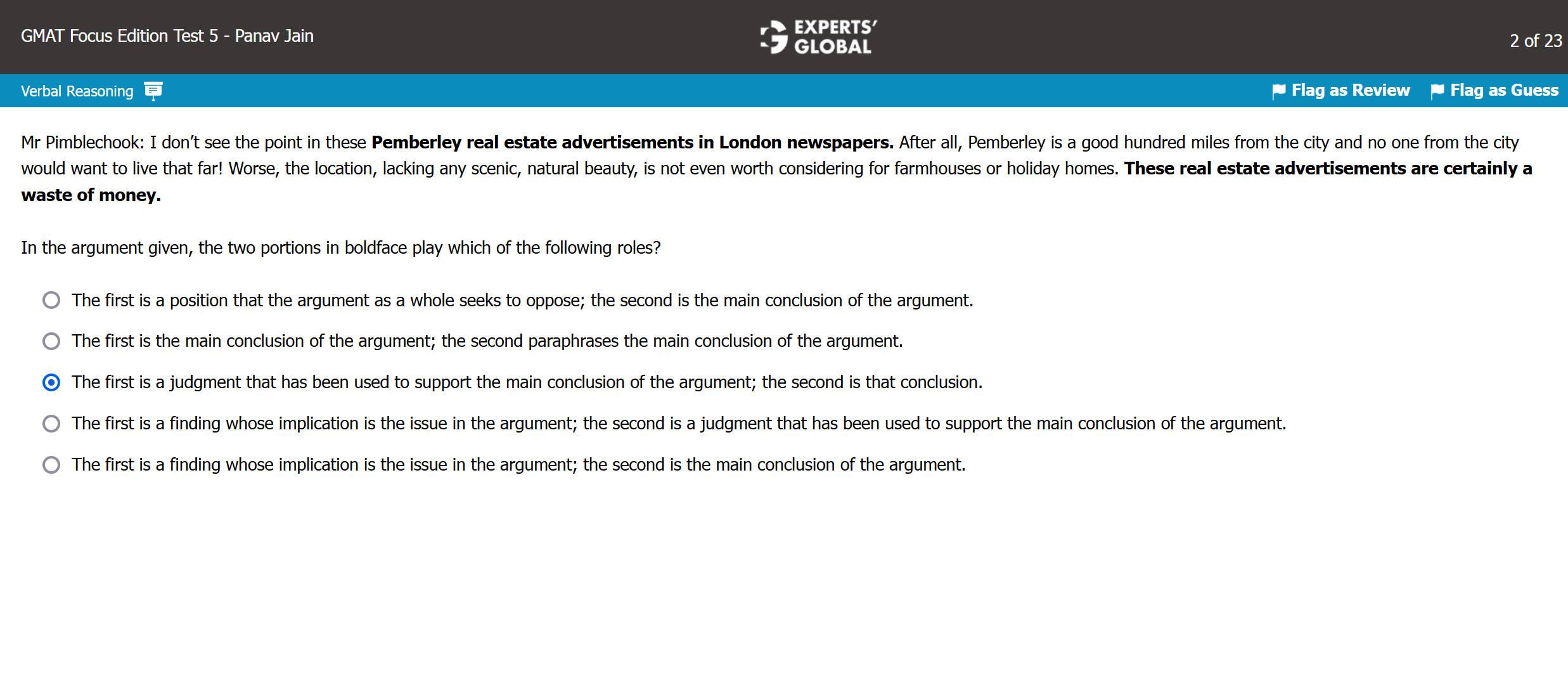
riri3026 Good question. I am sure this can confuse a lot of students. Here is what they mean:

Option A: "a position that the argument seeks to oppose"
This would mean the first boldface itself states a claim or viewpoint that Mr. Pimblechook is arguing against.

Option E: "a finding whose implication is the issue in the argument"
This means the first boldface identifies a fact or observation, and the argument discusses what this fact means or whether it's worthwhile.

Applying This to the Argument:

Look at the first boldface: "Pemberley real estate advertisements in London newspapers"

  • Is this stating a position/claim? No—it's simply identifying what exists (the advertisements are there)
  • Is Mr. Pimblechook opposing the advertisements themselves? No—he's questioning their value/usefulness
  • What's the actual issue being debated? Whether these advertisements are worthwhile (their implication/consequence)

Why E is Correct:
The first boldface is a finding (observation that these ads exist), and the implication (Are they worth the money? Will they work?) is exactly what Mr. Pimblechook addresses. The second is clearly the main conclusion: "certainly a waste of money."

I hope this addresses your doubt. I suggest you practice similar boldface questions here (you'll find many OG questions) - select Boldface under Critical Reasoning and choose Easy/Medium level questions to master these subtle distinctions.
User avatar
amoeba99
Joined: 19 Feb 2025
Last visit: 18 Apr 2026
Posts: 31
Own Kudos:
Given Kudos: 21
Location: India
GMAT Focus 1: 755 Q90 V89 DI84
GPA: 7.95
GMAT Focus 1: 755 Q90 V89 DI84
Posts: 31
Kudos: 8
Kudos
Add Kudos
Bookmarks
Bookmark this Post
I am not able to agree to the main conclusion given here. The main conclusion should be "I don't see the point ..." and "These real estate advertisements are certainly a waste one money" supports the former. I am not sure how I am wrong.
User avatar
egmat
User avatar
e-GMAT Representative
Joined: 02 Nov 2011
Last visit: 11 Apr 2026
Posts: 5,632
Own Kudos:
Given Kudos: 707
GMAT Date: 08-19-2020
Expert
Expert reply
Active GMAT Club Expert! Tag them with @ followed by their username for a faster response.
Posts: 5,632
Kudos: 33,427
Kudos
Add Kudos
Bookmarks
Bookmark this Post
amoeba99
I am not able to agree to the main conclusion given here. The main conclusion should be "I don't see the point ..." and "These real estate advertisements are certainly a waste one money" supports the former. I am not sure how I am wrong.
amoeba99 The first boldface is just identifying the subject/topic being discussed – it's a finding or fact (that these advertisements exist), not a claim or conclusion.

The second boldface is: "These real estate advertisements are certainly a waste of money"

This is the main conclusion of the argument – the definitive judgment Mr. Pimblechook is making.

Understanding the Argument Structure:

  1. Topic Introduction: "I don't see the point in these [first boldface: Pemberley real estate advertisements in London newspapers]" – The speaker introduces the subject and expresses initial skepticism
  2. Supporting Evidence: "After all, Pemberley is 100 miles away... no one would want to live that far... lacking scenic beauty..." – These are the reasons supporting the conclusion
  3. Main Conclusion: "[second boldface: These real estate advertisements are certainly a waste of money]" – This is the final, definitive judgment

Do you see why the first sentence could not be the main conclusion? It is just setting the context to the main conclusion which is the last statement.

Let me know if you still feel confused!
User avatar
Dream009
Joined: 05 Nov 2024
Last visit: 13 Mar 2026
Posts: 276
Own Kudos:
Given Kudos: 60
Location: India
Concentration: Strategy, Leadership
GMAT Focus 1: 615 Q82 V79 DI80
GRE 1: Q30 V50
GPA: 84
WE:General Management (Consulting)
Products:
GMAT Focus 1: 615 Q82 V79 DI80
GRE 1: Q30 V50
Posts: 276
Kudos: 98
Kudos
Add Kudos
Bookmarks
Bookmark this Post
Option C also states that statement 2 is the conclusion then on what basis did you eliminate it. B/w C & E - I was more inclined towards C since it seems to be a judgement and not finding. What if there is some-other data which also needs to assess. The author is only making a claim basis his thinking so its a judgement.
Akshat_verma_25
Some arguments are more complex and contain more than one conclusion. In this case, the first bolded statement — “I don’t see the point in these Pemberley real estate advertisements in London newspapers” — is clearly an opinion by Mr. P. The last statement — “These real estate advertisements are certainly a waste of money” — is also an opinion.

For these kinds of arguments, I like to use the Because–Therefore test: Because _____, therefore ____.

Now, let’s apply it to the two statements and see which one works as the main conclusion:
  1. Because “I don’t see the point in these Pemberley real estate advertisements in London newspapers,” therefore “These real estate advertisements are certainly a waste of money.”
    – This seems to follow the author’s line of reasoning more naturally.
  2. Because “These real estate advertisements are certainly a waste of money,” therefore “I don’t see the point in these Pemberley real estate advertisements in London newspapers.”
    – I feel skeptical about this one.

Hence, the main conclusion of this argument is: “These real estate advertisements are certainly a waste of money.”
Now, let’s tackle the answer choices. I can quickly eliminate B, C, and E because in those, the second bolded statement is not treated as the main conclusion. Coming to option A: “The first is a position that the argument opposes.” Honestly, that doesn’t fit at all. The whole point of the argument is that Mr. P is criticizing the advertising strategy — saying they’re wasting money and advertising in the wrong place.

So, by process of elimination, I’d select E as the correct answer.
One might argue that it’s not explicitly stated whether the first statement is a secondary conclusion, but that’s fine by me. Maybe the test maker wants to see if I’ll get confused or if I’ll stick to logical analysis and arrive at the correct answer.


User avatar
yashhw
Joined: 08 Jan 2025
Last visit: 20 Apr 2026
Posts: 8
Given Kudos: 95
Products:
Posts: 8
Kudos: 0
Kudos
Add Kudos
Bookmarks
Bookmark this Post
egmat

I have a follow-up question, when evaluating a boldfaced portion, do we consider the broader directional flow of the argument it belongs to, or do we assess only the bolded text at face value?
For instance, if the entire first sentence were boldfaced rather than just 'Pemberley real estate advertisements in London newspapers,' would our analysis be any different? I still get the sense that, viewed as a complete sentence, it expresses more than a mere finding, it carries an element of judgement.
Could you please help clarify this? Much appreciated!
egmat

amoeba99 The first boldface is just identifying the subject/topic being discussed – it's a finding or fact (that these advertisements exist), not a claim or conclusion.

The second boldface is: "These real estate advertisements are certainly a waste of money"

This is the main conclusion of the argument – the definitive judgment Mr. Pimblechook is making.

Understanding the Argument Structure:

  1. Topic Introduction: "I don't see the point in these [first boldface: Pemberley real estate advertisements in London newspapers]" – The speaker introduces the subject and expresses initial skepticism
  2. Supporting Evidence: "After all, Pemberley is 100 miles away... no one would want to live that far... lacking scenic beauty..." – These are the reasons supporting the conclusion
  3. Main Conclusion: "[second boldface: These real estate advertisements are certainly a waste of money]" – This is the final, definitive judgment

Do you see why the first sentence could not be the main conclusion? It is just setting the context to the main conclusion which is the last statement.

Let me know if you still feel confused!
User avatar
AbhishekP220108
Joined: 04 Aug 2024
Last visit: 20 Apr 2026
Posts: 494
Own Kudos:
Given Kudos: 135
GMAT Focus 1: 555 Q81 V78 DI74
Products:
GMAT Focus 1: 555 Q81 V78 DI74
Posts: 494
Kudos: 209
Kudos
Add Kudos
Bookmarks
Bookmark this Post
Hi yashhw

The very first step is to understand how each line is used and what role each plays in the argument. Then we have to identify what is the main conclusion. Since we have already understood how the argument is structured we can assign the role and the direction in comparison to main conclusion and then evaluate the option choice.

Secondly yes, if the entire 1st line has been bolded then role would have changed as you identified.

Hope this helps

yashhw
egmat

I have a follow-up question, when evaluating a boldfaced portion, do we consider the broader directional flow of the argument it belongs to, or do we assess only the bolded text at face value?
For instance, if the entire first sentence were boldfaced rather than just 'Pemberley real estate advertisements in London newspapers,' would our analysis be any different? I still get the sense that, viewed as a complete sentence, it expresses more than a mere finding, it carries an element of judgement.
Could you please help clarify this? Much appreciated!
Moderators:
GMAT Club Verbal Expert
7391 posts
494 posts
358 posts