Events & Promotions
| Last visit was: 27 Sep 2026, 02:46 |
It is currently 27 Sep 2026, 02:46 |
|
|

GMAT Club Daily Prep
Thank you for using the timer - this advanced tool can estimate your performance and suggest more practice questions. We have subscribed you to Daily Prep Questions via email.
Customized
for You
Track
Your Progress
Practice
Pays
Not interested in getting valuable practice questions and articles delivered to your email? No problem, unsubscribe here.
 Sep 28
07:00 PM EDT
-10:00 PM EDT
Boost your GMAT score in less than one month in a live online class + 6 months access to TTP OnDemand video courses included! Class starts Mon, Tues, Wed, Thur, Fri Sept. 28, 2026 - Oct. 16, 2027, 7:00pm-10:00pm EST Sep 29
11:00 AM EDT
-01:00 PM EDT
" Description: Top scores are possible when you enroll in a powerful GMAT course, taught live online + 6 months access to TTP OnDemand video courses included! Class starts Tues/Thur Sept. 29, 2026 - Dec. 3, 2026, 11:00am-1:00pm EST Oct 01
07:00 AM BST
-08:00 AM GMT
Welcome to the GMAT Club's Free Interview Prep Event for Top MBA Programs! Buy tickets - Virtual series that’s all set to equip you to -excel in your MBA interviews. Oct 03
01:00 PM EDT
-04:00 PM EDT
Top scores are possible when you enroll in a powerful GMAT course, taught live online + 6 months access to TTP OnDemand video courses included! Class starts Saturdays Oct. 3, 2026 - Dec. 26, 2026, 1:00pm-4:00pm EST

 Updated on: 13 Dec 2018, 04:18
Originally posted by vjsharma25 on 22 Mar 2011, 04:37.
Last edited by Bunuel on 13 Dec 2018, 04:18, edited 2 times in total.
Last edited by Bunuel on 13 Dec 2018, 04:18, edited 2 times in total.
Renamed the topic and edited the question.
Kudos
Bookmarks


B
Be sure to select an answer first to save it in the Error Log before revealing the correct answer (OA)!
Difficulty:
 55%
(hard)
55%
(hard)
Question Stats:
64% (02:02) correct 36%
(02:09)
wrong
based on 1435
sessions
36%
(02:09)
wrong
based on 1435
sessions
History
Date
Time
Result
Not Attempted Yet
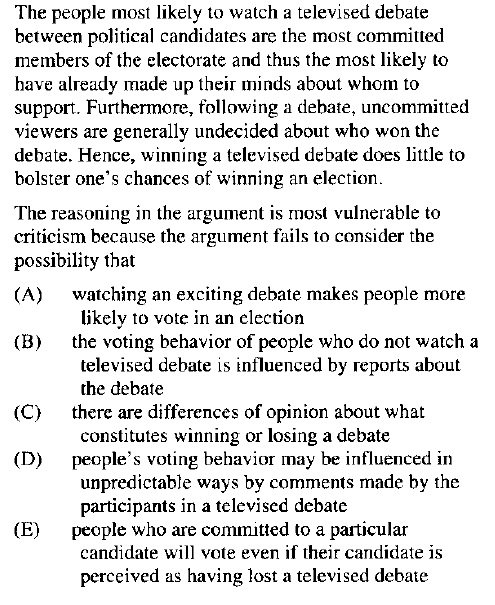
The people most likely to watch a televised debate between political candidates are the most committed members of the electorate and thus the most likely to have already made up their minds about whom to support. Furthermore, following a debate, uncommitted viewers are generally undecided about who won the debate. Hence, winning a televised debate does little to bolster ones chances of winning an election.
The reasoning in the argument is most vulnerable to criticism because the argument fails to consider the possibility that
(A) watching an exciting debate makes people more likely to vote in an election
(B) the voting behavior of people who do not watch a televised debate is influenced by reports about the debate
(C) there are differences of opinion about what constitutes winning or losing a debate
(D) peoples voting behavior may be influenced in unpredictable ways by comments made by the participants in a televised debate
(E) people who are committed to a particular candidate will vote even if their candidate is perceived as having lost a televised debate
television.jpg [ 155.38 KiB | Viewed 15339 times ]
The reasoning in the argument is most vulnerable to criticism because the argument fails to consider the possibility that
(A) watching an exciting debate makes people more likely to vote in an election
(B) the voting behavior of people who do not watch a televised debate is influenced by reports about the debate
(C) there are differences of opinion about what constitutes winning or losing a debate
(D) peoples voting behavior may be influenced in unpredictable ways by comments made by the participants in a televised debate
(E) people who are committed to a particular candidate will vote even if their candidate is perceived as having lost a televised debate
Attachment:
television.jpg [ 155.38 KiB | Viewed 15339 times ]
 21 Dec 2018, 04:21
Kudos
Bookmarks
vjsharma25
One of those questions in which focusing on the conclusion is extremely important (I admit it is important in most questions!)
Premises:
People most likely to watch the debate are those who have already made up their mind (so candidate wins/loses is irrelevant to them)
Uncommitted viewers are generally undecided about who won the debate. So winning doesn't lead to these viewers voting for the winning candidate.
Conclusion: Winning a televised debate does little to bolster ones chances of winning an election.
We need to weaken it. The conclusion says winning debate doesn't do much to increase chances of winning the election. We need to show how "winning the debate could increase one's chances of winning the election". What is it that we failed to consider? What is it that shows that "winning the debate could increase one's chances of winning the election".
(A) watching an exciting debate makes people more likely to vote in an election
We are talking about the people who watched the debate. If they were committed, they already knew who to vote for. If they were uncommitted, they couldn't figure out who won. Hence, even if more of them vote, will they vote for the winning candidate, we can't say. Either they were already committed or couldn't make out who won. So winning doesn't help.
(B) the voting behavior of people who do not watch a televised debate is influenced by reports about the debate.
Ok, so there are reports about the debate and win/loss. The voting behaviour of people who do not watch the debate could be influenced by publishing of a win. Hence, winning could help tilt the scale in the winner's favour. So winning could increase chances of winning the election. Correct.
(C) there are differences of opinion about what constitutes winning or losing a debate
Whether winning is tightly defined is irrelevant. Anyway, the argument says winning doesn't help. So this option doesn't say that winning helps.
(D) peoples voting behavior may be influenced in unpredictable ways by comments made by the participants in a televised debate
Here is the trick in this option - unpredictable ways by comments. This option says that comments (whether winner makes or loser is irrelevant) could make people behave in an unpredictable manner (whether they vote for winner or not, we cannot say). Hence, it doesn't say that "winning the debate" could help in any way.
(E) people who are committed to a particular candidate will vote even if their candidate is perceived as having lost a televised debate
This essentially says what the argument says. Hence it doesn't weaken the argument.
Answer (B)
General Discussion
 23 Mar 2011, 01:00
Kudos
Bookmarks
It's D!
The argument fails to consider that people who are committed to a particular candidate can change their vote due to unforeseen circumstances!
The argument fails to consider that people who are committed to a particular candidate can change their vote due to unforeseen circumstances!
25 May 2012, 21:45
Kudos
Bookmarks
I discarded B because it talks of people not watching the debate. The passage is more about the people watching the debate. New Information is added that provides the current analysis wrong. Good Question.


 )
) CORRECT.