Events & Promotions
|
|

GMAT Club Daily Prep
Thank you for using the timer - this advanced tool can estimate your performance and suggest more practice questions. We have subscribed you to Daily Prep Questions via email.
Customized
for You
Track
Your Progress
Practice
Pays
Not interested in getting valuable practice questions and articles delivered to your email? No problem, unsubscribe here.
 Sep 21
07:00 PM EDT
-10:00 PM EDT
Boost your GMAT score in less than one month in a live online class + 6 months access to TTP OnDemand video courses included! Sep 18
10:00 AM IST
-11:00 PM IST
Start your journey with a fully customized action plan and work with a dedicated mentor to achieve a 735+ score. Sep 20
03:30 AM EDT
-04:30 AM EDT
Looking for your GMAT motivation to break through the score plateau? Pragati improved her score by massive 160 points with strategic guidance and hard-work! Find out how personalized mentorship and a strong mindset can turn GMAT struggles into success. Sep 23
12:30 AM EDT
-01:30 AM EDT
Learn how Keshav, a Chartered Accountant, scored an impressive 705 on GMAT in just 30 days with GMATWhiz's expert guidance. In this video, he shares preparation tips and strategies that worked for him, including the mock, time management, and more Sep 26
01:00 PM EDT
-04:00 PM EDT
Top scores are possible when you enroll in a powerful GMAT course, taught live online + 6 months access to TTP OnDemand video courses included. Class starts Saturdays Sept. 26, 2026 - Dec. 19, 2026, 1:00pm-4:00pm ES Sep 26
06:00 PM PDT
-07:00 PM PDT
Free- full-length test + 15 concept videos + 150+ short videos + study plan!


D
Be sure to select an answer first to save it in the Error Log before revealing the correct answer (OA)!
Difficulty:
 5%
(low)
5%
(low)
Question Stats:
88% (01:16) correct 12%
(01:42)
wrong
based on 8557
sessions
12%
(01:42)
wrong
based on 8557
sessions
History
Date
Time
Result
Not Attempted Yet
Because no employee wants to be associated with bad news in the eyes of a superior, information about serious problems at lower levels is progressively softened and distorted as it goes up each step in the management hierarchy. The chief executive is therefore, less well informed about problems at lower levels than are his or her subordinates at those levels.
The conclusion drawn above is based on the assumption that
(A) problems should be solved at levels in the management hierarchy at which they occur
(B) employees should be rewarded for accurately reporting problems to their superiors
(C) problems-solving ability is more important at higher levels than it is at lower levels of the management hierarchy
(D) chief executives obtain information about problems at lower levels from no source other than their subordinates
(E) some employees are more concerned about truth than about the way they are perceived by their superiors
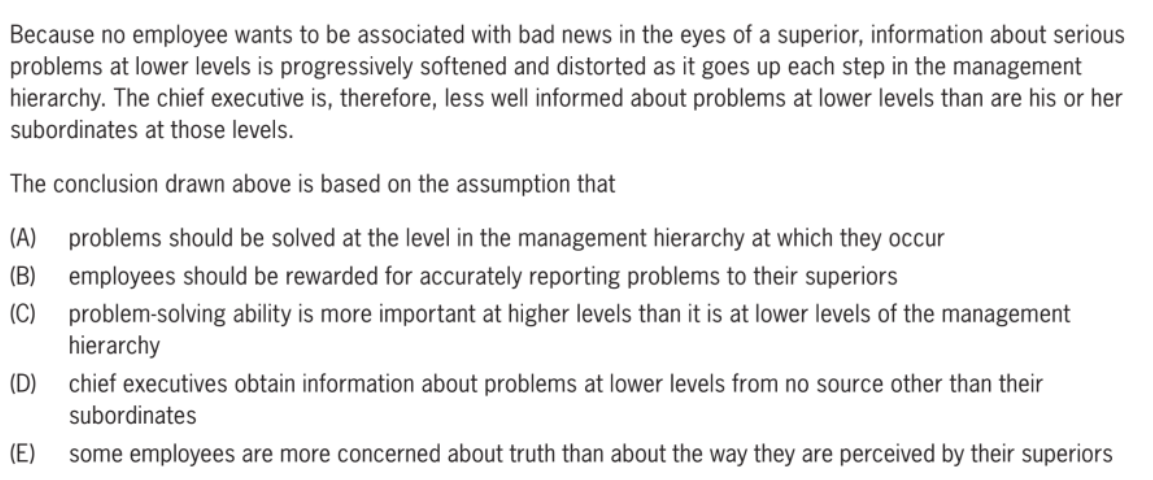
guys i find answer choice D as the most appropriate But i want to know the type of assumption it is and also how d can be the assumption. 
GMAT-Club-Forum-46wvxdf9.png [ 241.33 KiB | Viewed 7780 times ]
The conclusion drawn above is based on the assumption that
(A) problems should be solved at levels in the management hierarchy at which they occur
(B) employees should be rewarded for accurately reporting problems to their superiors
(C) problems-solving ability is more important at higher levels than it is at lower levels of the management hierarchy
(D) chief executives obtain information about problems at lower levels from no source other than their subordinates
(E) some employees are more concerned about truth than about the way they are perceived by their superiors
guys i find answer choice D as the most appropriate But i want to know the type of assumption it is and also how d can be the assumption.
Attachment:
GMAT-Club-Forum-46wvxdf9.png [ 241.33 KiB | Viewed 7780 times ]

 03 Feb 2013, 19:15
Kudos
Bookmarks
Aristocrat
Hi,
The first step in the process is understanding the passage or drawing a logical structure. The argument structure is of the form A->B->C. Let's draw it:
No employee wants to be associated with bad news in the eyes of a superior ------------>>>> information about serious problems at lower levels is progressively softened and distorted as it goes up each step in the management hierarchy ----------------->>>>>>> the chief executive is less well informed about problems at lower levels than are his or her subordinates at those levels.
Does the argument make sense? It says that employees don't want to be associated with bad news; so, they distort the bad news when they report to higher levels. Now, this means that chief executive would be less well informed about problems than his juniors (this is because the distortion in information increase as the information travels up the heirarchy).
Now, in these kind of causal arguments A->B: we need to consider all the statements which could break this relationship and negation of such statements would be assumption (since our conclusion is that the relation A->B holds, so anything which prevents such relationship, we assume it not to be true)
Now, if you can pre-think an assumption in this case, do it; if not, just move on to the options. However, for understanding purpose, let's see how prethinking can be done here:
Is there a way chief executive knows as well as his juniors even though information is distorted as it travels up?
The answer could be that if he has some other source of information than his immediate juniors. In this case, he'll probably know as well or better than his juniors.
Therefore the assumption for the conclusion to hold, would be that Chief executive has no other source of information than his juniors.
This is what is expressed by option D, which is the correct choice.
Hope this helps

Thanks,
Chiranjeev
 29 Aug 2011, 05:33
Kudos
Bookmarks
Because no employee wants to be associated with bad news in the eyes of a superior, information about serious problems at lower levels is progressively softened and distorted as it goes up each step in the management hierarchy. the chief executive is therefore, less well informed about problems at lower levels than are his or her subordinates at those levels.
The conclusion drawn above is based on the assumption that
a) problems should be solved at levels in the management hierarchy at which they occur
b) employees should be rewarded for accurately reporting problems to their superiors
c) problems-solving ability is more important at higher levels than it is at lower levels of the management hierarchy
d) chief executives obtain information about problems at lower levels from the no source other than their subordinates
e) some employees are more are concerned about truth than about the way they are perceived by their superiors
The assumption here is a logic gap assumption.
An assumption is what is absolutely necessary for the conclusion to be true. In short, an assumption is a hidden premise that bridges the gap between the premises and the conclusion.
See how the premises jump to the conclusion here.
Premise 1. No employee wants to be associated with bad news in the eyes of the superior.
Premise 2. Hence, information about serious problems at lower levels is softened and distorted as it goes up the management ladder.
Conclusion: the CEO is less well informed about the problems at lower level than the sub-ordinates at that levels.
Premises say that information is softened by sub-ordinates. Conclusion says that the CEO is less well informed that sub-ordinates. Does it not assume that CEO is not informed by any other means than his sub-ordinates?
Try negating the choice D. The conclusion falls apart.
Negating is a good test on assumption questions.
Lets have a look at other choices.
A - problem solving is not discussed in the argument. though this seems like a real world solution, it is not in the scope of the argument and by no means is the assumption made to reason.
B - same as A. it is a solution. not an assumption
C - this is a trap choice! this is NOT an assumption. this might be true but this is not an assumption. even if problem solving ability were not more important at higher levels, this argument would remain valid.
D - correct answer as discussed above.
E - this assumption actually weakening the conclusion by challenging the premises. Remember, in CR assumption questions the validity of premises and conclusion cannot be challenged unless the question asks for a flaw in reasoning in which the assumption is put in a negative light!!
The conclusion drawn above is based on the assumption that
a) problems should be solved at levels in the management hierarchy at which they occur
b) employees should be rewarded for accurately reporting problems to their superiors
c) problems-solving ability is more important at higher levels than it is at lower levels of the management hierarchy
d) chief executives obtain information about problems at lower levels from the no source other than their subordinates
e) some employees are more are concerned about truth than about the way they are perceived by their superiors
The assumption here is a logic gap assumption.
An assumption is what is absolutely necessary for the conclusion to be true. In short, an assumption is a hidden premise that bridges the gap between the premises and the conclusion.
See how the premises jump to the conclusion here.
Premise 1. No employee wants to be associated with bad news in the eyes of the superior.
Premise 2. Hence, information about serious problems at lower levels is softened and distorted as it goes up the management ladder.
Conclusion: the CEO is less well informed about the problems at lower level than the sub-ordinates at that levels.
Premises say that information is softened by sub-ordinates. Conclusion says that the CEO is less well informed that sub-ordinates. Does it not assume that CEO is not informed by any other means than his sub-ordinates?
Try negating the choice D. The conclusion falls apart.
Negating is a good test on assumption questions.
Lets have a look at other choices.
A - problem solving is not discussed in the argument. though this seems like a real world solution, it is not in the scope of the argument and by no means is the assumption made to reason.
B - same as A. it is a solution. not an assumption
C - this is a trap choice! this is NOT an assumption. this might be true but this is not an assumption. even if problem solving ability were not more important at higher levels, this argument would remain valid.
D - correct answer as discussed above.
E - this assumption actually weakening the conclusion by challenging the premises. Remember, in CR assumption questions the validity of premises and conclusion cannot be challenged unless the question asks for a flaw in reasoning in which the assumption is put in a negative light!!