Events & Promotions
|
|

GMAT Club Daily Prep
Thank you for using the timer - this advanced tool can estimate your performance and suggest more practice questions. We have subscribed you to Daily Prep Questions via email.
Customized
for You
Track
Your Progress
Practice
Pays
Not interested in getting valuable practice questions and articles delivered to your email? No problem, unsubscribe here.
 Sep 02
01:00 PM EDT
-11:59 PM EDT
Take 30% off all study plans with code COURSEWORK - Expires on Monday 9/7 Sep 03
01:30 AM EDT
-02:30 AM EDT
At one point, she believed GMAT wasn’t for her. After scoring 595, self-doubt crept in and she questioned her potential. But instead of quitting, she made the right strategic changes. The result? A remarkable comeback to 695. Check out how Saakshi did it. Sep 04
10:00 AM PDT
-11:00 AM PDT
What does test anxiety really look like on the GMAT? For many test takers, it does not look like a panic attack. Instead, it shows up as brain fog, rereading, negative comparisons, mental noise.... Sep 06
09:30 AM EDT
-12:30 PM EST
Top scores are possible when you enroll in a powerful EA course, taught live online + 6 months access to TTP OnDemand video courses included! Perfect class schedule and easy course access for working professionals. Class starts Sundays Sept. 6, 2026.- Sep 07
12:01 AM PDT
-11:59 PM PDT
On the 7th, GMAT Club Tests will be Free! Including all the Quizzes, Questions, and Tests. 12 AM - 11:59 PM PDT  Sep 07
12:30 AM EDT
-01:30 AM EDT
Tejas studied hard but kept repeating the same mistakes. After 3 attempts at 645, a focused 4-week strategy helped him identify and fix what was holding him back—leading to a 695 with just 12–15 hours of study per week.- Sep 09
07:00 AM PDT
-10:00 AM PDT
Meet AdComs and explore top Master’s programs - MiM, MiF, MSc, MSBA and more. - Application Fee Waivers - Free 1-Week of GMAT Club Tests: - Master's Application Toolkit - Grand Prize Giveaway  Sep 15
07:00 PM EDT
-09:00 PM EST
Elite scores are possible when you enroll in a powerful GMAT course, taught live online + 6 months access to TTP OnDemand video courses included! Class starts Tues/Thurs Sept. 15, 2026 - Nov. 15, 2027, 7:00pm-9:00pm EST Sep 21
08:00 PM EDT
-10:00 PM EDT
Boost your GMAT score in less than one month in a live online class + 6 months access to TTP OnDemand video courses included! Class starts Mon, Tues, Wed, Thur, Fri Sept. 21, 2026 - Oct. 9, 2027, 7:00pm-10:00pm EST


A
Be sure to select an answer first to save it in the Error Log before revealing the correct answer (OA)!
Difficulty:
 5%
(low)
5%
(low)
Question Stats:
90% (01:52) correct 10%
(02:21)
wrong
based on 647
sessions
10%
(02:21)
wrong
based on 647
sessions
History
Date
Time
Result
Not Attempted Yet
Of the 500 business people surveyed, 78 percent said that they use their laptop computers at home, 65 percent said that they use them in hotels, and 52 percent said that they use them both at home and in hotels. How many of the business people surveyed said that they do not use their laptop computers either at home or in hotels?
A. 45
B. 55
C. 65
D. 95
E. 130
PS11427
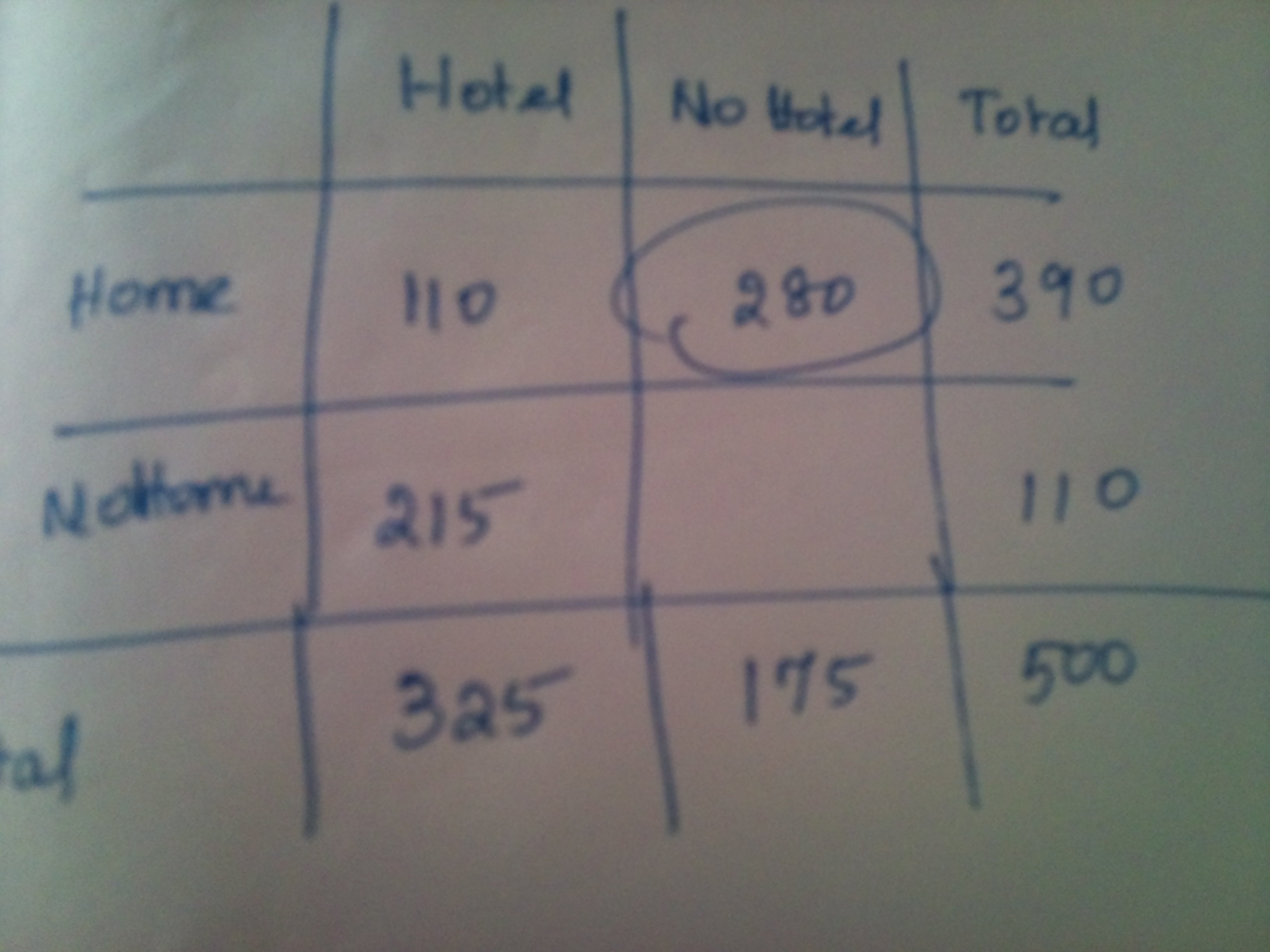
DSC_0112.jpg [ 3.01 MiB | Viewed 25834 times ]
Can somebody give the formula for this overlapping set problem?
P(AUB) = P(A)+P(B)-P(A intersection B)
I tried to use the domain matrix learnt from MGMAT. But somewhere I am going wrong, can someone help?
A. 45
B. 55
C. 65
D. 95
E. 130
PS11427
Attachment:
DSC_0112.jpg [ 3.01 MiB | Viewed 25834 times ]
Can somebody give the formula for this overlapping set problem?
P(AUB) = P(A)+P(B)-P(A intersection B)
I tried to use the domain matrix learnt from MGMAT. But somewhere I am going wrong, can someone help?
Solving this question helps.
Taking a timed set of similar questions in
GMAT Club Forum Quiz →
is even better.

 23 Oct 2013, 15:40
Kudos
Bookmarks
I kept everything in percentage form since that is how the information was presented. I did not want to introduce calculations that could lead to an error.
I used the group formula:
Total = Group 1 + Group 2 - Both + Neither.
Using the formula above and the information we are given:
100% = 78% + 65% - 52% + Neither
100% = 91% + Neither or
Neither = 100% - 91% = 9%
The total here is 500 so we can multiply 9% with 500 to get the amount of business people who do no use their laptops at home or in hotels.
(9/100) * 500 = 45
All of the methods mentioned above work, but I hope someone finds this helpful too. We can never have too many ways to approach a problem.
I used the group formula:
Total = Group 1 + Group 2 - Both + Neither.
Using the formula above and the information we are given:
100% = 78% + 65% - 52% + Neither
100% = 91% + Neither or
Neither = 100% - 91% = 9%
The total here is 500 so we can multiply 9% with 500 to get the amount of business people who do no use their laptops at home or in hotels.
(9/100) * 500 = 45
All of the methods mentioned above work, but I hope someone finds this helpful too. We can never have too many ways to approach a problem.

 01 Dec 2012, 06:05
Kudos
Bookmarks
SreeViji
I guess you made a mathematical error. Personally, I prefer creating the matrix in percentages when the question is given in percentages. And finally multiply what I want with the total. However for illustration the matrix should be
Attachments
Untitled.png [ 9.56 KiB | Viewed 26285 times ]