Last visit was: 21 Apr 2026, 17:38 It is currently 21 Apr 2026, 17:38
Close
GMAT Club Daily Prep
Thank you for using the timer - this advanced tool can estimate your performance and suggest more practice questions. We have subscribed you to Daily Prep Questions via email.

Customized
for You

we will pick new questions that match your level based on your Timer History

Track
Your Progress

every week, we’ll send you an estimated GMAT score based on your performance

Practice
Pays

we will pick new questions that match your level based on your Timer History
Not interested in getting valuable practice questions and articles delivered to your email? No problem, unsubscribe here.
Close
Request Expert Reply
Confirm Cancel
User avatar
NeverSurrender
Joined: 17 Oct 2012
Last visit: 14 May 2016
Posts: 38
Own Kudos:
1,110
 [170]
Given Kudos: 8
Location: Canada
GMAT 1: 520 Q35 V26
GMAT 2: 670 Q48 V34
GMAT 2: 670 Q48 V34
Posts: 38
Kudos: 1,110
 [170]
21
Kudos
Add Kudos
149
Bookmarks
Bookmark this Post
Most Helpful Reply
User avatar
Bunuel
User avatar
Math Expert
Joined: 02 Sep 2009
Last visit: 21 Apr 2026
Posts: 109,728
Own Kudos:
Given Kudos: 105,800
Products:
Expert
Expert reply
Active GMAT Club Expert! Tag them with @ followed by their username for a faster response.
Posts: 109,728
Kudos: 810,468
 [42]
17
Kudos
Add Kudos
25
Bookmarks
Bookmark this Post
User avatar
maaadhu
Joined: 04 Apr 2013
Last visit: 16 Sep 2014
Posts: 96
Own Kudos:
194
 [29]
Given Kudos: 36
Posts: 96
Kudos: 194
 [29]
29
Kudos
Add Kudos
Bookmarks
Bookmark this Post
General Discussion
User avatar
Bunuel
User avatar
Math Expert
Joined: 02 Sep 2009
Last visit: 21 Apr 2026
Posts: 109,728
Own Kudos:
810,468
 [7]
Given Kudos: 105,800
Products:
Expert
Expert reply
Active GMAT Club Expert! Tag them with @ followed by their username for a faster response.
Posts: 109,728
Kudos: 810,468
 [7]
6
Kudos
Add Kudos
1
Bookmarks
Bookmark this Post
maaadhu
Bunuel
If a loan of P dollars, at an interest rate of r percent per year compounded monthly, is payable in n monthly installments of m dollars each, then m is determined by the formula
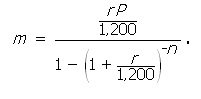
John and Sue took out loans whose monthly installments were determined by using the formula above. Both loans had the same interest rate and the same number of monthly installments. John's monthly installment was what percent of Sue's monthly installment?


Given that r and n are the same for John and Sue.

John's monthly installment was what percent of Sue's monthly installment? --> \(\frac{m_j}{m_j+m_s}=?\)

(1) The amount of Sue's loan was 4 times the amount of John's loan --> \(P_s=4*P_j\) --> \(\frac{m_j}{m_j+m_s}=\frac{P_j}{P_j+4P_j}=0.2\) (everything else get reduced). Sufficient.

(2) Sue's monthly installment was 4 times John's monthly installment --> \(\frac{m_j}{m_j+m_s}=\frac{m_j}{m_j+4m_j}=0.2\). Sufficient.


Answer: D.


Bunuel,

Isnt the question asking for

[ m(j)/m(s) ] * 100?
and thats 25%.

Please correct me if wrong

Yes, that's true. Though the solution would be almost the same.
User avatar
Qoofi
Joined: 18 Dec 2012
Last visit: 23 Feb 2024
Posts: 64
Own Kudos:
206
 [3]
Given Kudos: 56
Location: India
Concentration: General Management, Strategy
GMAT 1: 530 Q37 V25
GMAT 2: 660 Q49 V32
GPA: 3.32
WE:Manufacturing and Production (Manufacturing)
GMAT 2: 660 Q49 V32
Posts: 64
Kudos: 206
 [3]
3
Kudos
Add Kudos
Bookmarks
Bookmark this Post
Bunuel

Yes, that's true. Though the solution would be almost the same.

But the percentage value differs right ?
avatar
Chandni170
Joined: 29 Sep 2012
Last visit: 31 Mar 2015
Posts: 7
Own Kudos:
20
 [14]
Given Kudos: 1
Posts: 7
Kudos: 20
 [14]
11
Kudos
Add Kudos
3
Bookmarks
Bookmark this Post
Hi Bunuel,

Please could you explain how we deduced to mj/(mj + ms)? Although, I understand that it would essentially mean Mj's percentage contribution thereby giving Ms percent. But I wanted to understand the thought process/approach of coming to that.

Here's how I solved it. Let me know if there's any flaw:

Given: r and n are same. Therefore, the only value which may cause a difference in Mj and Ms is P (the loan amounts)

Questn stem: Mj is what percent of Ms? i.e. Mj/Ms=?

So I'm looking for either Pj and Ps or Mj and Ms itself.

St 1: Ps= 4Pj----> Will give me the ratio Mj:Ms--- SUFFICIENT

St 2: Ms= 4Mj----> Answers the questn stem directly---- SUFFICIENT

Answer D.

Thanks,
Chandni
User avatar
Mascarfi
Joined: 08 May 2015
Last visit: 05 Jul 2024
Posts: 65
Own Kudos:
297
 [2]
Given Kudos: 14
GMAT 1: 630 Q39 V38
GMAT 2: 670 Q44 V38
GMAT 3: 750 Q49 V44
GMAT 3: 750 Q49 V44
Posts: 65
Kudos: 297
 [2]
2
Kudos
Add Kudos
Bookmarks
Bookmark this Post
Correct me if i am wrong, but since it is asking for percent and it uses the same formula and states that the monthly installments are the same for both, you dont have to make any calculation. If you have the monthy installments relation you have the loan amount relation and vice-versa.

it does not matter here if it is compound or simple interest, you have the same interest formula and the same number of monthly installments for both John and Sue.

You have (in both 1 and 2) that Sue is 4 times John, so 1/4 = 25%, done...next question...
avatar
Kekki
Joined: 06 Aug 2015
Last visit: 15 Jun 2016
Posts: 4
Own Kudos:
14
 [10]
Given Kudos: 10
Posts: 4
Kudos: 14
 [10]
10
Kudos
Add Kudos
Bookmarks
Bookmark this Post
This question is made really confusing. It took me some time to figure out what they really were asking and what is given.

Once you figure it out, it's more a Sub-600 Level question. Basically everything is the same but amount or monthly installment is 4 times bigger -> which both make the monthly installment 4 times bigger.

I had some time pressure during the mock-test so I was just one click away of guessing this question because it seemed like some Level 800 question. Could see lot of people doing it to save some time. -> Note to myself: If GMAT tries to word the question harder, the calculus itself is mostly realtively easy. A easy looking, short, few words question, however, is likely to have a trap.
User avatar
minwoswoh
Joined: 10 May 2014
Last visit: 17 Nov 2021
Posts: 114
Own Kudos:
405
 [6]
Given Kudos: 28
Posts: 114
Kudos: 405
 [6]
5
Kudos
Add Kudos
1
Bookmarks
Bookmark this Post
Mascarfi
Correct me if i am wrong, but since it is asking for percent and it uses the same formula and states that the monthly installments are the same for both, you dont have to make any calculation. If you have the monthy installments relation you have the loan amount relation and vice-versa.

it does not matter here if it is compound or simple interest, you have the same interest formula and the same number of monthly installments for both John and Sue.

You have (in both 1 and 2) that Sue is 4 times John, so 1/4 = 25%, done...next question...
Hi Mascarfi,
Yes, you are correct. The interest rate and the number of monthly installments are the same for both John and Sue. The only difference is the principal of each person. Therefore, if the principal is different but the formula is the same, we can conclude that the monthly installment dollar amount will also be different for each person.
- Statement 1 gives you the answer in terms of principal
- Statement 2 gives you the answer in terms of monthly installment dollar amount.

The wording is unnecessarily cumbersome and the question stem displays an ugly formula just to scare you.
Once you understand what the question is really asking, I´d say this becomes a 600-level question that can be clearly solved under 2 minutes.

Cheers,
avatar
cfsm
Joined: 30 May 2016
Last visit: 14 Jun 2016
Posts: 1
Posts: 1
Kudos: 0
Kudos
Add Kudos
Bookmarks
Bookmark this Post
Does anyone have any tips for simplifying questions such as this? I look at this question, with so much going on, and it takes me well over 2 minutes of re-reading to even start to understand what is going on. Should i just register guesses on these types of questions on the GMAT, and move on?

Thanks
avatar
Nikademus
Joined: 13 Jun 2016
Last visit: 15 Aug 2016
Posts: 1
Own Kudos:
7
 [7]
Posts: 1
Kudos: 7
 [7]
6
Kudos
Add Kudos
1
Bookmarks
Bookmark this Post
The question is much much simpler then it looks like. It took me less then 10 seconds to solve it.

If you look at the question and the formula there are
- p with p1=Sue's loan, p2=John's loan
- Interest r
- Monthly installment n
- Installment m, m1 for Sue, m2 for John

The questions states explicitely that r and n are exactly the same, so f(p) = m depends solely on p in a linear way

=> f(p) = A * p with A = all the small details you really do not need to care about

(1) P1 = 4P2 => f(P1) = f(4*P2) = m1 = 4m2, sufficient to calculate 1/4=25% (not 20% as wrongly calculated above, but that doesn't really matter, as it is not asked)
(2) m1 of Sue = 4*m2 of John => Already the answer! Sufficent to calculate 1/4=25%

Answer is D, both are sufficient alone
avatar
heena.makhijani
Joined: 25 May 2016
Last visit: 20 Nov 2017
Posts: 2
Own Kudos:
Given Kudos: 28
GMAT 1: 570 Q44 V25
GMAT 1: 570 Q44 V25
Posts: 2
Kudos: 3
Kudos
Add Kudos
Bookmarks
Bookmark this Post
Nikademus
The question is much much simpler then it looks like. It took me less then 10 seconds to solve it.

If you look at the question and the formula there are
- p with p1=Sue's loan, p2=John's loan
- Interest r
- Monthly installment n
- Installment m, m1 for Sue, m2 for John

The questions states explicitely that r and n are exactly the same, so f(p) = m depends solely on p in a linear way

=> f(p) = A * p with A = all the small details you really do not need to care about

(1) P1 = 4P2 => f(P1) = f(4*P2) = m1 = 4m2, sufficient to calculate 1/4=25% (not 20% as wrongly calculated above, but that doesn't really matter, as it is not asked)
(2) m1 of Sue = 4*m2 of John => Already the answer! Sufficent to calculate 1/4=25%

Answer is D, both are sufficient alone


nice explanation!! this helped
User avatar
Cez005
Joined: 13 Dec 2013
Last visit: 11 Feb 2020
Posts: 92
Own Kudos:
Given Kudos: 122
Location: United States (NY)
Concentration: General Management, International Business
GMAT 1: 710 Q46 V41
GMAT 2: 720 Q48 V40
GPA: 4
WE:Consulting (Consulting)
Products:
GMAT 2: 720 Q48 V40
Posts: 92
Kudos: 148
Kudos
Add Kudos
Bookmarks
Bookmark this Post
P is the only variable since r and n are specified as constants.

1) Tells us that Ps (P for Sue) is 4* Pj (P for John). m for Sue = 4Pj. m for John = Pj. (Pj/4Pj)*100=25%

2) ms (monthly installment for Sue) is 4*mj (monthly installment for John). (mj/4mj)*100+25%

D


Agree?
avatar
Benacher07
Joined: 12 Jul 2016
Last visit: 15 Jul 2017
Posts: 16
Own Kudos:
15
 [1]
Given Kudos: 212
Posts: 16
Kudos: 15
 [1]
1
Kudos
Add Kudos
Bookmarks
Bookmark this Post
Using the formula and doing lengthy calculation is a waste of time since the only thing one should be aware of is that :
the first statement ables to get the answer by using the principal, while, the second allows do the same with the monthly installment amount
User avatar
energetics
Joined: 05 Feb 2018
Last visit: 09 Oct 2020
Posts: 294
Own Kudos:
Given Kudos: 325
Posts: 294
Kudos: 970
Kudos
Add Kudos
Bookmarks
Bookmark this Post
This question is just asking about ratios. The key point is that everything is the same except the total amount P, and the subsequent monthly (P/12). The ratio of both is the same.

1) Gives us the ratio of S total to J total as 4:1. S monthly to J monthly is thus also 4:1
2) Gives us the ratio of monthly to monthly, which is the reverse of 1)

I think this question is a good example of when doing any kind of calculation or manipulation is actually counterproductive... or doing much writing at all instead of just thinking about it.
User avatar
DarleneTran
Joined: 31 Dec 2017
Last visit: 30 Mar 2020
Posts: 50
Own Kudos:
Posts: 50
Kudos: 27
Kudos
Add Kudos
Bookmarks
Bookmark this Post
----Correct me if I am wrong-----
The formula looks a bit complicated and our focus will be shifted easily to this complication. Let's break down the the problem.
We have the same interest rate (r), the number of monthly installments (n)
-->The differences will be Principal (P) and values of monthly installments (m)
Question: mj/ms (John's values of monthly installments and Sue's values of monthly installments)

St1: Sue's principal is 4 times John's principal (Ps=4Pj)-->Suff
Because both m&P are in the same side of the ratio, so if P increase then m will increase.
St2: ms=4mj
The given info answer the question directly-->Suff

So the answer is D: both A&B are correct.
User avatar
GDT
Joined: 02 Jan 2020
Last visit: 18 Sep 2020
Posts: 233
Own Kudos:
Given Kudos: 477
Posts: 233
Kudos: 118
Kudos
Add Kudos
Bookmarks
Bookmark this Post
Bunuel
maaadhu
Bunuel
If a loan of P dollars, at an interest rate of r percent per year compounded monthly, is payable in n monthly installments of m dollars each, then m is determined by the formula

John and Sue took out loans whose monthly installments were determined by using the formula above. Both loans had the same interest rate and the same number of monthly installments. John's monthly installment was what percent of Sue's monthly installment?


Given that r and n are the same for John and Sue.

John's monthly installment was what percent of Sue's monthly installment? --> \(\frac{m_j}{m_j+m_s}=?\)

(1) The amount of Sue's loan was 4 times the amount of John's loan --> \(P_s=4*P_j\) --> \(\frac{m_j}{m_j+m_s}=\frac{P_j}{P_j+4P_j}=0.2\) (everything else get reduced). Sufficient.

(2) Sue's monthly installment was 4 times John's monthly installment --> \(\frac{m_j}{m_j+m_s}=\frac{m_j}{m_j+4m_j}=0.2\). Sufficient.


Answer: D.


Bunuel,

Isnt the question asking for

[ m(j)/m(s) ] * 100?
and thats 25%.

Please correct me if wrong

Yes, that's true. Though the solution would be almost the same.

VeritasKarishma, MentorTutoring

Can you pls clarify what Bunuel meant here in saying that solution would be almost same

Though, this is a DS question where we just need to look for sufficiency, if it were a PS question then 25% would be the answer

Kindly help with this
Thanks in advance!
avatar
AndrewN
avatar
Volunteer Expert
Joined: 16 May 2019
Last visit: 29 Mar 2025
Posts: 3,490
Own Kudos:
7,660
 [1]
Given Kudos: 500
Expert
Expert reply
Posts: 3,490
Kudos: 7,660
 [1]
Kudos
Add Kudos
1
Bookmarks
Bookmark this Post
GDT
Bunuel
maaadhu
Bunuel
If a loan of P dollars, at an interest rate of r percent per year compounded monthly, is payable in n monthly installments of m dollars each, then m is determined by the formula

John and Sue took out loans whose monthly installments were determined by using the formula above. Both loans had the same interest rate and the same number of monthly installments. John's monthly installment was what percent of Sue's monthly installment?


Given that r and n are the same for John and Sue.

John's monthly installment was what percent of Sue's monthly installment? --> \(\frac{m_j}{m_j+m_s}=?\)

(1) The amount of Sue's loan was 4 times the amount of John's loan --> \(P_s=4*P_j\) --> \(\frac{m_j}{m_j+m_s}=\frac{P_j}{P_j+4P_j}=0.2\) (everything else get reduced). Sufficient.

(2) Sue's monthly installment was 4 times John's monthly installment --> \(\frac{m_j}{m_j+m_s}=\frac{m_j}{m_j+4m_j}=0.2\). Sufficient.


Answer: D.


Bunuel,

Isnt the question asking for

[ m(j)/m(s) ] * 100?
and thats 25%.

Please correct me if wrong

Yes, that's true. Though the solution would be almost the same.

VeritasKarishma, MentorTutoring

Can you pls clarify what Bunuel meant here in saying that solution would be almost same

Though, this is a DS question where we just need to look for sufficiency, if it were a PS question then 25% would be the answer

Kindly help with this
Thanks in advance!
Hello, GDT. I cannot speak for Bunuel, but the math checks out just fine. It appears as if the solution offered answers the question, John's monthly installment was what percent of the combined monthly installment? John pays 1 part in 5, since Sue's payment is 4 times John's, so the J:S payment ratio is 1:4. Yes, the answer would be 25% in a PS question, although I will be honest and say that I was not worried about calculating an exact answer here. That is, if r and n are both constant, since they would represent the same values for John and Sue, that leaves only P or m as variables to consider, or those that can be manipulated. Statement (1) tells us about P, allowing us to potentially solve the equation for m, while statement (2) tells us about m instead. This was a pretty quick (D) (although I cannot boast a speed read and sub-10-second answer, as someone claimed above).

Thank you for tagging me, and good luck with your studies.

- Andrew
User avatar
ueh55406
Joined: 19 Dec 2020
Last visit: 31 Aug 2021
Posts: 146
Own Kudos:
Given Kudos: 316
Posts: 146
Kudos: 50
Kudos
Add Kudos
Bookmarks
Bookmark this Post
I believe the best (and fast) way is to just write the formula on the pad and look at what values are changing, of course the constants in the formula won't change in either of the two, John and Sue, cases. so, the catch is to find what will change between in either of the two cases.

the rate for both is given to be the same, and the number of months for which they paid their premium or whatever are equal as well. so, the only "variable" changing are 'm" (installed paid each month in dollars) and "P" (amount of loan taken) once you have that this becomes a 10 sec question.
User avatar
bumpbot
User avatar
Non-Human User
Joined: 09 Sep 2013
Last visit: 04 Jan 2021
Posts: 38,956
Own Kudos:
Posts: 38,956
Kudos: 1,117
Kudos
Add Kudos
Bookmarks
Bookmark this Post
Automated notice from GMAT Club BumpBot:

A member just gave Kudos to this thread, showing it’s still useful. I’ve bumped it to the top so more people can benefit. Feel free to add your own questions or solutions.

This post was generated automatically.
Moderators:
Math Expert
109728 posts
498 posts
211 posts