Last visit was: 21 Apr 2026, 00:52 It is currently 21 Apr 2026, 00:52
Close
GMAT Club Daily Prep
Thank you for using the timer - this advanced tool can estimate your performance and suggest more practice questions. We have subscribed you to Daily Prep Questions via email.

Customized
for You

we will pick new questions that match your level based on your Timer History

Track
Your Progress

every week, we’ll send you an estimated GMAT score based on your performance

Practice
Pays

we will pick new questions that match your level based on your Timer History
Not interested in getting valuable practice questions and articles delivered to your email? No problem, unsubscribe here.
Close
Request Expert Reply
Confirm Cancel
User avatar
EgmatQuantExpert
User avatar
e-GMAT Representative
Joined: 04 Jan 2015
Last visit: 02 Apr 2024
Posts: 3,657
Own Kudos:
20,857
 [52]
Given Kudos: 165
Expert
Expert reply
Posts: 3,657
Kudos: 20,857
 [52]
7
Kudos
Add Kudos
45
Bookmarks
Bookmark this Post
Most Helpful Reply
User avatar
EgmatQuantExpert
User avatar
e-GMAT Representative
Joined: 04 Jan 2015
Last visit: 02 Apr 2024
Posts: 3,657
Own Kudos:
20,857
 [8]
Given Kudos: 165
Expert
Expert reply
Posts: 3,657
Kudos: 20,857
 [8]
2
Kudos
Add Kudos
6
Bookmarks
Bookmark this Post
General Discussion
User avatar
abhimahna
User avatar
Board of Directors
Joined: 18 Jul 2015
Last visit: 06 Jul 2024
Posts: 3,481
Own Kudos:
5,779
 [3]
Given Kudos: 346
Status:Emory Goizueta Alum
Products:
Expert
Expert reply
Posts: 3,481
Kudos: 5,779
 [3]
3
Kudos
Add Kudos
Bookmarks
Bookmark this Post
avatar
hatemnag
Joined: 20 Apr 2014
Last visit: 19 Jan 2020
Posts: 65
Own Kudos:
17
 [2]
Given Kudos: 50
Posts: 65
Kudos: 17
 [2]
1
Kudos
Add Kudos
Bookmarks
Bookmark this Post
I guess the final answer is : -1< X <3 & x <-3
since the zero points are 3 , -1 , -3
if we try each number within the range , the inequality will hold true, using the detailed equation :
(x-3)(x-3)(x+1)(x+3)(x-3)<0
But I propose to ignore the even powered expression like the case of (x-3) since the product of such expression must be positive.
Please Payal correct my answer if something is wrong
avatar
Shiv2016
Joined: 02 Sep 2016
Last visit: 14 Aug 2024
Posts: 509
Own Kudos:
Given Kudos: 277
Posts: 509
Kudos: 215
Kudos
Add Kudos
Bookmarks
Bookmark this Post
@e-gmat team

Is it by any chance possible that all the powers are even and hence the wavy line bounces back for all the points?
avatar
naveens222
Joined: 06 Oct 2015
Last visit: 23 Dec 2018
Posts: 9
Own Kudos:
3
 [1]
Given Kudos: 13
Posts: 9
Kudos: 3
 [1]
1
Kudos
Add Kudos
Bookmarks
Bookmark this Post
Shiv2016
@e-gmat team

Is it by any chance possible that all the powers are even and hence the wavy line bounces back for all the points?

If all the powers are zero then the equation never becomes less than zero.
e.x: (x-3)^4(x+6)^6(x-1)^2<0
here the minimum value of the inequality is 0, for no value of x the equation becomes less than zero.
no solution is the answer in such case.
avatar
kunalbean
Joined: 01 Dec 2018
Last visit: 20 Sep 2019
Posts: 33
Own Kudos:
Given Kudos: 25
Posts: 33
Kudos: 12
Kudos
Add Kudos
Bookmarks
Bookmark this Post
hatemnag
I guess the final answer is : -1< X <3 & x <-3
since the zero points are 3 , -1 , -3
if we try each number within the range , the inequality will hold true, using the detailed equation :
(x-3)(x-3)(x+1)(x+3)(x-3)<0
But I propose to ignore the even powered expression like the case of (x-3) since the product of such expression must be positive.
Please Payal correct my answer if something is wrong


Hello! Following this method, eqns will be (x-3)^3 (x+1) ^5 (x+3) < 0
=> x < 3 or x<-3 or x<-1 (x+1) = 0
So how did you decipher that x >-1 ?
avatar
divyanshag95
Joined: 31 Jul 2019
Last visit: 14 Mar 2021
Posts: 1
Given Kudos: 3
Posts: 1
Kudos: 0
Kudos
Add Kudos
Bookmarks
Bookmark this Post
how to decide the direction of the graph? whether it would start from the negative or positive?
avatar
aggarwalneha91
Joined: 16 Aug 2019
Last visit: 03 Jan 2022
Posts: 1
Given Kudos: 15
Posts: 1
Kudos: 0
Kudos
Add Kudos
Bookmarks
Bookmark this Post
How to decide the direction of graph?
Can't we have the ranges as -3<x<-1 or x>3 ?
User avatar
agar123
Joined: 03 Sep 2019
Last visit: 19 Oct 2021
Posts: 104
Own Kudos:
46
 [1]
Given Kudos: 40
Posts: 104
Kudos: 46
 [1]
Kudos
Add Kudos
Bookmarks
Bookmark this Post
EgmatQuantExpert
Solution:

Hey Everyone,

Please find below, the solution of the given problem.


Rewriting the inequality to easily identify the zero points

\((x-3)^2 (x+1)^5 (x^2-9)<0\)

Since

\((x^2-9)=(x+3)*(x-3)\)

The given inequality can be written as

\((x-3)^3 (x+1)^5 (x+3)<0\)


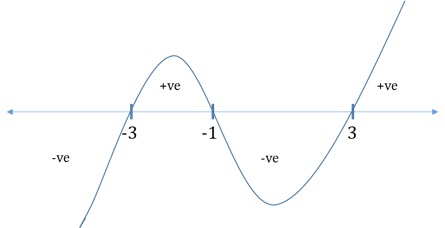
Plotting the zero points and drawing the wavy line:


Required Range: x < -3 or -1 < x < 3

Correct Answer: Option D


Hi Payal,
Can you please help me? According to egmat tutorial whenever power is even the wavy line bounce back and it will not cross the zero point, but here the power of (x-3) is even, so if we start from the top right corner how it can cross the zero point and came into the -ve region?

Regards,
User avatar
Thelegend2631
Joined: 04 May 2020
Last visit: 18 Nov 2025
Posts: 371
Own Kudos:
Given Kudos: 308
Status:What goes round comes around, so does Kudos.
Location: India
GPA: 3
WE:Business Development (Retail Banking)
Kudos
Add Kudos
Bookmarks
Bookmark this Post
EgmatQuantExpert
Solution:

Hey Everyone,

Please find below, the solution of the given problem.


Rewriting the inequality to easily identify the zero points

\((x-3)^2 (x+1)^5 (x^2-9)<0\)

Since

\((x^2-9)=(x+3)*(x-3)\)

The given inequality can be written as

\((x-3)^3 (x+1)^5 (x+3)<0\)


Plotting the zero points and drawing the wavy line:


Required Range: x < -3 or -1 < x < 3

Correct Answer: Option D


Wavy line approach is pretty cool.

My question is..

After i arrange the intersections points aka Roots,
How do i start the wave.

Is it always starting from below X axis - upward curve?

I tried few sources but everyone has a different approach and this concept is not yet clear.
Bunuel VeritasKarishma

Posted from my mobile device
User avatar
Thelegend2631
Joined: 04 May 2020
Last visit: 18 Nov 2025
Posts: 371
Own Kudos:
Given Kudos: 308
Status:What goes round comes around, so does Kudos.
Location: India
GPA: 3
WE:Business Development (Retail Banking)
Kudos
Add Kudos
Bookmarks
Bookmark this Post
agar123
EgmatQuantExpert
Solution:

Hey Everyone,

Please find below, the solution of the given problem.


Rewriting the inequality to easily identify the zero points

\((x-3)^2 (x+1)^5 (x^2-9)<0\)

Since

\((x^2-9)=(x+3)*(x-3)\)

The given inequality can be written as

\((x-3)^3 (x+1)^5 (x+3)<0\)


Plotting the zero points and drawing the wavy line:


Required Range: x < -3 or -1 < x < 3

Correct Answer: Option D


Hi Payal,
Can you please help me? According to egmat tutorial whenever power is even the wavy line bounce back and it will not cross the zero point, but here the power of (x-3) is even, so if we start from the top right corner how it can cross the zero point and came into the -ve region?

Regards,


That's because ( X²- 9 ) =( x-3)(x+3) hence the power of

(X-3)³

Posted from my mobile device
User avatar
KarishmaB
Joined: 16 Oct 2010
Last visit: 20 Apr 2026
Posts: 16,438
Own Kudos:
79,368
 [1]
Given Kudos: 484
Location: Pune, India
Expert
Expert reply
Active GMAT Club Expert! Tag them with @ followed by their username for a faster response.
Posts: 16,438
Kudos: 79,368
 [1]
1
Kudos
Add Kudos
Bookmarks
Bookmark this Post
Hemanthdasu13
EgmatQuantExpert
Solution:

Hey Everyone,

Please find below, the solution of the given problem.


Rewriting the inequality to easily identify the zero points

\((x-3)^2 (x+1)^5 (x^2-9)<0\)

Since

\((x^2-9)=(x+3)*(x-3)\)

The given inequality can be written as

\((x-3)^3 (x+1)^5 (x+3)<0\)


Plotting the zero points and drawing the wavy line:


Required Range: x < -3 or -1 < x < 3

Correct Answer: Option D


Wavy line approach is pretty cool.

My question is..

After i arrange the intersections points aka Roots,
How do i start the wave.

Is it always starting from below X axis - upward curve?

I tried few sources but everyone has a different approach and this concept is not yet clear.
Bunuel VeritasKarishma

Posted from my mobile device


Hemanthdasu13

Follow one style else you will mix them up.
Here is the step by step process I follow: https://youtu.be/PWsUOe77__E
User avatar
KarishmaB
Joined: 16 Oct 2010
Last visit: 20 Apr 2026
Posts: 16,438
Own Kudos:
79,368
 [2]
Given Kudos: 484
Location: Pune, India
Expert
Expert reply
Active GMAT Club Expert! Tag them with @ followed by their username for a faster response.
Posts: 16,438
Kudos: 79,368
 [2]
1
Kudos
Add Kudos
1
Bookmarks
Bookmark this Post
EgmatQuantExpert
Wavy Line Method Application - Exercise Question #2


Find the range of values of x that satisfy the inequality \((x - 3)^2 (x + 1)^5 (x^2 - 9) < 0\)


A. x > 1
B. x > -3
C. -1 < x < 3
D. x < -3 or -1 < x < 3
E. x < -3


Wavy Line Method Application has been explained in detail in the following post:: Wavy Line Method Application - Complex Algebraic Inequalities


Detailed solution will be posted soon.

To read all our articles: Must read articles to reach Q51


Responding to a pm:

First check out how the inequalities are represented on the number line here: https://www.youtube.com/watch?v=VnEVS8kmWa8

Next, we can use the wavy line method to solve this.
\((x - 3)^2 (x + 1)^5 (x^2 - 9) < 0\)
\((x - 3)^2 (x + 1)^5 (x + 3)(x - 3) < 0\)
Factors with even exponents are taken as constants. Factors with positive odd exponents are taken as if they have an exponent of 1.

Hence transition points are -3, -1 and 3 only.

Since we are looking for negative values of the expression, we see that x < -3 or -1 < x < 3

Answer (D)
User avatar
luisdicampo
Joined: 10 Feb 2025
Last visit: 19 Apr 2026
Posts: 480
Own Kudos:
Given Kudos: 328
Products:
Posts: 480
Kudos: 73
Kudos
Add Kudos
Bookmarks
Bookmark this Post
Deconstructing the Question

Factor first:
\(x^2-9=(x-3)(x+3)\)

So the inequality becomes:
\((x-3)^3(x+1)^5(x+3)<0\)

Critical points:
\(-3,\,-1,\,3\)

All exponents are odd, so the sign changes at each critical point.

Step-by-step

For \(x<-3\), the product is negative.

For \(-3<x<-1\), the product is positive.

For \(-1<x<3\), the product is negative.

For \(x>3\), the product is positive.

Since the inequality is strict, \(x=-3,-1,3\) are excluded.

Solution:
\(x<-3\text{ or }-1<x<3\)

Answer: D
Moderators:
Math Expert
109715 posts
Tuck School Moderator
853 posts