Last visit was: 23 Apr 2026, 03:21 It is currently 23 Apr 2026, 03:21
Close
GMAT Club Daily Prep
Thank you for using the timer - this advanced tool can estimate your performance and suggest more practice questions. We have subscribed you to Daily Prep Questions via email.

Customized
for You

we will pick new questions that match your level based on your Timer History

Track
Your Progress

every week, we’ll send you an estimated GMAT score based on your performance

Practice
Pays

we will pick new questions that match your level based on your Timer History
Not interested in getting valuable practice questions and articles delivered to your email? No problem, unsubscribe here.
Close
Request Expert Reply
Confirm Cancel
User avatar
EgmatQuantExpert
User avatar
e-GMAT Representative
Joined: 04 Jan 2015
Last visit: 02 Apr 2024
Posts: 3,657
Own Kudos:
20,865
 [51]
Given Kudos: 165
Expert
Expert reply
Posts: 3,657
Kudos: 20,865
 [51]
1
Kudos
Add Kudos
50
Bookmarks
Bookmark this Post
Most Helpful Reply
User avatar
chetan2u
User avatar
GMAT Expert
Joined: 02 Aug 2009
Last visit: 22 Apr 2026
Posts: 11,229
Own Kudos:
44,998
 [8]
Given Kudos: 335
Status:Math and DI Expert
Location: India
Concentration: Human Resources, General Management
GMAT Focus 1: 735 Q90 V89 DI81
Products:
Expert
Expert reply
GMAT Focus 1: 735 Q90 V89 DI81
Posts: 11,229
Kudos: 44,998
 [8]
6
Kudos
Add Kudos
2
Bookmarks
Bookmark this Post
User avatar
EgmatQuantExpert
User avatar
e-GMAT Representative
Joined: 04 Jan 2015
Last visit: 02 Apr 2024
Posts: 3,657
Own Kudos:
20,865
 [7]
Given Kudos: 165
Expert
Expert reply
Posts: 3,657
Kudos: 20,865
 [7]
1
Kudos
Add Kudos
6
Bookmarks
Bookmark this Post
General Discussion
User avatar
PKN
Joined: 01 Oct 2017
Last visit: 11 Oct 2025
Posts: 809
Own Kudos:
1,636
 [2]
Given Kudos: 41
Status:Learning stage
WE:Supply Chain Management (Energy)
Posts: 809
Kudos: 1,636
 [2]
Kudos
Add Kudos
2
Bookmarks
Bookmark this Post
EgmatQuantExpert
Solving inequalities- Number Line Method - Practice Question #1

Find the range of values of x such that \((x-5)^3 (2-4x) < 0\)


A. \(\frac{1}{2} < x < 5\)
B. \(0 < x < \frac{1}{2}\)
C. \(x >5\)
D. \(\frac{1}{2} < x < 5\)
E. \((x < \frac{1}{2}\)) and (\(x > 5\))

\((x-5)^3 (2-4x) < 0\)
Or, \(-2\left(x-5\right)^3\left(2x-1\right)<0\)
Or, \(2\left(x-5\right)^3\left(2x-1\right)>0\)

Critical points:- 5, 1/2
Using wavy curve method:-
range of x:-
\(x<\frac{1}{2}\) or \(x>5\)

Ans. (E)

P.S:- In option (E) , OR sounds logical instead of AND.
User avatar
Kem12
Joined: 18 Apr 2018
Last visit: 01 Feb 2021
Posts: 67
Own Kudos:
Given Kudos: 211
Posts: 67
Kudos: 34
Kudos
Add Kudos
Bookmarks
Bookmark this Post
EgmatQuantExpert

Solution


Given:
    • An inequality, \((x-5)^3 (2-4x) < 0\)

To find:
    • The range of x, that satisfies the above inequality[/list

    Approach and Working:
      • So, if we observe carefully, the inequality given to us can be written as,
        o \((x-5)^2 * (x-5) * (2-4x) < 0\)
      • We know that, any number of the form N2 is always positive, expect for N = 0.
        o So, we can say that, \((x - 5)^2\) is always positive, expect for x = 5,
        o Thus, the inequality can be written as (x - 5) * (2 - 4x) < 0
      • Now, let’s multiply the inequality by -1 to make the coefficient of x, positive
        o And, note that the inequality sign must be changed as we are multiplying it by a negative number, -1
        o Thus, the inequality becomes, (x - 5) * (4x - 2) > 0
      • The zero points of this inequality are x = 5 and \(x = \frac{1}{2}\)
      • Plot these points on the number line.
        o Since, both (x – 5) and (4x – 2) > 0, the inequality will be positive, for all the points to the right of 5
        o And, it is negative, in the region, between \(\frac{1}{2}\) and 5, since (x – 5) is negative and (4x – 2) is positive in this region
        o It is again positive for all the values less than \(\frac{1}{2}\), since both (x – 5) and (4x – 2) are negative in this region
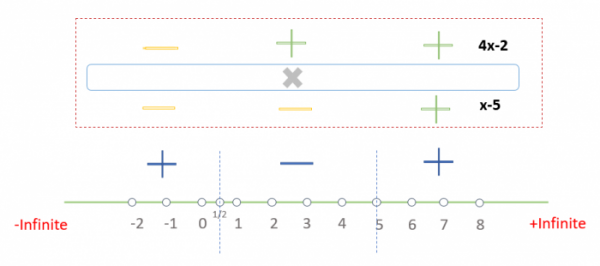


Therefore, the range of x is \(x < \frac{1}{2}\) and x > 5

Hence, the correct answer is option E.

Answer: E



Hello EgmatQuantExpert, thanks for the wholesome explanation. I would like to know why after multiplying the whole inequality by -1, the sign in (x-5) did no change only that of 2-4x changed. Thanks.

Posted from my mobile device
User avatar
fskilnik
Joined: 12 Oct 2010
Last visit: 03 Jan 2025
Posts: 883
Own Kudos:
Given Kudos: 57
Status:GMATH founder
Expert
Expert reply
Posts: 883
Kudos: 1,880
Kudos
Add Kudos
Bookmarks
Bookmark this Post
EgmatQuantExpert


Find the range of values of x such that \((x-5)^3 (2-4x) < 0\)

A. \(\frac{1}{2} < x < 5\)
B. \(0 < x < \frac{1}{2}\)
C. \(x >5\)
D. \(\frac{1}{2} < x < 5\)
E. \((x < \frac{1}{2}\)) and (\(x > 5\))
\(?\,\,\,:\,\,\,{\left( {x - 5} \right)^3}\left( {2 - 4x} \right) < 0\,\,\,\,\,\, \Leftrightarrow \,\,\,\,\,\boxed{\left( {x - 5} \right)\left( {1 - 2x} \right) < 0}\)

\(\left( {x - 5} \right)\left( {1 - 2x} \right) = 0\,\,\,\,\, \Leftrightarrow \,\,\,\,x = 5\,\,{\text{or}}\,\,x = \frac{1}{2}\)

\(?\,\,:\,\,\,\left\{ {x < \frac{1}{2}} \right\}\,\,\, \cup \,\,\,\left\{ {x > 5} \right\}\)

The solution above follows the notations and rationale taught in the GMATH method.

Regards,
fskilnik.
User avatar
Hungluu92vn
Joined: 10 Feb 2017
Last visit: 01 Mar 2024
Posts: 33
Own Kudos:
Given Kudos: 163
Location: Viet Nam
GPA: 3.5
WE:General Management (Education)
Posts: 33
Kudos: 86
Kudos
Add Kudos
Bookmarks
Bookmark this Post
I thought the answer must be written in form like x < 1/2 or x > 5 as there is no way x can satisfy both the condition. The "And" here made me confused.
User avatar
fskilnik
Joined: 12 Oct 2010
Last visit: 03 Jan 2025
Posts: 883
Own Kudos:
Given Kudos: 57
Status:GMATH founder
Expert
Expert reply
Posts: 883
Kudos: 1,880
Kudos
Add Kudos
Bookmarks
Bookmark this Post
Hungluu92vn
I thought the answer must be written in form like x < 1/2 or x > 5 as there is no way x can satisfy both the condition. The "And" here made me confused.
Hi, Hungluu92vn!

Excellent observation. I have avoided to use the term "and", because EACH x cannot be simultaneously in ]-infinity, 1/2[ and in ]5, +infinity[.
That´s why, for the solution set of a inequation such as the one presented in the question stem, the proper word is OR , the proper symbol is U (reunion).

Other experts used the term AND, specifically in this question, because the word "range" was presented in the question stem!
Their interpretation: there are real values "x" that belong to ]-infinity, 1/2[ AND there are (OTHER) real values "x" that belong to ]5, +infinity[.
(It is as if "x" is a dummy variable: different "roles" each time it appears! This is not the classical way of looking into this "theme" but... you got the point!)

Regards,
fskilnik.
User avatar
T1101
Joined: 07 Aug 2018
Last visit: 18 Nov 2021
Posts: 79
Own Kudos:
Given Kudos: 247
Location: United States (MA)
GMAT 1: 560 Q39 V28
GMAT 2: 670 Q48 V34
GMAT 2: 670 Q48 V34
Posts: 79
Kudos: 358
Kudos
Add Kudos
Bookmarks
Bookmark this Post
Under 30sec approach

You directly see that x can be bigger than 5. Eliminate A,B and D.
Left with C or E. --> x can also be negative therefore eliminate C. Hence, E
avatar
Abhinav93
Joined: 15 Aug 2018
Last visit: 28 Jul 2019
Posts: 3
Own Kudos:
1
 [1]
Given Kudos: 2
Posts: 3
Kudos: 1
 [1]
1
Kudos
Add Kudos
Bookmarks
Bookmark this Post
Hello Egmatquantexpert why are multiplying by -1? What is the need for it?

Posted from my mobile device
User avatar
bansalgaurav
Joined: 26 Mar 2021
Last visit: 20 Nov 2021
Posts: 112
Own Kudos:
32
 [2]
Given Kudos: 36
Location: India
Concentration: General Management, Strategy
Schools: IIMB EPGP'23
GMAT 1: 640 Q50 V25
Schools: IIMB EPGP'23
GMAT 1: 640 Q50 V25
Posts: 112
Kudos: 32
 [2]
2
Kudos
Add Kudos
Bookmarks
Bookmark this Post
Note: While solving inequalities, remember the following simple rules :
-->If the product of two numbers is less than zero, then one of them is less than zero and the other one is greater than zero. ==> if ab <0 ==> a<0 & b>0 OR a>0 & b<0
-->If the product of two numbers is greater than zero, then either both the numbers are lesser than zero or both the numbers are greater than zero ==> if ab > 0 ==> a>0 & b>0 OR a<0 & b<0
--> Multiplying both sides of an inequality reverses the sign of inequality. Example If a<0 ==> -a>0

Now the given equation can be simplified as : 2[(x-5)^3][(1-2x)] < 0

Thus we can say either of the following has to hold true::
1: x-5 < 0 and 1-2x >0 2: x-5 > 0 and 1-2x <0
The above two conditions can be further simplified in terms of X as:
1: x < 5 and x < 1/2 { note if 1-2x > 0 ==>2x-1 <0 . multiplying by -1 on both sides reverses the inequality sign}
Both the conditions can hold true only if x<1/2
2: x> 1/2 and x>5
Both the conditions can hold true if x>5
Thus the answer is E.
User avatar
bansalgaurav
Joined: 26 Mar 2021
Last visit: 20 Nov 2021
Posts: 112
Own Kudos:
Given Kudos: 36
Location: India
Concentration: General Management, Strategy
Schools: IIMB EPGP'23
GMAT 1: 640 Q50 V25
Schools: IIMB EPGP'23
GMAT 1: 640 Q50 V25
Posts: 112
Kudos: 32
Kudos
Add Kudos
Bookmarks
Bookmark this Post
Abhinav93
Hello Egmatquantexpert why are multiplying by -1? What is the need for it?

Posted from my mobile device

Multiplying by -1 eases the equation.
If 1-2x<0 ==> -2x < -1 ==> -x < -1/2 Now since we have to find answer in terms of X not in terms of -X hence we multiply by -1 here which yields :: (-x)(-1) > (-1/2)(-1) ==> x>1/2

Note:: Multiplication of any negative number on both sides of an inequality reverses the sign of inequality.

Note, whenever you see "-x" in inequality and if the answer is in therms of "x", first convert that "x" into positive by multiplying the inequality by -1.

In this question my first step would be 1-2x<0 ==> 2x-1>0 ==>x>1/2 . this helps me solve the ineq. in a smoother manner
User avatar
bumpbot
User avatar
Non-Human User
Joined: 09 Sep 2013
Last visit: 04 Jan 2021
Posts: 38,959
Own Kudos:
Posts: 38,959
Kudos: 1,117
Kudos
Add Kudos
Bookmarks
Bookmark this Post
Automated notice from GMAT Club BumpBot:

A member just gave Kudos to this thread, showing it’s still useful. I’ve bumped it to the top so more people can benefit. Feel free to add your own questions or solutions.

This post was generated automatically.
Moderators:
Math Expert
109773 posts
Tuck School Moderator
853 posts