Events & Promotions
|
|

GMAT Club Daily Prep
Thank you for using the timer - this advanced tool can estimate your performance and suggest more practice questions. We have subscribed you to Daily Prep Questions via email.
Customized
for You
Track
Your Progress
Practice
Pays
Not interested in getting valuable practice questions and articles delivered to your email? No problem, unsubscribe here.
 Sep 24
08:00 AM EDT
-08:30 AM EDT
Meet Tuck at an informal student or staff-hosted coffee chat in a city near you! Sep 24
01:30 AM EDT
-01:30 AM EDT
Tejas studied hard but kept repeating the same mistakes. After 3 attempts at 645, a focused 4-week strategy helped him identify and fix what was holding him back—leading to a 695 with just 12–15 hours of study per week. Sep 26
01:00 PM EDT
-04:00 PM EDT
Top scores are possible when you enroll in a powerful GMAT course, taught live online + 6 months access to TTP OnDemand video courses included. Class starts Saturdays Sept. 26, 2026 - Dec. 19, 2026, 1:00pm-4:00pm ES Sep 26
06:00 PM PDT
-07:00 PM PDT
Free- full-length test + 15 concept videos + 150+ short videos + study plan! Sep 29
11:00 AM EDT
-01:00 PM EDT
" Description: Top scores are possible when you enroll in a powerful GMAT course, taught live online + 6 months access to TTP OnDemand video courses included! Class starts Tues/Thur Sept. 29, 2026 - Dec. 3, 2026, 11:00am-1:00pm EST Oct 01
07:00 AM BST
-08:00 AM GMT
Welcome to the GMAT Club's Free Interview Prep Event for Top MBA Programs! Buy tickets - Virtual series that’s all set to equip you to -excel in your MBA interviews.


C
Be sure to select an answer first to save it in the Error Log before revealing the correct answer (OA)!
Difficulty:
 85%
(hard)
85%
(hard)
Question Stats:
54% (02:39) correct 46%
(02:27)
wrong
based on 217
sessions
46%
(02:27)
wrong
based on 217
sessions
History
Date
Time
Result
Not Attempted Yet
GMATH practice exercise (Quant Class 15)
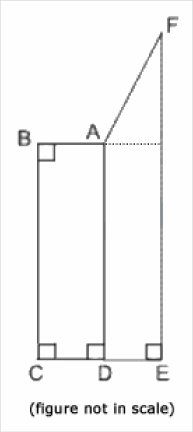
If quadrilaterals ABCD and ADEF have the same areas, is AF > 28 ?
(1) EF = 10
(2) CE = 24
Edited:
01. The contest related to this post is finished!
02. We have presented the official solution.
03. We have added the dotted line, to avoid the interpretation that F could be "below" line AB.
(A) Statement 1 alone is sufficient, but statement 2 alone is not.
(B) Statement 2 alone is sufficient, but statement 1 alone is not.
(C) Both statements together are sufficient, but neither alone is sufficient.
(D) Each statement alone is sufficient.
(E) Neither statement is sufficient, even when combined.
If quadrilaterals ABCD and ADEF have the same areas, is AF > 28 ?
(1) EF = 10
(2) CE = 24
Edited:
01. The contest related to this post is finished!
02. We have presented the official solution.
03. We have added the dotted line, to avoid the interpretation that F could be "below" line AB.
(A) Statement 1 alone is sufficient, but statement 2 alone is not.
(B) Statement 2 alone is sufficient, but statement 1 alone is not.
(C) Both statements together are sufficient, but neither alone is sufficient.
(D) Each statement alone is sufficient.
(E) Neither statement is sufficient, even when combined.

 15 Mar 2019, 13:30
Kudos
Bookmarks
IMO, Ans C
Considering both statements together and a rectangle with base CE and height FE, resultant area 240.
So, area of each quad is less than / equal to 240/2= 120 max.
In trapezium / rectangle ADEF, FE is 10, so average of FE+AD is less than or equal to 10. So, max possible value of DE is 12.
In triangle DEF with base 12 and height 10, Hyp FD is root 244, approx 15.something.
As AF is smaller than FD, AF cannot be greater than 28.
Considering both statements together and a rectangle with base CE and height FE, resultant area 240.
So, area of each quad is less than / equal to 240/2= 120 max.
In trapezium / rectangle ADEF, FE is 10, so average of FE+AD is less than or equal to 10. So, max possible value of DE is 12.
In triangle DEF with base 12 and height 10, Hyp FD is root 244, approx 15.something.
As AF is smaller than FD, AF cannot be greater than 28.
15 Mar 2019, 18:03
Kudos
Bookmarks
(1) EF = 10
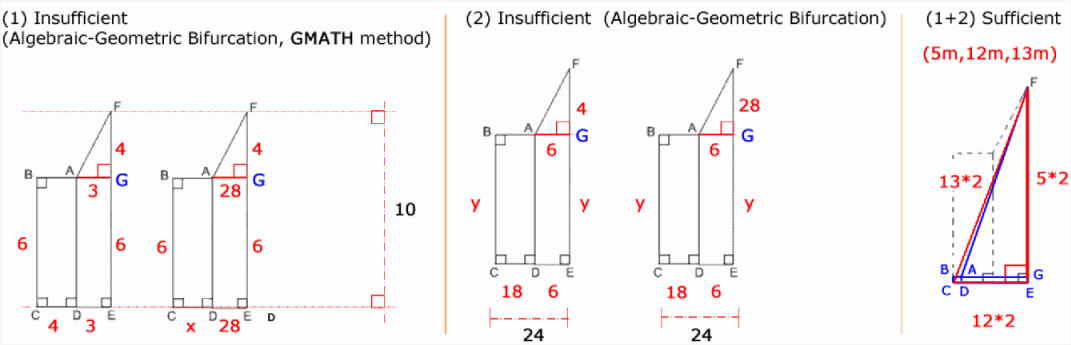
We don't know the length of DE. You can stretch DE very far apart (could be to a ridiculous number, say to 1 million) then clearly AF, which forms the hypotenuse of the right triangle with base the length of DE & height < 10 would be greater than 28. However, if DE is very short, such as length of 1, then AF is the hypotenuse of a right triangle with other sides 1 & a side less than 10, so AF is less than 28.
Insufficient
(2) CE = 24
A similar thought exercise can be performed here, where if EF is a ridiculously long length, then you can construct AF to be >28, but if EF is sufficiently short enough, then AF < 28.
Insufficient
(Both 1 & 2)
Knowing EF is 10 and CE is 24, we can try to maximize the length of AF to see if it exceeds 28. If it doesn't, then we know the answer is sufficient.
We can set BA and AD to be very small, almost 0, such that AF forms the hypotenuse of a right triangle with sides 10 and 24, which a quick calculation shows that at most AF can be 26. So AF is definitely less than 28.
Answer is C
We don't know the length of DE. You can stretch DE very far apart (could be to a ridiculous number, say to 1 million) then clearly AF, which forms the hypotenuse of the right triangle with base the length of DE & height < 10 would be greater than 28. However, if DE is very short, such as length of 1, then AF is the hypotenuse of a right triangle with other sides 1 & a side less than 10, so AF is less than 28.
Insufficient
(2) CE = 24
A similar thought exercise can be performed here, where if EF is a ridiculously long length, then you can construct AF to be >28, but if EF is sufficiently short enough, then AF < 28.
Insufficient
(Both 1 & 2)
Knowing EF is 10 and CE is 24, we can try to maximize the length of AF to see if it exceeds 28. If it doesn't, then we know the answer is sufficient.
We can set BA and AD to be very small, almost 0, such that AF forms the hypotenuse of a right triangle with sides 10 and 24, which a quick calculation shows that at most AF can be 26. So AF is definitely less than 28.
Answer is C