Last visit was: 24 Apr 2026, 08:32 It is currently 24 Apr 2026, 08:32
Close
GMAT Club Daily Prep
Thank you for using the timer - this advanced tool can estimate your performance and suggest more practice questions. We have subscribed you to Daily Prep Questions via email.

Customized
for You

we will pick new questions that match your level based on your Timer History

Track
Your Progress

every week, we’ll send you an estimated GMAT score based on your performance

Practice
Pays

we will pick new questions that match your level based on your Timer History
Not interested in getting valuable practice questions and articles delivered to your email? No problem, unsubscribe here.
Close
Request Expert Reply
Confirm Cancel
User avatar
jackg0101
Joined: 15 Nov 2023
Last visit: 03 Jan 2024
Posts: 4
Own Kudos:
208
 [75]
Given Kudos: 8
Posts: 4
Kudos: 208
 [75]
4
Kudos
Add Kudos
71
Bookmarks
Bookmark this Post
Most Helpful Reply
User avatar
gmatophobia
User avatar
Quant Chat Moderator
Joined: 22 Dec 2016
Last visit: 19 Apr 2026
Posts: 3,173
Own Kudos:
11,461
 [7]
Given Kudos: 1,862
Location: India
Concentration: Strategy, Leadership
Posts: 3,173
Kudos: 11,461
 [7]
7
Kudos
Add Kudos
Bookmarks
Bookmark this Post
General Discussion
User avatar
GmatKnightTutor
User avatar
Major Poster
Joined: 31 Jan 2020
Last visit: 01 Nov 2025
Posts: 5,204
Own Kudos:
1,575
 [1]
Given Kudos: 18
Posts: 5,204
Kudos: 1,575
 [1]
1
Kudos
Add Kudos
Bookmarks
Bookmark this Post
User avatar
Amobnc
Joined: 28 Sep 2022
Last visit: 18 Feb 2025
Posts: 38
Own Kudos:
Given Kudos: 250
Location: Portugal
GMAT Focus 1: 605 Q82 V83 DI75
Products:
GMAT Focus 1: 605 Q82 V83 DI75
Posts: 38
Kudos: 11
Kudos
Add Kudos
Bookmarks
Bookmark this Post
Can I get a clearer explanation of why E) is incorrect please?
Thanks!
User avatar
MartyMurray
Joined: 11 Aug 2023
Last visit: 24 Apr 2026
Posts: 1,848
Own Kudos:
7,110
 [2]
Given Kudos: 212
GMAT 1: 800 Q51 V51
Expert
Expert reply
Active GMAT Club Expert! Tag them with @ followed by their username for a faster response.
GMAT 1: 800 Q51 V51
Posts: 1,848
Kudos: 7,110
 [2]
2
Kudos
Add Kudos
Bookmarks
Bookmark this Post
 
Amobnc
Can I get a clearer explanation of why E) is incorrect please?
Thanks!
­The statement completed with (E) is:

Most of the stores in Advik's town that are owned by women have fewer than five employees.

That statement is not supported by the passage because the passage provides no information indicating the proportion of stores owned by women that have fewer than five employees.

In other words the passage does not indicate the value of the following:

          \(\frac{\text{women owned stores with fewer than five employees}}{\text{total women owned stores}}\)

In other words, we don't have any information on the characteristics of "most of the stores in Advik's town that are owned by women," such as what this choice says.­

The passage tells us about only the proportion of stores with fewer than five employees owned by women, which is "most stores with fewer than five employees," or more than half. In other words, it tells us the following:

          \(\frac{\text{women owned stores with fewer than five employees}}{\text{total stores with fewer than five employees}} > \frac{1}{2}\) 
User avatar
MBAToronto2024
Joined: 21 Apr 2024
Last visit: 06 Feb 2025
Posts: 96
Own Kudos:
Given Kudos: 110
Location: Canada
Posts: 96
Kudos: 17
Kudos
Add Kudos
Bookmarks
Bookmark this Post
KarishmaB what's wrong with option D?
User avatar
KarishmaB
Joined: 16 Oct 2010
Last visit: 23 Apr 2026
Posts: 16,442
Own Kudos:
79,403
 [3]
Given Kudos: 485
Location: Pune, India
Expert
Expert reply
Active GMAT Club Expert! Tag them with @ followed by their username for a faster response.
Posts: 16,442
Kudos: 79,403
 [3]
3
Kudos
Add Kudos
Bookmarks
Bookmark this Post
jackg0101
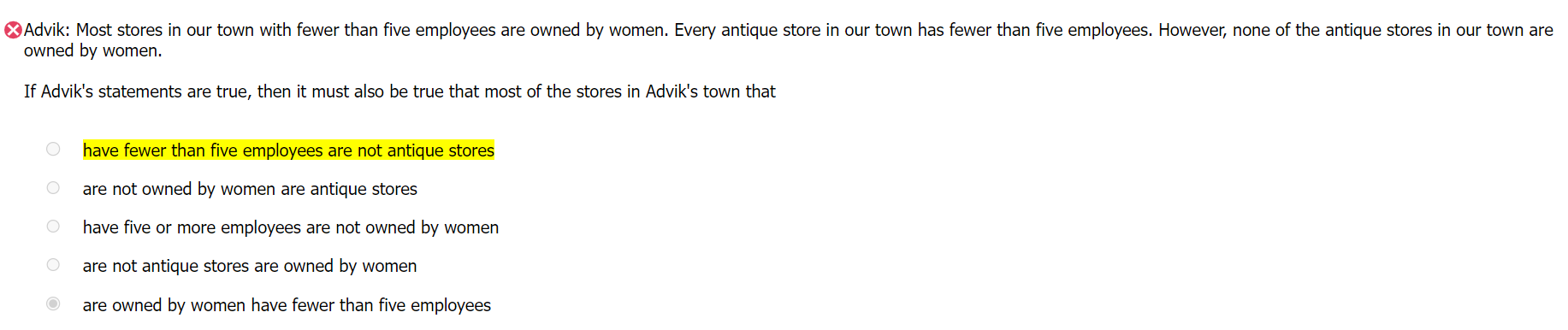
Advik: Most stores in our town with fewer than five employees are owned by women. Every antique store in our town has fewer than five employees. However, none of the antique stores in our town are owned by women.

If Advik's statements are true, then it must also be true that most of the stores in Advik's town that

A. have fewer than five employees are not antique stores
B. are not owned by women are antique stores
C. have five or more employees are not owned by women
D. are not antique stores are owned by women
E. are owned by women have fewer than five employees­

­


Given:
Most stores in our town with fewer than five employees are owned by women.
Say there are 20 stores with fewer than 5 employees. At least 11 of these are owned by women. Note here that we have no idea about how many stores there are that have more than 5 employees.


Every antique store in our town has fewer than five employees.
So all antique stores are a part of those 20.

However, none of the antique stores in our town are owned by women.
But none of the antique stores are a part of that 'at least 11'.

It works, right? It is possible that exactly 11 of those 20 stores are owned by women and all antique stores are a part of the leftover 9. Or say 12 of those 20 stores are owned by women and all antique stores are a part of the leftover 8 etc.


Attachment:
Screenshot 2024-11-18 at 2.49.03 PM.png
Screenshot 2024-11-18 at 2.49.03 PM.png [ 89.83 KiB | Viewed 9709 times ]


If Advik's statements are true, then it must also be true that most of the stores in Advik's town that

A. have fewer than five employees are not antique stores

Most of the stores that have fewer than five employees are not antique stores.

This is correct.

"stores that have fewer than five employees" - 20 stores assumed above

So this statement says that "Most of the 20 stores are not antique stores."
This is correct. We saw above that antique stores can be at most 9 of the 20 stores.

B. are not owned by women are antique stores

Most of the stores that are not owned by women are antique stores.

We don't know how many overall stores are not owned by women i.e. are owned by men.
As we see in the Venn diagram above, number of stores owned by men is unknown.


C. have five or more employees are not owned by women

Most of the stores that have five or more employees are not owned by women

We don't know how many stores have 5 or more employees.


D. are not antique stores are owned by women

Most of the stores that are not antique stores are owned by women

We don't know how many stores are outside the green antique stores circle. We don't know how many stores have 5 or more employees and who owns them. Are most of them owned by women or men, we cannot say. Either is possible.


E. are owned by women have fewer than five employees­

Most of the stores that are owned by women have fewer than five employees­.

Again, we don't know how many stores have 5 or more employees and who owns them. As per our example, women own 11 stores with less than 5 employees. Women could own no store with 5 or more employees or they could own 100 stores with 5 or more employees.

Answer (A)

I have discussed how using SETS can help in solving CR questions in the following videos:

https://youtu.be/0uqq17WCJiE
https://youtu.be/XCBp62o70Eg
Attachment:
GMAT-Club-Forum-lfvcigh7.png
GMAT-Club-Forum-lfvcigh7.png [ 62.31 KiB | Viewed 6341 times ]
User avatar
Raman109
Joined: 17 Aug 2009
Last visit: 28 Jul 2025
Posts: 706
Own Kudos:
212
 [1]
Given Kudos: 33
Posts: 706
Kudos: 212
 [1]
Kudos
Add Kudos
1
Bookmarks
Bookmark this Post
Advik: Most stores in our town with fewer than five employees are owned by women. Every antique store in our town has fewer than five employees. However, none of the antique stores in our town are owned by women.

Take < 5 employees as group A
>= 5 employees as group B

So in group A, most are owned by women.
Antique stores are part of group A but are not part of the "most"

If Advik's statements are true, then it must also be true that most of the stores in Advik's town that

A. have fewer than five employees are not antique stores - True.
B. are not owned by women are antique stores - We don't know.
C. have five or more employees are not owned by women - No info on Group B - out of scope.
D. are not antique stores are owned by women - We don't know about group B.
E. are owned by women have fewer than five employees­ - It uses all the words but reverses the logic. We know most in group 1 are owned by women. Not that whatever is owned by women have less than 5 employees. What if there are 10 people in group A and 5 million in group B and most of the group B is also owned by women? Wrong.
User avatar
VasundharaS
Joined: 24 Jan 2020
Last visit: 02 Apr 2026
Posts: 28
Own Kudos:
Given Kudos: 99
Location: India
GPA: 8.07
Posts: 28
Kudos: 6
Kudos
Add Kudos
Bookmarks
Bookmark this Post
Why not D? This is crazy I don't understand :'(
jackg0101
Advik: Most stores in our town with fewer than five employees are owned by women. Every antique store in our town has fewer than five employees. However, none of the antique stores in our town are owned by women.

If Advik's statements are true, then it must also be true that most of the stores in Advik's town that

A. have fewer than five employees are not antique stores
B. are not owned by women are antique stores
C. have five or more employees are not owned by women
D. are not antique stores are owned by women
E. are owned by women have fewer than five employees­

­
Attachment:
GMAT-Club-Forum-4ce5b6k8.png
User avatar
anjanaroy
Joined: 24 Mar 2025
Last visit: 14 Oct 2025
Posts: 7
Own Kudos:
Given Kudos: 5
Posts: 7
Kudos: 1
Kudos
Add Kudos
Bookmarks
Bookmark this Post
I still think E is the correct option as "This must be true. Since most stores with fewer than five employees are owned by women, and no antique stores (which are a subset of stores with fewer than five employees) are owned by women, the stores owned by women must be from the non-antique subset of stores with fewer than five employees. So, all stores owned by women must have fewer than five employees." Whereas the Option A could be true but not necessarily. All antique stores have fewer than five employees, but that doesn't mean most stores with fewer than five employees are not antique stores. This is not logically required.
jackg0101
Advik: Most stores in our town with fewer than five employees are owned by women. Every antique store in our town has fewer than five employees. However, none of the antique stores in our town are owned by women.

If Advik's statements are true, then it must also be true that most of the stores in Advik's town that

A. have fewer than five employees are not antique stores
B. are not owned by women are antique stores
C. have five or more employees are not owned by women
D. are not antique stores are owned by women
E. are owned by women have fewer than five employees­

­
Attachment:
GMAT-Club-Forum-4ce5b6k8.png
User avatar
egmat
User avatar
e-GMAT Representative
Joined: 02 Nov 2011
Last visit: 24 Apr 2026
Posts: 5,632
Own Kudos:
33,433
 [1]
Given Kudos: 707
GMAT Date: 08-19-2020
Expert
Expert reply
Active GMAT Club Expert! Tag them with @ followed by their username for a faster response.
Posts: 5,632
Kudos: 33,433
 [1]
1
Kudos
Add Kudos
Bookmarks
Bookmark this Post
This is a classic GMAT Critical Reasoning inference question that tests your ability to identify what must logically follow from a set of premises. Let me break down the logical structure to help you see the solution clearly.

Core Logic Analysis:
Step 1: Map the Given Information

Let's organize what Advik tells us:
Fact 1: Most stores with <5 employees → owned by women
Fact 2: ALL antique stores → have <5 employees
Fact 3: NO antique stores → owned by women

Step 2: Identify the Critical Contradiction

Here's where it gets interesting. Notice that:
  • Antique stores are a subset of stores with <5 employees (from Fact 2)
  • But antique stores have 0% women ownership (from Fact 3)
  • Yet the overall group has "most" (>50%) women ownership (from Fact 1)

Step 3: Apply Mathematical Logic
For the math to work, if antique stores contribute 0% to women ownership, and the overall average must still be >50%, then:

Antique stores must be a minority of all small stores
The non-antique small stores must compensate with higher women ownership

Think of it this way: If you have 100 small stores and 70 are women-owned, but we know ALL antique stores (let's say 20) are NOT women-owned, then those 70 women-owned stores must come from the remaining 80 non-antique stores.

Step 4: Evaluate Answer Choice A

"Most stores that have fewer than five employees are not antique stores"

This must be true! If antique stores were the majority of small stores, and none are women-owned, then most small stores would NOT be women-owned - contradicting Fact 1.
Answer: A

The other choices fail because:

B, D, E: Make claims we can't support with the given information
C: Discusses stores with 5+ employees, which we know nothing about

Want to master this question type systematically? Check out the complete solution on Neuron by e-GMAT to learn the advanced framework for handling "must be true" questions with overlapping sets. You'll discover how to quickly identify compensation patterns and avoid common traps that appear in 700+ level CR questions. Access detailed solutions for other similar Official questions here on Neuron to build consistent accuracy.
User avatar
Goldenfuture
Joined: 24 Dec 2024
Last visit: 29 Jan 2026
Posts: 150
Own Kudos:
Given Kudos: 48
Posts: 150
Kudos: 12
Kudos
Add Kudos
Bookmarks
Bookmark this Post
I don't understand how D is in-correct.
See we are already told most stores are owned by women - so they have 50%+
Now none of Antique stores are owned by women - so that that as a%
100-51% = 49% this a sits in this 49% - let this be 0.5%
Now we are simply asked if women own majority of 100-a%
And the answer is a hands down yes = 100-0.5% = 99.5%
50% of this is definitely 49.75%, which is less tham 50%+
Hence women do own majority or most of the non-antique stores of Advik's town - where is this reasoning wrong?
Bunuel KarishmaB


KarishmaB


Given:
Most stores in our town with fewer than five employees are owned by women.
Say there are 20 stores with fewer than 5 employees. At least 11 of these are owned by women. Note here that we have no idea about how many stores there are that have more than 5 employees.


Every antique store in our town has fewer than five employees.
So all antique stores are a part of those 20.

However, none of the antique stores in our town are owned by women.
But none of the antique stores are a part of that 'at least 11'.

It works, right? It is possible that exactly 11 of those 20 stores are owned by women and all antique stores are a part of the leftover 9. Or say 12 of those 20 stores are owned by women and all antique stores are a part of the leftover 8 etc.


Attachment:
Screenshot 2024-11-18 at 2.49.03 PM.png


If Advik's statements are true, then it must also be true that most of the stores in Advik's town that

A. have fewer than five employees are not antique stores

Most of the stores that have fewer than five employees are not antique stores.

This is correct.

"stores that have fewer than five employees" - 20 stores assumed above

So this statement says that "Most of the 20 stores are not antique stores."
This is correct. We saw above that antique stores can be at most 9 of the 20 stores.

B. are not owned by women are antique stores

Most of the stores that are not owned by women are antique stores.

We don't know how many overall stores are not owned by women i.e. are owned by men.
As we see in the Venn diagram above, number of stores owned by men is unknown.


C. have five or more employees are not owned by women

Most of the stores that have five or more employees are not owned by women

We don't know how many stores have 5 or more employees.


D. are not antique stores are owned by women

Most of the stores that are not antique stores are owned by women

We don't know how many stores are outside the green antique stores circle. We don't know how many stores have 5 or more employees and who owns them. Are most of them owned by women or men, we cannot say. Either is possible.


E. are owned by women have fewer than five employees­

Most of the stores that are owned by women have fewer than five employees­.

Again, we don't know how many stores have 5 or more employees and who owns them. As per our example, women own 11 stores with less than 5 employees. Women could own no store with 5 or more employees or they could own 100 stores with 5 or more employees.

Answer (A)

I have discussed how using SETS can help in solving CR questions in the following videos:

https://youtu.be/0uqq17WCJiE
https://youtu.be/XCBp62o70Eg
Attachment:
GMAT-Club-Forum-lfvcigh7.png
User avatar
Goldenfuture
Joined: 24 Dec 2024
Last visit: 29 Jan 2026
Posts: 150
Own Kudos:
Given Kudos: 48
Posts: 150
Kudos: 12
Kudos
Add Kudos
Bookmarks
Bookmark this Post
Okay I understand now. I am presuming in the venn diagram I made only shops with less than 5 employees and option D does not things so - its larger and all shops are added - less than 5 and more than 5
Goldenfuture
I don't understand how D is in-correct.
See we are already told most stores are owned by women - so they have 50%+
Now none of Antique stores are owned by women - so that that as a%
100-51% = 49% this a sits in this 49% - let this be 0.5%
Now we are simply asked if women own majority of 100-a%
And the answer is a hands down yes = 100-0.5% = 99.5%
50% of this is definitely 49.75%, which is less tham 50%+
Hence women do own majority or most of the non-antique stores of Advik's town - where is this reasoning wrong?
Bunuel KarishmaB


Moderators:
GMAT Club Verbal Expert
7391 posts
501 posts
358 posts