Events & Promotions
|
|

GMAT Club Daily Prep
Thank you for using the timer - this advanced tool can estimate your performance and suggest more practice questions. We have subscribed you to Daily Prep Questions via email.
Customized
for You
Track
Your Progress
Practice
Pays
Not interested in getting valuable practice questions and articles delivered to your email? No problem, unsubscribe here.
 Sep 02
01:00 PM EDT
-11:59 PM EDT
Take 30% off all study plans with code COURSEWORK - Expires on Monday 9/7 Sep 04
10:00 AM EDT
-11:59 PM EDT
We’ve worked incredibly hard to build TTP into the best test prep experience possible, and it would mean a lot to us to win Newsweek’s 2026 Readers’ Choice Award for Best Test Prep. If TTP has helped you, we’d be incredibly grateful for your vote. Sep 07
12:01 AM PDT
-11:59 PM PDT
On the 7th, GMAT Club Tests will be Free! Including all the Quizzes, Questions, and Tests. 12 AM - 11:59 PM PDT- Sep 07
10:00 AM PDT
-11:00 AM PDT
A complete walkthrough of GMAT Club’s free 12-week GMAT study plan: what you study each week, how progress and goals are tracked, how the error log works, and how your practice unlocks paid tools at no cost. - Sep 09
07:00 AM PDT
-10:00 AM PDT
Meet AdComs and explore top Master’s programs - MiM, MiF, MSc, MSBA and more. - Application Fee Waivers - Free 1-Week of GMAT Club Tests: - Master's Application Toolkit - Grand Prize Giveaway - Sep 09
10:00 AM PDT
-11:00 AM PDT
Three MBA applications. Three rejections. No interview invites. A year later, Aman was admitted to Cambridge Judge, SMU, and IMD. In this episode of MBA Admit Stories, Aman shares how he rebuilt his MBA application...  Sep 15
07:00 PM EDT
-09:00 PM EST
Elite scores are possible when you enroll in a powerful GMAT course, taught live online + 6 months access to TTP OnDemand video courses included! Class starts Tues/Thurs Sept. 15, 2026 - Nov. 15, 2027, 7:00pm-9:00pm EST Sep 21
08:00 PM EDT
-10:00 PM EDT
Boost your GMAT score in less than one month in a live online class + 6 months access to TTP OnDemand video courses included! Class starts Mon, Tues, Wed, Thur, Fri Sept. 21, 2026 - Oct. 9, 2027, 7:00pm-10:00pm EST


 04 Dec 2023, 06:51
Kudos
Bookmarks


D
Be sure to select an answer first to save it in the Error Log before revealing the correct answer (OA)!
Difficulty:
 95%
(hard)
95%
(hard)
Question Stats:
50% (02:19) correct 50%
(02:29)
wrong
based on 1146
sessions
50%
(02:29)
wrong
based on 1146
sessions
History
Date
Time
Result
Not Attempted Yet
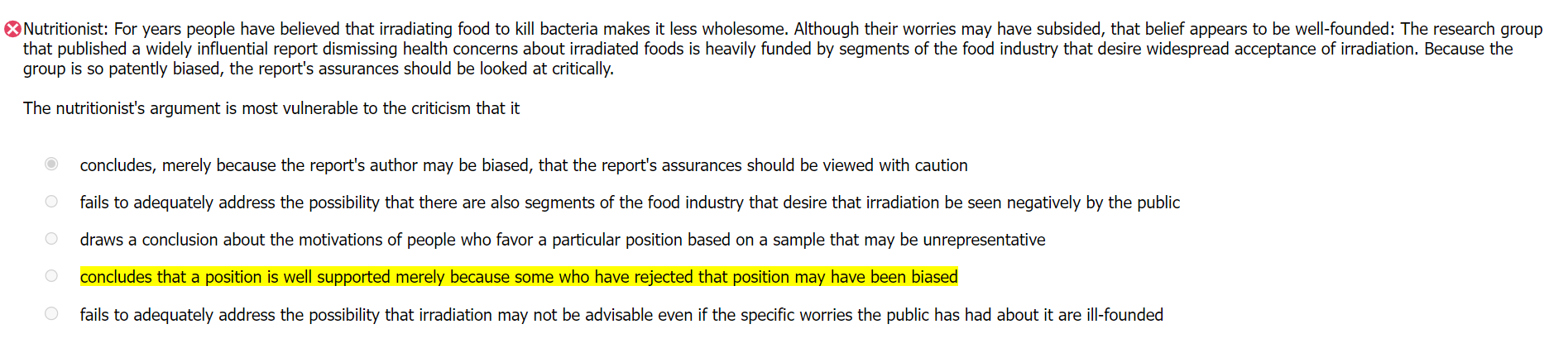
Nutritionist: For years people have believed that irradiating food to kill bacteria makes it less wholesome. Although their worries may have subsided, that belief appears to be well-founded: The research group that published a widely influential report dismissing health concerns about irradiated foods is heavily funded by segments of the food industry that desire widespread acceptance of irradiation. Because the group is so patently biased, the report's assurances should be looked at critically.
The nutritionist's argument is most vulnerable to the criticism that it
A. concludes, merely because the report's author may be biased, that the report's assurances should be viewed with caution
B. fails to adequately address the possibility that there are also segments of the food industry that desire that irradiation be seen negatively by the public
C. draws a conclusion about the motivations of people who favor a particular position based on a sample that may be unrepresentative
D. concludes that a position is well supported merely because some who have rejected that position may have been biased
E. fails to adequately address the possibility that irradiation may not be advisable even if the specific worries the public has had about it are ill-founded

GMAT-Club-Forum-ucxmxlvh.png [ 109.7 KiB | Viewed 5338 times ]
The nutritionist's argument is most vulnerable to the criticism that it
A. concludes, merely because the report's author may be biased, that the report's assurances should be viewed with caution
B. fails to adequately address the possibility that there are also segments of the food industry that desire that irradiation be seen negatively by the public
C. draws a conclusion about the motivations of people who favor a particular position based on a sample that may be unrepresentative
D. concludes that a position is well supported merely because some who have rejected that position may have been biased
E. fails to adequately address the possibility that irradiation may not be advisable even if the specific worries the public has had about it are ill-founded
Attachment:
GMAT-Club-Forum-ucxmxlvh.png [ 109.7 KiB | Viewed 5338 times ]
Pro tip:
Combine official questions for familiarity with GMAT Club Tests for analytics and tougher Focus-level practice so the real exam feels manageable.
Explore →

 04 Dec 2023, 10:02
Kudos
Bookmarks
Explanation
Nutritionist: For years people have believed that irradiating food to kill bacteria makes it less wholesome. Although their worries may have subsided, that belief appears to be well-founded: The research group that published a widely influential report dismissing health concerns about irradiated foods is heavily funded by segments of the food industry that desire widespread acceptance of irradiation. Because the group is so patently biased, the report's assurances should be looked at critically.
The nutritionist's argument is most vulnerable to the criticism that it
To correctly answer this question, we need to find a choice that describes a flaw in the argument. The flaw will likely have something to do with how the conclusion is supported by the evidence.
Reviewing the argument, we see that the main conclusion is the following:
Although their worries may have subsided, that belief (that irradiating food to kill bacteria makes it less wholesome) appears to be well-founded
The support for the conclusion is the following:
The research group that published a widely influential report dismissing health concerns about irradiated foods is heavily funded by segments of the food industry that desire widespread acceptance of irradiation. Because the group is so patently biased, the report's assurances should be looked at critically.
An issue that can jumps out at us as we go from the support to the conclusion is that the support is that "the report's assurances should be looked at critically," whereas the conclusion is that the belief that irradiating food to kill bacteria makes it less wholesome "appears to be well-founded."
The issue with that evidence being used to support that conclusion is that the evidence casts doubt on assurances that the belief is NOT TRUE whereas the conclusion is that the belief is well founded, in other words, basically, that the belief IS TRUE.
Simply put, the author uses the fact that we haven't proved the belief untrue to support the conclusion that it is true. Of course, the fact that we haven't proved something untrue doesn't mean that it's well founded. For example, I doubt that anyone has ever demonstrated that tickling an alligator with a feather won't make it laugh, but that fact certainly does not make the belief that tickling an alligator with a feather will make it laugh well founded.
Now, let's go to the answer choices.
A. concludes, merely because the report's author may be biased, that the report's assurances should be viewed with caution
This choice accurately describes something the argument does, but the fact that the argument does what this choice describes is not a flaw. After all, it's not illogical to conclude that the report's assurances should be viewed with caution given the fact that the report's author may be biased.
Eliminate.
B. fails to adequately address the possibility that there are also segments of the food industry that desire that irradiation be seen negatively by the public
The argument does not address the possibility mentioned by this choice, but its failing to address that possibility is not a flaw. After all, even if there are segments of the food industry that desire that irradiation be seen negatively by the public, it's still the case that the people who created the report mentioned in the argument were biased. In other words, other people's desires don't somehow make the report reliable.
Eliminate.
C. draws a conclusion about the motivations of people who favor a particular position based on a sample that may be unrepresentative
This choice is clearly incorrect because the people whose motivations the author mentions and the people the author bases his presumptions about those motivations on are the same people. In other words, the sample and the people with the motivations are the same, meaning there cannot possibly be an issue with the sample.
Eliminate.
D. concludes that a position is well supported merely because some who have rejected that position may have been biased
This choice may not quickly jump out as correct, but if we look at it carefully we see that it is.
As we discussed above, there is an issue with the argument in that the conclusion that the belief is well founded is based on the support that assurances that it is not true came from biased people. Reviewing this choice, we can see that it describes that exact issue, using different wording. Let's see how:
concludes that a position is well supported -> concludes that a belief is well founded
because some who have rejected that position may have been biased -> because assurances that that belief is not true come from biased people
So, this choice perfectly captures the flaw in the argument.
Keep.
E. fails to adequately address the possibility that irradiation may not be advisable even if the specific worries the public has had about it are ill-founded
It's true that the argument does not "address the possibility that irradiation may not be advisable even if the specific worries the public has had about it are ill-founded."
However, the fact that the argument does not address that possibility is not a flaw. After all, the matter of that possibility is irrelevant to this argument which is about only the belief that irradiating food to kill bacteria makes it less wholesome.
Eliminate.
The correct answer is (D).
Nutritionist: For years people have believed that irradiating food to kill bacteria makes it less wholesome. Although their worries may have subsided, that belief appears to be well-founded: The research group that published a widely influential report dismissing health concerns about irradiated foods is heavily funded by segments of the food industry that desire widespread acceptance of irradiation. Because the group is so patently biased, the report's assurances should be looked at critically.
The nutritionist's argument is most vulnerable to the criticism that it
To correctly answer this question, we need to find a choice that describes a flaw in the argument. The flaw will likely have something to do with how the conclusion is supported by the evidence.
Reviewing the argument, we see that the main conclusion is the following:
Although their worries may have subsided, that belief (that irradiating food to kill bacteria makes it less wholesome) appears to be well-founded
The support for the conclusion is the following:
The research group that published a widely influential report dismissing health concerns about irradiated foods is heavily funded by segments of the food industry that desire widespread acceptance of irradiation. Because the group is so patently biased, the report's assurances should be looked at critically.
An issue that can jumps out at us as we go from the support to the conclusion is that the support is that "the report's assurances should be looked at critically," whereas the conclusion is that the belief that irradiating food to kill bacteria makes it less wholesome "appears to be well-founded."
The issue with that evidence being used to support that conclusion is that the evidence casts doubt on assurances that the belief is NOT TRUE whereas the conclusion is that the belief is well founded, in other words, basically, that the belief IS TRUE.
Simply put, the author uses the fact that we haven't proved the belief untrue to support the conclusion that it is true. Of course, the fact that we haven't proved something untrue doesn't mean that it's well founded. For example, I doubt that anyone has ever demonstrated that tickling an alligator with a feather won't make it laugh, but that fact certainly does not make the belief that tickling an alligator with a feather will make it laugh well founded.
Now, let's go to the answer choices.
A. concludes, merely because the report's author may be biased, that the report's assurances should be viewed with caution
This choice accurately describes something the argument does, but the fact that the argument does what this choice describes is not a flaw. After all, it's not illogical to conclude that the report's assurances should be viewed with caution given the fact that the report's author may be biased.
Eliminate.
B. fails to adequately address the possibility that there are also segments of the food industry that desire that irradiation be seen negatively by the public
The argument does not address the possibility mentioned by this choice, but its failing to address that possibility is not a flaw. After all, even if there are segments of the food industry that desire that irradiation be seen negatively by the public, it's still the case that the people who created the report mentioned in the argument were biased. In other words, other people's desires don't somehow make the report reliable.
Eliminate.
C. draws a conclusion about the motivations of people who favor a particular position based on a sample that may be unrepresentative
This choice is clearly incorrect because the people whose motivations the author mentions and the people the author bases his presumptions about those motivations on are the same people. In other words, the sample and the people with the motivations are the same, meaning there cannot possibly be an issue with the sample.
Eliminate.
D. concludes that a position is well supported merely because some who have rejected that position may have been biased
This choice may not quickly jump out as correct, but if we look at it carefully we see that it is.
As we discussed above, there is an issue with the argument in that the conclusion that the belief is well founded is based on the support that assurances that it is not true came from biased people. Reviewing this choice, we can see that it describes that exact issue, using different wording. Let's see how:
concludes that a position is well supported -> concludes that a belief is well founded
because some who have rejected that position may have been biased -> because assurances that that belief is not true come from biased people
So, this choice perfectly captures the flaw in the argument.
Keep.
E. fails to adequately address the possibility that irradiation may not be advisable even if the specific worries the public has had about it are ill-founded
It's true that the argument does not "address the possibility that irradiation may not be advisable even if the specific worries the public has had about it are ill-founded."
However, the fact that the argument does not address that possibility is not a flaw. After all, the matter of that possibility is irrelevant to this argument which is about only the belief that irradiating food to kill bacteria makes it less wholesome.
Eliminate.
The correct answer is (D).
 17 Jun 2024, 02:19
Kudos
Bookmarks
jm2k5
This is a flaw in reasoning question.
Premises:
The research group that published a report that says "irradiating food is healthy" is heavily funded by those who desire widespread acceptance of irradiation.
Because the group is so patently biased, the report's assurances should be looked at critically.
Conclusion of Nutritionist: The belief that irradiating food to kill bacteria makes it less wholesome appears to be well-founded.
Here is the flaw in the nutritionist's argument. He says that because a report that says "irradiating food is healthy" may be biased, hence irradiating food is not healthy. He provides no data on why irradiating food is not healthy.
A. concludes, merely because the report's author may be biased, that the report's assurances should be viewed with caution
He doesn't conlcude that report's assurances should be viewed with caution. He concludes that opposite of the reports conclusion seems to be correct.
B. fails to adequately address the possibility that there are also segments of the food industry that desire that irradiation be seen negatively by the public
Irrelevant. The ones who funded the reasearch desired that irradiation be seen positively by the public. Those who desire that irradiation be seen negatively by the public have no role in this argument.
C. draws a conclusion about the motivations of people who favor a particular position based on a sample that may be unrepresentative
"position based on a sample that may be unrepresentative" has not been discussed. How the research was conducted and sample was taken is irrelevant.
D. concludes that a position is well supported merely because some who have rejected that position may have been biased
Exactly. The nutritionist concludes that a position (irradiating food to kill bacteria makes it less wholesome) is well supported merely because some who have rejected that position may have been biased.
E. fails to adequately address the possibility that irradiation may not be advisable even if the specific worries the public has had about it are ill-founded
We have to find the flaw with the given logic, not worry about how he could strengthen his logic.
Answer (D)
Flaw in reasoning is discussed here: https://youtu.be/3s0tWn3tiT8
Attachment:
GMAT-Club-Forum-dts9n3cg.png [ 109.7 KiB | Viewed 5264 times ]