Events & Promotions
|
|

GMAT Club Daily Prep
Thank you for using the timer - this advanced tool can estimate your performance and suggest more practice questions. We have subscribed you to Daily Prep Questions via email.
Customized
for You
Track
Your Progress
Practice
Pays
Not interested in getting valuable practice questions and articles delivered to your email? No problem, unsubscribe here.
 Sep 26
06:00 PM PDT
-07:00 PM PDT
Free- full-length test + 15 concept videos + 150+ short videos + study plan! Sep 27
01:30 AM EDT
-02:30 AM EDT
At one point, she believed GMAT wasn’t for her. After scoring 595, self-doubt crept in and she questioned her potential. But instead of quitting, she made the right strategic changes. The result? A remarkable comeback to 695. Check out how Saakshi did it. Sep 26
12:30 AM EDT
-01:30 AM EDT
Struggling to find the right strategies to score a 99 %ile on GMAT Focus? Riya (GMAT 715) boosted her score by 100-points in just 15 days! Discover how the right mentorship, tailored strategies, and an unwavering mindset can transform your GMAT prep. Sep 28
07:00 PM EDT
-10:00 PM EDT
Boost your GMAT score in less than one month in a live online class + 6 months access to TTP OnDemand video courses included! Class starts Mon, Tues, Wed, Thur, Fri Sept. 28, 2026 - Oct. 16, 2027, 7:00pm-10:00pm EST Sep 29
11:00 AM EDT
-01:00 PM EDT
" Description: Top scores are possible when you enroll in a powerful GMAT course, taught live online + 6 months access to TTP OnDemand video courses included! Class starts Tues/Thur Sept. 29, 2026 - Dec. 3, 2026, 11:00am-1:00pm EST Oct 01
07:00 AM BST
-08:00 AM GMT
Welcome to the GMAT Club's Free Interview Prep Event for Top MBA Programs! Buy tickets - Virtual series that’s all set to equip you to -excel in your MBA interviews. Oct 03
01:00 PM EDT
-04:00 PM EDT
Top scores are possible when you enroll in a powerful GMAT course, taught live online + 6 months access to TTP OnDemand video courses included! Class starts Saturdays Oct. 3, 2026 - Dec. 26, 2026, 1:00pm-4:00pm EST

GMATCoachBen
Expert
Tutor
Joined: 21 Mar 2017
Last visit: 16 Sep 2026
Posts: 461
Given Kudos: 217
Status:Professional GMAT Trainer
Affiliations: GMAT Coach
Location: United States (WA)
GMAT Focus 1: 775 Q87 V90 DI88 (Online) 
GMAT 1: 760 Q50 V44
GMAT 2: 770 Q51 V44
GMAT 3: 770 Q50 V44
GMAT 4: 770 Q50 V45 (Online)
GMAT 5: 780 Q51 V48
Expert reply
 Updated on: 10 Jun 2024, 03:06
Originally posted by GMATCoachBen on 08 Feb 2024, 20:56.
Last edited by Bunuel on 10 Jun 2024, 03:06, edited 2 times in total.
Last edited by Bunuel on 10 Jun 2024, 03:06, edited 2 times in total.
Kudos
Bookmarks


Dropdown 1: both female and male children
Dropdown 2: 13 but less than 14
Be sure to select an answer first to save it in the Error Log before revealing the correct answer (OA)!
Difficulty:
 45%
(medium)
45%
(medium)
Question Stats:
67% (01:52) correct 33%
(02:10)
wrong
based on 2974
sessions
33%
(02:10)
wrong
based on 2974
sessions
History
Date
Time
Result
Not Attempted Yet
The graph shows data for 40 children, half of whom were male (M) and half of whom were female (F), in each of three age groups: at least 9 but less than 10 years old, at least 11 but less than 12 years old, and at least 13 but less than 14 years old. These children were taught to perform chest compressions used in cardiopulmonary resuscitation (CPR). For CPR, ideal compression depth is 40 to 50 millimeters (mm). The children used a practice mannequin with sensors that recorded the average (arithmetic mean) depth achieved by each child. The results are plotted on the graph.
Based on the information provided, select from each drop-down menu the option that completes the statement most accurately.
In the study, age and average compression depth are positively correlated for
Among the three age groups displayed, the median average compression depth is in the ideal range for CPR for the group of children who are at least years old.
ID: 100478
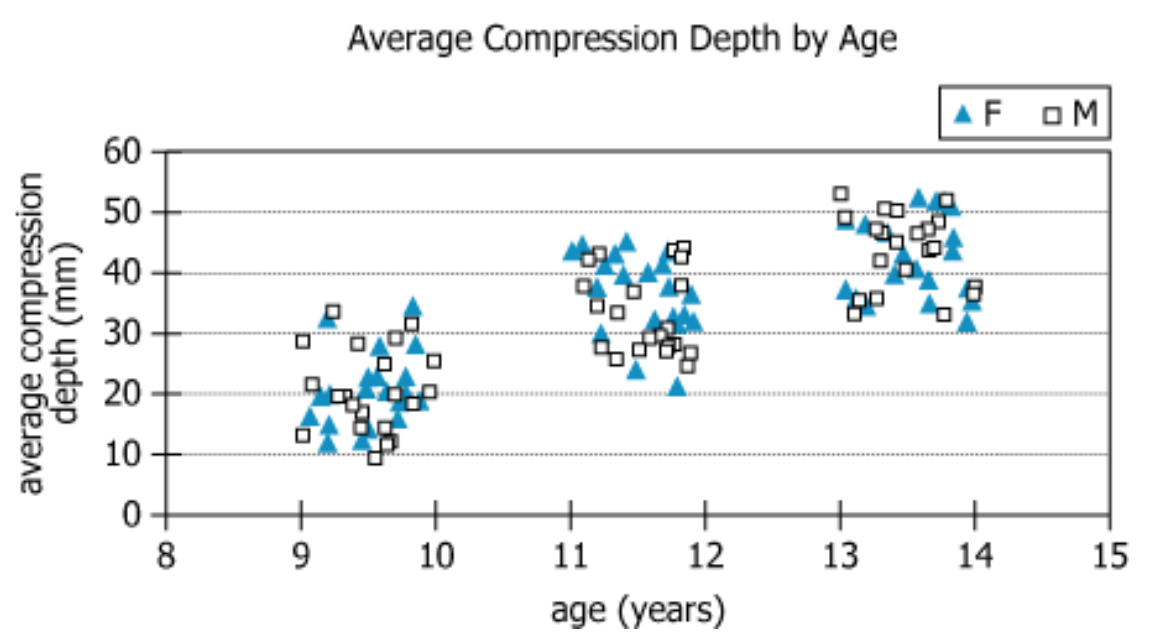
Average Compression Depth by Age.png [ 165.11 KiB | Viewed 17489 times ]
Attachment:
Average Compression Depth by Age.png [ 165.11 KiB | Viewed 17489 times ]
ShowHide Answer
Official Answer
Dropdown 1: both female and male children
Dropdown 2: 13 but less than 14
Every tricky question should trigger a follow up quiz.
Build that habit with
GMAT Club Forum Quiz →.
GMATCoachBen
Expert
Tutor
Joined: 21 Mar 2017
Last visit: 16 Sep 2026
Posts: 461
Given Kudos: 217
Status:Professional GMAT Trainer
Affiliations: GMAT Coach
Location: United States (WA)
GMAT Focus 1: 775 Q87 V90 DI88 (Online)
GMAT 1: 760 Q50 V44
GMAT 2: 770 Q51 V44
GMAT 3: 770 Q50 V44
GMAT 4: 770 Q50 V45 (Online)
GMAT 5: 780 Q51 V48
Expert reply
08 Feb 2024, 20:57
Kudos
Bookmarks
Video solution here:
General Discussion
 04 Mar 2025, 06:10
Kudos
Bookmarks
Part 1—When the age increases in each category, the compression depth also increases for the majority of the points, which tells you that it is for both males and females age and average compression are positively Correlated.
Part 2 - This is evident from the graph. The median of the children whose average compression depths are in the ideal range of depths are children from at least 13 years old but less than 14 years old category.
Hope this helps
Part 2 - This is evident from the graph. The median of the children whose average compression depths are in the ideal range of depths are children from at least 13 years old but less than 14 years old category.
Hope this helps





