Events & Promotions
|
|

GMAT Club Daily Prep
Thank you for using the timer - this advanced tool can estimate your performance and suggest more practice questions. We have subscribed you to Daily Prep Questions via email.
Customized
for You
Track
Your Progress
Practice
Pays
Not interested in getting valuable practice questions and articles delivered to your email? No problem, unsubscribe here.
 Sep 15
07:00 PM EDT
-09:00 PM EST
Elite scores are possible when you enroll in a powerful GMAT course, taught live online + 6 months access to TTP OnDemand video courses included! Class starts Tues/Thurs Sept. 15, 2026 - Nov. 15, 2027, 7:00pm-9:00pm EST Sep 18
08:00 PM PDT
-09:00 PM PDT
Video explanations + diagnosis of 10 weakest areas + 150+ short videos + study plan! Sep 21
07:00 PM EDT
-10:00 PM EDT
Boost your GMAT score in less than one month in a live online class + 6 months access to TTP OnDemand video courses included! Class starts Mon, Tues, Wed, Thur, Fri Sept. 21, 2026 - Oct. 9, 2027, 7:00pm-10:00pm EST


 11 Mar 2024, 10:08
Kudos
Bookmarks


C
Be sure to select an answer first to save it in the Error Log before revealing the correct answer (OA)!
Difficulty:
 25%
(medium)
25%
(medium)
Question Stats:
77% (01:29) correct 23%
(01:40)
wrong
based on 879
sessions
23%
(01:40)
wrong
based on 879
sessions
History
Date
Time
Result
Not Attempted Yet
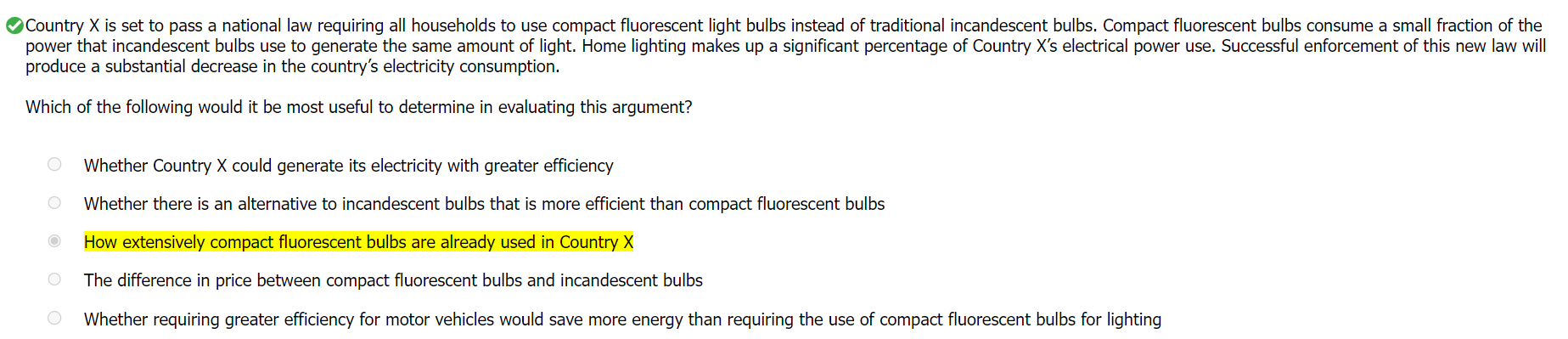
Country X is set to pass a national law requiring all households to use compact fluorescent light bulbs instead of traditional incandescent bulbs. Compact fluorescent bulbs consume a small fraction of the power that incandescent bulbs use to generate the same amount of light. Home lighting makes up a significant percentage of Country X’s electrical power use. Successful enforcement of this new law will produce a substantial decrease in the country’s electricity consumption.
Which of the following would it be most useful to determine in evaluating this argument?
A. Whether Country X could generate its electricity with greater efficiency
B. Whether there is an alternative to incandescent bulbs that is more efficient than compact fluorescent bulbs
C. How extensively compact fluorescent bulbs are already used in Country X
D. The difference in price between compact fluorescent bulbs and incandescent bulbs
E. Whether requiring greater efficiency for motor vehicles would save more energy than requiring the use of compact fluorescent bulbs for lighting
GMAT-Club-Forum-ju2ijcs3.png [ 97.41 KiB | Viewed 2890 times ]
Which of the following would it be most useful to determine in evaluating this argument?
A. Whether Country X could generate its electricity with greater efficiency
B. Whether there is an alternative to incandescent bulbs that is more efficient than compact fluorescent bulbs
C. How extensively compact fluorescent bulbs are already used in Country X
D. The difference in price between compact fluorescent bulbs and incandescent bulbs
E. Whether requiring greater efficiency for motor vehicles would save more energy than requiring the use of compact fluorescent bulbs for lighting
Attachment:
GMAT-Club-Forum-ju2ijcs3.png [ 97.41 KiB | Viewed 2890 times ]
Using official mocks already?
Add GMAT Club Tests for harder practice, analytics, and explanations without overlapping Official Guide or official mock questions.
Try it now →
Try it now →
 11 Mar 2024, 11:11
Kudos
Bookmarks
Bunuel
(A) Generation of electricity is of no use, we are interested in electricity consumption.
(B) Alternative not under discussion and out of scope.
(C) Can be true, if 90% already use then the law will have minimum effect.
(D) Difference in price not relevant to substantial decrease in the country’s electricity consumption.
(E) greater efficiency for motor vehicles - Out of scope...
Hence, IMHO (C)


 28 Oct 2024, 05:35
Kudos
Bookmarks
Between C and D
C. How extensively compact fluorescent bulbs are already used in Country X
YES, it will be most useful to determine in evaluating this argument. If this is already high (close to 100%), then successful enforcement of this new law will NOT produce a substantial decrease in the country’s electricity consumption.
D. The difference in price between compact fluorescent bulbs and incandescent bulbs.
Price is irrelevant here because this national law requires all households to use compact fluorescent light bulbs. (even if cost is high).
C. How extensively compact fluorescent bulbs are already used in Country X
YES, it will be most useful to determine in evaluating this argument. If this is already high (close to 100%), then successful enforcement of this new law will NOT produce a substantial decrease in the country’s electricity consumption.
D. The difference in price between compact fluorescent bulbs and incandescent bulbs.
Price is irrelevant here because this national law requires all households to use compact fluorescent light bulbs. (even if cost is high).