Events & Promotions
|
|

GMAT Club Daily Prep
Thank you for using the timer - this advanced tool can estimate your performance and suggest more practice questions. We have subscribed you to Daily Prep Questions via email.
Customized
for You
Track
Your Progress
Practice
Pays
Not interested in getting valuable practice questions and articles delivered to your email? No problem, unsubscribe here.
 Sep 21
07:00 PM EDT
-10:00 PM EDT
Boost your GMAT score in less than one month in a live online class + 6 months access to TTP OnDemand video courses included! Sep 23
12:30 AM EDT
-01:30 AM EDT
Learn how Keshav, a Chartered Accountant, scored an impressive 705 on GMAT in just 30 days with GMATWhiz's expert guidance. In this video, he shares preparation tips and strategies that worked for him, including the mock, time management, and more Sep 24
01:30 AM EDT
-01:30 AM EDT
Tejas studied hard but kept repeating the same mistakes. After 3 attempts at 645, a focused 4-week strategy helped him identify and fix what was holding him back—leading to a 695 with just 12–15 hours of study per week. Sep 26
06:00 PM PDT
-07:00 PM PDT
Free- full-length test + 15 concept videos + 150+ short videos + study plan!

 03 Aug 2024, 11:09
Kudos
Bookmarks


Aditi: Could achieve the stated goal
Dhruv: Could NOT achieve the stated goal
Raj: Could NOT achieve the stated goal
Be sure to select an answer first to save it in the Error Log before revealing the correct answer (OA)!
Difficulty:
 95%
(hard)
95%
(hard)
Question Stats:
52% (02:37) correct 48%
(02:43)
wrong
based on 1251
sessions
48%
(02:43)
wrong
based on 1251
sessions
History
Date
Time
Result
Not Attempted Yet
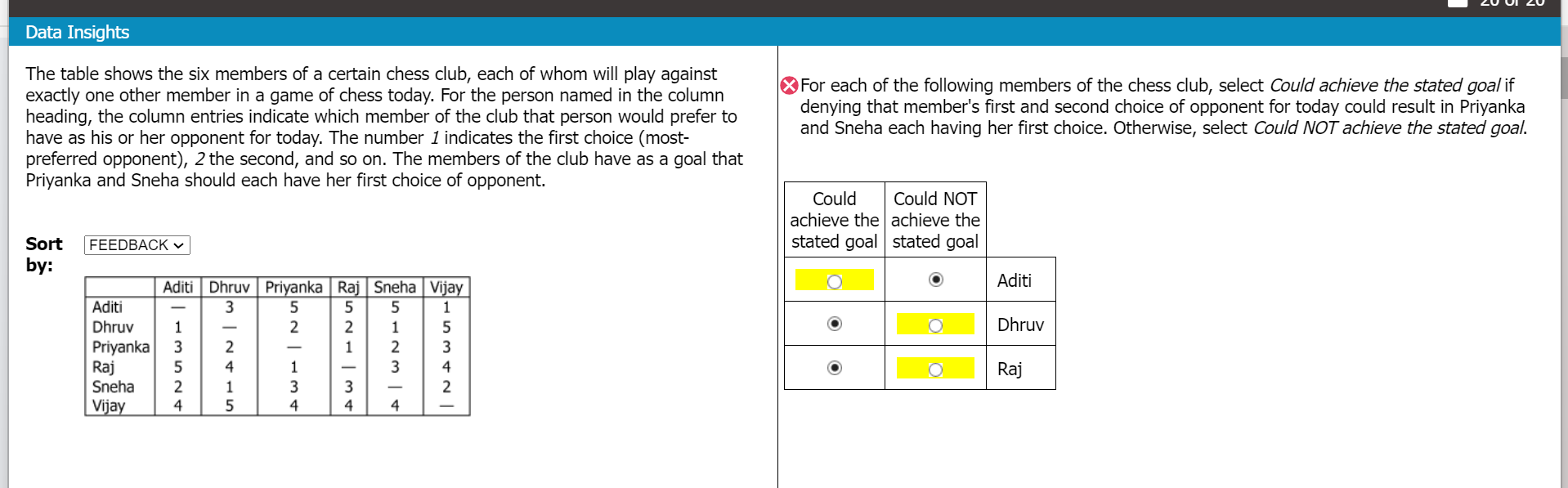
The table shows the Six members of a certain chess club, each of whom will play against exactly one other member in a game of chess today. For the person named in the column heading, the column entries indicate which member of the club that person would prefer to have as his or her opponent for today. The number 1 indicates the first choice (most- preferred opponent), 2 the second, and so on. The members of the club have as a goal that Priyanka and Sneha should each have her first choice of opponent.
For each of the following members of the chess club, select Could achieve the stated goal if denying that member’s first and second choice of opponent for today could result in Priyanka and Sneha each having her first choice. Otherwise, select Could NOT achieve the stated goal.

GMAT-Club-Forum-c1041bri.png [ 134.38 KiB | Viewed 7315 times ]
| Aditi | Dhruv | Priyanka | Raj | Sneha | Vijay | |
|---|---|---|---|---|---|---|
| Aditi | - | 3 | 5 | 5 | 5 | 1 |
| Dhruv | 1 | - | 2 | 2 | 1 | 5 |
| Priyanka | 3 | 2 | - | 1 | 2 | 3 |
| Raj | 5 | 4 | 1 | - | 3 | 4 |
| Sneha | 2 | 1 | 3 | 3 | - | 2 |
| Vijay | 4 | 5 | 4 | 4 | 4 | - |
For each of the following members of the chess club, select Could achieve the stated goal if denying that member’s first and second choice of opponent for today could result in Priyanka and Sneha each having her first choice. Otherwise, select Could NOT achieve the stated goal.
Attachment:
GMAT-Club-Forum-c1041bri.png [ 134.38 KiB | Viewed 7315 times ]
| Could achieve the stated goal | Could NOT achieve the stated goal | |
| Aditi | ||
| Dhruv | ||
| Raj |
ShowHide Answer
Official Answer
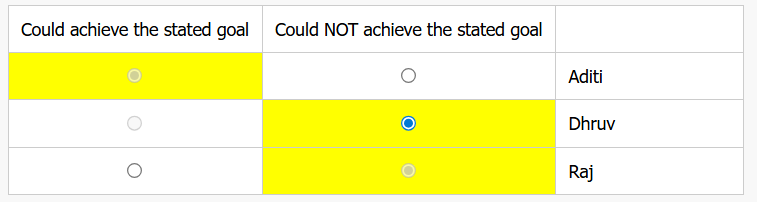
Aditi: Could achieve the stated goal
Dhruv: Could NOT achieve the stated goal
Raj: Could NOT achieve the stated goal
Pro tip:
Combine official questions for familiarity with GMAT Club Tests for analytics and tougher Focus-level practice so the real exam feels manageable.
Explore →
 30 Dec 2024, 02:08
Kudos
Bookmarks
Shakira876
GOAL: Priyanka and Sneha should each have her first choice of opponent.
Priyanka - Raj
Sneha - Dhruv
If goal is met, only Aditi and Vijay are left so of course they need to be paired together.
Goal is met only if the pairing is the following:
Priyanka - Raj
Sneha - Dhruv
Aditi - Vijay
1. Aditi
If Aditi is denied her 1st and 2nd choices, i.e. Dhruv and Sneha, it is possible that she gets Vijay and pairing is as the goal indicates. Hence it is possible to achieve the goal. Not necessary, but possible.
Select 'Could achieve the stated goal'
2. Dhruv
If Dhruv is denied Sneha and Priyanka, "Sneha - Dhruv" pairing is not possible. Hence goal will not be achieved.
Select 'Could NOT achieve the stated goal'
3. Raj
If Raj is denied Priyanka and Dhruv, "Priyanka - Raj" pairing is not possible. Hence goal will not be achieved.
Select 'Could NOT achieve the stated goal'
Attachment:
GMAT-Club-Forum-rxja8wek.png [ 134.38 KiB | Viewed 7189 times ]

 29 Nov 2025, 11:39
Kudos
Bookmarks
The table shows the Six members of a certain chess club, each of whom will play against exactly one other member in a game of chess today. For the person named in the column heading, the column entries indicate which member of the club that person would prefer to have as his or her opponent for today. The number 1 indicates the first choice (most- preferred opponent), 2 the second, and so on. The members of the club have as a goal that Priyanka and Sneha should each have her first choice of opponent.
For each of the following members of the chess club, select Could achieve the stated goal if denying that member’s first and second choice of opponent for today could result in Priyanka and Sneha each having her first choice. Otherwise, select Could NOT achieve the stated goal.
First pin down what the “goal” actually means: the goal is that Priyanka and Sneha each get their first-choice opponent. This does not mean that they have to pick first or that they have any priority over the others; it just means that, in the final matching, we want each of them to be paired with her own first choice. From the table (column = person’s preferences):
• Priyanka’s first choice is Raj
• Sneha’s first choice is Dhruv
So to achieve the goal we must have these pairs:
• Priyanka - Raj
• Sneha - Dhruv
That uses up Priyanka, Raj, Sneha, and Dhruv. The only two people left are Aditi and Vijay, so they must play each other. So there is exactly one pairing that achieves the goal:
• Priyanka - Raj
• Sneha - Dhruv
• Aditi - Vijay
Now, let's check what the question wants from us: for each of Aditi, Dhruv, and Raj, we need to see whether we can still get this exact pairing if that person does not get either their first or second choice of opponent. If we can, then we “Could achieve the stated goal”; if we cannot, then we “Could NOT achieve the stated goal.”
1. Aditi
Aditi’s column:
1st choice: Dhruv
2nd choice: Sneha
To achieve the goal, Aditi is matched with Vijay. Vijay is not one of her top two choices, so we could indeed deny Aditi both her 1st and 2nd choices and still achieve the goal.
So, if Aditi is denied her first and second choice of opponent, the club Could achieve the stated goal.
2. Dhruv
Dhruv’s column:
1st choice: Sneha
2nd choice: Priyanka
To achieve the goal, Dhruv must be paired with Sneha. But Sneha is his 1st choice, and he is not allowed to be paired with either his first or his second choice. So Dhruv cannot be paired with Sneha, and the goal cannot be achieved.
So, if Dhruv is denied his first and second choice of opponent, the club Could NOT achieve the stated goal.
3. Raj
Raj’s column:
1st choice: Priyanka
2nd choice: Dhruv
To achieve the goal, Raj must be paired with Priyanka. But Priyanka is his 1st choice, and he is not allowed to be paired with either his first or his second choice. So Raj cannot be paired with Priyanka, and the goal cannot be achieved.
So, if Raj is denied his first and second choice of opponent, the club Could NOT achieve the stated goal.

GMAT-Club-Forum-26kn5bud.png [ 12.3 KiB | Viewed 3870 times ]
| Aditi | Dhruv | Priyanka | Raj | Sneha | Vijay | |
|---|---|---|---|---|---|---|
| Aditi | - | 3 | 5 | 5 | 5 | 1 |
| Dhruv | 1 | - | 2 | 2 | 1 | 5 |
| Priyanka | 3 | 2 | - | 1 | 2 | 3 |
| Raj | 5 | 4 | 1 | - | 3 | 4 |
| Sneha | 2 | 1 | 3 | 3 | - | 2 |
| Vijay | 4 | 5 | 4 | 4 | 4 | - |
For each of the following members of the chess club, select Could achieve the stated goal if denying that member’s first and second choice of opponent for today could result in Priyanka and Sneha each having her first choice. Otherwise, select Could NOT achieve the stated goal.
First pin down what the “goal” actually means: the goal is that Priyanka and Sneha each get their first-choice opponent. This does not mean that they have to pick first or that they have any priority over the others; it just means that, in the final matching, we want each of them to be paired with her own first choice. From the table (column = person’s preferences):
• Priyanka’s first choice is Raj
• Sneha’s first choice is Dhruv
So to achieve the goal we must have these pairs:
• Priyanka - Raj
• Sneha - Dhruv
That uses up Priyanka, Raj, Sneha, and Dhruv. The only two people left are Aditi and Vijay, so they must play each other. So there is exactly one pairing that achieves the goal:
• Priyanka - Raj
• Sneha - Dhruv
• Aditi - Vijay
Now, let's check what the question wants from us: for each of Aditi, Dhruv, and Raj, we need to see whether we can still get this exact pairing if that person does not get either their first or second choice of opponent. If we can, then we “Could achieve the stated goal”; if we cannot, then we “Could NOT achieve the stated goal.”
1. Aditi
Aditi’s column:
1st choice: Dhruv
2nd choice: Sneha
To achieve the goal, Aditi is matched with Vijay. Vijay is not one of her top two choices, so we could indeed deny Aditi both her 1st and 2nd choices and still achieve the goal.
So, if Aditi is denied her first and second choice of opponent, the club Could achieve the stated goal.
2. Dhruv
Dhruv’s column:
1st choice: Sneha
2nd choice: Priyanka
To achieve the goal, Dhruv must be paired with Sneha. But Sneha is his 1st choice, and he is not allowed to be paired with either his first or his second choice. So Dhruv cannot be paired with Sneha, and the goal cannot be achieved.
So, if Dhruv is denied his first and second choice of opponent, the club Could NOT achieve the stated goal.
3. Raj
Raj’s column:
1st choice: Priyanka
2nd choice: Dhruv
To achieve the goal, Raj must be paired with Priyanka. But Priyanka is his 1st choice, and he is not allowed to be paired with either his first or his second choice. So Raj cannot be paired with Priyanka, and the goal cannot be achieved.
So, if Raj is denied his first and second choice of opponent, the club Could NOT achieve the stated goal.
Attachment:
GMAT-Club-Forum-26kn5bud.png [ 12.3 KiB | Viewed 3870 times ]