Events & Promotions
| Last visit was: 27 Sep 2026, 00:10 |
It is currently 27 Sep 2026, 00:10 |
|
|

GMAT Club Daily Prep
Thank you for using the timer - this advanced tool can estimate your performance and suggest more practice questions. We have subscribed you to Daily Prep Questions via email.
Customized
for You
Track
Your Progress
Practice
Pays
Not interested in getting valuable practice questions and articles delivered to your email? No problem, unsubscribe here.
 Sep 27
01:30 AM EDT
-02:30 AM EDT
At one point, she believed GMAT wasn’t for her. After scoring 595, self-doubt crept in and she questioned her potential. But instead of quitting, she made the right strategic changes. The result? A remarkable comeback to 695. Check out how Saakshi did it. Sep 28
07:00 PM EDT
-10:00 PM EDT
Boost your GMAT score in less than one month in a live online class + 6 months access to TTP OnDemand video courses included! Class starts Mon, Tues, Wed, Thur, Fri Sept. 28, 2026 - Oct. 16, 2027, 7:00pm-10:00pm EST Sep 29
11:00 AM EDT
-01:00 PM EDT
" Description: Top scores are possible when you enroll in a powerful GMAT course, taught live online + 6 months access to TTP OnDemand video courses included! Class starts Tues/Thur Sept. 29, 2026 - Dec. 3, 2026, 11:00am-1:00pm EST Oct 01
02:00 AM EDT
-03:00 AM EDT
Tejas studied hard but kept repeating the same mistakes. After 3 attempts at 645, a focused 4-week strategy helped him identify and fix what was holding him back—leading to a 695 with just 12–15 hours of study per week. Oct 01
07:00 AM BST
-08:00 AM GMT
Welcome to the GMAT Club's Free Interview Prep Event for Top MBA Programs! Buy tickets - Virtual series that’s all set to equip you to -excel in your MBA interviews. Oct 03
01:00 PM EDT
-04:00 PM EDT
Top scores are possible when you enroll in a powerful GMAT course, taught live online + 6 months access to TTP OnDemand video courses included! Class starts Saturdays Oct. 3, 2026 - Dec. 26, 2026, 1:00pm-4:00pm EST

 19 Aug 2024, 01:52
Kudos
Bookmarks


Dropdown 1: less than
Dropdown 2: none
Be sure to select an answer first to save it in the Error Log before revealing the correct answer (OA)!
Difficulty:
 35%
(medium)
35%
(medium)
Question Stats:
73% (01:57) correct 27%
(02:36)
wrong
based on 2167
sessions
27%
(02:36)
wrong
based on 2167
sessions
History
Date
Time
Result
Not Attempted Yet
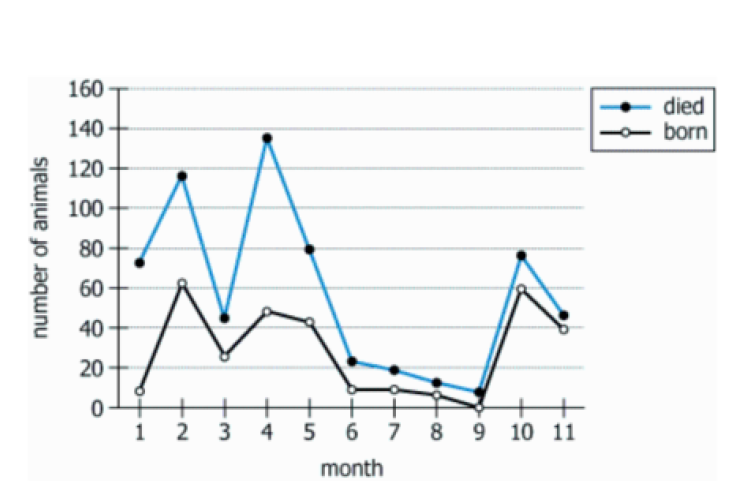
The graph refers to a captive population of animals. For each month of a consecutive 11-month period, it depicts the number of animals that died and the number of animals that were born. These were the only population changes; no animals joined the population from outside, and no animals (except those that died and were removed) left the population.
Based on the information provided, select from each drop-down menu the option that creates the most accurate statement.
At the end of the 11-month period, the number of animals in the population was the number of animals in the population at the beginning of the period.
The monthly totals of births and deaths resulted in a net population increase in of the months.
The graph refers to a captive population of animals. For each month of a consecutive 11-month period, it depicts the number of animals that died and the number of animals that were born. These were the only population changes; no animals joined the population from outside, and no animals (except those that died and were removed) left the population.
Based on the information provided, select from each drop-down menu the option that creates the most accurate statement.
At the end of the 11-month period, the number of animals in the population was the number of animals in the population at the beginning of the period.
The monthly totals of births and deaths resulted in a net population increase in of the months.
ShowHide Answer
Official Answer
Dropdown 1: less than
Dropdown 2: none
 08 Sep 2024, 18:59
Kudos
Bookmarks
Let me answer this question.
1) At the end of the 11-month period, the number of animals in the population was less than
the number of animals in the population at the beginning of the period.
Reason: In all the months Died numbers were higher than born. So after 11 months total no. of animals will decrease.
2) The monthly totals of births and deaths resulted in a net population increase in none of the months.
Reason: Because at no month born number was more than died. (Black line (born) was always less than blue (died))
1) At the end of the 11-month period, the number of animals in the population was less than
the number of animals in the population at the beginning of the period.
Reason: In all the months Died numbers were higher than born. So after 11 months total no. of animals will decrease.
2) The monthly totals of births and deaths resulted in a net population increase in none of the months.
Reason: Because at no month born number was more than died. (Black line (born) was always less than blue (died))
General Discussion
 07 Sep 2024, 01:36
Kudos
Bookmarks

AKT16
Joined: 20 Oct 2021
Last visit: 21 Feb 2026
Posts: 113
Own Kudos:
Given Kudos: 151
Location: India
Concentration: Operations, General Management
Schools: Broad'26 (D)
GMAT Focus 1: 645 Q87 V80 DI78 
GMAT Focus 2: 675 Q86 V83 DI81
GMAT 1: 660 Q50 V29
WE:Manufacturing and Production (Manufacturing)
07 Sep 2024, 07:37
Kudos
Bookmarks
In the above graph,every month more animals are died than born.
Definitely number of animals are decreased.
Posted from my mobile device
Definitely number of animals are decreased.
Posted from my mobile device






