Events & Promotions
|
|

GMAT Club Daily Prep
Thank you for using the timer - this advanced tool can estimate your performance and suggest more practice questions. We have subscribed you to Daily Prep Questions via email.
Customized
for You
Track
Your Progress
Practice
Pays
Not interested in getting valuable practice questions and articles delivered to your email? No problem, unsubscribe here.
 Sep 15
07:00 PM EDT
-09:00 PM EST
Elite scores are possible when you enroll in a powerful GMAT course, taught live online + 6 months access to TTP OnDemand video courses included! Class starts Tues/Thurs Sept. 15, 2026 - Nov. 15, 2027, 7:00pm-9:00pm EST Sep 18
08:00 PM PDT
-09:00 PM PDT
Video explanations + diagnosis of 10 weakest areas + 150+ short videos + study plan! Sep 21
07:00 PM EDT
-10:00 PM EDT
Boost your GMAT score in less than one month in a live online class + 6 months access to TTP OnDemand video courses included! Class starts Mon, Tues, Wed, Thur, Fri Sept. 21, 2026 - Oct. 9, 2027, 7:00pm-10:00pm EST


Dropdown 1: Peanut and Chicken Breast
Dropdown 2: Shrimp and Pork Chops
Be sure to select an answer first to save it in the Error Log before revealing the correct answer (OA)!
Difficulty:
 95%
(hard)
95%
(hard)
Question Stats:
49% (01:54) correct 51%
(02:05)
wrong
based on 465
sessions
51%
(02:05)
wrong
based on 465
sessions
History
Date
Time
Result
Not Attempted Yet
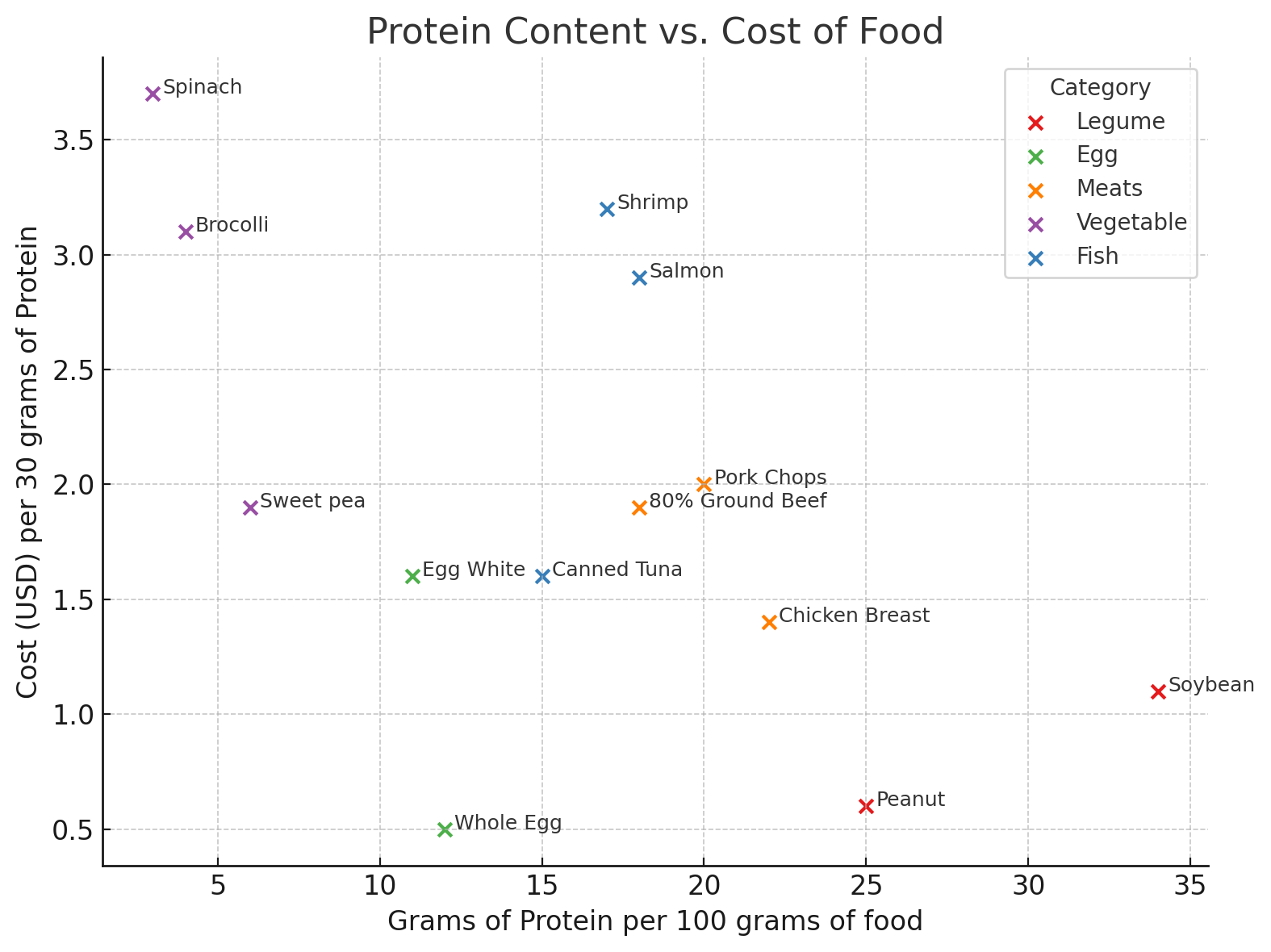
The chart above shows the relationship between grams of protein per 100 grams of food and the cost (USD) per 30 grams of protein for various food items. The data points are labeled with the food name, and the color represents the food category of each item.
From each drop-down menu, select the option that creates the most accurate statement based on the information provided.
A family looking to incorporate two different food categories at the lowest cost, with each food having more than 20 grams of protein per 100 grams of food, should include in their diet.
A family looking to incorporate two different food categories at the highest cost, with each food having at least 15 grams of protein per 100 grams of food, should include in their diet.
Attachment:
GMAT-Club-Forum-44veejpv.png [ 92.87 KiB | Viewed 1727 times ]
ShowHide Answer
Official Answer
Dropdown 1: Peanut and Chicken Breast
Dropdown 2: Shrimp and Pork Chops


 15 Apr 2025, 02:34
Kudos
Bookmarks
Official Solution:
Drop-down 1:
• We are asked to select two food items that both have more than 20 grams of protein per 100 grams of food. Additionally, the two items must come from different food categories.
Looking at the chart, we see that several foods meet the protein requirement — including Peanut, Soybean, and Chicken Breast. However, Peanut and Soybean both belong to the Legume category, so selecting both would violate the condition of using two different categories.
Peanut (Legume) has the lowest cost among qualifying foods. To meet the requirement of using a different category, we must pair Peanut with the lowest-cost item from another category — which is Chicken Breast (Meats).
Drop-down 2:
• We are asked to select two food items that each have at least 15 grams of protein per 100 grams of food. Again, the two items must come from different food categories.
Looking at the chart, Shrimp (Fish) has the highest cost among qualifying foods. To meet the requirement of using a different category, the next most expensive item is Pork Chops (Meats).
Correct answer:
Dropdown 1: "Peanut and Chicken Breast"
Dropdown 2: "Shrimp and Pork Chops"
Bunuel
Drop-down 1:
• We are asked to select two food items that both have more than 20 grams of protein per 100 grams of food. Additionally, the two items must come from different food categories.
Looking at the chart, we see that several foods meet the protein requirement — including Peanut, Soybean, and Chicken Breast. However, Peanut and Soybean both belong to the Legume category, so selecting both would violate the condition of using two different categories.
Peanut (Legume) has the lowest cost among qualifying foods. To meet the requirement of using a different category, we must pair Peanut with the lowest-cost item from another category — which is Chicken Breast (Meats).
Drop-down 2:
• We are asked to select two food items that each have at least 15 grams of protein per 100 grams of food. Again, the two items must come from different food categories.
Looking at the chart, Shrimp (Fish) has the highest cost among qualifying foods. To meet the requirement of using a different category, the next most expensive item is Pork Chops (Meats).
Correct answer:
Dropdown 1: "Peanut and Chicken Breast"
Dropdown 2: "Shrimp and Pork Chops"
General Discussion
 13 Sep 2024, 03:32
Kudos
Bookmarks
Just keep in mind the question asks us to select 2 different FOOD CATEGORY. Hence Peanut and Chicken as lowest and Shrimp and Pork as highest.




