Thank you for using the timer - this advanced tool can estimate your performance and suggest more practice questions. We have subscribed you to Daily Prep Questions via email.
Customized for You
we will pick new questions that match your level based on your Timer History
Track Your Progress
every week, we’ll send you an estimated GMAT score based on your performance
Practice Pays
we will pick new questions that match your level based on your Timer History
Not interested in getting valuable practice questions and articles delivered to your email? No problem, unsubscribe here.
Thank you for using the timer!
We noticed you are actually not timing your practice. Click the START button first next time you use the timer.
There are many benefits to timing your practice, including:
Struggling with GMAT Verbal as a non-native speaker? Harsh improved his score from 595 to 695 in just 45 days—and scored a 99 %ile in Verbal (V88)! Learn how smart strategy, clarity, and guided prep helped him gain 100 points.
At one point, she believed GMAT wasn’t for her. After scoring 595, self-doubt crept in and she questioned her potential. But instead of quitting, she made the right strategic changes. The result? A remarkable comeback to 695. Check out how Saakshi did it.
The Target Test Prep course represents a quantum leap forward in GMAT preparation, a radical reinterpretation of the way that students should study. Try before you buy with a 5-day, full-access trial of the course for FREE!
Prefer video-based learning? The Target Test Prep OnDemand course is a one-of-a-kind video masterclass featuring 400 hours of lecture-style teaching by Scott Woodbury-Stewart, founder of Target Test Prep and one of the most accomplished GMAT instructors
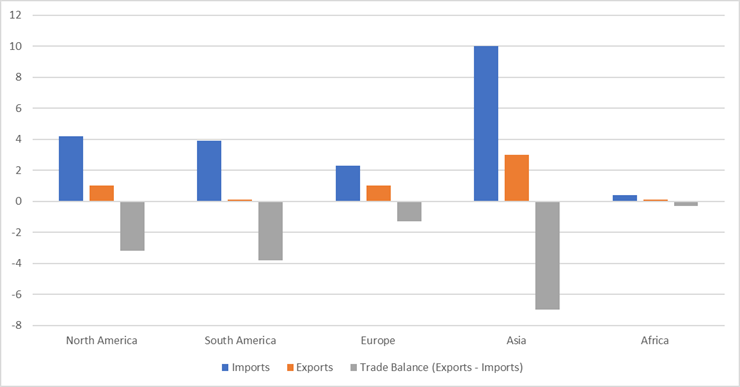
The graph shows the trade value of edible fishery products between the United States and various regions, measured in billions of dollars in 2018.
If in 2018, 20% of U.S. exports to Asia were to India, and 40% of U.S. imports from Asia were from India, then the trade deficit with India accounted for approximately of the U.S. trade deficit with Asia.
The U.S. would have had to its level of edible fishery exports to eliminate its total trade deficit.
The graph shows the trade value of edible fishery products between the United States and various regions, measured in billions of dollars in 2018.
If in 2018, 20% of U.S. exports to Asia were to India, and 40% of U.S. imports from Asia were from India, then the trade deficit with India accounted for approximately of the U.S. trade deficit with Asia.
The U.S. would have had to its level of edible fishery exports to eliminate its total trade deficit.
Show more
Drop-down 1:
U.S. exports to Asia were 3 billion, and 20% of that would be 0.6 billion. U.S. imports from Asia were 10 billion, and 40% of that would be 4 billion. The trade deficit with India, therefore, would be 0.6 billion - 4 billion = -3.4 billion, which is approximately 50% of the total deficit with Asia, which is 7 billion.
Drop-down 2:
The total export from the U.S. is approximately \(1 + 0.1 + 1 + 3 + 0.1 = 5.2\) billion, while the total import is \(4.2 + 3.9 + 2.3 + 10 + 0.4 = 20.8\) billion. Therefore, the U.S. would have had to increase its level of edible fishery exports fourfold to eliminate the trade deficit.
I saw "increase 3 times its level of exports" as Exports + 3*Exports.
Like if you heard "increase once" you'd expect "Something + Something". Likewise, "Increase twice", you'd expect something has been added twice "Something + 2*Something".
It seems GMAT is consistent in this regard. There are lots of other problems where you have to be careful with whether it is a X multiplier or a (X-1)% increase.
Are you supposed to just guess?
Bunuel
Official Solution:
Bunuel
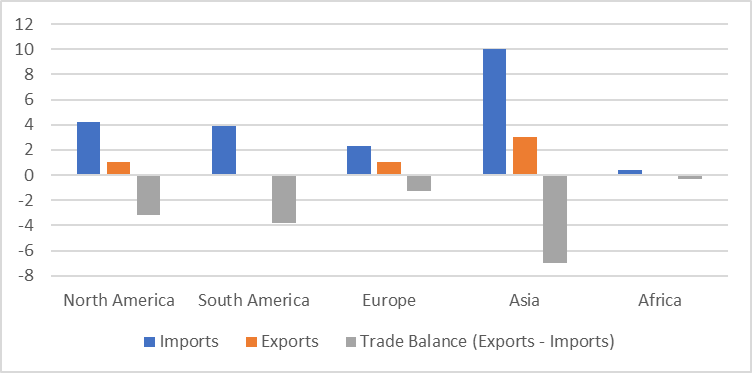
The graph shows the trade value of edible fishery products between the United States and various regions, measured in billions of dollars in 2018.
If in 2018, 20% of U.S. exports to Asia were to India, and 40% of U.S. imports from Asia were from India, then the trade deficit with India accounted for approximately of the U.S. trade deficit with Asia.
The U.S. would have had to its level of edible fishery exports to eliminate the trade deficit.
Drop-down 1:
U.S. exports to Asia were 3 billion, and 20% of that would be 0.6 billion. U.S. imports from Asia were 10 billion, and 40% of that would be 4 billion. The trade deficit with India, therefore, would be 0.6 billion - 4 billion = -3.4 billion, which is approximately 50% of the total deficit with Asia, which is 7 billion.
Drop-down 2:
The total export from the U.S. is approximately \(1 + 0.1 + 1 + 3 + 0.1 = 5.2\) billion, while the total import is \(4.2 + 3.9 + 2.3 + 10 + 0.4 = 20.8\) billion. Therefore, the U.S. would have had to increase its level of edible fishery exports fourfold to eliminate the trade deficit.
I saw "increase 3 times its level of exports" as Exports + 3*Exports.
Like if you heard "increase once" you'd expect "Something + Something". Likewise, "Increase twice", you'd expect something has been added twice "Something + 2*Something".
It seems GMAT is consistent in this regard. There are lots of other problems where you have to be careful with whether it is a X multiplier or a (X-1)% increase.
Are you supposed to just guess?
Bunuel
Official Solution:
Bunuel
The graph shows the trade value of edible fishery products between the United States and various regions, measured in billions of dollars in 2018.
If in 2018, 20% of U.S. exports to Asia were to India, and 40% of U.S. imports from Asia were from India, then the trade deficit with India accounted for approximately of the U.S. trade deficit with Asia.
The U.S. would have had to its level of edible fishery exports to eliminate the trade deficit.
Drop-down 1:
U.S. exports to Asia were 3 billion, and 20% of that would be 0.6 billion. U.S. imports from Asia were 10 billion, and 40% of that would be 4 billion. The trade deficit with India, therefore, would be 0.6 billion - 4 billion = -3.4 billion, which is approximately 50% of the total deficit with Asia, which is 7 billion.
Drop-down 2:
The total export from the U.S. is approximately \(1 + 0.1 + 1 + 3 + 0.1 = 5.2\) billion, while the total import is \(4.2 + 3.9 + 2.3 + 10 + 0.4 = 20.8\) billion. Therefore, the U.S. would have had to increase its level of edible fishery exports fourfold to eliminate the trade deficit.
Correct answer:
Dropdown 1: "50%"
Dropdown 2: "increase four times "
Show more
Increase 3 times means something multiplied by 3. There is no ambiguity in that. I think you are confusing 3 times more and 3 times as many, which also mean the same thing.
Here is my post from another topic addressing this issue:
Agree that it's confusing but check below:
Merriam Webster's Dictionary of English Usage:
The argument in this case is that times more (or times larger, times stronger, times brighter, etc.) is ambiguous, so that "He has five times more money than you" can be misunderstood as meaning "He has six times as much money as you." It is, in fact, possible to misunderstand times more in this way, but it takes a good deal of effort. If you have $100, five times that is $500, which means that "five times more than $100" can mean (the commentators claim) "$500 more than $100," which equals "$600," which equals "six times as much as $100." The commentators regard this as a serious ambiguity, and they advise you to avoid it by always saying "times as much" instead of "times more." Here again, it seems that they are paying homage to mathematics at the expense of language. The fact is that "five times more" and "five times as much" are idiomatic phrases which have - and are understood to have - exactly the same meaning.
The "ambiguity" of times more is imaginary: in the world of actual speech and writing, the meaning of times more is clear and unequivocal. It is an idiom that has existed in our language for more than four centuries, and there is no real reason to avoid its use.
ethanhunt007 Hi, I have an issue with the phrase "greater than"
If I say X is twice of Y, then it should mean --> X = 2Y If I say X is two times greater than Y, shouldn't it mean --> X = 3Y
There seems to be some confusion about this earlier in this thread. The phrase "X is 2 times greater than Y" simply means that X = 2Y. It's understandable that this might seem confusing, because if instead we say "X is 200% greater than Y" we definitely mean that X = 3Y, but this all boils down to idiomatic usage in English. If you think of smaller numbers, it might be clear this is how the phrase is used in the language (there's a reason you've never heard anyone say "X is 1 times greater than Y" to mean that X is twice as big as Y), and it's also what the dictionary says, as quoted at this link:
Hi sir, this is my first post or any kind of content here
Just a question: How do we infer/indirectly the graph's value such as 4.2 or 3.9 or etc. I mean pls correct me if I missed anything, but middle values I can understand. Without minute scaling it's tough to assume it right?
- Sai Krishna A (India)
Bunuel
Official Solution:
Bunuel
The graph shows the trade value of edible fishery products between the United States and various regions, measured in billions of dollars in 2018.
If in 2018, 20% of U.S. exports to Asia were to India, and 40% of U.S. imports from Asia were from India, then the trade deficit with India accounted for approximately of the U.S. trade deficit with Asia.
The U.S. would have had to its level of edible fishery exports to eliminate the trade deficit.
Drop-down 1:
U.S. exports to Asia were 3 billion, and 20% of that would be 0.6 billion. U.S. imports from Asia were 10 billion, and 40% of that would be 4 billion. The trade deficit with India, therefore, would be 0.6 billion - 4 billion = -3.4 billion, which is approximately 50% of the total deficit with Asia, which is 7 billion.
Drop-down 2:
The total export from the U.S. is approximately \(1 + 0.1 + 1 + 3 + 0.1 = 5.2\) billion, while the total import is \(4.2 + 3.9 + 2.3 + 10 + 0.4 = 20.8\) billion. Therefore, the U.S. would have had to increase its level of edible fishery exports fourfold to eliminate the trade deficit.
Hi sir, this is my first post or any kind of content here
Just a question: How do we infer/indirectly the graph's value such as 4.2 or 3.9 or etc. I mean pls correct me if I missed anything, but middle values I can understand. Without minute scaling it's tough to assume it right?
- Sai Krishna A (India)
Bunuel
Official Solution:
Bunuel
The graph shows the trade value of edible fishery products between the United States and various regions, measured in billions of dollars in 2018.
If in 2018, 20% of U.S. exports to Asia were to India, and 40% of U.S. imports from Asia were from India, then the trade deficit with India accounted for approximately of the U.S. trade deficit with Asia.
The U.S. would have had to its level of edible fishery exports to eliminate the trade deficit.
Drop-down 1:
U.S. exports to Asia were 3 billion, and 20% of that would be 0.6 billion. U.S. imports from Asia were 10 billion, and 40% of that would be 4 billion. The trade deficit with India, therefore, would be 0.6 billion - 4 billion = -3.4 billion, which is approximately 50% of the total deficit with Asia, which is 7 billion.
Drop-down 2:
The total export from the U.S. is approximately \(1 + 0.1 + 1 + 3 + 0.1 = 5.2\) billion, while the total import is \(4.2 + 3.9 + 2.3 + 10 + 0.4 = 20.8\) billion. Therefore, the U.S. would have had to increase its level of edible fishery exports fourfold to eliminate the trade deficit.
Correct answer:
Dropdown 1: "50%"
Dropdown 2: "increase four times "
Show more
You approximate values from the graph based on the available scaling. It may not provide exact values for every point, but close approximations are sufficient to solve such problems.
The total export from the U.S. is approximately \(1 + 0.1 + 1 + 3 + 0.1 = 5.2\) billion, while the total import is \(4.2 + 3.9 + 2.3 + 10 + 0.4 = 20.8\) billion. Therefore, the U.S. would have had to increase its level of edible fishery exports fourfold to eliminate the trade deficit.
Show more
Why are we finding imports/exports and not deficit/imports?
For example if Imports = 4Bn, Exports = 1Bn and Deficit = 3Bn, wouldn't you need just 3Bn to cover the deficit? 3Bn is 3 times more than exports (i.e. deficit/exports not imports/exports)
The total export from the U.S. is approximately \(1 + 0.1 + 1 + 3 + 0.1 = 5.2\) billion, while the total import is \(4.2 + 3.9 + 2.3 + 10 + 0.4 = 20.8\) billion. Therefore, the U.S. would have had to increase its level of edible fishery exports fourfold to eliminate the trade deficit.
Why are we finding imports/exports and not deficit/imports?
For example if Imports = 4Bn, Exports = 1Bn and Deficit = 3Bn, wouldn't you need just 3Bn to cover the deficit? 3Bn is 3 times more than exports (i.e. deficit/exports not imports/exports)
Show more
In your example, you need 3 billion. But increasing exports from 1 billion to 4 billion (adding 3 billion) means increasing exports 4 times.
I don’t quite agree with the solution. For 2nd part, Exports ~ 5 Bn, Imports ~20 Bn => Requirement ~15 Bn Why are we assuming that the demand is increasing here? The demand should be constant, right, i.e., delta change in exports should be (20+5)/2 - 5 = 7.5 -> Both of these should meet midway because once you increase the exports, the imports automatically should decrease, right?
Show more
No, increasing exports doesn't automatically decrease imports. The graph is based on actual trade values, not a fixed-demand model. Imports are given as fixed amounts, so to eliminate the deficit, we assume imports stay constant, and we calculate how much exports alone would need to rise to match total imports. That’s why we don’t "meet midway", we’re not adjusting imports here.
I like the solution - it’s helpful. TLDR • “increase by a factor of k” / “must scale by a factor of k” → multiply by k (GMAT: same) • “k times as large as ...” → multiply by k (GMAT: same) • “increase k %” or “k % larger/greater” → add k % of the original; final = (1 + k %) × original (GMAT: same) • “A is what percent of B?” → (A ÷ B) × 100 % (GMAT: same) • “By what factor must A grow to equal B?” → B ÷ A (GMAT: same)
Only real trap: “k times larger/greater/more than ...” – Literal math-purist reading: final = (k + 1) × original – GMAT/common usage: final = k × original