Events & Promotions
|
|

GMAT Club Daily Prep
Thank you for using the timer - this advanced tool can estimate your performance and suggest more practice questions. We have subscribed you to Daily Prep Questions via email.
Customized
for You
Track
Your Progress
Practice
Pays
Not interested in getting valuable practice questions and articles delivered to your email? No problem, unsubscribe here.
 Sep 26
06:00 PM PDT
-07:00 PM PDT
Free- full-length test + 15 concept videos + 150+ short videos + study plan! Sep 27
01:30 AM EDT
-02:30 AM EDT
At one point, she believed GMAT wasn’t for her. After scoring 595, self-doubt crept in and she questioned her potential. But instead of quitting, she made the right strategic changes. The result? A remarkable comeback to 695. Check out how Saakshi did it. Sep 26
12:30 AM EDT
-01:30 AM EDT
Struggling to find the right strategies to score a 99 %ile on GMAT Focus? Riya (GMAT 715) boosted her score by 100-points in just 15 days! Discover how the right mentorship, tailored strategies, and an unwavering mindset can transform your GMAT prep. Sep 28
07:00 PM EDT
-10:00 PM EDT
Boost your GMAT score in less than one month in a live online class + 6 months access to TTP OnDemand video courses included! Class starts Mon, Tues, Wed, Thur, Fri Sept. 28, 2026 - Oct. 16, 2027, 7:00pm-10:00pm EST Sep 29
11:00 AM EDT
-01:00 PM EDT
" Description: Top scores are possible when you enroll in a powerful GMAT course, taught live online + 6 months access to TTP OnDemand video courses included! Class starts Tues/Thur Sept. 29, 2026 - Dec. 3, 2026, 11:00am-1:00pm EST Oct 01
07:00 AM BST
-08:00 AM GMT
Welcome to the GMAT Club's Free Interview Prep Event for Top MBA Programs! Buy tickets - Virtual series that’s all set to equip you to -excel in your MBA interviews. Oct 03
01:00 PM EDT
-04:00 PM EDT
Top scores are possible when you enroll in a powerful GMAT course, taught live online + 6 months access to TTP OnDemand video courses included! Class starts Saturdays Oct. 3, 2026 - Dec. 26, 2026, 1:00pm-4:00pm EST

 Updated on: 20 Nov 2024, 01:39
Originally posted by harshpurohit3700 on 19 Nov 2024, 12:58.
Last edited by Bunuel on 20 Nov 2024, 01:39, edited 5 times in total.
Last edited by Bunuel on 20 Nov 2024, 01:39, edited 5 times in total.
Kudos
Bookmarks
Professor Rodriguez: The kingdom of Xincua experienced significant population loss in the 10th century. The best explanation for this is a drier climate that lasted about 100 years. That period included some less dry decades but also at least four extremely dry decades, as attested by tree-ring and sediment data. During these decades, growing crops became harder, especially since the semiarid Xincua territory needed extensive irrigation even in less dry periods. The resulting population loss and unrest—arising from out-migration, increasing mortality due to poorer nutrition, and a lower birth rate—likely made maintenance of irrigation systems more difficult. Some small dams, for example, deteriorated significantly during the dry period.


It provides some support for an assertion made by Rodriguez.: Yes
It provides some support for an assertion made by Ojukwu.: Yes
It provides conclusive proof that an assertion made by Rodriguez is incorrect.: No
Be sure to select an answer first to save it in the Error Log before revealing the correct answer (OA)!
Difficulty:
 35%
(medium)
35%
(medium)
Question Stats:
61% (03:22) correct 39%
(03:10)
wrong
based on 1053
sessions
39%
(03:10)
wrong
based on 1053
sessions
History
Date
Time
Result
Not Attempted Yet
For each of the following statements about the Table tab, select Yes if the information provided indicates that the statement is true. Otherwise, select No.
| Yes | No | |
| It provides some support for an assertion made by Rodriguez. | ||
| It provides some support for an assertion made by Ojukwu. | ||
| It provides conclusive proof that an assertion made by Rodriguez is incorrect. |
ShowHide Answer
Official Answer
It provides some support for an assertion made by Rodriguez.: Yes
It provides some support for an assertion made by Ojukwu.: Yes
It provides conclusive proof that an assertion made by Rodriguez is incorrect.: No
The largest amount of Xincua's 10th-century population loss occurred after 940.: No
Parts of Xincua's irrigation systems declined during the 10th century.: Yes
The general standard of nutrition in Xincua declined during the 10th century.: Yes
Be sure to select an answer first to save it in the Error Log before revealing the correct answer (OA)!
Difficulty:
 5%
(low)
5%
(low)
Question Stats:
80% (01:11) correct
20%
(01:30)
wrong
based on 955
sessions
History
Date
Time
Result
Not Attempted Yet
For each of the following statements, select Yes if the information provided indicates that it is a statement with which both Rodriguez and Ojukwu are likely to agree. Otherwise, select No.
| Yes | No | |
| The largest amount of Xincua's 10th-century population loss occurred after 940. | ||
| Parts of Xincua's irrigation systems declined during the 10th century. | ||
| The general standard of nutrition in Xincua declined during the 10th century. |
ShowHide Answer
Official Answer
The largest amount of Xincua's 10th-century population loss occurred after 940.: No
Parts of Xincua's irrigation systems declined during the 10th century.: Yes
The general standard of nutrition in Xincua declined during the 10th century.: Yes
Drastic reductions in water supply led to civil strife and mass out-migrations and impaired kings' ability to rule.
Be sure to select an answer first to save it in the Error Log before revealing the correct answer (OA)!
Difficulty:
15%
(low)
Question Stats:
73% (01:16) correct
27%
(01:31)
wrong
based on 998
sessions
History
Date
Time
Result
Not Attempted Yet
Based on the information provided, which one of the following statements concerning the primary cause of population decline in 10th century Xincua, if it were shown to be true, would most strengthen the support for Rodriguez's position, while undermining the support for Ojukwu's position?
| Declining government revenue made it difficult to ensure continued functioning of irrigation systems. | |
| There had been some ongoing migration out of Xincua even up to the end of the 9th century. | |
| Drastic reductions in water supply led to civil strife and mass out-migrations and impaired kings' ability to rule. | |
| Conflict among political factions increased as population declined. | |
| Political instability damaged the society's ability to deal with crises such as a decline in the water supply. |
ShowHide Answer
Official Answer
Drastic reductions in water supply led to civil strife and mass out-migrations and impaired kings' ability to rule.
Attachment:
File comment: Table for the Table section.
Question from the GMAT official practice exam-5. (Official Mock series)
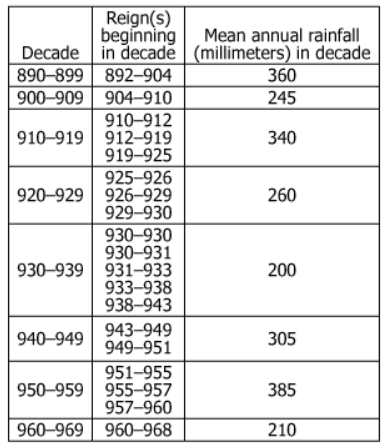
Table.png [ 90.53 KiB | Viewed 9332 times ]
Question from the GMAT official practice exam-5. (Official Mock series)
Table.png [ 90.53 KiB | Viewed 9332 times ]
Pro tip:
Combine official questions for familiarity with GMAT Club Tests for analytics and tougher Focus-level practice so the real exam feels manageable.
Explore →
 25 Nov 2024, 19:43
Kudos
Bookmarks
1. We are asked to check which statements are true or false.
- It provides some support for an assertion made by Rodriguez. Rodriguez states that there was a drought: "that period included some less dry decades but also at least four extremely dry decades." The table shows that most of annual rainfall amounts are less than average and 4 decades had under 260. So, this statement is true.
- It provides some support for an assertion made by Ojukwu. Ojukwu states that there was a lot of instability: "the turmoil is shown by the very short reigns of kings in the 900s, especially in the period 920-959, indicating instability that toppled kings." The table shows that a lot of the reigns were way below average and that it happened especially between 920 to 959. So, this statement is true.
- It provides conclusive proof that an assertion made by Rodriguez is incorrect. The table doesn't show anything to dismiss Rodriguez and as earlier stated, it rather supports their statement. So, this statement is false.
2. The question asks to find whether the two professors would both agree on the statements.
- The largest amount of Xincua's 10th-century population loss occurred after 940. Both professors never pinpointed when in the 10th century did the population loss happen. So, this statement is a no.
- Parts of Xincua's irrigation systems declined during the 10th century. Rodriguez said: "made maintenance of irrigation systems more difficult. Some small dams, for example, deteriorated significantly during the dry period." Ojukwu said: "also, irrigation systems deteriorated; evidence from similar cultures of the time suggests that vandalism against public installations was a form of protest." So, this statement is a yes.
- The general standard of nutrition in Xincua declined during the 10th century. Rodriguez said: "increasing mortality due to poorer nutrition." Ojukwu said: "the political situation ultimately led to out-migration, poorer nutrition, and fewer births, resulting in a declining population." So, this statement is a yes.
3. We need to find a statement that supports Rodriguez but undermines Xincua. Such a statement could state that a drought is the cause behind the turmoil, and thus the drought would be the main cause behind the population loss. The only statement that would work is: "Drastic reductions in water supply led to civil strife and mass out-migrations and impaired kings' ability to rule."
- It provides some support for an assertion made by Rodriguez. Rodriguez states that there was a drought: "that period included some less dry decades but also at least four extremely dry decades." The table shows that most of annual rainfall amounts are less than average and 4 decades had under 260. So, this statement is true.
- It provides some support for an assertion made by Ojukwu. Ojukwu states that there was a lot of instability: "the turmoil is shown by the very short reigns of kings in the 900s, especially in the period 920-959, indicating instability that toppled kings." The table shows that a lot of the reigns were way below average and that it happened especially between 920 to 959. So, this statement is true.
- It provides conclusive proof that an assertion made by Rodriguez is incorrect. The table doesn't show anything to dismiss Rodriguez and as earlier stated, it rather supports their statement. So, this statement is false.
2. The question asks to find whether the two professors would both agree on the statements.
- The largest amount of Xincua's 10th-century population loss occurred after 940. Both professors never pinpointed when in the 10th century did the population loss happen. So, this statement is a no.
- Parts of Xincua's irrigation systems declined during the 10th century. Rodriguez said: "made maintenance of irrigation systems more difficult. Some small dams, for example, deteriorated significantly during the dry period." Ojukwu said: "also, irrigation systems deteriorated; evidence from similar cultures of the time suggests that vandalism against public installations was a form of protest." So, this statement is a yes.
- The general standard of nutrition in Xincua declined during the 10th century. Rodriguez said: "increasing mortality due to poorer nutrition." Ojukwu said: "the political situation ultimately led to out-migration, poorer nutrition, and fewer births, resulting in a declining population." So, this statement is a yes.
3. We need to find a statement that supports Rodriguez but undermines Xincua. Such a statement could state that a drought is the cause behind the turmoil, and thus the drought would be the main cause behind the population loss. The only statement that would work is: "Drastic reductions in water supply led to civil strife and mass out-migrations and impaired kings' ability to rule."
General Discussion
 22 Nov 2024, 23:39
Kudos
Bookmarks
In question 1 third part, why is the answer YES wrong.
"It provides conclusive proof that an assertion made by Rodriguez is incorrect."
As per professor R
"That period included some less dry decades"
but decade 950-959 was not dry at all as per the table.
"It provides conclusive proof that an assertion made by Rodriguez is incorrect."
As per professor R
"That period included some less dry decades"
but decade 950-959 was not dry at all as per the table.