Events & Promotions
|
|

GMAT Club Daily Prep
Thank you for using the timer - this advanced tool can estimate your performance and suggest more practice questions. We have subscribed you to Daily Prep Questions via email.
Customized
for You
Track
Your Progress
Practice
Pays
Not interested in getting valuable practice questions and articles delivered to your email? No problem, unsubscribe here.
 Sep 23
12:30 AM EDT
-01:30 AM EDT
Learn how Keshav, a Chartered Accountant, scored an impressive 705 on GMAT in just 30 days with GMATWhiz's expert guidance. In this video, he shares preparation tips and strategies that worked for him, including the mock, time management, and more Sep 24
01:30 AM EDT
-01:30 AM EDT
Tejas studied hard but kept repeating the same mistakes. After 3 attempts at 645, a focused 4-week strategy helped him identify and fix what was holding him back—leading to a 695 with just 12–15 hours of study per week. Sep 26
01:00 PM EDT
-04:00 PM EDT
Top scores are possible when you enroll in a powerful GMAT course, taught live online + 6 months access to TTP OnDemand video courses included. Class starts Saturdays Sept. 26, 2026 - Dec. 19, 2026, 1:00pm-4:00pm ES Sep 26
06:00 PM PDT
-07:00 PM PDT
Free- full-length test + 15 concept videos + 150+ short videos + study plan! Sep 29
11:00 AM EDT
-01:00 PM EDT
" Description: Top scores are possible when you enroll in a powerful GMAT course, taught live online + 6 months access to TTP OnDemand video courses included! Class starts Tues/Thur Sept. 29, 2026 - Dec. 3, 2026, 11:00am-1:00pm EST Oct 01
07:00 AM BST
-08:00 AM GMT
Welcome to the GMAT Club's Free Interview Prep Event for Top MBA Programs! Buy tickets - Virtual series that’s all set to equip you to -excel in your MBA interviews.

 26 Dec 2024, 22:55
Kudos
Bookmarks
Question 1


C
Be sure to select an answer first to save it in the Error Log before revealing the correct answer (OA)!
Difficulty:
 45%
(medium)
45%
(medium)
Question Stats:
62% (02:41) correct 38%
(02:56) wrong
based on 1099
sessions
38%
(02:56) wrong
based on 1099
sessions
History
Date
Time
Result
Not Attempted Yet
Question 2
D
Be sure to select an answer first to save it in the Error Log before revealing the correct answer (OA)!
Difficulty:
35%
(medium)
Question Stats:
72% (01:33) correct 28%
(01:46) wrong
based on 1146
sessions
History
Date
Time
Result
Not Attempted Yet
Question 3
C
Be sure to select an answer first to save it in the Error Log before revealing the correct answer (OA)!
Difficulty:
 55%
(hard)
55%
(hard)
Question Stats:
62% (01:36) correct 38%
(01:36) wrong
based on 1112
sessions
History
Date
Time
Result
Not Attempted Yet
By the early 1970s, historian Gabriel Kolko and economist George Stigler had independently reached compatible conclusions about the interests served by the United States government's regulation of business during the Progressive era (1890-1915). Kolko argued that big business led the struggle for federal regulation and that regulatory legislation was motivated primarily by legislators' desire to benefit business, not, as the view dominant up until that time had held, by the desire to protect the public interest. As Stigler explained, the federal government's ability to subsidize business, to control the entry of foreign goods, and to fix prices could be used by businesses to their advantage, just as campaign contributions from businesses could be used to advantage by legislators.
There is no denying Kolko's and Stigler's basic claims. Nevertheless, businesses within an industry did not always welcome being regulated, nor did industries necessarily respond uniformly to legislators' efforts to enact regulations affecting them. All but one major railroad in 1905 opposed an expansion of the regulatory power of the Interstate Commerce Committee (ICC) of the United States Senate, and though the Hepburn Act, which granted the ICC rate-making power in the railroad industry, was passed the following year, commercial users of the railroads were divided about the passage of the act: the coal industry opposed it, the agricultural industry favored it, and the lumber industry was split.
There is no denying Kolko's and Stigler's basic claims. Nevertheless, businesses within an industry did not always welcome being regulated, nor did industries necessarily respond uniformly to legislators' efforts to enact regulations affecting them. All but one major railroad in 1905 opposed an expansion of the regulatory power of the Interstate Commerce Committee (ICC) of the United States Senate, and though the Hepburn Act, which granted the ICC rate-making power in the railroad industry, was passed the following year, commercial users of the railroads were divided about the passage of the act: the coal industry opposed it, the agricultural industry favored it, and the lumber industry was split.
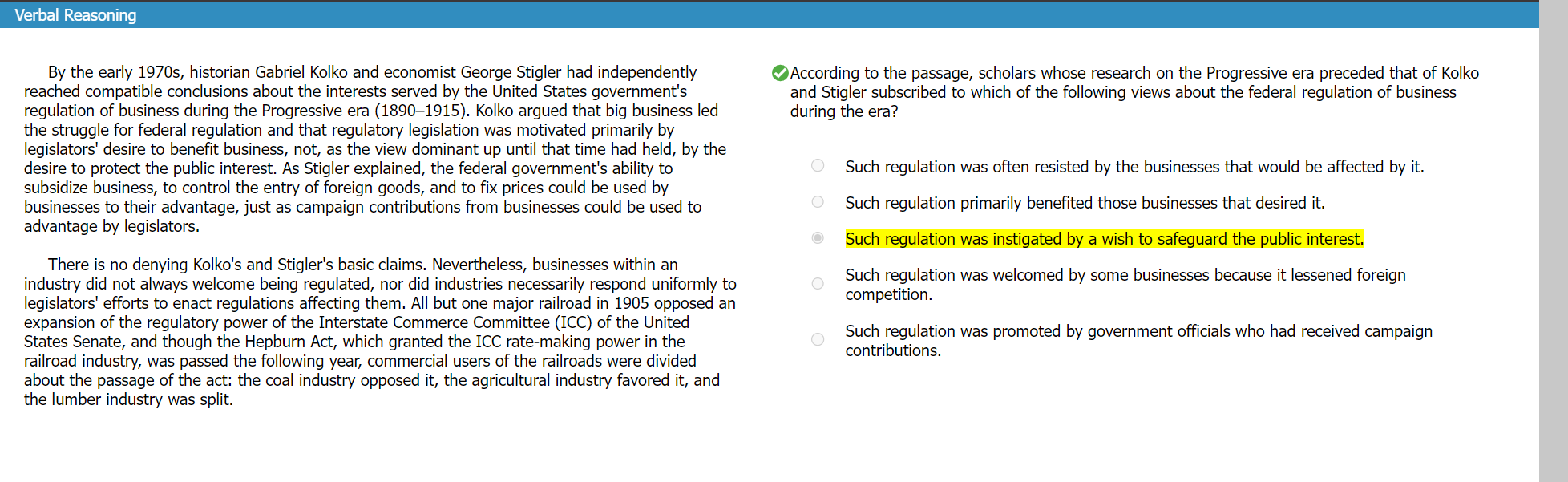
According to the passage, scholars whose research on the Progressive era preceded that of Kolkoand Stigler subscribed to which of the following views about the federal regulation of businessduring the era?
A. Such regulation was often resisted by the businesses that would be affected by it.
B. Such regulation primarily benefited those businesses that desired it.
C. Such regulation was instigated by a wish to safeguard the public interest.
D. Such regulation was welcomed by some businesses because it lessened foreign competition.
E. Such regulation was promoted by government officials who had received campaign contributions.
A. Such regulation was often resisted by the businesses that would be affected by it.
B. Such regulation primarily benefited those businesses that desired it.
C. Such regulation was instigated by a wish to safeguard the public interest.
D. Such regulation was welcomed by some businesses because it lessened foreign competition.
E. Such regulation was promoted by government officials who had received campaign contributions.
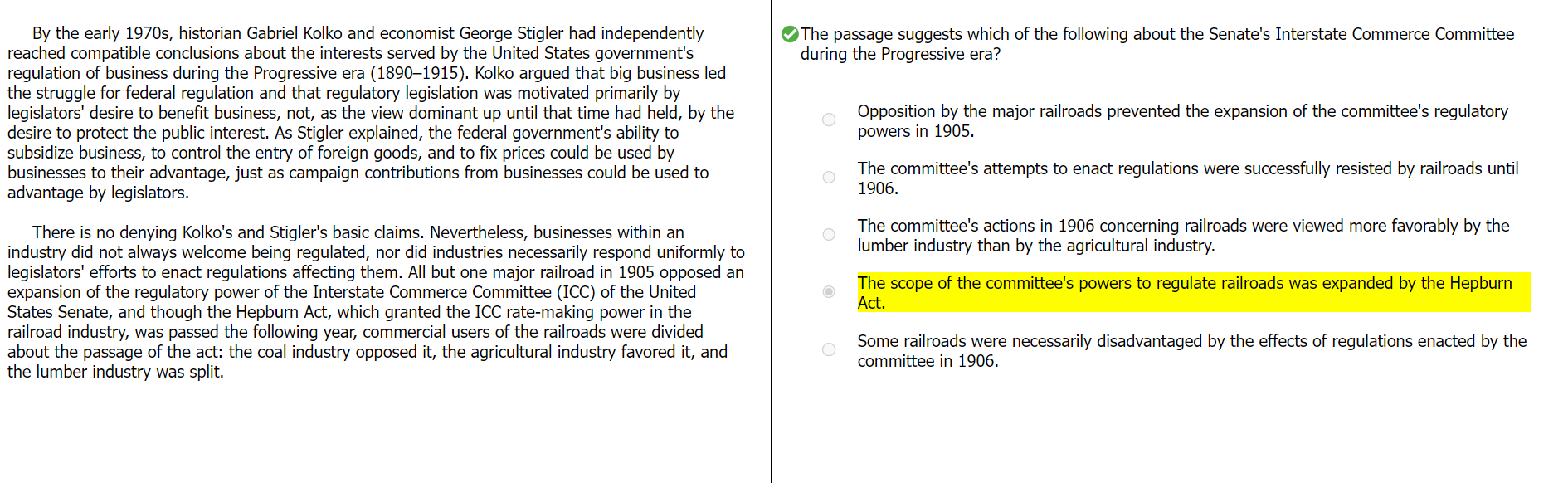
The passage suggests which of the following about the Senate's Interstate Commerce Committee during the Progressive era?
A. Opposition by the major railroads prevented the expansion of the committee's regulatory powers in 1905.
B. The committee's attempts to enact regulations were successfully resisted by railroads until 1906.
C. The committee's actions in 1906 concerning railroads were viewed more favorably by the lumber industry than by the agricultural industry.
D. The scope of the committee's powers to regulate railroads was expanded by the Hepburn Act.
E. Some railroads were necessarily disadvantaged by the effects of regulations enacted by the committee in 1906.
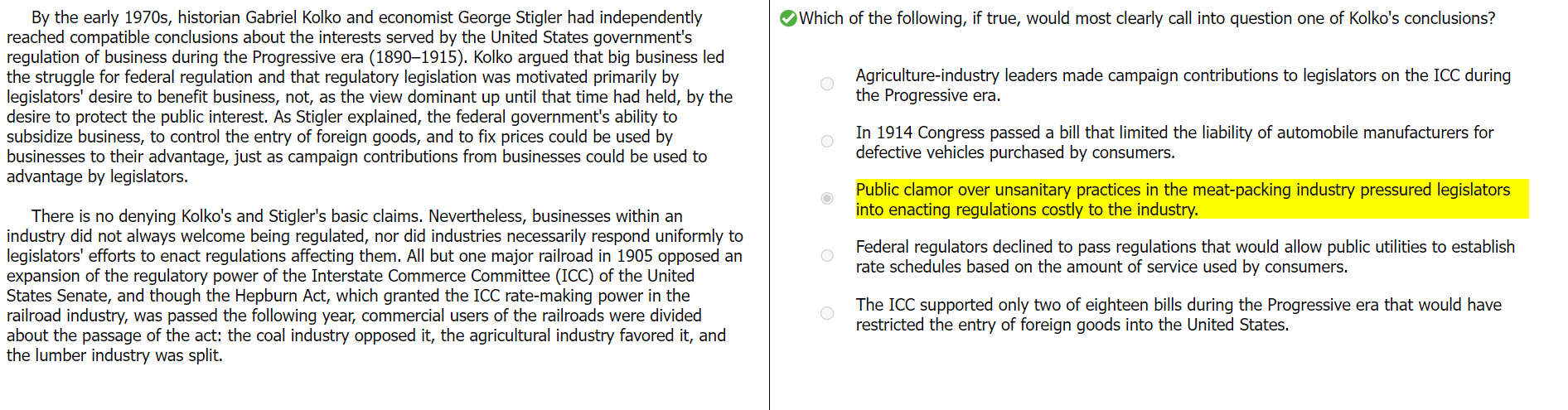
Which of the following, if true, would most clearly call into question one of Kolko's conclusions?
A. Agriculture-industry leaders made campaign contributions to legislators on the ICC during the Progressive era.
B. In 1914 Congress passed a bill that limited the liability of automobile manufacturers for defective vehicles purchased by consumers.
C. Public clamor over unsanitary practices in the meat-packing industry pressured legislators into enacting regulations costly to the industry.
D. Federal regulators declined to pass regulations that would allow public utilities to establish rate schedules based on the amount of service used by consumers.
E. The ICC supported only two of eighteen bills during the Progressive era that would have restricted the entry of foreign goods into the United States.
Hello,
Sharing an RC question which appeared on my official mock 5
Sharing an RC question which appeared on my official mock 5
Attachment:
GMAT-Club-Forum-sjoqg69a.png [ 191.65 KiB | Viewed 5908 times ]
Attachment:
GMAT-Club-Forum-0sgqpwut.png [ 185.07 KiB | Viewed 5910 times ]
Attachment:
GMAT-Club-Forum-yjvytmi2.png [ 194.84 KiB | Viewed 5914 times ]
Question exposed a gap?
Take sectional Adaptive Quant, Verbal, or DI tests on GMAT Club and review the detailed score report.
Get started →
 13 Mar 2025, 00:12
Kudos
Bookmarks
Question 1.
According to the passage, scholars whose research on the Progressive era preceded that of Kolkoand Stigler subscribed to which of the following views about the federal regulation of businessduring the era?
A. Such regulation was often resisted by the businesses that would be affected by it.
B. Such regulation primarily benefited those businesses that desired it.
C. Such regulation was instigated by a wish to safeguard the public interest.
D. Such regulation was welcomed by some businesses because it lessened foreign competition.
E. Such regulation was promoted by government officials who had received campaign contributions.
Given:
Kolko argued that big business led the struggle for federal regulation and that regulatory legislation was motivated primarily by legislators' desire to benefit business, not, as the view dominant up until that time had held, by the desire to protect the public interest.
So before 1970s, the dominant view was that regulatory legislation in Progressive era was motivated by the desire to protect the public. That is all we know about the view at that time. Rest nothing is known so all other options are incorrect.
Answer (C)
Question 2.
The passage suggests which of the following about the Senate's Interstate Commerce Committee during the Progressive era?
A. Opposition by the major railroads prevented the expansion of the committee's regulatory powers in 1905.
B. The committee's attempts to enact regulations were successfully resisted by railroads until 1906.
C. The committee's actions in 1906 concerning railroads were viewed more favorably by the lumber industry than by the agricultural industry.
D. The scope of the committee's powers to regulate railroads was expanded by the Hepburn Act.
E. Some railroads were necessarily disadvantaged by the effects of regulations enacted by the committee in 1906.
Given:
All but one major railroad in 1905 opposed an expansion of the regulatory power of the Interstate Commerce Committee (ICC) of the United States Senate, and though the Hepburn Act, which granted the ICC rate-making power in the railroad industry, was passed the following year
So Hepburn Act was passed and it expanded the ICC's power. Hence (D) is correct.
A. Opposition by the major railroads prevented the expansion of the committee's regulatory powers in 1905.
The expansion took place. Hence this is incorrect.
B. The committee's attempts to enact regulations were successfully resisted by railroads until 1906.
We are given that Hepburn act was passed. Hence incorrect.
C. The committee's actions in 1906 concerning railroads were viewed more favorably by the lumber industry than by the agricultural industry.
Incorrect. Agricultural industry was in favor, Lumber was split.
E. Some railroads were necessarily disadvantaged by the effects of regulations enacted by the committee in 1906.
Not given anywhere.
Answer (D)
Question 3.
Which of the following, if true, would most clearly call into question one of Kolko's conclusions?
A. Agriculture-industry leaders made campaign contributions to legislators on the ICC during the Progressive era.
B. In 1914 Congress passed a bill that limited the liability of automobile manufacturers for defective vehicles purchased by consumers.
C. Public clamor over unsanitary practices in the meat-packing industry pressured legislators into enacting regulations costly to the industry.
D. Federal regulators declined to pass regulations that would allow public utilities to establish rate schedules based on the amount of service used by consumers.
E. The ICC supported only two of eighteen bills during the Progressive era that would have restricted the entry of foreign goods into the United States.
Given:
Kolko argued that big business led the struggle for federal regulation and that regulatory legislation was motivated primarily by legislators' desire to benefit business, not, as the view dominant up until that time had held, by the desire to protect the public interest.
As Stigler explained, the federal government's ability to subsidize business, to control the entry of foreign goods, and to fix prices could be used by businesses to their advantage, just as campaign contributions from businesses could be used to advantage by legislators.
We are asked about Kolko specifically so we will focus on that though as the passage says - their conclusions were the same.
A. Agriculture-industry leaders made campaign contributions to legislators on the ICC during the Progressive era.
Stigler explains that campaign contributions from businesses could be used to advantage by legislators. Hence it is in line with what Stigler said.
B. In 1914 Congress passed a bill that limited the liability of automobile manufacturers for defective vehicles purchased by consumers.
This is a benefit to the big business, hence in line with what Kolko said.
C. Public clamor over unsanitary practices in the meat-packing industry pressured legislators into enacting regulations costly to the industry.
This is contrary to what Kolko said. The legislations were meant to benefit business as per Kolko but this legislation harmed business (costly to it). Hence answer.
D. Federal regulators declined to pass regulations that would allow public utilities to establish rate schedules based on the amount of service used by consumers.
Public utilities are out of scope. We are discussing big businesses only. So whether it benefited the public utility or consumers is irrelevant.
E. The ICC supported only two of eighteen bills during the Progressive era that would have restricted the entry of foreign goods into the United States.
This option talks about the degree of benefit ICC provided to the businesses. It supported 2 bills which benefitted the businesses. What it did to the other 16 bills, we don't know. Perhaps it refrained from supporting or opposing. Perhaps the 16 bills were so egregious that they could not support them. We don't know. This option does not show harm to the business. It shows a small benefit only.
Answer (C)
According to the passage, scholars whose research on the Progressive era preceded that of Kolkoand Stigler subscribed to which of the following views about the federal regulation of businessduring the era?
A. Such regulation was often resisted by the businesses that would be affected by it.
B. Such regulation primarily benefited those businesses that desired it.
C. Such regulation was instigated by a wish to safeguard the public interest.
D. Such regulation was welcomed by some businesses because it lessened foreign competition.
E. Such regulation was promoted by government officials who had received campaign contributions.
Given:
Kolko argued that big business led the struggle for federal regulation and that regulatory legislation was motivated primarily by legislators' desire to benefit business, not, as the view dominant up until that time had held, by the desire to protect the public interest.
So before 1970s, the dominant view was that regulatory legislation in Progressive era was motivated by the desire to protect the public. That is all we know about the view at that time. Rest nothing is known so all other options are incorrect.
Answer (C)
Question 2.
The passage suggests which of the following about the Senate's Interstate Commerce Committee during the Progressive era?
A. Opposition by the major railroads prevented the expansion of the committee's regulatory powers in 1905.
B. The committee's attempts to enact regulations were successfully resisted by railroads until 1906.
C. The committee's actions in 1906 concerning railroads were viewed more favorably by the lumber industry than by the agricultural industry.
D. The scope of the committee's powers to regulate railroads was expanded by the Hepburn Act.
E. Some railroads were necessarily disadvantaged by the effects of regulations enacted by the committee in 1906.
Given:
All but one major railroad in 1905 opposed an expansion of the regulatory power of the Interstate Commerce Committee (ICC) of the United States Senate, and though the Hepburn Act, which granted the ICC rate-making power in the railroad industry, was passed the following year
So Hepburn Act was passed and it expanded the ICC's power. Hence (D) is correct.
A. Opposition by the major railroads prevented the expansion of the committee's regulatory powers in 1905.
The expansion took place. Hence this is incorrect.
B. The committee's attempts to enact regulations were successfully resisted by railroads until 1906.
We are given that Hepburn act was passed. Hence incorrect.
C. The committee's actions in 1906 concerning railroads were viewed more favorably by the lumber industry than by the agricultural industry.
Incorrect. Agricultural industry was in favor, Lumber was split.
E. Some railroads were necessarily disadvantaged by the effects of regulations enacted by the committee in 1906.
Not given anywhere.
Answer (D)
Question 3.
Which of the following, if true, would most clearly call into question one of Kolko's conclusions?
A. Agriculture-industry leaders made campaign contributions to legislators on the ICC during the Progressive era.
B. In 1914 Congress passed a bill that limited the liability of automobile manufacturers for defective vehicles purchased by consumers.
C. Public clamor over unsanitary practices in the meat-packing industry pressured legislators into enacting regulations costly to the industry.
D. Federal regulators declined to pass regulations that would allow public utilities to establish rate schedules based on the amount of service used by consumers.
E. The ICC supported only two of eighteen bills during the Progressive era that would have restricted the entry of foreign goods into the United States.
Given:
Kolko argued that big business led the struggle for federal regulation and that regulatory legislation was motivated primarily by legislators' desire to benefit business, not, as the view dominant up until that time had held, by the desire to protect the public interest.
As Stigler explained, the federal government's ability to subsidize business, to control the entry of foreign goods, and to fix prices could be used by businesses to their advantage, just as campaign contributions from businesses could be used to advantage by legislators.
We are asked about Kolko specifically so we will focus on that though as the passage says - their conclusions were the same.
A. Agriculture-industry leaders made campaign contributions to legislators on the ICC during the Progressive era.
Stigler explains that campaign contributions from businesses could be used to advantage by legislators. Hence it is in line with what Stigler said.
B. In 1914 Congress passed a bill that limited the liability of automobile manufacturers for defective vehicles purchased by consumers.
This is a benefit to the big business, hence in line with what Kolko said.
C. Public clamor over unsanitary practices in the meat-packing industry pressured legislators into enacting regulations costly to the industry.
This is contrary to what Kolko said. The legislations were meant to benefit business as per Kolko but this legislation harmed business (costly to it). Hence answer.
D. Federal regulators declined to pass regulations that would allow public utilities to establish rate schedules based on the amount of service used by consumers.
Public utilities are out of scope. We are discussing big businesses only. So whether it benefited the public utility or consumers is irrelevant.
E. The ICC supported only two of eighteen bills during the Progressive era that would have restricted the entry of foreign goods into the United States.
This option talks about the degree of benefit ICC provided to the businesses. It supported 2 bills which benefitted the businesses. What it did to the other 16 bills, we don't know. Perhaps it refrained from supporting or opposing. Perhaps the 16 bills were so egregious that they could not support them. We don't know. This option does not show harm to the business. It shows a small benefit only.
Answer (C)
Yasho1998
General Discussion

 07 Jan 2025, 20:36
Kudos
Bookmarks
Can someone help explain Question 2? Why is b option incorrect?






