Events & Promotions
|
|

GMAT Club Daily Prep
Thank you for using the timer - this advanced tool can estimate your performance and suggest more practice questions. We have subscribed you to Daily Prep Questions via email.
Customized
for You
Track
Your Progress
Practice
Pays
Not interested in getting valuable practice questions and articles delivered to your email? No problem, unsubscribe here.
 Jun 04
01:00 AM EDT
-02:00 AM EDT
Learn how Keshav, a Chartered Accountant, scored an impressive 705 on GMAT in just 30 days with GMATWhiz's expert guidance. In this video, he shares preparation tips and strategies that worked for him, including the mock, time management, and more. Jun 04
08:30 AM PDT
-09:30 AM PDT
For most test takers, Data Insights is the most challenging section on the GMAT, with test takers scoring several points lower on average on DI than on Quant or Verbal and completing the section with less time to spare. May 29
10:00 AM IST
-11:00 PM IST
Start your journey with a fully customized action plan and work with a dedicated mentor to achieve a 735+ score. Jun 03
12:30 AM EDT
-01:30 AM EDT
Learn how Kamakshi achieved a GMAT 675 with an impressive 96th %ile in Data Insights. Discover the unique methods and exam strategies that helped her excel in DI along with other sections for a balanced and high score.- Jun 03
08:30 AM PDT
-09:30 AM PDT
In Episode 7 of our GMAT Ninja CR series, we are rounding up the oddballs, the misfits, and the format-benders: EXCEPT, Fill-In-The-Blanks, and other unusual Critical Reasoning question types. When you see a question that ends with a literal blank line  Jun 08
03:00 PM PDT
-04:00 PM PDT
15 Full-length GMAT FE mocks with insightful analytics, weakness diagnosis, and video explanations!- Jun 10
06:00 AM PDT
-06:15 PM PDT
Register for the GMAT Club Virtual MBA Spotlight Fair – the world’s premier event for serious MBA candidates. This is your chance to hear directly from Admissions Directors at nearly every Top 30 MBA program..


 26 Dec 2025, 09:00
Kudos
Bookmarks


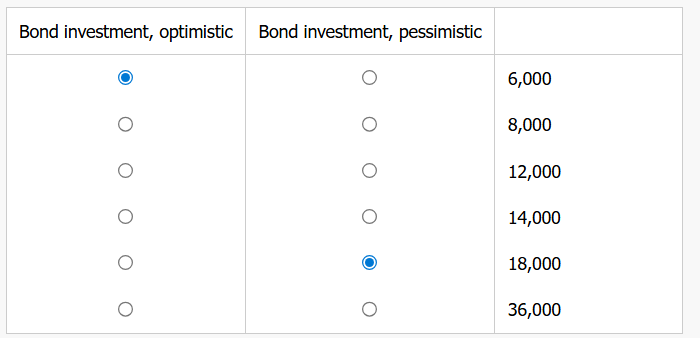
Bond investment, optimistic: 6,000
Bond investment, pessimistic: 18,000
Be sure to select an answer first to save it in the Error Log before revealing the correct answer (OA)!
Difficulty:
 75%
(hard)
75%
(hard)
Question Stats:
74% (02:44) correct 26%
(03:10)
wrong
based on 268
sessions
26%
(03:10)
wrong
based on 268
sessions
History
Date
Time
Result
Not Attempted Yet
12 Days of Christmas Competition
This question is part of our holiday event
Win $40,000 in prizes: courses, tests, and more
An investor purchases a no interest certificate that he cannot sell for 2 years. He buys certificates with a total purchase price of $2,400. At the same time, he invests an additional sum in a treasury bond that earns 3% simple interest per year.
The investor’s goal is a combined net gain of $600 from the two investments after 2 years.
Two analysts give different projections for how the certificate’s market value will change over the two years. Under the optimistic projection, each year the market value increases by a fixed amount equal to 5% of the original $2,400 purchase price. Under the pessimistic projection, each year the market value decreases by a fixed amount equal to 10% of the original $2,400 purchase price.
In the table, select for Bond investment, optimistic the amount the investor must invest in the bond to reach the $600 goal under the optimistic scenario, and select for Bond investment, pessimistic the amount the investor must invest in the bond to reach the $600 goal under the pessimistic scenario. Make only two selections, one in each column.
I31-44
| Bond investment, optimistic | Bond investment, pessimistic | |
| 6,000 | ||
| 8,000 | ||
| 12,000 | ||
| 14,000 | ||
| 18,000 | ||
| 36,000 |
ShowHide Answer
Official Answer
Bond investment, optimistic: 6,000
Bond investment, pessimistic: 18,000
26 Dec 2025, 10:00
Kudos
Bookmarks
An investor purchases a no interest certificate that he cannot sell for 2 years. He buys certificates with a total purchase price of $2,400. At the same time, he invests an additional sum in a treasury bond that earns 3% simple interest per year.
The investor’s goal is a combined net gain of $600 from the two investments after 2 years.
Two analysts give different projections for how the certificate’s market value will change over the two years. Under the optimistic projection, each year the market value increases by a fixed amount equal to 5% of the original $2,400 purchase price. Under the pessimistic projection, each year the market value decreases by a fixed amount equal to 10% of the original $2,400 purchase price.
In the table, select for Bond investment, optimistic the amount the investor must invest in the bond to reach the $600 goal under the optimistic scenario, and select for Bond investment, pessimistic the amount the investor must invest in the bond to reach the $600 goal under the pessimistic scenario. Make only two selections, one in each column.
Optimistic scenario:
Each year the certificate gains 5% of 2,400, which is 120. Over 2 years, the gain is 240.
So the bond must provide the remaining gain: 600 - 240 = 360.
At 3% simple interest per year, the bond earns 6% over 2 years, so 0.06 * Bond investment = 360.
Bond investment = 360/0.06 = 6,000.
Pessimistic scenario:
Each year the certificate loses 10% of 2,400, which is 240. Over 2 years, the loss is 480.
So the bond must cover 600 + 480 = 1,080 in gain.
With 6% total simple interest over 2 years, 0.06 * Bond investment = 1,080.
Bond investment = 1,080/0.06 = 18,000.

GMAT-Club-Forum-8riy804y.png [ 18.49 KiB | Viewed 1755 times ]
The investor’s goal is a combined net gain of $600 from the two investments after 2 years.
Two analysts give different projections for how the certificate’s market value will change over the two years. Under the optimistic projection, each year the market value increases by a fixed amount equal to 5% of the original $2,400 purchase price. Under the pessimistic projection, each year the market value decreases by a fixed amount equal to 10% of the original $2,400 purchase price.
In the table, select for Bond investment, optimistic the amount the investor must invest in the bond to reach the $600 goal under the optimistic scenario, and select for Bond investment, pessimistic the amount the investor must invest in the bond to reach the $600 goal under the pessimistic scenario. Make only two selections, one in each column.
GMAT Club Official Explanation:
Optimistic scenario:
Each year the certificate gains 5% of 2,400, which is 120. Over 2 years, the gain is 240.
So the bond must provide the remaining gain: 600 - 240 = 360.
At 3% simple interest per year, the bond earns 6% over 2 years, so 0.06 * Bond investment = 360.
Bond investment = 360/0.06 = 6,000.
Pessimistic scenario:
Each year the certificate loses 10% of 2,400, which is 240. Over 2 years, the loss is 480.
So the bond must cover 600 + 480 = 1,080 in gain.
With 6% total simple interest over 2 years, 0.06 * Bond investment = 1,080.
Bond investment = 1,080/0.06 = 18,000.
Attachment:
GMAT-Club-Forum-8riy804y.png [ 18.49 KiB | Viewed 1755 times ]
General Discussion
 26 Dec 2025, 09:29
Kudos
Bookmarks
Bunuel
in optimistic -
gain is 0.05 * 2 * 2400 = 240
remaiing gain reqd = 600-240 = 360
investrment reqd in bond = x
x* 0.03 * 2 = 360
x=6000
in pesimeistic
loss is 0.1 * 2 * 2400 = 480
gain reqd = 600 - ( -480) = 1080
investemnt reqd in bond = y
y* 0.03 * 2 = 1080
y=18000
answer is 6000, 18000