Events & Promotions
|
|

GMAT Club Daily Prep
Thank you for using the timer - this advanced tool can estimate your performance and suggest more practice questions. We have subscribed you to Daily Prep Questions via email.
Customized
for You
Track
Your Progress
Practice
Pays
Not interested in getting valuable practice questions and articles delivered to your email? No problem, unsubscribe here.
 Aug 27
10:00 AM EDT
-11:00 AM EDT
We’ve worked incredibly hard to build TTP into the best test prep experience possible, and it would mean a lot to us to win Newsweek’s 2026 Readers’ Choice Award for Best Test Prep. If TTP has helped you, we’d be incredibly grateful for your vote. Sep 04
10:00 AM PDT
-11:00 AM PDT
What does test anxiety really look like on the GMAT? For many test takers, it does not look like a panic attack. Instead, it shows up as brain fog, rereading, negative comparisons, mental noise.... Sep 06
09:30 AM EDT
-12:30 PM EST
Top scores are possible when you enroll in a powerful EA course, taught live online + 6 months access to TTP OnDemand video courses included! Perfect class schedule and easy course access for working professionals. Class starts Sundays Sept. 6, 2026.- Sep 07
12:01 AM PDT
-11:59 PM PDT
On the 7th, GMAT Club Tests will be Free! Including all the Quizzes, Questions, and Tests. 12 AM - 11:59 PM PDT - Sep 09
07:00 AM PDT
-10:00 AM PDT
Meet AdComs and explore top Master’s programs - MiM, MiF, MSc, MSBA and more. - Application Fee Waivers - Free 1-Week of GMAT Club Tests: - Master's Application Toolkit - Grand Prize Giveaway  Sep 15
07:00 PM EDT
-09:00 PM EST
Elite scores are possible when you enroll in a powerful GMAT course, taught live online + 6 months access to TTP OnDemand video courses included! Class starts Tues/Thurs Sept. 15, 2026 - Nov. 15, 2027, 7:00pm-9:00pm EST Sep 21
08:00 PM EDT
-10:00 PM EDT
Boost your GMAT score in less than one month in a live online class + 6 months access to TTP OnDemand video courses included! Class starts Mon, Tues, Wed, Thur, Fri Sept. 21, 2026 - Oct. 9, 2027, 7:00pm-10:00pm EST

Question 1


E
Be sure to select an answer first to save it in the Error Log before revealing the correct answer (OA)!
Difficulty:
 5%
(low)
5%
(low)
Question Stats:
83% (02:10) correct 17%
(02:05) wrong
based on 756
sessions
17%
(02:05) wrong
based on 756
sessions
History
Date
Time
Result
Not Attempted Yet
Question 2
E
Be sure to select an answer first to save it in the Error Log before revealing the correct answer (OA)!
Difficulty:
 25%
(medium)
25%
(medium)
Question Stats:
69% (00:49) correct 31%
(01:02) wrong
based on 763
sessions
History
Date
Time
Result
Not Attempted Yet
Question 3
D
Be sure to select an answer first to save it in the Error Log before revealing the correct answer (OA)!
Difficulty:
5%
(low)
Question Stats:
86% (00:41) correct 14%
(01:10) wrong
based on 741
sessions
History
Date
Time
Result
Not Attempted Yet
Question 4
A
Be sure to select an answer first to save it in the Error Log before revealing the correct answer (OA)!
Difficulty:
35%
(medium)
Question Stats:
62% (01:04) correct 38%
(01:08) wrong
based on 612
sessions
History
Date
Time
Result
Not Attempted Yet
Question 5
B
Be sure to select an answer first to save it in the Error Log before revealing the correct answer (OA)!
Difficulty:
15%
(low)
Question Stats:
73% (00:44) correct 27%
(00:47) wrong
based on 562
sessions
History
Date
Time
Result
Not Attempted Yet
Question 6
C
Be sure to select an answer first to save it in the Error Log before revealing the correct answer (OA)!
Difficulty:
15%
(low)
Question Stats:
70% (00:45) correct 30%
(01:06) wrong
based on 410
sessions
History
Date
Time
Result
Not Attempted Yet




GMAT-Club-Forum-o51h4d5a.png [ 43.91 KiB | Viewed 5026 times ]

GMAT-Club-Forum-zdzpxqw2.png [ 122.42 KiB | Viewed 5020 times ]

GMAT-Club-Forum-9z5bj155.png [ 54.92 KiB | Viewed 5028 times ]

GMAT-Club-Forum-e04pyflg.png [ 64.08 KiB | Viewed 5050 times ]
Competition is driving many companies to implement performance improvement programs, but there are different approaches to improving a company’s performance. Activity-centered programs, often advocated by consulting firms, define goals in a long-term, global manner and typically involve formulation of new managerial philosophies as well as extensive motivational and problem-solving training for employees. Companies assume that if they introduce enough improvement activities, operational performance will improve. In 1988, for example, a large financial institution implemented a “total quality” program to improve operational performance and win customer loyalty. After two years of costly effort, however, the program’s consultants summarized their progress by citing improved employee communication and morale but no improvement in profits.
Studies show that activity-centered programs offer meager payoffs compared with results-driven programs. Results-driven programs, which require relatively little initial investment, set specific, measurable short-term goals—such as increased yields, reduced delivery time, or reduced product development time—and implement procedural changes only when they lead directly to improved results. Whereas the activity-driven approach invests time and money in preparatory efforts that rarely yield desired outcomes, the results-driven approach identifies specific goals and the resources, tools, and action plans needed for meeting them.
Studies show that activity-centered programs offer meager payoffs compared with results-driven programs. Results-driven programs, which require relatively little initial investment, set specific, measurable short-term goals—such as increased yields, reduced delivery time, or reduced product development time—and implement procedural changes only when they lead directly to improved results. Whereas the activity-driven approach invests time and money in preparatory efforts that rarely yield desired outcomes, the results-driven approach identifies specific goals and the resources, tools, and action plans needed for meeting them.
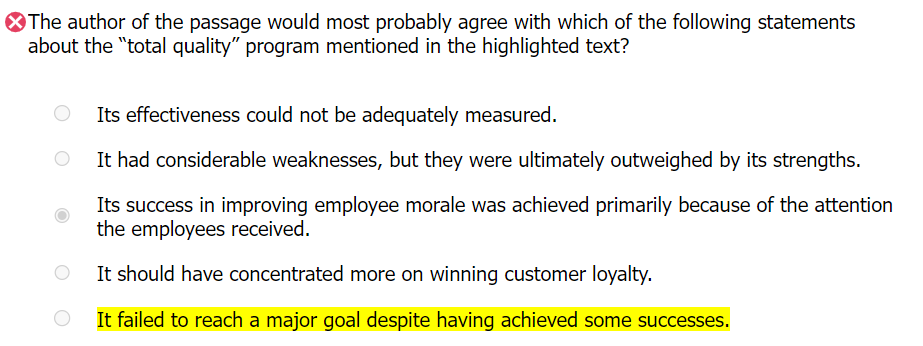
1. The author of the passage would most probably agree with which of the following statements about the "total quality” program mentioned in the highlighted text?
A. Its effectiveness could not be adequately measured.
B. It had considerable weaknesses, but they were ultimately outweighed by its strengths.
C. Its success in improving employee morale was achieved primarily because of the attention the employees received.
D. It should have concentrated more on winning customer loyalty.
E. It failed to reach a major goal despite having achieved some successes.
A. Its effectiveness could not be adequately measured.
B. It had considerable weaknesses, but they were ultimately outweighed by its strengths.
C. Its success in improving employee morale was achieved primarily because of the attention the employees received.
D. It should have concentrated more on winning customer loyalty.
E. It failed to reach a major goal despite having achieved some successes.
2. The primary purpose of the passage is to
A. explain why many companies have been attracted to activity-centered improvement programs
B. explain why activity-centered improvement programs are usually more expensive than results-driven programs
C. describe the kinds of companies most likely to benefit from a results-driven rather than an activity-centered improvement program
D. assess the relative strengths and weaknesses of activity-centered improvement programs and results-driven programs
E. argue that activity-centered improvement programs are less likely to produce desired outcomes than are results-driven programs
A. explain why many companies have been attracted to activity-centered improvement programs
B. explain why activity-centered improvement programs are usually more expensive than results-driven programs
C. describe the kinds of companies most likely to benefit from a results-driven rather than an activity-centered improvement program
D. assess the relative strengths and weaknesses of activity-centered improvement programs and results-driven programs
E. argue that activity-centered improvement programs are less likely to produce desired outcomes than are results-driven programs
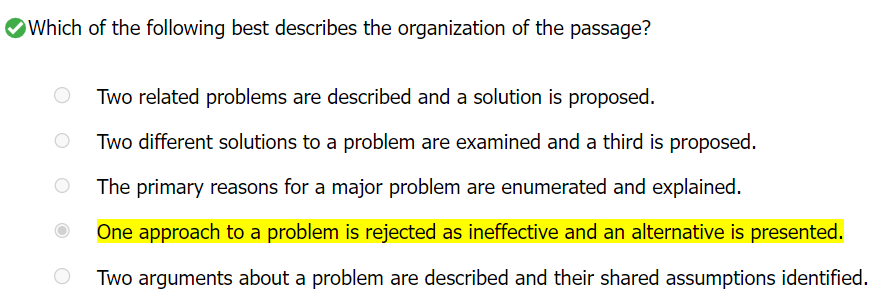
3. Which of the following best describes the organization of the passage?
A. Two related problems are described and a solution is proposed.
B. Two different solutions to a problem are examined and a third is proposed.
C. The primary reasons for a major problem are enumerated and explained.
D. One approach to a problem is rejected as ineffective and an alternative is presented.
E. Two arguments about a problem are described and their shared assumptions identified.
A. Two related problems are described and a solution is proposed.
B. Two different solutions to a problem are examined and a third is proposed.
C. The primary reasons for a major problem are enumerated and explained.
D. One approach to a problem is rejected as ineffective and an alternative is presented.
E. Two arguments about a problem are described and their shared assumptions identified.
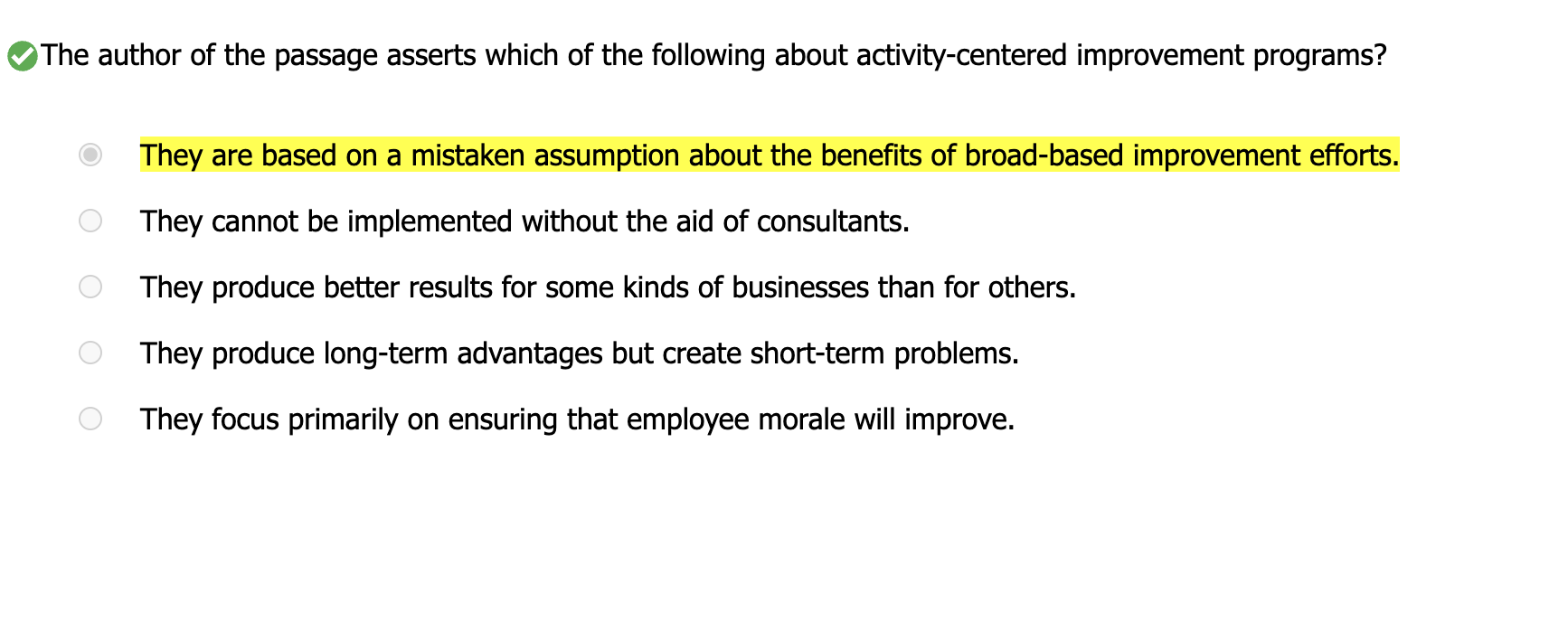
4. The author of the passage asserts which of the following about activity-centered improvement programs?
A. They are based on a mistaken assumption about the benefits of broad-based improvement efforts.
B. They cannot be implemented without the aid of consultants.
C. They produce better results for some kinds of businesses than for others.
D. They produce long-term advantages but create short-term problems.
E. They focus primarily on ensuring that employee morale will improve.
A. They are based on a mistaken assumption about the benefits of broad-based improvement efforts.
B. They cannot be implemented without the aid of consultants.
C. They produce better results for some kinds of businesses than for others.
D. They produce long-term advantages but create short-term problems.
E. They focus primarily on ensuring that employee morale will improve.
5. The author of the passage suggests that in comparison with results-driven programs, activity-centered programs are
A. occasionally more cost effective
B. less practical
C. less expensive
D. less popular with managers
E. more effective in small businesses
A. occasionally more cost effective
B. less practical
C. less expensive
D. less popular with managers
E. more effective in small businesses
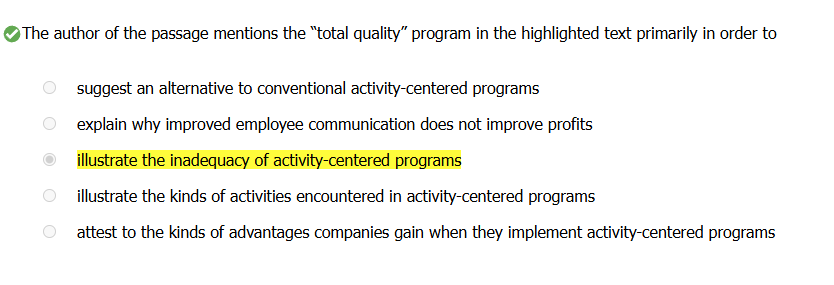
6. The author of the passage mentions the "total quality" program in the highlighted text primarily in order to
A. suggest an alternative to conventional activity-centered programs
B. explain why improved employee communication does not improve profits
C. illustrate the inadequacy of activity-centered programs
D. illustrate the kinds of activities encountered in activity-centered programs
E. attest to the kinds of advantages companies gain when they implement activity-centered programs
A. suggest an alternative to conventional activity-centered programs
B. explain why improved employee communication does not improve profits
C. illustrate the inadequacy of activity-centered programs
D. illustrate the kinds of activities encountered in activity-centered programs
E. attest to the kinds of advantages companies gain when they implement activity-centered programs
Attachment:
GMAT-Club-Forum-o51h4d5a.png [ 43.91 KiB | Viewed 5026 times ]
Attachment:
GMAT-Club-Forum-zdzpxqw2.png [ 122.42 KiB | Viewed 5020 times ]
Attachment:
GMAT-Club-Forum-9z5bj155.png [ 54.92 KiB | Viewed 5028 times ]
Attachment:
GMAT-Club-Forum-e04pyflg.png [ 64.08 KiB | Viewed 5050 times ]
Need more Tests to Practice?
GMAT Club Tests give expert solutions for every question in full and sectional GMAT Focus mocks.
Learn more →

 22 Apr 2024, 13:02
Kudos
Bookmarks
Could you explain why the answer to 1) is e) and not a)


 23 Apr 2024, 08:40
Kudos
Bookmarks
GMATchAttack
(A) is indirectly opposite, in fact. Although it is mentioned that the total quality program's consultants summarizing their progress by citing improved employee communication and morale, it also explicitly states that there was "no improvement in profits." This indicates that the effectiveness of the program could indeed be measured, at least in terms of its impact on profits, which was a major goal of the program.