Events & Promotions
|
|

GMAT Club Daily Prep
Thank you for using the timer - this advanced tool can estimate your performance and suggest more practice questions. We have subscribed you to Daily Prep Questions via email.
Customized
for You
Track
Your Progress
Practice
Pays
Not interested in getting valuable practice questions and articles delivered to your email? No problem, unsubscribe here.
 Sep 15
07:00 PM EDT
-09:00 PM EST
Elite scores are possible when you enroll in a powerful GMAT course, taught live online + 6 months access to TTP OnDemand video courses included! Class starts Tues/Thurs Sept. 15, 2026 - Nov. 15, 2027, 7:00pm-9:00pm EST Sep 21
07:00 PM EDT
-10:00 PM EDT
Boost your GMAT score in less than one month in a live online class + 6 months access to TTP OnDemand video courses included! Class starts Mon, Tues, Wed, Thur, Fri Sept. 21, 2026 - Oct. 9, 2027, 7:00pm-10:00pm EST


 11 Mar 2024, 09:16
Kudos
Bookmarks


B
Be sure to select an answer first to save it in the Error Log before revealing the correct answer (OA)!
Difficulty:
 55%
(hard)
55%
(hard)
Question Stats:
68% (01:52) correct 32%
(02:19)
wrong
based on 1149
sessions
32%
(02:19)
wrong
based on 1149
sessions
History
Date
Time
Result
Not Attempted Yet
A study of project teams at professional service firms found that those teams feeling high levels of pressure to perform well for their clients tended to leave their clients less satisfied. The researchers hypothesized that this is because teams under higher pressure, regardless of the source, tend to deliberate less about important decisions and defer to the judgment of the members with the most seniority.
Which of the following would, if true, most help support the researchers’ proposed explanation?
A. Those teams experiencing the highest levels of pressure tended to have the least interaction with clients.
B. The more-junior members of the project teams tended to have the most information about a project’s needs and the expectations of clients.
C. The team members with the most work experience commonly had project histories with diverse ranges of clients.
D. Those teams experiencing less pressure tended to have less variation in age range among their members.
E. Many clients often have unrealistically high expectations of professional service firms, even when they do not pressure project teams directly.
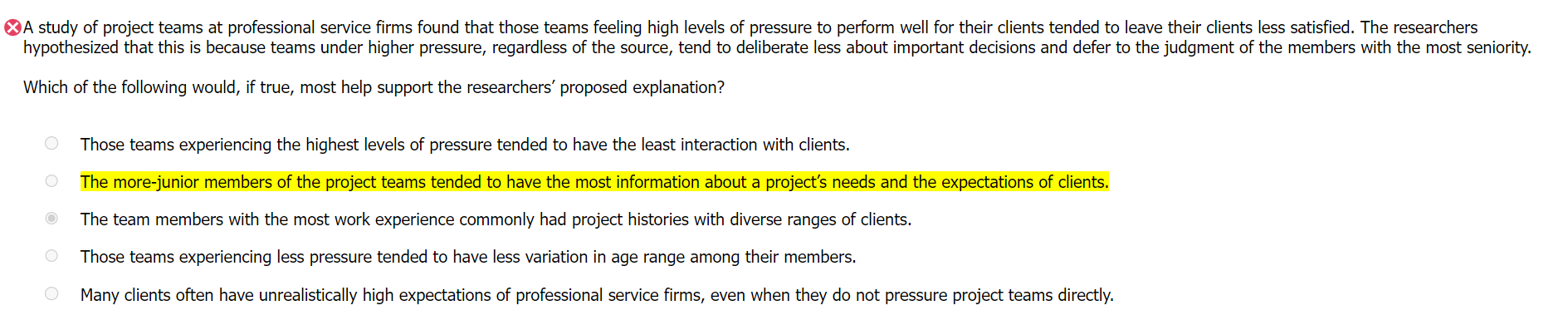
GMAT-Club-Forum-wmismmd8.png [ 97.31 KiB | Viewed 3506 times ]
Which of the following would, if true, most help support the researchers’ proposed explanation?
A. Those teams experiencing the highest levels of pressure tended to have the least interaction with clients.
B. The more-junior members of the project teams tended to have the most information about a project’s needs and the expectations of clients.
C. The team members with the most work experience commonly had project histories with diverse ranges of clients.
D. Those teams experiencing less pressure tended to have less variation in age range among their members.
E. Many clients often have unrealistically high expectations of professional service firms, even when they do not pressure project teams directly.
Attachment:
GMAT-Club-Forum-wmismmd8.png [ 97.31 KiB | Viewed 3506 times ]
Question exposed a gap?
Take sectional Adaptive Quant, Verbal, or DI tests on GMAT Club and review the detailed score report.
Get started →
 11 Mar 2024, 09:36
Kudos
Bookmarks
A. Those teams experiencing the highest levels of pressure tended to have the least interaction with clients.
This answer choice suggests that perhaps the amount of interaction is a variable in the client's satisfaction.
B. The more-junior members of the project teams tended to have the most information about a project’s needs and the expectations of clients.
As teams under high amounts of pressure tend to defer important decisions to the the members with the most seniority, if these senior members are not the most informed about the project's needs and the client's expectations it will lead to them doing what they deem best and not what was specified and expected by the client leading to dissatisfied clients.
C. The team members with the most work experience commonly had project histories with diverse ranges of clients.
Irrelevant. We are looking at the correlation of the pressure felt by the team and the satisfaction of the client.
D. Those teams experiencing less pressure tended to have less variation in age range among their members.
As with answer choice C, this is irrelevant and does not look at the correlation of pressure of the team and satisfaction of the client.
E. Many clients often have unrealistically high expectations of professional service firms, even when they do not pressure project teams directly.
In this case, no matter the amount of pressure the team feels, the client will be dissatisfied.
ANSWER B
This answer choice suggests that perhaps the amount of interaction is a variable in the client's satisfaction.
B. The more-junior members of the project teams tended to have the most information about a project’s needs and the expectations of clients.
As teams under high amounts of pressure tend to defer important decisions to the the members with the most seniority, if these senior members are not the most informed about the project's needs and the client's expectations it will lead to them doing what they deem best and not what was specified and expected by the client leading to dissatisfied clients.
C. The team members with the most work experience commonly had project histories with diverse ranges of clients.
Irrelevant. We are looking at the correlation of the pressure felt by the team and the satisfaction of the client.
D. Those teams experiencing less pressure tended to have less variation in age range among their members.
As with answer choice C, this is irrelevant and does not look at the correlation of pressure of the team and satisfaction of the client.
E. Many clients often have unrealistically high expectations of professional service firms, even when they do not pressure project teams directly.
In this case, no matter the amount of pressure the team feels, the client will be dissatisfied.
ANSWER B

 11 Mar 2024, 10:35
Kudos
Bookmarks
A study of project teams at professional service firms found that those teams feeling high levels of pressure to perform well for their clients tended to leave their clients less satisfied. The researchers hypothesized that this is because teams under higher pressure, regardless of the source, tend to deliberate less about important decisions and defer to the judgment of the members with the most seniority.
The researchers' conclusion is the following:
this is because teams under higher pressure, regardless of the source, tend to deliberate less about important decisions and defer to the judgment of the members with the most seniority
To fully understand the conclusion, we must understand what the look-above marker "this" at the beginning of the conclusion refers to. Looking above in the passage, we see that "this" refers to the following phenomenon:
those teams feeling high levels of pressure to perform well for their clients tended to leave their clients less satisfied
So, we see that the researchers have hypothesized that the cause of "less satisfied" clients is teams under high pressure tending "to deliberate less about important decisions and defer to the judgment of the members with the most seniority."
Which of the following would, if true, most help support the researchers’ proposed explanation?
This question is a Strengthen question, and the correct answer will strengthen the case for the researchers' hypothesis.
A. Those teams experiencing the highest levels of pressure tended to have the least interaction with clients.
This choice weakens, rather than strengthens, the argument.
After all, if this choice is true, then there's a possible alternative cause for less satisfied clients when teams are under high pressure. Maybe the clients are left less satisfied because they had less interaction with the teams.
By presenting a possible alternative cause, this choice indicates that the researchers' hypothesis may not be correct.
Eliminate.
B. The more-junior members of the project teams tended to have the most information about a project’s needs and the expectations of clients.
It took me some time to settle on this choice, but I finally saw that this choice does help to confirm the reseachers' hypothesis.
After all, if this choice is true, then by deliberating less about important decisions and deferring to the judgment of the members with the most seniority, a team would reduce its use of "information about a project’s needs and the expectations of clients," which "more-junior members" have more of than members with the most seniority do.
Of course, in that case, by deliberating less and deferring more, a team would likely reduce the quality of the results it achieved, an outcome that would in turn leave clients less satisfied.
So, by showing how deliberating less about important decisions and deferring more to members with the most seniority would result in clients being less satisfied, this choice helps to confirm that deliberating less and deferring more is indeed the cause of clients being less satisfied when teams are under high pressure.
Keep.
C. The team members with the most work experience commonly had project histories with diverse ranges of clients.
This choice might explain why teams under higher pressure tend to defer to the judgment of the members with the most seniority. The most senior team members have knowledge of diverse ranges of clients.
At the same time, the fact that experienced team members have knowledge wouldn't explain why the clients are less satisfied.
Eliminate.
D. Those teams experiencing less pressure tended to have less variation in age range among their members.
This choice might explain why teams under less pressure tend to defer less to the judgment of the members with the most seniority: there's less difference in age, so there's less reason to defer.
At the same time, we don't need such an explanation, and there's no clear connection between "variation in age" and "less satisfied clients."
So, this choice has no clear effect on the argument.
Eliminate.
E. Many clients often have unrealistically high expectations of professional service firms, even when they do not pressure project teams directly.
This choice would explain why clients in general are often unsatisfied: they have unrealistically high expectations.
At the same time, we don't need a new cause of clients being unsatisfied. We need information that confirms that the researchers are right about the cause for "less satisfaction" when teams are "under high pressure."
So, the information this choice provide about "many clients" in general, rather than only clients with teams "under high pressure," has no effect on the strength of the argument.
Eliminate.
Correct answer: B
The researchers' conclusion is the following:
this is because teams under higher pressure, regardless of the source, tend to deliberate less about important decisions and defer to the judgment of the members with the most seniority
To fully understand the conclusion, we must understand what the look-above marker "this" at the beginning of the conclusion refers to. Looking above in the passage, we see that "this" refers to the following phenomenon:
those teams feeling high levels of pressure to perform well for their clients tended to leave their clients less satisfied
So, we see that the researchers have hypothesized that the cause of "less satisfied" clients is teams under high pressure tending "to deliberate less about important decisions and defer to the judgment of the members with the most seniority."
Which of the following would, if true, most help support the researchers’ proposed explanation?
This question is a Strengthen question, and the correct answer will strengthen the case for the researchers' hypothesis.
A. Those teams experiencing the highest levels of pressure tended to have the least interaction with clients.
This choice weakens, rather than strengthens, the argument.
After all, if this choice is true, then there's a possible alternative cause for less satisfied clients when teams are under high pressure. Maybe the clients are left less satisfied because they had less interaction with the teams.
By presenting a possible alternative cause, this choice indicates that the researchers' hypothesis may not be correct.
Eliminate.
B. The more-junior members of the project teams tended to have the most information about a project’s needs and the expectations of clients.
It took me some time to settle on this choice, but I finally saw that this choice does help to confirm the reseachers' hypothesis.
After all, if this choice is true, then by deliberating less about important decisions and deferring to the judgment of the members with the most seniority, a team would reduce its use of "information about a project’s needs and the expectations of clients," which "more-junior members" have more of than members with the most seniority do.
Of course, in that case, by deliberating less and deferring more, a team would likely reduce the quality of the results it achieved, an outcome that would in turn leave clients less satisfied.
So, by showing how deliberating less about important decisions and deferring more to members with the most seniority would result in clients being less satisfied, this choice helps to confirm that deliberating less and deferring more is indeed the cause of clients being less satisfied when teams are under high pressure.
Keep.
C. The team members with the most work experience commonly had project histories with diverse ranges of clients.
This choice might explain why teams under higher pressure tend to defer to the judgment of the members with the most seniority. The most senior team members have knowledge of diverse ranges of clients.
At the same time, the fact that experienced team members have knowledge wouldn't explain why the clients are less satisfied.
Eliminate.
D. Those teams experiencing less pressure tended to have less variation in age range among their members.
This choice might explain why teams under less pressure tend to defer less to the judgment of the members with the most seniority: there's less difference in age, so there's less reason to defer.
At the same time, we don't need such an explanation, and there's no clear connection between "variation in age" and "less satisfied clients."
So, this choice has no clear effect on the argument.
Eliminate.
E. Many clients often have unrealistically high expectations of professional service firms, even when they do not pressure project teams directly.
This choice would explain why clients in general are often unsatisfied: they have unrealistically high expectations.
At the same time, we don't need a new cause of clients being unsatisfied. We need information that confirms that the researchers are right about the cause for "less satisfaction" when teams are "under high pressure."
So, the information this choice provide about "many clients" in general, rather than only clients with teams "under high pressure," has no effect on the strength of the argument.
Eliminate.
Correct answer: B










