Events & Promotions
|
|

GMAT Club Daily Prep
Thank you for using the timer - this advanced tool can estimate your performance and suggest more practice questions. We have subscribed you to Daily Prep Questions via email.
Customized
for You
Track
Your Progress
Practice
Pays
Not interested in getting valuable practice questions and articles delivered to your email? No problem, unsubscribe here.
 Sep 15
07:00 PM EDT
-09:00 PM EST
Elite scores are possible when you enroll in a powerful GMAT course, taught live online + 6 months access to TTP OnDemand video courses included! Class starts Tues/Thurs Sept. 15, 2026 - Nov. 15, 2027, 7:00pm-9:00pm EST Sep 21
07:00 PM EDT
-10:00 PM EDT
Boost your GMAT score in less than one month in a live online class + 6 months access to TTP OnDemand video courses included! Class starts Mon, Tues, Wed, Thur, Fri Sept. 21, 2026 - Oct. 9, 2027, 7:00pm-10:00pm EST

 13 Apr 2024, 23:23
Kudos
Bookmarks


D
Be sure to select an answer first to save it in the Error Log before revealing the correct answer (OA)!
Difficulty:
 75%
(hard)
75%
(hard)
Question Stats:
54% (01:46) correct 46%
(01:59)
wrong
based on 1207
sessions
46%
(01:59)
wrong
based on 1207
sessions
History
Date
Time
Result
Not Attempted Yet
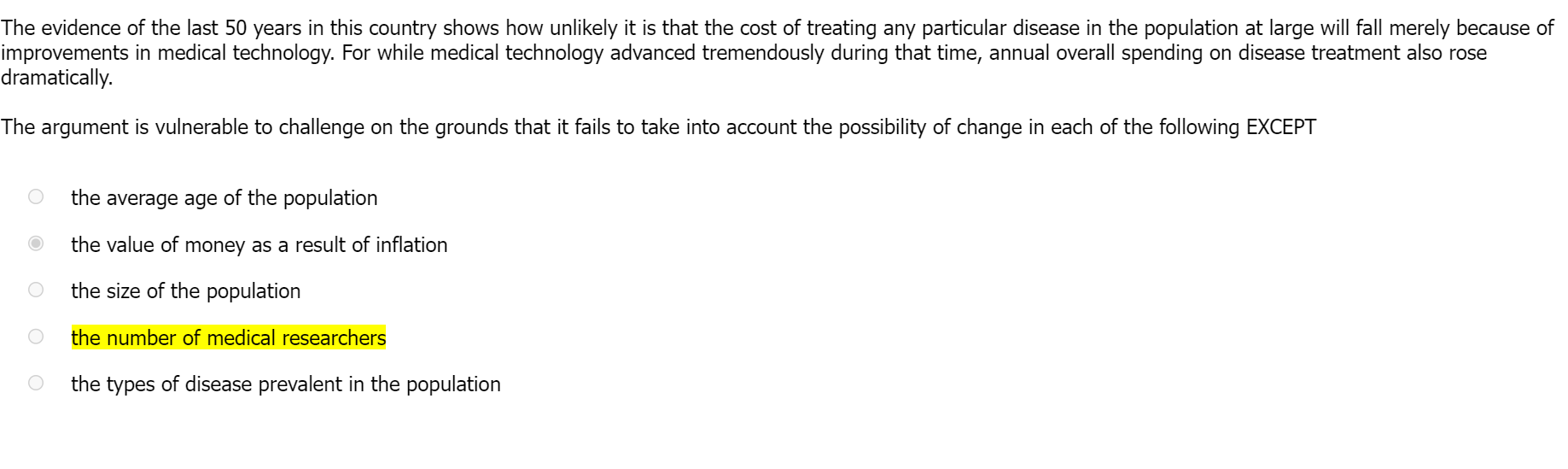
The evidence of the last 50 years in this country shows how unlikely it is that the cost of treating any particular disease in the population at large will fall merely because of improvements in medical technology. For while medical technology advanced tremendously during that time, annual overall spending on disease treatment also rose dramatically.
The argument is vulnerable to challenge on the grounds that it fails to take into account the possibility of change in each of the following EXCEPT
A. the average age of the population
B. the value of money as a result of inflation
C. the size of the population
D. the number of medical researchers
E. the types of disease prevalent in the population
111.5.png [ 72.52 KiB | Viewed 12489 times ]
The argument is vulnerable to challenge on the grounds that it fails to take into account the possibility of change in each of the following EXCEPT
A. the average age of the population
B. the value of money as a result of inflation
C. the size of the population
D. the number of medical researchers
E. the types of disease prevalent in the population
Attachment:
111.5.png [ 72.52 KiB | Viewed 12489 times ]
Need more Tests to Practice?
GMAT Club Tests give expert solutions for every question in full and sectional GMAT Focus mocks.
Learn more →

 Updated on: 28 Oct 2024, 18:20
Originally posted by MartyMurray on 15 Apr 2024, 15:09.
Last edited by MartyMurray on 28 Oct 2024, 18:20, edited 2 times in total.
Last edited by MartyMurray on 28 Oct 2024, 18:20, edited 2 times in total.
Kudos
Bookmarks
The evidence of the last 50 years in this country shows how unlikely it is that the cost of treating any particular disease in the population at large will fall merely because of improvements in medical technology. For while medical technology advanced tremendously during that time, annual overall spending on disease treatment also rose dramatically.
The conclusion of the argument is the following:
The evidence of the last 50 years in this country shows how unlikely it is that the cost of treating any particular disease in the population at large will fall merely because of improvements in medical technology.
The support for the conclusion is the following:
while medical technology advanced tremendously during that time, annual overall spending on disease treatment also rose dramatically
One issue with this argument that may jump out at us is that the conclusion is about "the cost of treating any particular disease" whereas the evidence is about "overall annual spending on disease treatment."
So, basically, the author has used evidence about an increase in TOTAL spending to support the conclusion that the cost of treating any PARTICULAR disease does not fall because of improvements in medical technology.
Using that evidence to support the conclusion is a questionable approach since the fact that overall spending increased does not necessarily indicate that the cost of treating any particular disease did not fall. After all, there could be many reasons why overall spending would increase even if the cost of treating specific diseases fell.
The argument is vulnerable to challenge on the grounds that it fails to take into account the possibility of change in each of the following EXCEPT
This question is a Logical Flaw EXCEPT question. So, the correct answer will be the only choice that does NOT bring up a variable such that the argument is flawed because it fails to take into account the possibility that that variable has changed.
A. the average age of the population
The argument is flawed because it does not take into account the possibility of change in "the average age of the population."
After all, if the average age has increased, that change could be the reason why "annual overall spending on disease treatment ... rose dramatically."
So, if the average age of the population changed, it could be that the cost of treating any particular disease in the population at large DOES fall because of improvements in medical technology but overall spending increased anyway because the average age increased and older people used medical services more.
In that case, the argument's conclusion does not follow from the evidence.
Eliminate.
B. the value of money as a result of inflation
The argument is flawed because it does not take into account the possibility of change in "the value of money as a result of inflation."
After all, if the value of money has changed as a result of inflation, that change could be the reason why "annual overall spending on disease treatment ... rose dramatically."
So, if the value of money did change, it could be that the cost of treating any particular disease in the population at large DOES fall because of improvements in medical technology but overall spending increased anyway because the value of money changed as a result of inflation.
In that case, the argument's conclusion does not follow from the evidence.
Eliminate.
C. the size of the population
The argument is flawed because it does not take into account the possibility of change in "the size of the population."
After all, if the size of the population has increased, that change could be the reason why "annual overall spending on disease treatment ... rose dramatically."
So, if the size of the population changed, it could be that the cost of treating any particular disease in the population at large DOES fall because of improvements in medical technology but overall spending increased anyway because the size of the population increased and so there were more people spending on medical services.
In that case, the argument's conclusion does not follow from the evidence.
Eliminate.
D. the number of medical researchers
This choice is interesting.
Let's say that the author has failed to take into account that there may have been a change in the number of medical researchers. Maybe the number of medical researchers has increased.
OK, in that case, it could be that an increase in the number of medical researchers has somehow caused the cost of treating any particular disease to increase.
Would that mean that the author's conclusion isn't correct?
No, because in that case, the pattern that the author has identified still exists. Spending has increased as technology has improved. Maybe the reason is that improvements in technology require more researchers. OK, in that case, costs still appear to have increased even though technology improved. So, the author's argument still works.
To better understand why this choice isn't correct, we can consider the difference between this choice and the other choices.
All the other choices somehow INDICATE THAT THE COST OF TREATING ANY PARTICULAR DISEASE MAY NOT ACTUALLY HAVE INCREASED. They all indicate that something other than increases in the costs of treating particular diseases, such as a population increase or inflation may have caused "overall spending" to increase. So, those choices indicate that the author may have arrived at an invalid conclusion because the author failed to consider something.
In other words, the other choices indicate that, even though the premise that "overall spending" increased is true, it may not be true that improvements in technology don't lead to decreases in "the cost of treating any particular disease."
In contrast, this choice may EXPLAIN WHY COSTS DID INCREASE. Maybe they increased because of a change in the number of researchers.
OK, sure, but in that case, costs still increased. So, the author could be correct in saying that improvements in technology aren't likely to cause costs to decrease because, regardless of why costs have increased, they have increased. So, the conclusion still makes sense.
So, even if there was a change in the number of medical researchers, the evidence that spending has increased still supports the conclusion.
Thus, since this question is a Logical Flaw EXCEPT question, this choice is correct because it's the only one that does not highlight a flaw in the argument.
Keep.
E. the types of disease prevalent in the population
The argument is flawed because it does not take into account the possibility of change in "the types of disease prevalent in the population."
After all, if the types of disease prevalent in the population have changed, that change could be the reason why "annual overall spending on disease treatment ... rose dramatically." After all, the new types of diseases that are prevalent could be more expensive to treat than the ones that were prevalent before.
So, if the types of disease prevalent in the population have changed, it could be that the cost of treating any particular disease in the population at large DOES fall because of improvements in medical technology but overall spending increased anyway because the types of disease prevalent in the population changed with the result that overall spending increased.
In that case, the argument's conclusion does not follow from the evidence.
Eliminate.
Correct answer: D
The conclusion of the argument is the following:
The evidence of the last 50 years in this country shows how unlikely it is that the cost of treating any particular disease in the population at large will fall merely because of improvements in medical technology.
The support for the conclusion is the following:
while medical technology advanced tremendously during that time, annual overall spending on disease treatment also rose dramatically
One issue with this argument that may jump out at us is that the conclusion is about "the cost of treating any particular disease" whereas the evidence is about "overall annual spending on disease treatment."
So, basically, the author has used evidence about an increase in TOTAL spending to support the conclusion that the cost of treating any PARTICULAR disease does not fall because of improvements in medical technology.
Using that evidence to support the conclusion is a questionable approach since the fact that overall spending increased does not necessarily indicate that the cost of treating any particular disease did not fall. After all, there could be many reasons why overall spending would increase even if the cost of treating specific diseases fell.
The argument is vulnerable to challenge on the grounds that it fails to take into account the possibility of change in each of the following EXCEPT
This question is a Logical Flaw EXCEPT question. So, the correct answer will be the only choice that does NOT bring up a variable such that the argument is flawed because it fails to take into account the possibility that that variable has changed.
A. the average age of the population
The argument is flawed because it does not take into account the possibility of change in "the average age of the population."
After all, if the average age has increased, that change could be the reason why "annual overall spending on disease treatment ... rose dramatically."
So, if the average age of the population changed, it could be that the cost of treating any particular disease in the population at large DOES fall because of improvements in medical technology but overall spending increased anyway because the average age increased and older people used medical services more.
In that case, the argument's conclusion does not follow from the evidence.
Eliminate.
B. the value of money as a result of inflation
The argument is flawed because it does not take into account the possibility of change in "the value of money as a result of inflation."
After all, if the value of money has changed as a result of inflation, that change could be the reason why "annual overall spending on disease treatment ... rose dramatically."
So, if the value of money did change, it could be that the cost of treating any particular disease in the population at large DOES fall because of improvements in medical technology but overall spending increased anyway because the value of money changed as a result of inflation.
In that case, the argument's conclusion does not follow from the evidence.
Eliminate.
C. the size of the population
The argument is flawed because it does not take into account the possibility of change in "the size of the population."
After all, if the size of the population has increased, that change could be the reason why "annual overall spending on disease treatment ... rose dramatically."
So, if the size of the population changed, it could be that the cost of treating any particular disease in the population at large DOES fall because of improvements in medical technology but overall spending increased anyway because the size of the population increased and so there were more people spending on medical services.
In that case, the argument's conclusion does not follow from the evidence.
Eliminate.
D. the number of medical researchers
This choice is interesting.
Let's say that the author has failed to take into account that there may have been a change in the number of medical researchers. Maybe the number of medical researchers has increased.
OK, in that case, it could be that an increase in the number of medical researchers has somehow caused the cost of treating any particular disease to increase.
Would that mean that the author's conclusion isn't correct?
No, because in that case, the pattern that the author has identified still exists. Spending has increased as technology has improved. Maybe the reason is that improvements in technology require more researchers. OK, in that case, costs still appear to have increased even though technology improved. So, the author's argument still works.
To better understand why this choice isn't correct, we can consider the difference between this choice and the other choices.
All the other choices somehow INDICATE THAT THE COST OF TREATING ANY PARTICULAR DISEASE MAY NOT ACTUALLY HAVE INCREASED. They all indicate that something other than increases in the costs of treating particular diseases, such as a population increase or inflation may have caused "overall spending" to increase. So, those choices indicate that the author may have arrived at an invalid conclusion because the author failed to consider something.
In other words, the other choices indicate that, even though the premise that "overall spending" increased is true, it may not be true that improvements in technology don't lead to decreases in "the cost of treating any particular disease."
In contrast, this choice may EXPLAIN WHY COSTS DID INCREASE. Maybe they increased because of a change in the number of researchers.
OK, sure, but in that case, costs still increased. So, the author could be correct in saying that improvements in technology aren't likely to cause costs to decrease because, regardless of why costs have increased, they have increased. So, the conclusion still makes sense.
So, even if there was a change in the number of medical researchers, the evidence that spending has increased still supports the conclusion.
Thus, since this question is a Logical Flaw EXCEPT question, this choice is correct because it's the only one that does not highlight a flaw in the argument.
Keep.
E. the types of disease prevalent in the population
The argument is flawed because it does not take into account the possibility of change in "the types of disease prevalent in the population."
After all, if the types of disease prevalent in the population have changed, that change could be the reason why "annual overall spending on disease treatment ... rose dramatically." After all, the new types of diseases that are prevalent could be more expensive to treat than the ones that were prevalent before.
So, if the types of disease prevalent in the population have changed, it could be that the cost of treating any particular disease in the population at large DOES fall because of improvements in medical technology but overall spending increased anyway because the types of disease prevalent in the population changed with the result that overall spending increased.
In that case, the argument's conclusion does not follow from the evidence.
Eliminate.
Correct answer: D
General Discussion

 16 Apr 2024, 15:54
Kudos
Bookmarks
MartyMurray KarishmaB GMATNinja I selected option D because the "number of researchers " has no bearing on the cost of a particular disease. The argument dint make any mistake by failing to take into account the number of medical researchers because we don't know the efficiency of each medical researcher / the productivity of each researcher and we are told that the significant advancement in medical technology has already been made.
Is my reasoning my correct ?
Please advise. KarishmaB MartyMurray GMATNinja
Posted from my mobile device
Is my reasoning my correct ?
Please advise. KarishmaB MartyMurray GMATNinja
Posted from my mobile device