Events & Promotions
|
|

GMAT Club Daily Prep
Thank you for using the timer - this advanced tool can estimate your performance and suggest more practice questions. We have subscribed you to Daily Prep Questions via email.
Customized
for You
Track
Your Progress
Practice
Pays
Not interested in getting valuable practice questions and articles delivered to your email? No problem, unsubscribe here.
 Sep 15
07:00 PM EDT
-09:00 PM EST
Elite scores are possible when you enroll in a powerful GMAT course, taught live online + 6 months access to TTP OnDemand video courses included! Class starts Tues/Thurs Sept. 15, 2026 - Nov. 15, 2027, 7:00pm-9:00pm EST Sep 21
07:00 PM EDT
-10:00 PM EDT
Boost your GMAT score in less than one month in a live online class + 6 months access to TTP OnDemand video courses included! Class starts Mon, Tues, Wed, Thur, Fri Sept. 21, 2026 - Oct. 9, 2027, 7:00pm-10:00pm EST



 Updated on: 09 Jul 2013, 10:39
Originally posted by RaviChandra on 14 Sep 2010, 07:27.
Last edited by Bunuel on 09 Jul 2013, 10:39, edited 1 time in total.
Last edited by Bunuel on 09 Jul 2013, 10:39, edited 1 time in total.
Added the OA.
Kudos
Bookmarks


B
Be sure to select an answer first to save it in the Error Log before revealing the correct answer (OA)!
Difficulty:
 95%
(hard)
95%
(hard)
Question Stats:
49% (03:17) correct 51%
(03:07)
wrong
based on 145
sessions
51%
(03:07)
wrong
based on 145
sessions
History
Date
Time
Result
Not Attempted Yet
Two squares, each of side lengths 1 unit and having their centres at O, are rotated with respect to each other to generate octagon ABCDEFGH, as shown in the figure above. If AB = 43/99, find the area of the octagon.
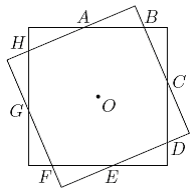
G86.PNG [ 5.44 KiB | Viewed 12920 times ]
A. 73/99
B. 86/99
C. 1287/9801
D. 76/99
Attachment:
G86.PNG [ 5.44 KiB | Viewed 12920 times ]
A. 73/99
B. 86/99
C. 1287/9801
D. 76/99
 14 Sep 2010, 08:24
Kudos
Bookmarks
EASY WAY is as shown below
Connect AO and BO to get a AOB. We get totally 8 triangles like this.
Now. Lets calculate the AREA of AOB
AREA = .5*base*hiegt = 0.5*43/99 * 1/2 note: i/2 is the hieght as the length of a side of the given square is 1 and half of that is what is the hieght
hence AREA = 1/4 * 43/99
As told we have 8 similar triangles in this octagon.
Hence ANSWER = 8*1/4 * 43/99 = 86/99
Hope it is clear
Connect AO and BO to get a AOB. We get totally 8 triangles like this.
Now. Lets calculate the AREA of AOB
AREA = .5*base*hiegt = 0.5*43/99 * 1/2 note: i/2 is the hieght as the length of a side of the given square is 1 and half of that is what is the hieght
hence AREA = 1/4 * 43/99
As told we have 8 similar triangles in this octagon.
Hence ANSWER = 8*1/4 * 43/99 = 86/99
Hope it is clear

 14 Sep 2010, 07:52
Kudos
Bookmarks
RaviChandra
First note that all the triangles will have the same dimensions. Let the legs of these triangles be \(x\) and \(y\), also we know that the hypotenuse equals to \(\frac{43}{99}\), so \(x^2+y^2=(\frac{43}{99})^2\).
If we take one side of a square we'll see that \(x+y+\frac{43}{99}=1\) --> \(x+y=\frac{56}{99}\) --> square it --> \(x^2+2xy+y^2=(\frac{56}{99})^2\), as from above \(x^2+y^2=(\frac{43}{99})^2\), then: \((\frac{43}{99})^2+2xy=(\frac{56}{99})^2\) --> \(2xy=(\frac{56}{99})^2-(\frac{43}{99})^2=(\frac{56}{99}-\frac{43}{99})(\frac{56}{99}+\frac{43}{99})=\frac{13}{99}*1=\frac{13}{99}\);
Now, the are of the octagon will be area of a square minus area of 4 triangles --> \(area=1-4*(\frac{1}{2}*xy)=1-2xy=1-\frac{13}{99}=\frac{86}{99}\).
Answer: B.