Last visit was: 24 Apr 2026, 02:45 It is currently 24 Apr 2026, 02:45
Close
GMAT Club Daily Prep
Thank you for using the timer - this advanced tool can estimate your performance and suggest more practice questions. We have subscribed you to Daily Prep Questions via email.

Customized
for You

we will pick new questions that match your level based on your Timer History

Track
Your Progress

every week, we’ll send you an estimated GMAT score based on your performance

Practice
Pays

we will pick new questions that match your level based on your Timer History
Not interested in getting valuable practice questions and articles delivered to your email? No problem, unsubscribe here.
Close
Request Expert Reply
Confirm Cancel
User avatar
varunmaheshwari
Joined: 25 Aug 2008
Last visit: 28 Jun 2012
Posts: 99
Own Kudos:
334
 [45]
Given Kudos: 5
Location: India
WE 1: 3.75 IT
WE 2: 1.0 IT
Posts: 99
Kudos: 334
 [45]
7
Kudos
Add Kudos
38
Bookmarks
Bookmark this Post
Most Helpful Reply
User avatar
fluke
User avatar
Retired Moderator
Joined: 20 Dec 2010
Last visit: 24 Oct 2013
Posts: 1,095
Own Kudos:
5,167
 [19]
Given Kudos: 376
Posts: 1,095
Kudos: 5,167
 [19]
16
Kudos
Add Kudos
3
Bookmarks
Bookmark this Post
User avatar
KarishmaB
Joined: 16 Oct 2010
Last visit: 23 Apr 2026
Posts: 16,442
Own Kudos:
79,400
 [19]
Given Kudos: 485
Location: Pune, India
Expert
Expert reply
Active GMAT Club Expert! Tag them with @ followed by their username for a faster response.
Posts: 16,442
Kudos: 79,400
 [19]
12
Kudos
Add Kudos
7
Bookmarks
Bookmark this Post
General Discussion
User avatar
vinodmallapu
Joined: 06 May 2011
Last visit: 14 Dec 2011
Posts: 8
Own Kudos:
2
 [1]
Posts: 8
Kudos: 2
 [1]
1
Kudos
Add Kudos
Bookmarks
Bookmark this Post
The Answer is C.


To get a triangle 128 times(2^7) smaller than the main triangle, you will have to partition it 7 times.
For each Odd partition you will get 3 Shaded regions.
For each Even partition you will get 1 shaded region the will again be partitions into regions by subsequent odd partition.So, we will no consider these partitions.

Partition 1 2 3 4 5 6 7
Shaded Regions 3 1 3 1 3 1 3

Consider the area of main triangle be A.
So the shaded region will be (3)*(1/4^7)A + (3)*(1/4^5)A + (3)*(1/4^3)A + (3)*(1/4^1)A

= 3/4 (2^-12 + 2^-8 + 2^-4 + 2^0 ) A

To get the fraction of shaded region , (3/4 (2^-12 + 2^-8 + 2^-4 + 2^0 ) A) / A
= 3/4 (2^-12 + 2^-8 + 2^-4 + 2^0 )
User avatar
diebeatsthegmat
Joined: 18 Oct 2010
Last visit: 08 Jan 2012
Posts: 44
Own Kudos:
Posts: 44
Kudos: 26
Kudos
Add Kudos
Bookmarks
Bookmark this Post
may i ask which source it is from? i dont think real test will have such kinda of question
User avatar
GMATmission
Joined: 16 Aug 2011
Last visit: 13 Jan 2012
Posts: 104
Own Kudos:
219
 [2]
Given Kudos: 43
Status:Bell the GMAT!!!
Affiliations: Aidha
Location: Singapore
Concentration: Finance, General Management
GMAT 1: 680 Q46 V37
GMAT 2: 620 Q49 V27
GMAT 3: 700 Q49 V36
WE:Other (Other)
GMAT 3: 700 Q49 V36
Posts: 104
Kudos: 219
 [2]
2
Kudos
Add Kudos
Bookmarks
Bookmark this Post
IMO C.

I did not calculate it completely. Just calculated the area of first two partitions and established a pattern and then used the pattern to guess the answer. That's what I am going to do if something like this comes in real test as well :)
User avatar
mohnish104
Joined: 03 Dec 2012
Last visit: 19 Apr 2014
Posts: 142
Own Kudos:
976
 [1]
Given Kudos: 291
Posts: 142
Kudos: 976
 [1]
1
Kudos
Add Kudos
Bookmarks
Bookmark this Post
fluke
varunmaheshwari
Attachment:
InscribedTraingles.JPG
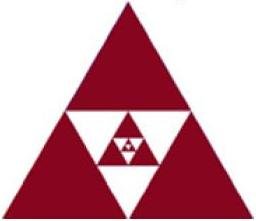
The figure is made up of a series of inscribed equilateral triangles. If the pattern continues until the length of
a side of the largest triangle (i.e. the entire figure) is exactly 128 times that of the smallest triangle, what
fraction of the total figure will be shaded?

A. 1\4(2^0 + 2^-4 + 2^-8 + 2^-12)

B. 1\4(2^0 + 2^-2 + 2^-4 + 2^-6)

C. 3\4(2^0 + 2^-4 + 2^-8 + 2^-12)

D. 3\4(2^0 + 2^-2 + 2^-4 + 2^-6)

E. 3\4(2^0 + 2^-1 + 2^-2 + 2^-3)

PS: I am sorry for the formatting of the answer choices like this.

\(Area \hspace{3} of \hspace{3} equilateral \hspace{3} triangle = \frac{\sqrt{3}}{4}*(side)^2\)

\(Total \hspace{3} Area = \frac{\sqrt{3}}{4}(128)^2=\frac{\sqrt{3}}{4}(2^7)^2=\frac{\sqrt{3}}{4}*2^{14}\)

\(Shaded \hspace{3} portion \hspace{3} of \hspace{3} outer \hspace{3} most= \frac{3}{4}*\frac{\sqrt{3}}{4}*(2^7)^2\) {:Side=128=2^7}
Skip the next: {:Side=64}
\(Shaded \hspace{3} portion \hspace{3} of 3^{rd}= \frac{3}{4}*\frac{\sqrt{3}}{4}*(2^5)^2\) {:Side=32=2^5}
\(Shaded \hspace{3} portion \hspace{3} of 5^{th}= \frac{3}{4}*\frac{\sqrt{3}}{4}*(2^3)^2\) {:Side=8=2^3}
\(Shaded \hspace{3} portion \hspace{3} of 7^{th}= \frac{3}{4}*\frac{\sqrt{3}}{4}*(2^1)^2\) {:Side=2=2^1}

Take the fraction:
\(\frac{\frac{3}{4}*\frac{\sqrt{3}}{4}(2^{14}+2^{10}+2^{6}+2^{2})}{\frac{\sqrt{3}}{4}*2^{14}}\)

\(=\frac{\frac{3}{4}(2^{14}+2^{10}+2^{6}+2^{2})}{2^{14}}\)

\(=\frac{3}{4}(\frac{2^{14}}{2^{14}}+\frac{2^{10}}{2^{14}}+\frac{2^{6}}{2^{14}}+\frac{2^{2}}{2^{14}})\)

\(=\frac{3}{4}(2^{(14-14)}+2^{(10-14)}+2^{(6-14)}+2^{(2-14)})\)

\(=\frac{3}{4}(2^0+2^{-4}+2^{-8}+2^{-12})\)

Ans: "C"


Can you please explain why u skipped certain sides?
User avatar
jlgdr
Joined: 06 Sep 2013
Last visit: 24 Jul 2015
Posts: 1,302
Own Kudos:
Given Kudos: 355
Concentration: Finance
Posts: 1,302
Kudos: 2,976
Kudos
Add Kudos
Bookmarks
Bookmark this Post
vinodmallapu
The Answer is C.


To get a triangle 128 times(2^7) smaller than the main triangle, you will have to partition it 7 times.
For each Odd partition you will get 3 Shaded regions.
For each Even partition you will get 1 shaded region the will again be partitions into regions by subsequent odd partition.So, we will no consider these partitions.

Partition 1 2 3 4 5 6 7
Shaded Regions 3 1 3 1 3 1 3

Consider the area of main triangle be A.
So the shaded region will be (3)*(1/4^7)A + (3)*(1/4^5)A + (3)*(1/4^3)A + (3)*(1/4^1)A

= 3/4 (2^-12 + 2^-8 + 2^-4 + 2^0 ) A

To get the fraction of shaded region , (3/4 (2^-12 + 2^-8 + 2^-4 + 2^0 ) A) / A
= 3/4 (2^-12 + 2^-8 + 2^-4 + 2^0 )

Excuse me but would you explain why you skipped the even partitions?

Cheers!
J :)
User avatar
gmatprav
Joined: 25 Oct 2013
Last visit: 19 Nov 2015
Posts: 109
Own Kudos:
Given Kudos: 55
Posts: 109
Kudos: 186
Kudos
Add Kudos
Bookmarks
Bookmark this Post
I believe the even portions are skipped because those are considered shaded in the next odd portions.
User avatar
mvictor
User avatar
Board of Directors
Joined: 17 Jul 2014
Last visit: 14 Jul 2021
Posts: 2,118
Own Kudos:
1,277
 [4]
Given Kudos: 236
Location: United States (IL)
Concentration: Finance, Economics
GMAT 1: 650 Q49 V30
GPA: 3.92
WE:General Management (Transportation)
Products:
GMAT 1: 650 Q49 V30
Posts: 2,118
Kudos: 1,277
 [4]
2
Kudos
Add Kudos
2
Bookmarks
Bookmark this Post
varunmaheshwari
Attachment:
InscribedTraingles.JPG
The figure is made up of a series of inscribed equilateral triangles. If the pattern continues until the length of a side of the largest triangle (i.e. the entire figure) is exactly 128 times that of the smallest triangle, what fraction of the total figure will be shaded?

A. 1\4(2^0 + 2^-4 + 2^-8 + 2^-12)

B. 1\4(2^0 + 2^-2 + 2^-4 + 2^-6)

C. 3\4(2^0 + 2^-4 + 2^-8 + 2^-12)

D. 3\4(2^0 + 2^-2 + 2^-4 + 2^-6)

E. 3\4(2^0 + 2^-1 + 2^-2 + 2^-3)

PS: I am sorry for the formatting of the answer choices like this.


I didn't get into details, and solved it with logic.
we have 4 equal triangles. we know for sure that the shaded area will be greater than 3/4 of the total figure.
A and B are right away out.

i started with E.
3/4 *(1+1/2 + 1/4 + 1/8) = 3/4 * (8+4+2+1)/8 = 3/4 * 15/8 ->result is greater than 1. so out.

D
3/4 * (1+1/4 +1/16 + 1/64) = 3/4* (64+16+4+1)/64 = 3/4 * 85/64 = 255/256 - clearly no!


only left - C
User avatar
RK84
Joined: 20 Mar 2015
Last visit: 31 Oct 2018
Posts: 41
Own Kudos:
Given Kudos: 34
Location: United States
Concentration: General Management, Strategy
WE:Design (Manufacturing)
Posts: 41
Kudos: 38
Kudos
Add Kudos
Bookmarks
Bookmark this Post
varunmaheshwari
Attachment:
InscribedTraingles.JPG
The figure is made up of a series of inscribed equilateral triangles. If the pattern continues until the length of a side of the largest triangle (i.e. the entire figure) is exactly 128 times that of the smallest triangle, what fraction of the total figure will be shaded?

A. 1\4(2^0 + 2^-4 + 2^-8 + 2^-12)

B. 1\4(2^0 + 2^-2 + 2^-4 + 2^-6)

C. 3\4(2^0 + 2^-4 + 2^-8 + 2^-12)

D. 3\4(2^0 + 2^-2 + 2^-4 + 2^-6)

E. 3\4(2^0 + 2^-1 + 2^-2 + 2^-3)

PS: I am sorry for the formatting of the answer choices like this.

Just a glance at the image shows that the shaded area would be around 75%. Calculating all the options till two terms only as rest are too small, we get C as the answer.
User avatar
shashankism
Joined: 13 Mar 2017
Last visit: 19 Feb 2026
Posts: 608
Own Kudos:
Given Kudos: 88
Affiliations: IIT Dhanbad
Location: India
Concentration: General Management, Entrepreneurship
GPA: 3.8
WE:Engineering (Energy)
Posts: 608
Kudos: 712
Kudos
Add Kudos
Bookmarks
Bookmark this Post
varunmaheshwari

The figure is made up of a series of inscribed equilateral triangles. If the pattern continues until the length of a side of the largest triangle (i.e. the entire figure) is exactly 128 times that of the smallest triangle, what fraction of the total figure will be shaded?


A. \(\frac{1}{4}(2^0 + 2^{-4} + 2^{-8} + 2^{-12})\)


B. \(\frac{1}{4}(2^0 + 2^{-2} + 2^{-4} + 2^{-6})\)


C. \(\frac{3}{4}(2^0 + 2^{-4} + 2^{-8} + 2^{-12})\)


D. \(\frac{3}{4}(2^0 + 2^{-2} + 2^{-4} + 2^{-6})\)


E. \(\frac{3}{4}(2^0 + 2^{-1} + 2^{-2} + 2^{-3})\)

Attachment:
InscribedTraingles.JPG

Though i marked the wrong answer, Lets try to solve easy way..
1/128 = 1/2^7 . So center triangle will go upto 8th triangle in the center and will be unshaded.
Let A be the area of bigger triangle. Lets number biggest triangle as 1 and then smaller center triangles as 2 and next smaller center triangle as 3 and so on.

So, First focusing on 1st bigger triangle no. 1..
Shaded region = 3/4 A

Now , In 2nd smaller triangle no. 2 , we have only shaded region from 1/4th of the part i.e from triangle no.3. So we will consider it in the next calculation in triangle no.3

In triangle 3,
Shaded region = 3/4 * triangle 3 = 3/4 *(1/4)^2 A

In triangle no. 4 , we have only shaded region from 1/4th of the part i.e from triangle no.5. So we will consider it in the next calculation in triangle no.5

In triangle 5,
Shaded region = 3/4 * triangle 5 = 3/4* 1/4 *1/4 * triangle 3 = 3/4 *(1/4)^2 * (1/4)^2 A

In triangle 6, we have only shaded region from 1/4th of the part i.e from triangle no.7. So we will consider it in the next calculation in triangle no.7
Shaded region = 3/4 * (1/4)^2 * (1/4)^2 * (1/4)^2 A


Sum of shaded regions = 3/4 A + 3/4 *(1/4)^2 A + 3/4 *(1/4)^2 * (1/4)^2 A + 3/4 * (1/4)^2 * (1/4)^2 * (1/4)^2 A
= 3/4 (1/2^0 + 1/2^4 + 1/2^8 + 1/2^12) A

Answer C
User avatar
quantrace
User avatar
Current Student
Joined: 27 Feb 2017
Last visit: 29 Jun 2022
Posts: 14
Own Kudos:
7
 [1]
Given Kudos: 25
Location: Spain
GMAT 1: 740 Q49 V42
GMAT 1: 740 Q49 V42
Posts: 14
Kudos: 7
 [1]
1
Kudos
Add Kudos
Bookmarks
Bookmark this Post
varunmaheshwari

The figure is made up of a series of inscribed equilateral triangles. If the pattern continues until the length of a side of the largest triangle (i.e. the entire figure) is exactly 128 times that of the smallest triangle, what fraction of the total figure will be shaded?


A. \(\frac{1}{4}(2^0 + 2^{-4} + 2^{-8} + 2^{-12})\)


B. \(\frac{1}{4}(2^0 + 2^{-2} + 2^{-4} + 2^{-6})\)


C. \(\frac{3}{4}(2^0 + 2^{-4} + 2^{-8} + 2^{-12})\)


D. \(\frac{3}{4}(2^0 + 2^{-2} + 2^{-4} + 2^{-6})\)


E. \(\frac{3}{4}(2^0 + 2^{-1} + 2^{-2} + 2^{-3})\)

Attachment:
The attachment InscribedTraingles.JPG is no longer available

I solved it as per the image attached, hope it is clear and helps.
Attachments

gmat1.jpg
gmat1.jpg [ 639.05 KiB | Viewed 10213 times ]

User avatar
bumpbot
User avatar
Non-Human User
Joined: 09 Sep 2013
Last visit: 04 Jan 2021
Posts: 38,966
Own Kudos:
Posts: 38,966
Kudos: 1,117
Kudos
Add Kudos
Bookmarks
Bookmark this Post
Automated notice from GMAT Club BumpBot:

A member just gave Kudos to this thread, showing it’s still useful. I’ve bumped it to the top so more people can benefit. Feel free to add your own questions or solutions.

This post was generated automatically.
Moderators:
Math Expert
109802 posts
Tuck School Moderator
853 posts