Events & Promotions
|
|

GMAT Club Daily Prep
Thank you for using the timer - this advanced tool can estimate your performance and suggest more practice questions. We have subscribed you to Daily Prep Questions via email.
Customized
for You
Track
Your Progress
Practice
Pays
Not interested in getting valuable practice questions and articles delivered to your email? No problem, unsubscribe here.
 Sep 10
08:00 PM PDT
-09:00 PM PDT
Free- full-length test + 15 concept videos + 150+ short videos + study plan! Sep 08
12:30 AM EDT
-01:30 AM EDT
Looking for your GMAT motivation to break through the score plateau? Pragati improved her score by massive 160 points with strategic guidance and hard-work! Find out how personalized mentorship and a strong mindset can turn GMAT struggles into success. Sep 10
01:00 AM EDT
-02:00 AM EDT
Learn how Keshav, a Chartered Accountant, scored an impressive 705 on GMAT in just 30 days with GMATWhiz's expert guidance. In this video, he shares preparation tips and strategies that worked for him, including the mock, time management, and more. Sep 15
07:00 PM EDT
-09:00 PM EST
Elite scores are possible when you enroll in a powerful GMAT course, taught live online + 6 months access to TTP OnDemand video courses included! Class starts Tues/Thurs Sept. 15, 2026 - Nov. 15, 2027, 7:00pm-9:00pm EST Sep 21
07:00 PM EDT
-10:00 PM EDT
Boost your GMAT score in less than one month in a live online class + 6 months access to TTP OnDemand video courses included! Class starts Mon, Tues, Wed, Thur, Fri Sept. 21, 2026 - Oct. 9, 2027, 7:00pm-10:00pm EST

 21 Aug 2014, 00:45
Kudos
Bookmarks


B
Be sure to select an answer first to save it in the Error Log before revealing the correct answer (OA)!
Difficulty:
 65%
(hard)
65%
(hard)
Question Stats:
67% (03:37) correct 33%
(03:26)
wrong
based on 159
sessions
33%
(03:26)
wrong
based on 159
sessions
History
Date
Time
Result
Not Attempted Yet
In the figure below, square AFGE is inside square ABCD such that G is on arc BD, which is centered at C. If DC=8, what is the area of shaded region DEG
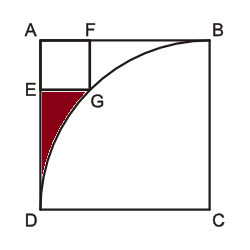
square.png [ 7.06 KiB | Viewed 6129 times ]
A: \(64\sqrt{2} - 32 - 16\pi\)
B: \(8[4\sqrt{2} - (\pi + 2)]\)
C: \(64 - 32\pi\)
D: \(64 - 16\pi\)
E: \(64\sqrt{2} - 8\pi\)
Attachment:
square.png [ 7.06 KiB | Viewed 6129 times ]
A: \(64\sqrt{2} - 32 - 16\pi\)
B: \(8[4\sqrt{2} - (\pi + 2)]\)
C: \(64 - 32\pi\)
D: \(64 - 16\pi\)
E: \(64\sqrt{2} - 8\pi\)

 21 Aug 2014, 13:10
Kudos
Bookmarks
PareshGmat
Area of the square ABCD = 64
Area of sector CBD = \(\frac{\pi * 8^2}{4} = 16\pi\)
Attachment:
1.jpg [ 11.31 KiB | Viewed 6023 times ]
For square GHCI, GC is the diagonal. Therefore, \(GH = GI = 4\sqrt{2}\) which makes \(FG = GE = 8 - 4\sqrt{2} = 4(2 - \sqrt{2})\)
Now, as the diagonal AC divides both the square ABCD and the sector CBD into equal halves, Area of region DAG = Area of region BAG
Also, the same diagonal divides the small square AEGF into two congruent triangles. So, Area of region DEG = Area of region BFG
Now, Area of region DAG + Area of region BAG = Area of the square ABCD - Area of sector CBD - Area of square AEGF
Area of region DAG = \(\frac{64 - 16\pi - [4(2 - \sqrt{2})]^2}{2} = 32 - 8\pi - \frac{16(4 + 2 - 4\sqrt{2})}{2} = 8(4 - \pi - 6 + 4\sqrt{2}) = 8 [4\sqrt{2} - (\pi + 2)]\)
Hence the answer is B.
Hope it's clear.
 21 Aug 2014, 13:33
Kudos
Bookmarks
PareshGmat
Dear PareshGmat,
That's a great question. I think it is very much like something the GMAT could ask on one of the harder questions.
Here's a solution.
If we take the big square ABCD (Area = 64) and subtract both the quarter circle and the little square AFGE, then divide the remaining area in half, we will get the shaded area. Very elegant.
Of course, big square ABCD = 64.
Quarter circle = \(16\pi\)
What about the little square?
Attachment:
square, circular arc, smaller square.JPG [ 20.01 KiB | Viewed 5963 times ]
Of course, GC is just the radius of the circle: GC = 8
Well, \(AG = AC - GC = 8sqrt(2) - 8 = 8(sqrt(2) - 1)\)
That's the diagonal of the square AFGE.
As a shortcut, we can find the area of any square by squaring the diagonal, and then dividing by two.
Area of AFGE = \(\frac{(AG)^2}{2}\)
Area of AFGE = \(\frac{(8(sqrt(2) - 1))^2}{2}\)
Area of AFGE = \(32(sqrt(2) - 1)^2\)
Area of AFGE = \(32(2 - 2sqrt(2) + 1)\)
Area of AFGE = \(96 - 64sqrt(2)\)
Twice shaded region = (Square ABCD) - (quarter circle) - (Square AFGE)
Twice shaded region = \(64 - 16\pi - (96 - 64sqrt(2))\)
Twice shaded region = \(64sqrt(2) - 32 - 16\pi\)
Divide by 2
Shaded region = \(32sqrt(2) - 16 - 8\pi\)
Factor out an 8
Shaded region = \(8(4sqrt(2) - 2 - \pi)\)
Shaded region = \(8(4sqrt(2) - (2 + \pi))\)
Answer = (B)
Great problem!
Mike





