Last visit was: 24 Apr 2026, 04:52 It is currently 24 Apr 2026, 04:52
Close
GMAT Club Daily Prep
Thank you for using the timer - this advanced tool can estimate your performance and suggest more practice questions. We have subscribed you to Daily Prep Questions via email.

Customized
for You

we will pick new questions that match your level based on your Timer History

Track
Your Progress

every week, we’ll send you an estimated GMAT score based on your performance

Practice
Pays

we will pick new questions that match your level based on your Timer History
Not interested in getting valuable practice questions and articles delivered to your email? No problem, unsubscribe here.
Close
Request Expert Reply
Confirm Cancel
User avatar
PathFinder007
Joined: 10 Mar 2014
Last visit: 21 Oct 2018
Posts: 127
Own Kudos:
745
 [61]
Given Kudos: 13
Posts: 127
Kudos: 745
 [61]
6
Kudos
Add Kudos
55
Bookmarks
Bookmark this Post
Most Helpful Reply
avatar
PareshGmat
Joined: 27 Dec 2012
Last visit: 10 Jul 2016
Posts: 1,531
Own Kudos:
8,272
 [18]
Given Kudos: 193
Status:The Best Or Nothing
Location: India
Concentration: General Management, Technology
WE:Information Technology (Computer Software)
Posts: 1,531
Kudos: 8,272
 [18]
13
Kudos
Add Kudos
5
Bookmarks
Bookmark this Post
User avatar
Bunuel
User avatar
Math Expert
Joined: 02 Sep 2009
Last visit: 24 Apr 2026
Posts: 109,811
Own Kudos:
Given Kudos: 105,869
Products:
Expert
Expert reply
Active GMAT Club Expert! Tag them with @ followed by their username for a faster response.
Posts: 109,811
Kudos: 810,947
 [17]
3
Kudos
Add Kudos
13
Bookmarks
Bookmark this Post
General Discussion
User avatar
EMPOWERgmatRichC
User avatar
Major Poster
Joined: 19 Dec 2014
Last visit: 31 Dec 2023
Posts: 21,777
Own Kudos:
13,047
 [4]
Given Kudos: 450
Status:GMAT Assassin/Co-Founder
Affiliations: EMPOWERgmat
Location: United States (CA)
GMAT 1: 800 Q51 V49
GRE 1: Q170 V170
Expert
Expert reply
GMAT 1: 800 Q51 V49
GRE 1: Q170 V170
Posts: 21,777
Kudos: 13,047
 [4]
3
Kudos
Add Kudos
1
Bookmarks
Bookmark this Post
Hi PathFinder007,

Since this question asks which of the following relationships MUST be true, we can TEST VALUES to find the true statement and disprove the others. Here's how.

Since we have 2 "small" right triangles inside of 1 "big" right triangle, I'm going to take advantage of some common right triangle patterns that exist in math.

Let's make AngleA = 45 degrees and AngleC = 45 degrees

So both little triangles are 45/45/90 and the big triangle is 45/45/90

This means that AD = BD = CD and AB = BC

If I make AD = BD = CD = 10...
.....then AB = BC = 10(root2)...

Now we can TEST those values against the answers and eliminate...

Answer A: 100 = 200 + 200...NOT true...ELIMINATE it.

Answer B: 1/100 = 1/200 + 1/200...TRUE. Keep it.

Answer C: 1/100 = 0...NOT true...ELIMINATE it.

Answer D: 100 = 800...NOT true. ELIMINATE it.

Answer E: 100 = 0...NOT true. ELIMINATE it.

Final Answer:
GMAT assassins aren't born, they're made,
Rich
User avatar
KarishmaB
Joined: 16 Oct 2010
Last visit: 23 Apr 2026
Posts: 16,442
Own Kudos:
79,400
 [4]
Given Kudos: 485
Location: Pune, India
Expert
Expert reply
Active GMAT Club Expert! Tag them with @ followed by their username for a faster response.
Posts: 16,442
Kudos: 79,400
 [4]
2
Kudos
Add Kudos
2
Bookmarks
Bookmark this Post
PathFinder007
In the figure above, AB is perpendicular to BC and BD is perpendicular to AC. Which of the following relationships must be true.
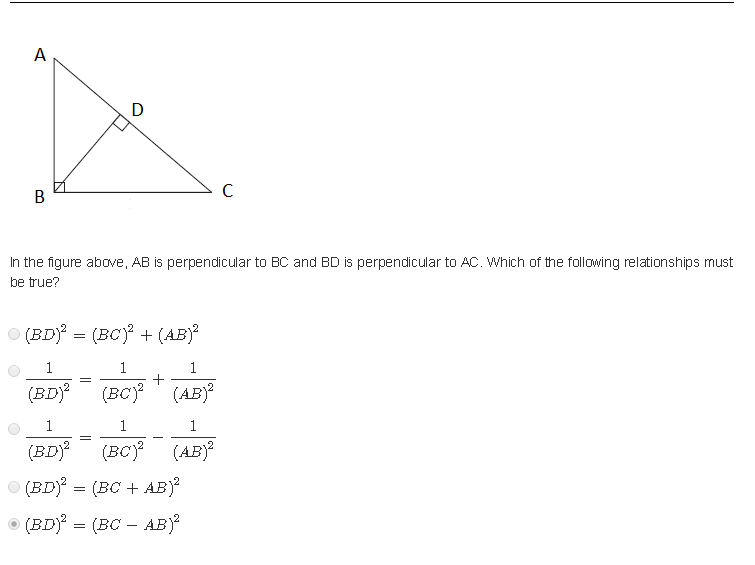

Here is how we can arrive at the relation from scratch:

In right triangle ADB, \(BD^2 = AB^2 - AD^2\)

We need BD and AB in our equation but not AD. So get rid of AD.

Triangle ABC is similar to ADB. So \(\frac{AB}{AD} = \frac{BC}{BD}\)

\(AD = \frac{AB*BD}{BC}\)

Substitute in equation above:

\(BD^2 = AB^2 - \frac{AB^2 * BD^2}{BC^2}\)

\(BD^2*BC^2 = AB^2 * BC^2 - AB^2 * BD^2\)

Divide by \(AB^2 * BC^2 * BD^2\)

\(\frac{1}{AB^2} = \frac{1}{BD^2} - \frac{1}{BC^2}\)

\(\frac{1}{BD^2} = \frac{1}{AB^2} + \frac{1}{BC^2}\)

Answer (B)
User avatar
AndyNeedsGMAT
Joined: 11 Oct 2012
Last visit: 26 Nov 2020
Posts: 28
Own Kudos:
Given Kudos: 74
GMAT 1: 610 Q42 V32
Products:
GMAT 1: 610 Q42 V32
Posts: 28
Kudos: 25
Kudos
Add Kudos
Bookmarks
Bookmark this Post
VeritasPrepKarishma
PathFinder007
In the figure above, AB is perpendicular to BC and BD is perpendicular to AC. Which of the following relationships must be true.

Here is how we can arrive at the relation from scratch:

In right triangle ADB, \(BD^2 = AB^2 - AD^2\)

We need BD and AB in our equation but not AD. So get rid of AD.

Triangle ABC is similar to ADB. So \(\frac{AB}{AD} = \frac{BC}{BD}\)

\(AD = \frac{AB*BD}{BC}\)

Substitute in equation above:

\(BD^2 = AB^2 - \frac{AB^2 * BD^2}{BC^2}\)

\(BD^2*BC^2 = AB^2 * BC^2 - AB^2 * BD^2\)

Divide by \(AB^2 * BC^2 * BD^2\)

\(\frac{1}{AB^2} = \frac{1}{BD^2} - \frac{1}{BC^2}\)

\(\frac{1}{BD^2} = \frac{1}{AB^2} + \frac{1}{BC^2}\)

Answer (B)

Hi Karishma,
How do you deduce that "Triangle ABC is similar to ADB."
Kindly help...
User avatar
ENGRTOMBA2018
Joined: 20 Mar 2014
Last visit: 01 Dec 2021
Posts: 2,319
Own Kudos:
Given Kudos: 816
Concentration: Finance, Strategy
GMAT 1: 750 Q49 V44
GPA: 3.7
WE:Engineering (Aerospace and Defense)
Products:
GMAT 1: 750 Q49 V44
Posts: 2,319
Kudos: 3,890
Kudos
Add Kudos
Bookmarks
Bookmark this Post
ani781
VeritasPrepKarishma
PathFinder007
In the figure above, AB is perpendicular to BC and BD is perpendicular to AC. Which of the following relationships must be true.

Here is how we can arrive at the relation from scratch:

In right triangle ADB, \(BD^2 = AB^2 - AD^2\)

We need BD and AB in our equation but not AD. So get rid of AD.

Triangle ABC is similar to ADB. So \(\frac{AB}{AD} = \frac{BC}{BD}\)

\(AD = \frac{AB*BD}{BC}\)

Substitute in equation above:

\(BD^2 = AB^2 - \frac{AB^2 * BD^2}{BC^2}\)

\(BD^2*BC^2 = AB^2 * BC^2 - AB^2 * BD^2\)

Divide by \(AB^2 * BC^2 * BD^2\)

\(\frac{1}{AB^2} = \frac{1}{BD^2} - \frac{1}{BC^2}\)

\(\frac{1}{BD^2} = \frac{1}{AB^2} + \frac{1}{BC^2}\)

Answer (B)

Hi Karishma,
How do you deduce that "Triangle ABC is similar to ADB."
Kindly help...

Triangles ADB and ABC are similar by Angle-Angle (AA) similarity condition. Angle (A) is common to both the triangles as well as there is 1 right angle (=90 degree) in both the triangles. Thus you get the similarity of the triangles.
User avatar
KarishmaB
Joined: 16 Oct 2010
Last visit: 23 Apr 2026
Posts: 16,442
Own Kudos:
Given Kudos: 485
Location: Pune, India
Expert
Expert reply
Active GMAT Club Expert! Tag them with @ followed by their username for a faster response.
Posts: 16,442
Kudos: 79,400
Kudos
Add Kudos
Bookmarks
Bookmark this Post
ani781
VeritasPrepKarishma
PathFinder007
In the figure above, AB is perpendicular to BC and BD is perpendicular to AC. Which of the following relationships must be true.

Here is how we can arrive at the relation from scratch:

In right triangle ADB, \(BD^2 = AB^2 - AD^2\)

We need BD and AB in our equation but not AD. So get rid of AD.

Triangle ABC is similar to ADB. So \(\frac{AB}{AD} = \frac{BC}{BD}\)

\(AD = \frac{AB*BD}{BC}\)

Substitute in equation above:

\(BD^2 = AB^2 - \frac{AB^2 * BD^2}{BC^2}\)

\(BD^2*BC^2 = AB^2 * BC^2 - AB^2 * BD^2\)

Divide by \(AB^2 * BC^2 * BD^2\)

\(\frac{1}{AB^2} = \frac{1}{BD^2} - \frac{1}{BC^2}\)

\(\frac{1}{BD^2} = \frac{1}{AB^2} + \frac{1}{BC^2}\)

Answer (B)

Hi Karishma,
How do you deduce that "Triangle ABC is similar to ADB."
Kindly help...

In the given figure, triangle ABC is similar to triangle ADB and triangle ABC is also similar to triangle BDC.
Such a figure should instantly make you think of similarity.
The reason of similarity is the AA property. Each of these triangles has a right angle so one set of angles is equal.
Then, triangles ABC and ADB have angle A common so two angles are equal. Hence triangles ABC and ADB are similar.
Also triangles ABC and BDC have angle C common so two angles are equal. Hence triangles ABC and BDC are similar.

Here are a couple of posts that will help you understand how to quickly identify similar triangles:
https://www.gmatclub.com/forum/veritas-prep-resource-links-no-longer-available-399979.html#/2014/03 ... -trianges/
https://www.gmatclub.com/forum/veritas-prep-resource-links-no-longer-available-399979.html#/2014/03 ... -the-gmat/
User avatar
davedekoos
Joined: 09 Jul 2013
Last visit: 07 Nov 2025
Posts: 96
Own Kudos:
Given Kudos: 11
Posts: 96
Kudos: 347
Kudos
Add Kudos
Bookmarks
Bookmark this Post
I love problems like this because there are so many different approaches.

I must say though, I don't like Bunuel's approach, since he starts with the right answer, then shows that it is the right answer. But how did he know to start there in the first place?!

Let's work out the answer starting with what we know about the triangles.

Looking at \(\triangle\)ABC, we can express the area in two different ways:

\(Area = \frac{1}{2}AB*BC = \frac{1}{2}BD*AC\)

So \(AB*BC = BD*AC\) ...(1)

Since AC doesn't appear in the answer choices, we'll have to convert that into something else. Use Pythagoras:

\(AC^2 = AB^2 + BC^2\) ...(2)

Now let's combine equations (1) and (2)

First, square equation 1: \(AB^2*BC^2 = BD^2*AC^2\)

Then replace \(AC^2\) using equation (2): \(AB^2*BC^2 = BD^2*(AB^2 + BC^2)\)

Ok, now we have an expression involving only what we want, AB, BC and BD. We need to try to manipulate it into one of the answer choices. All the answer choices have BD on one side and AB and BC on the other, so we can start by doing that:

\(BD^2 = \frac{AB^2*BC^2}{(AB^2 + BC^2)}\)

This equation looks like a form we should be familiar with (from all those work rate problems). If we flip the equation over (take the reciprocal of both sides) it will look like:

\(\frac{1}{BD^2} = \frac{(AB^2 + BC^2)}{AB^2*BC^2}\) Now this is something we've seen many times. The equation can be rewritten as:

\(\frac{1}{BD^2} = \frac{AB^2}{AB^2*BC^2} + \frac{BC^2}{AB^2*BC^2}\)

\(\frac{1}{BD^2} = \frac{1}{BC^2}+ \frac{1}{AB^2}\) ...And this now matches one of our answer choices!

Answer B
User avatar
sahilvijay
Joined: 29 Jun 2017
Last visit: 16 Apr 2021
Posts: 289
Own Kudos:
Given Kudos: 76
GPA: 4
WE:Engineering (Transportation)
Products:
Posts: 289
Kudos: 931
Kudos
Add Kudos
Bookmarks
Bookmark this Post
PathFinder007
In the figure above, AB is perpendicular to BC and BD is perpendicular to AC. Which of the following relationships must be true.

Let angle BAD = 37
angle BCA = 53
angle CBD = 37
and angle ABD is 53

sin37 = 3/5 and cos 37= 4/5
applying in triangle
BD=3 , AB =5 , BC =15/4

putting the values in expression B

1/ (bd)^2 = 1/9. LHS
RHS is 1/BC^2 + 1?BD^2 = (4/25)^2 + (1/5)^2 = 16/225 + 1/25 = (16+9) /225 = 25/225 = 1/9 = LHS

Ans is B :thumbup:
User avatar
Bunuel
User avatar
Math Expert
Joined: 02 Sep 2009
Last visit: 24 Apr 2026
Posts: 109,811
Own Kudos:
Given Kudos: 105,869
Products:
Expert
Expert reply
Active GMAT Club Expert! Tag them with @ followed by their username for a faster response.
Posts: 109,811
Kudos: 810,947
Kudos
Add Kudos
Bookmarks
Bookmark this Post
PathFinder007
In the figure above, AB is perpendicular to BC and BD is perpendicular to AC. Which of the following relationships must be true.


Attachment:
Triangle.PNG

VERITAS PREP OFFICIAL SOLUTION:

What makes this question particularly difficult is the abstraction it entails; no numbers are provided in either the stimulus or the answer choices. But you do know multiple things about these triangles that should help you make sense of them:

1) Pythagorean Theorem \((a^2 + b^2 = c^2)\), which means that:

\((AB)^2 + (BC)^2 = (AC)^2\)

\((BD)^2 + (DC)^2 = (BC)^2\)

and

\((BD)^2 + (AD)^2 = (AB)^2\)


2) Area of a triangle equals \(\frac{1}{2}(base)(height)\), so since the area could be taken with AB as the height and BC as the base *OR* with BD as the height and AC as the base, you have:

\((AB)(BC) = (BD)(AC)\)

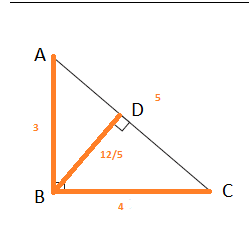
Now, using the Substitution Method for systems of equations you could look to get all the terms down to just AB, BD, and BC as you see in the answer choices, you could also pick numbers that will work with Pythagorean Theorem and check the answer choices. Since this is a right triangle but not necessarily isosceles, try the first set of Pythagorean triplets you can find, which is likely the 3:4:5 triangle. If you say that AB = 3, BC = 4, and AC = 5, you can then also say that BD needs to be 12/5, since the area calculations have to match with (AB)(BC) = (AC)(BD). Then if you plug in for the answer choices, you'll see that squaring (12/5) will lead to a messy fraction while squaring the other terms leads to integers, so none of A, D, and E can be correct. Then try B: \(\frac{1}{(BD)^2}=\frac{1}{(BC)^2}+\frac{1}{(AB)^2}\) would be:

\(\frac{25}{(144)}=\frac{1}{16}+\frac{1}{9}\)

Finding a common denominator on the right, you'll see that B is correct, as:

as:

\(\frac{25}{(144)}=\frac{9}{144}+\frac{16}{144}\).
avatar
VIVA1060
avatar
Current Student
Joined: 22 Jun 2019
Last visit: 01 Aug 2025
Posts: 40
Own Kudos:
Given Kudos: 149
Location: India
Schools: LBS '24 (A)
GPA: 4
Schools: LBS '24 (A)
Posts: 40
Kudos: 13
Kudos
Add Kudos
Bookmarks
Bookmark this Post
Hi Experts / Members, in what scenario will the perpendicular from angle B divide the hypotenuse into two equal halves (AD = DC)?

chetan2u Bunuel
User avatar
Bunuel
User avatar
Math Expert
Joined: 02 Sep 2009
Last visit: 24 Apr 2026
Posts: 109,811
Own Kudos:
810,947
 [1]
Given Kudos: 105,869
Products:
Expert
Expert reply
Active GMAT Club Expert! Tag them with @ followed by their username for a faster response.
Posts: 109,811
Kudos: 810,947
 [1]
1
Kudos
Add Kudos
Bookmarks
Bookmark this Post
VIVA1060
Hi Experts / Members, in what scenario will the perpendicular from angle B divide the hypotenuse into two equal halves (AD = DC)?

chetan2u Bunuel

It would happen when BA = BC, so when a right triangle is an isosceles. In this case the perpendicular to the hypotenuse would be the median and the angle bisector.
User avatar
bumpbot
User avatar
Non-Human User
Joined: 09 Sep 2013
Last visit: 04 Jan 2021
Posts: 38,971
Own Kudos:
Posts: 38,971
Kudos: 1,117
Kudos
Add Kudos
Bookmarks
Bookmark this Post
Automated notice from GMAT Club BumpBot:

A member just gave Kudos to this thread, showing it’s still useful. I’ve bumped it to the top so more people can benefit. Feel free to add your own questions or solutions.

This post was generated automatically.
Moderators:
Math Expert
109811 posts
Tuck School Moderator
853 posts