Last visit was: 23 Apr 2026, 16:27 It is currently 23 Apr 2026, 16:27
Close
GMAT Club Daily Prep
Thank you for using the timer - this advanced tool can estimate your performance and suggest more practice questions. We have subscribed you to Daily Prep Questions via email.

Customized
for You

we will pick new questions that match your level based on your Timer History

Track
Your Progress

every week, we’ll send you an estimated GMAT score based on your performance

Practice
Pays

we will pick new questions that match your level based on your Timer History
Not interested in getting valuable practice questions and articles delivered to your email? No problem, unsubscribe here.
Close
Request Expert Reply
Confirm Cancel
User avatar
EgmatQuantExpert
User avatar
e-GMAT Representative
Joined: 04 Jan 2015
Last visit: 02 Apr 2024
Posts: 3,657
Own Kudos:
Given Kudos: 165
Expert
Expert reply
Posts: 3,657
Kudos: 20,872
 [117]
2
Kudos
Add Kudos
113
Bookmarks
Bookmark this Post
Most Helpful Reply
User avatar
PKay
Joined: 23 Jul 2015
Last visit: 17 Sep 2022
Posts: 34
Own Kudos:
81
 [41]
Given Kudos: 392
Status:I am not giving up. Not yet.
Posts: 34
Kudos: 81
 [41]
33
Kudos
Add Kudos
7
Bookmarks
Bookmark this Post
avatar
khiemchii
Joined: 19 Nov 2016
Last visit: 24 Nov 2020
Posts: 6
Own Kudos:
25
 [23]
Given Kudos: 14
Posts: 6
Kudos: 25
 [23]
19
Kudos
Add Kudos
4
Bookmarks
Bookmark this Post
General Discussion
User avatar
nailin16
Joined: 05 Apr 2014
Last visit: 10 Feb 2019
Posts: 105
Own Kudos:
Given Kudos: 255
Location: India
Concentration: Economics, International Business
Schools: ISB '19 Fox"19
GMAT 1: 660 Q48 V33
GPA: 3
Schools: ISB '19 Fox"19
GMAT 1: 660 Q48 V33
Posts: 105
Kudos: 105
Kudos
Add Kudos
Bookmarks
Bookmark this Post
Let dist between a and 0 be x,then that between a and b would be 2x,and between b and C would be x.
Mod b-15 = 2* Mod 15-a
So, x= 9
Therefore mod c = 27

Sent from my HM 1SW using GMAT Club Forum mobile app
User avatar
EgmatQuantExpert
User avatar
e-GMAT Representative
Joined: 04 Jan 2015
Last visit: 02 Apr 2024
Posts: 3,657
Own Kudos:
20,872
 [15]
Given Kudos: 165
Expert
Expert reply
Posts: 3,657
Kudos: 20,872
 [15]
7
Kudos
Add Kudos
8
Bookmarks
Bookmark this Post
Alright, let's look at the detailed solution of the above question. Let's use the concept of absolute value \(|p-q|\) as the distance between the point p and q on the number line to solve this question.

Given
The following information is given in the question.
    • Points a, b and c such that \(c > b > a\)
    • \(a: (b – a) : (c – a) = 1: 2: 3\)
    • \(|b – 15| = 2 * |a-15|\) (We are taking the absolute values here, as we do not know the position of 15 with respect to a and b. For example, if \(b > 15\), then \(|b – 15| = b – 15\) but if b < 15, then\(|b – 15| = (15 - b)\)

Let’s assume the value of a to be x.
Hence, \(b-a = 2x\) and substituting the value of a, we get the value of \(b = 3x\)
Similarly, the value of \(c = 4x\)

To find
As, we need to find |c|, which is the distance of c from the origin, we can say that \(|c| = 4x\)

Approach and Working Out
Now, we are given the relationship between the distance of points a and b with respect to 15. However, we do not know the position of 15 with respect to a and b on the number line. So, the following cases can occur depending upon the position of 15 on the number line:


    o Distance between 15 and \(a = a – 15 = x – 15\) (as a is greater than 15)
    o Distance between 15 and b = \(b – 15 = 3x – 15\) (as b is greater than 15)
    o \(3x – 15 = 2*(x – 15)\) {as \(|b – 15| = 2 * |a-15|\)}
    o \(3x – 15 = 2x – 30\)
    o \(x = -15\), which is not possible as x is the coordinate of a point that lies on the right hand side of 0, i.e. it is positive. So, \(x > 0\).
    o Thus, we can reject this case.


    o Distance between 15 and a = \(15 – a = 15 – x\) (as 15 is greater than a)
    o Distance between 15 and b = \(b – 15 = 3x – 15\) (as b is greater than 15)
    o \(3x – 15 = 2*(15 – x)\){as \(|b – 15| = 2 * |a-15|\)}
    o \(3x – 15 = 30 – 2x\)
    o \(5x = 45\), i.e. \(x = 9\).
    o In this case we have assumed that \(a < 15\). So, \(x < 15\) (As the coordinate of point a is x). Also \(x > 0\), since it is the coordinate of a point that lies on the right hand side of 0.
    o So, \(0 < x< 15\). As we have calculated \(x = 9\), this is a possible case
    o We have calculated above, the value of \(c = 4x\). So, we have \(4x = 36\)


    o Distance between 15 and a = \(15 – a = 15 – x\) (as 15 is greater than a)
    o Distance between 15 and b = \(15 – b = 15 – 3x\) (as 15 is greater than b)
    o \(15 – 3x = 2*( 15 – x)\) {as \(|b – 15| = 2 * |a-15|\) }
    o \(15 – 3x = 30 – 2x\), i.e. \(x = -15\),
    o We know that \(x > 0\). So, \(x = -15\) is not a valid value.
    o Thus, we can reject this case.

Therefore, the value of |c|is 36
Correct Answer: C

User avatar
EgmatQuantExpert
User avatar
e-GMAT Representative
Joined: 04 Jan 2015
Last visit: 02 Apr 2024
Posts: 3,657
Own Kudos:
20,872
 [1]
Given Kudos: 165
Expert
Expert reply
Posts: 3,657
Kudos: 20,872
 [1]
1
Kudos
Add Kudos
Bookmarks
Bookmark this Post
nailin16
Let dist between a and 0 be x,then that between a and b would be 2x,and between b and C would be x.
Mod b-15 = 2* Mod 15-a
So, x= 9
Therefore mod c = 27

Sent from my HM 1SW using GMAT Club Forum mobile app

You have correctly calculated the value of x i.e. the distance between point a and 0 on the number line.
However, the value of |c| is 4x, and hence the answer would be 36.

Kindly review our solution above to understand where you went wrong.
User avatar
EgmatQuantExpert
User avatar
e-GMAT Representative
Joined: 04 Jan 2015
Last visit: 02 Apr 2024
Posts: 3,657
Own Kudos:
20,872
 [4]
Given Kudos: 165
Expert
Expert reply
Posts: 3,657
Kudos: 20,872
 [4]
4
Kudos
Add Kudos
Bookmarks
Bookmark this Post
khiemchii
From: "The distance between 0 and a, a and b, and a and c is in the ratio of 1:2:3"
Set a= 1, we have b = 3 and c =4
=> a : b : c is in the ratio of 1 : 3 : 4
=> c is divisible by 4
=> c is 36
C

There is a small flaw in your approach. You seem to have assumed c as a multiple of 4, which may not be the case always. For instance, let's look at a slightly different version of the same question.

On the number line shown, the distance between 0 and a, a and b, and a and c is in the ratio of 1:2:3. If the distance of point b from 11.25 is twice the distance of point a from 15, what is the value of |c|?

    A. 9
    B. 27
    C. 36
    D. 45
    E. 54


Solve this question using the approach mentioned by you and also using the solution provided by us. If you use the approach mentioned by you in your response, you will still the answer as 36 (Choice C). However, the answer to this modified version would be 27 (choice B), which is clearly not a multiple of 4.

User avatar
koenh
Joined: 15 Nov 2015
Last visit: 05 Jan 2021
Posts: 23
Own Kudos:
Given Kudos: 14
Location: Netherlands
GMAT 1: 730 Q47 V44
GPA: 3.99
GMAT 1: 730 Q47 V44
Posts: 23
Kudos: 20
Kudos
Add Kudos
Bookmarks
Bookmark this Post
EgmatQuantExpert

If the distance of point b from 15 is twice the distance of point a from 15

In your previous explanation you have also placed the point "15" to the left of A and to the right of B, but would this even be possible given the above limitation? Given the order of the letters, the only way I can see this condition being met is if 15 is 1/3 on the line between A and B.

I would appreciate your response.
User avatar
EgmatQuantExpert
User avatar
e-GMAT Representative
Joined: 04 Jan 2015
Last visit: 02 Apr 2024
Posts: 3,657
Own Kudos:
Given Kudos: 165
Expert
Expert reply
Posts: 3,657
Kudos: 20,872
Kudos
Add Kudos
Bookmarks
Bookmark this Post
koenh
EgmatQuantExpert

If the distance of point b from 15 is twice the distance of point a from 15

In your previous explanation you have also placed the point "15" to the left of A and to the right of B, but would this even be possible given the above limitation? Given the order of the letters, the only way I can see this condition being met is if 15 is 1/3 on the line between A and B.

I would appreciate your response.

Yes, you're absolutely right. :)

We have taken these cases as Case I (15 to the left of a or a>15) and Case III (15 to the right of B, 15>b). However, if you go through our explanation in details, you will understand that we have also concluded that these cases are not possible. Hence, the only case possible is Case II, in which 15 lies between a and b. The same has been explained in details in the solution.

The reason why we have discussed all possibilities is to ensure that we critically analyze all cases before arriving at a conclusion. Doing so, is extremely important while solving GMAT questions.

Regards,
Saquib
User avatar
fskilnik
Joined: 12 Oct 2010
Last visit: 03 Jan 2025
Posts: 883
Own Kudos:
1,882
 [1]
Given Kudos: 57
Status:GMATH founder
Expert
Expert reply
Posts: 883
Kudos: 1,882
 [1]
Kudos
Add Kudos
1
Bookmarks
Bookmark this Post
EgmatQuantExpert

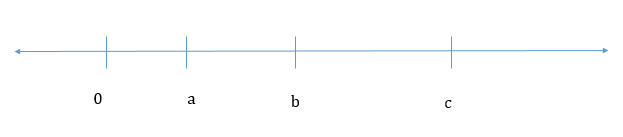
On the number line shown, the distance between 0 and a, a and b, and a and c is in the ratio of 1:2:3. If the distance of point b from 15 is twice the distance of point a from 15, what is the value of |c|?

    A. 9
    B. 27
    C. 36
    D. 45
    E. 54
Using info given (figure included) we have DATA and FOCUS as below:

\(0 < a < b < c\,\,\left( * \right)\)

\({\text{dist}}\left( {0,a} \right) = a\)

\(\left. \begin{gathered}\\
{\text{dist}}\left( {a,b} \right) = 2a\, \hfill \\\\
{\text{dist}}\left( {a,c} \right) = 3a \hfill \\ \\
\end{gathered} \right\}\,\,\,\mathop \Rightarrow \limits^{\left( * \right)} \,\,\,{\text{dist}}\left( {b,c} \right) = 3a - 2a = a\)

\(? = c = 4a\)

From the fact that \({\text{dist}}\left( {b,15} \right) = 2 \cdot {\text{dist}}\left( {a,15} \right)\) we have three possible scenarios:

\(b < 15:\)

\(15 - b = 2\left( {15 - a} \right)\,\,\,\, \Rightarrow \,\,\,\,15 = 2a - b = 2a - 3a = - a\,\,\,\, \Rightarrow \,\,\,a < 0\,\,\,\,{\text{impossible}}\,\,\)


\(a < 15 \leqslant b:\)

\(b - 15 = 2\left( {15 - a} \right)\,\,\,\, \Rightarrow \,\,\,\,3 \cdot 15 = 2a + b = 2a + 3a = 5a\,\,\,\, \Rightarrow \,\,? = 4a = 4 \cdot 9 = 36\)

And from the fact that we have already found (one viable) correct alternative choice, no need to evaluate the third scenario!


This solution follows the notations and rationale taught in the GMATH method.

Regards,
Fabio.
Attachments

18Set18_3w.gif
18Set18_3w.gif [ 1.92 KiB | Viewed 18284 times ]

User avatar
garvitbh11
Joined: 27 Apr 2018
Last visit: 04 Mar 2019
Posts: 16
Own Kudos:
Given Kudos: 144
Location: India
Concentration: Finance, International Business
GMAT 1: 600 Q44 V29
GPA: 3.9
GMAT 1: 600 Q44 V29
Posts: 16
Kudos: 1
Kudos
Add Kudos
Bookmarks
Bookmark this Post
EgmatQuantExpert
koenh
EgmatQuantExpert

If the distance of point b from 15 is twice the distance of point a from 15

In your previous explanation you have also placed the point "15" to the left of A and to the right of B, but would this even be possible given the above limitation? Given the order of the letters, the only way I can see this condition being met is if 15 is 1/3 on the line between A and B.

I would appreciate your response.

Yes, you're absolutely right. :)

We have taken these cases as Case I (15 to the left of a or a>15) and Case III (15 to the right of B, 15>b). However, if you go through our explanation in details, you will understand that we have also concluded that these cases are not possible. Hence, the only case possible is Case II, in which 15 lies between a and b. The same has been explained in details in the solution.

The reason why we have discussed all possibilities is to ensure that we critically analyze all cases before arriving at a conclusion. Doing so, is extremely important while solving GMAT questions.

Regards,
Saquib

Hello!! With all respect, I request you to explain how you got C=4x ?? I am getting a lil bit confused here.
Thank you in advance.
avatar
prgmatbiz
Joined: 12 Aug 2019
Last visit: 15 Jun 2020
Posts: 18
Own Kudos:
Given Kudos: 400
Location: United States
GMAT 1: 690 Q49 V33
GMAT 1: 690 Q49 V33
Posts: 18
Kudos: 15
Kudos
Add Kudos
Bookmarks
Bookmark this Post
EgmatQuantExpert
Alright, let's look at the detailed solution of the above question. Let's use the concept of absolute value \(|p-q|\) as the distance between the point p and q on the number line to solve this question.

Given
The following information is given in the question.
    • Points a, b and c such that \(c > b > a\)
    • \(a: (b – a) : (c – a) = 1: 2: 3\)
    • \(|b – 15| = 2 * |a-15|\) (We are taking the absolute values here, as we do not know the position of 15 with respect to a and b. For example, if \(b > 15\), then \(|b – 15| = b – 15\) but if b < 15, then\(|b – 15| = (15 - b)\)

Let’s assume the value of a to be x.
Hence, \(b-a = 2x\) and substituting the value of a, we get the value of \(b = 3x\)
Similarly, the value of \(c = 4x\)

To find

As, we need to find |c|, which is the distance of c from the origin, we can say that \(|c| = 4x\)

Approach and Working Out
Now, we are given the relationship between the distance of points a and b with respect to 15. However, we do not know the position of 15 with respect to a and b on the number line. So, the following cases can occur depending upon the position of 15 on the number line:


    o Distance between 15 and \(a = a – 15 = x – 15\) (as a is greater than 15)
    o Distance between 15 and b = \(b – 15 = 3x – 15\) (as b is greater than 15)
    o \(3x – 15 = 2*(x – 15)\) {as \(|b – 15| = 2 * |a-15|\)}
    o \(3x – 15 = 2x – 30\)
    o \(x = -15\), which is not possible as x is the coordinate of a point that lies on the right hand side of 0, i.e. it is positive. So, \(x > 0\).
    o Thus, we can reject this case.


    o Distance between 15 and a = \(15 – a = 15 – x\) (as 15 is greater than a)
    o Distance between 15 and b = \(b – 15 = 3x – 15\) (as b is greater than 15)
    o \(3x – 15 = 2*(15 – x)\){as \(|b – 15| = 2 * |a-15|\)}
    o \(3x – 15 = 30 – 2x\)
    o \(5x = 45\), i.e. \(x = 9\).
    o In this case we have assumed that \(a < 15\). So, \(x < 15\) (As the coordinate of point a is x). Also \(x > 0\), since it is the coordinate of a point that lies on the right hand side of 0.
    o So, \(0 < x< 15\). As we have calculated \(x = 9\), this is a possible case
    o We have calculated above, the value of \(c = 4x\). So, we have \(4x = 36\)


    o Distance between 15 and a = \(15 – a = 15 – x\) (as 15 is greater than a)
    o Distance between 15 and b = \(15 – b = 15 – 3x\) (as 15 is greater than b)
    o \(15 – 3x = 2*( 15 – x)\) {as \(|b – 15| = 2 * |a-15|\) }
    o \(15 – 3x = 30 – 2x\), i.e. \(x = -15\),
    o We know that \(x > 0\). So, \(x = -15\) is not a valid value.
    o Thus, we can reject this case.

Therefore, the value of |c|is 36
Correct Answer: C


after we establish c = 4x...can we just look at the answer choices for multiples of 4 and narrow down to choice C
User avatar
Fdambro294
Joined: 10 Jul 2019
Last visit: 20 Aug 2025
Posts: 1,331
Own Kudos:
772
 [1]
Given Kudos: 1,656
Posts: 1,331
Kudos: 772
 [1]
1
Kudos
Add Kudos
Bookmarks
Bookmark this Post
Rather then going through each algebraic case, I found it much easier and faster to use the answer choices

(1st) understand the concept that the Absolute Value of C is given by the distance on the Number Line from variable C to 0


(2nd) we are dealing with all positive values here. So the quantity inside the Modulus of:

[a]
Absolute value of b
[c]

Will be positive, so the Modulus is not needed.

[a] = a
Absolute value of b = b
[c] = c

(3rd)
We will name the unknown ratio multiplier = M

Distance from 0 to a = M
Distance from a to b = 2M
Distance from a to c = 3M

Now, once we set these up on the number line, we can see that:

Distance from b to c = (Dist. from a to c) - (Dist. from a to b)

= 3M - 2M = M


distance from b to c = M

And finally

Distance from c to the origin 0 = M + 2M + M = 4M


[c] = c = 4M = ????


Answer (a) 9

If c = 9 ———-> 4M = 9 ——-> M = 9/4

[a] = M = 9/4 = 2.25

= 3M = 27/4 = 6.75

a is further from 15 than c is, so this can’t be the answer


Answer (b) 27

If [c] = 4M = 27 ———> M = 27/4

[a] = M = 27/4 = 6.75

[b] = 3M = 81/4 = 20.25

b is closer to 15 than a is on the number line (can be done by simple inspection)

Answer (c) 36

If [c] = 36 ———> 4M = 36 ——-> M = 9

[a] = M = 9

[b] = 3M = 27

Distance from a to 15 ——- [15 - 9] = 6

Distance from b to 15 ——- [27 - 15] = 12

Since 12 is TWICE the value of 6, when the absolute value of c is 36, the constraints given are satisfied.


Answer (c)

Seems as if taking the algebraic road takes too long on this problem….

[b]Posted from my mobile device
User avatar
manan01
Joined: 18 Jan 2024
Last visit: 23 Apr 2026
Posts: 36
Own Kudos:
Given Kudos: 63
Location: India
Concentration: Strategy, Entrepreneurship
GMAT Focus 1: 585 Q80 V79 DI78
GPA: 9.4
GMAT Focus 1: 585 Q80 V79 DI78
Posts: 36
Kudos: 15
Kudos
Add Kudos
Bookmarks
Bookmark this Post
The solution is definitely incorrect, as the author has uncessarily assumed a,b,c to be Integers.
khiemchii
From: "The distance between 0 and a, a and b, and a and c is in the ratio of 1:2:3"
Set a= 1, we have b = 3 and c =4
=> a : b : c is in the ratio of 1 : 3 : 4
=> c is divisible by 4
=> c is 36
C

User avatar
Kinshook
User avatar
Major Poster
Joined: 03 Jun 2019
Last visit: 23 Apr 2026
Posts: 5,986
Own Kudos:
5,858
 [1]
Given Kudos: 163
Location: India
GMAT 1: 690 Q50 V34
WE:Engineering (Transportation)
Products:
GMAT 1: 690 Q50 V34
Posts: 5,986
Kudos: 5,858
 [1]
1
Kudos
Add Kudos
Bookmarks
Bookmark this Post
On the number line shown, the distance between 0 and a, a and b, and a and c is in the ratio of 1:2:3.

If the distance of point b from 15 is twice the distance of point a from 15, what is the value of |c|?

Let the distance between 0 and a be a.

b = a + 2a = 3a
c = a + 3a = 4a

|b -15| = 2|a -15|
|3a - 15| = 2|a - 15|

Case 1: a < 5
15 - 3a = 2(15-a)
15 - 3a = 30 - 2a
a = -15
But a>0
Not feasible

Case 2: 5<=a<15
3a - 15 = 2(15-a) = 30 - 2a
a = 9
c = 4a = 36
|c| = 36

Case 3: a>=15
3a - 15 = 2a - 30
a = -15
Not feasible

IMO C
Moderators:
Math Expert
109785 posts
Tuck School Moderator
853 posts