Events & Promotions
|
|

GMAT Club Daily Prep
Thank you for using the timer - this advanced tool can estimate your performance and suggest more practice questions. We have subscribed you to Daily Prep Questions via email.
Customized
for You
Track
Your Progress
Practice
Pays
Not interested in getting valuable practice questions and articles delivered to your email? No problem, unsubscribe here.
 Sep 15
07:00 PM EDT
-09:00 PM EST
Elite scores are possible when you enroll in a powerful GMAT course, taught live online + 6 months access to TTP OnDemand video courses included! Class starts Tues/Thurs Sept. 15, 2026 - Nov. 15, 2027, 7:00pm-9:00pm EST Sep 21
07:00 PM EDT
-10:00 PM EDT
Boost your GMAT score in less than one month in a live online class + 6 months access to TTP OnDemand video courses included! Class starts Mon, Tues, Wed, Thur, Fri Sept. 21, 2026 - Oct. 9, 2027, 7:00pm-10:00pm EST

 Updated on: 07 Aug 2018, 21:15
Originally posted by EgmatQuantExpert on 29 Nov 2016, 08:40.
Last edited by EgmatQuantExpert on 07 Aug 2018, 21:15, edited 6 times in total.
Last edited by EgmatQuantExpert on 07 Aug 2018, 21:15, edited 6 times in total.
Kudos
Bookmarks


C
Be sure to select an answer first to save it in the Error Log before revealing the correct answer (OA)!
Difficulty:
 5%
(low)
5%
(low)
Question Stats:
91% (01:26) correct 9%
(01:46)
wrong
based on 727
sessions
9%
(01:46)
wrong
based on 727
sessions
History
Date
Time
Result
Not Attempted Yet
Mastering Important Concepts Tested by GMAT in Triangles - II : Exercise Question
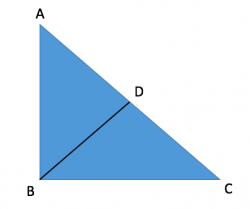
Q. In the figure given below, AB = BC = 2√2 units and AC = 4 units. If BD bisects the side AC, find the length of BD.
Answer Choices
A. 1
B. √2
C. 2
D. 2√2
E. 3
Key concepts on Triangles are explained in detail in the following posts:
1. Mastering Important Concepts Tested By GMAT in Triangle - I
2. Mastering Important Concepts Tested By GMAT in Triangle - II
Detailed solution will be posted soon.
Thanks,
Saquib
Quant Expert
e-GMAT

Q. In the figure given below, AB = BC = 2√2 units and AC = 4 units. If BD bisects the side AC, find the length of BD.
Answer Choices
A. 1
B. √2
C. 2
D. 2√2
E. 3
Key concepts on Triangles are explained in detail in the following posts:
1. Mastering Important Concepts Tested By GMAT in Triangle - I
2. Mastering Important Concepts Tested By GMAT in Triangle - II
Detailed solution will be posted soon.
Thanks,
Saquib
Quant Expert
e-GMAT
Updated on: 07 Aug 2018, 21:18
Originally posted by EgmatQuantExpert on 29 Nov 2016, 08:41.
Last edited by EgmatQuantExpert on 07 Aug 2018, 21:18, edited 3 times in total.
Last edited by EgmatQuantExpert on 07 Aug 2018, 21:18, edited 3 times in total.
Kudos
Bookmarks
Let's look at the detailed solution to the above question.
Since it is given in the question that AB = BC, we can infer that –
Also notice that,
\(AB^2 + BC^2 = (2√2)^2 + (2√2)^2\)
\(= 16\)
\(= 4^2\)
\(AB^2 + BC^2 = AC^2\)
Therefore, ABC is a right angled triangle. (Since it satisfies Pythagorus Theorem)
As we have mentioned in the article, in an isosceles triangle the median is also the perpendicular to side on which it is drawn.
Thus, another conclusion that we can draw is that BD is perpendicular to AC, since BD is the median as per the information given in the question.
To find the length of BD, we can use the formula of area of the triangle –
or we can write the area of triangle \(ABC = ½ * AC * BD\)……..(ii)
(where BD is the perpendicular and AC is the base)
Equating equation (i) and (ii) we get –
Hence the length of BD = 2 units …(option C)

Since it is given in the question that AB = BC, we can infer that –
- • ABC is an isosceles triangle.
Also notice that,
\(AB^2 + BC^2 = (2√2)^2 + (2√2)^2\)
\(= 16\)
\(= 4^2\)
\(AB^2 + BC^2 = AC^2\)
Therefore, ABC is a right angled triangle. (Since it satisfies Pythagorus Theorem)
As we have mentioned in the article, in an isosceles triangle the median is also the perpendicular to side on which it is drawn.
Thus, another conclusion that we can draw is that BD is perpendicular to AC, since BD is the median as per the information given in the question.
To find the length of BD, we can use the formula of area of the triangle –
- • Area of triangle \(ABC =½ * base * height\)
\(=½ *AB *BC\)……….. (i)
or we can write the area of triangle \(ABC = ½ * AC * BD\)……..(ii)
(where BD is the perpendicular and AC is the base)
Equating equation (i) and (ii) we get –
- • \(½ * AB * BC = ½ * AC * BD\)
• \(BD = (AB * BC)/AC\)
• \(BD = (2√2 * 2√2) / 4\)
• \(BD = 2\)
Hence the length of BD = 2 units …(option C)

 29 Nov 2016, 10:05
Kudos
Bookmarks
By Apollonius theorem,
\(AB^2+BC^2=2(AD^2+BD^2)\)
\(4X2+4X2=2(2^2+BD^2)\)
\(16=2(4+BD^2)\)
BD=2
Answer is C.
If u find my post useful, please press kudos!
\(AB^2+BC^2=2(AD^2+BD^2)\)
\(4X2+4X2=2(2^2+BD^2)\)
\(16=2(4+BD^2)\)
BD=2
Answer is C.
If u find my post useful, please press kudos!