Last visit was: 24 Apr 2026, 06:56 It is currently 24 Apr 2026, 06:56
Close
GMAT Club Daily Prep
Thank you for using the timer - this advanced tool can estimate your performance and suggest more practice questions. We have subscribed you to Daily Prep Questions via email.

Customized
for You

we will pick new questions that match your level based on your Timer History

Track
Your Progress

every week, we’ll send you an estimated GMAT score based on your performance

Practice
Pays

we will pick new questions that match your level based on your Timer History
Not interested in getting valuable practice questions and articles delivered to your email? No problem, unsubscribe here.
Close
Request Expert Reply
Confirm Cancel
User avatar
Bunuel
User avatar
Math Expert
Joined: 02 Sep 2009
Last visit: 24 Apr 2026
Posts: 109,813
Own Kudos:
Given Kudos: 105,870
Products:
Expert
Expert reply
Active GMAT Club Expert! Tag them with @ followed by their username for a faster response.
Posts: 109,813
Kudos: 810,996
 [16]
1
Kudos
Add Kudos
15
Bookmarks
Bookmark this Post
Most Helpful Reply
User avatar
Princ
Joined: 22 Feb 2018
Last visit: 04 May 2025
Posts: 351
Own Kudos:
924
 [5]
Given Kudos: 34
Posts: 351
Kudos: 924
 [5]
3
Kudos
Add Kudos
2
Bookmarks
Bookmark this Post
General Discussion
User avatar
Tulkin987
Joined: 28 Nov 2017
Last visit: 08 Sep 2020
Posts: 108
Own Kudos:
172
 [1]
Given Kudos: 135
Location: Uzbekistan
Posts: 108
Kudos: 172
 [1]
Kudos
Add Kudos
1
Bookmarks
Bookmark this Post
User avatar
Raksat
Joined: 20 Feb 2017
Last visit: 13 Feb 2025
Posts: 145
Own Kudos:
Given Kudos: 489
Location: India
Concentration: Operations, Strategy
WE:Engineering (Other)
Posts: 145
Kudos: 531
Kudos
Add Kudos
Bookmarks
Bookmark this Post
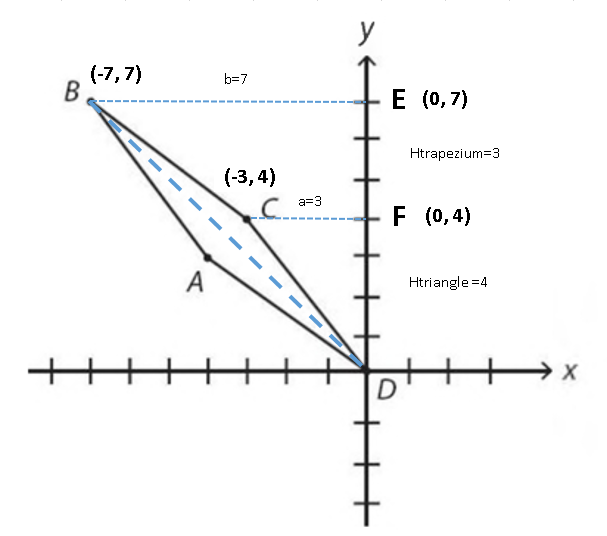
IMO the answer should be C
D: (0,0)
C:(-3, 4)
B :(-7, 7)
the diagonal of the parallelogram divide it into 2 triangles of equal areas.
we can find the triangle area if we know three vertices.
the formulae is given in : https://demonstrations.wolfram.com/TheAr ... terminant/
I find this very useful.
Area of triangle = 7/2
area of parallelogram = 7
avatar
el2010
Joined: 05 Aug 2016
Last visit: 27 Dec 2018
Posts: 13
Own Kudos:
9
 [1]
Given Kudos: 2
Location: United States
Concentration: General Management
GMAT 1: 730 Q50 V40
GMAT 1: 730 Q50 V40
Posts: 13
Kudos: 9
 [1]
Kudos
Add Kudos
1
Bookmarks
Bookmark this Post
Area of parallelogram is B x H so 7 x 7 = 49.
Area of triangle is 1/2 x B x H
Triangle A-(-4,0)-D = 1/2 x 3 x 4 = 6
Triangle C-(0,4)-(0,0) = 1/2 x 3 x 4 = 6
Triangle A-(-7,3)-B = 1/2 x 3 x 4 = 6
Triangle C-(-3,7)-B = 1/2 x 3 x 4 = 6
Area of square is s^2
Square A-(-4,0)-(-7,0)-(-7,3) = 3^2 = 9
Square C-(0,4)-(0,7)-(-3,7) = 3^2 = 9

Put it all together 49-6-6-6-6-9-9 = 7. Answer Choice C.
User avatar
Hero8888
Joined: 29 Dec 2017
Last visit: 14 Apr 2019
Posts: 299
Own Kudos:
Given Kudos: 273
Location: United States
Concentration: Marketing, Technology
GMAT 1: 630 Q44 V33
GMAT 2: 690 Q47 V37
GMAT 3: 710 Q50 V37
GPA: 3.25
WE:Marketing (Telecommunications)
GMAT 3: 710 Q50 V37
Posts: 299
Kudos: 348
Kudos
Add Kudos
Bookmarks
Bookmark this Post
Alternative method is to find the area of the rhombus (yes the figure ABCD is a rhombus since this is a Parallelogram with 4 equal sides)

S= d1*d2/2, where d1 and d2 are diagonals. The formula of distance if you know 2 points is Distance = square root of(x2−x1)^2+(y2−y1)^2 Answer C.
User avatar
Masterscorp
Joined: 14 Oct 2017
Last visit: 30 Mar 2021
Posts: 179
Own Kudos:
Given Kudos: 385
GMAT 1: 710 Q44 V41
GMAT 1: 710 Q44 V41
Posts: 179
Kudos: 290
Kudos
Add Kudos
Bookmarks
Bookmark this Post
Why can't we use the formula for the areas of parallelograms here?

I calculated that Point A must be at (-4;3) so I had the coordinates of all four points. I took AC = \(\sqrt{2}\) as the height and DC = 5 as the base. As \(\sqrt{2} =~ 1.4\) I calculated 1.4*5 which is 7. Of course 1.4 is only an approximation so the result is not exact.

I am aware that this solution doesn't work here but I want to understand why.
User avatar
Princ
Joined: 22 Feb 2018
Last visit: 04 May 2025
Posts: 351
Own Kudos:
924
 [1]
Given Kudos: 34
Posts: 351
Kudos: 924
 [1]
1
Kudos
Add Kudos
Bookmarks
Bookmark this Post
Masterscorp
Why can't we use the formula for the areas of parallelograms here?

I calculated that Point A must be at (-4;3) so I had the coordinates of all four points. I took AC = \(\sqrt{2}\) as the height and DC = 5 as the base. As \(\sqrt{2} =~ 1.4\) I calculated 1.4*5 which is 7. Of course 1.4 is only an approximation so the result is not exact.

I am aware that this solution doesn't work here but I want to understand why.

Masterscorp
to use the area of parallelogram formula here.
First we have to find the equation of CD,
\(y= \frac{{4-0}}{{-3-0}}x+c\)
As CD passes through (0,0); c would be zero
Equation of CD : \(y = - \frac{4}{3}x\)
\(y+\frac{4}{3}x=0\)

As you have already found out the coordinates of point A(-4,3)
We can find perpendicular distance between CD and Point A using
\(D =\frac{{|ax_1 +by_1+c|}}{{\sqrt{a^2+b^2}}}\)
In this case , \(a=\frac{4}{3},b=1,c=0,x_1=-4,y_1=3\)
Solving for D, we will get \(D = \frac{7}{5}=1.4\)
As length of \(CD =5\)
Area of Parallelogram ABCD = \(5*\frac{7}{5}= 7\)

AC is not perpendicular to CD as you assumed
Line equation of AC will \(y = \frac{{4-3}}{{-3+4}}x+c\)
\(y = x+c\)
putting (-3,4) in above equation, we will get \(c=7\)
So equation of line AC would be \(y = x+7\)

As product of slopes of two non vertical perpendicular line should be -1.
Let us check the product of slope of AC and CD, it is coming out be \(1*\frac{-4}{3}\) = \(\frac{-4}{3}\)
So line AC and CD are not perpendicular
User avatar
abhishek911
Joined: 09 Jun 2016
Last visit: 28 Jun 2022
Posts: 14
Own Kudos:
Given Kudos: 96
Location: India
Products:
Posts: 14
Kudos: 26
Kudos
Add Kudos
Bookmarks
Bookmark this Post
Princ
Masterscorp
Why can't we use the formula for the areas of parallelograms here?

I calculated that Point A must be at (-4;3) so I had the coordinates of all four points. I took AC = \(\sqrt{2}\) as the height and DC = 5 as the base. As \(\sqrt{2} =~ 1.4\) I calculated 1.4*5 which is 7. Of course 1.4 is only an approximation so the result is not exact.

I am aware that this solution doesn't work here but I want to understand why.

Masterscorp
to use the area of parallelogram formula here.
First we have to find the equation of CD,
\(y= \frac{{4-0}}{{-3-0}}x+c\)
As CD passes through (0,0); c would be zero
Equation of CD : \(y = - \frac{4}{3}x\)
\(y+\frac{4}{3}x=0\)

As you have already found out the coordinates of point A(-4,3)
We can find perpendicular distance between CD and Point A using
\(D =\frac{{|ax_1 +by_1+c|}}{{\sqrt{a^2+b^2}}}\)
In this case , \(a=\frac{4}{3},b=1,c=0,x_1=-4,y_1=3\)
Solving for D, we will get \(D = \frac{7}{5}=1.4\)
As length of \(CD =5\)
Area of Parallelogram ABCD = \(5*\frac{7}{5}= 7\)

AC is not perpendicular to CD as you assumed
Line equation of AC will \(y = \frac{{4-3}}{{-3+4}}x+c\)
\(y = x+c\)
putting (-3,4) in above equation, we will get \(c=7\)
So equation of line AC would be \(y = x+7\)

As product of slopes of two non vertical perpendicular line should be -1.
Let us check the product of slope of AC and CD, it is coming out be \(1*\frac{-4}{3}\) = \(\frac{-4}{3}\)
So line AC and CD are not perpendicular

Hi how do we find out the coordinates of point A. We can't assume them looking at the figure right. ?
User avatar
Princ
Joined: 22 Feb 2018
Last visit: 04 May 2025
Posts: 351
Own Kudos:
924
 [1]
Given Kudos: 34
Posts: 351
Kudos: 924
 [1]
1
Kudos
Add Kudos
Bookmarks
Bookmark this Post
abhishek911
Princ
Masterscorp
Why can't we use the formula for the areas of parallelograms here?

I calculated that Point A must be at (-4;3) so I had the coordinates of all four points. I took AC = \(\sqrt{2}\) as the height and DC = 5 as the base. As \(\sqrt{2} =~ 1.4\) I calculated 1.4*5 which is 7. Of course 1.4 is only an approximation so the result is not exact.

I am aware that this solution doesn't work here but I want to understand why.

Masterscorp
to use the area of parallelogram formula here.
First we have to find the equation of CD,
\(y= \frac{{4-0}}{{-3-0}}x+c\)
As CD passes through (0,0); c would be zero
Equation of CD : \(y = - \frac{4}{3}x\)
\(y+\frac{4}{3}x=0\)

As you have already found out the coordinates of point A(-4,3)
We can find perpendicular distance between CD and Point A using
\(D =\frac{{|ax_1 +by_1+c|}}{{\sqrt{a^2+b^2}}}\)
In this case , \(a=\frac{4}{3},b=1,c=0,x_1=-4,y_1=3\)
Solving for D, we will get \(D = \frac{7}{5}=1.4\)
As length of \(CD =5\)
Area of Parallelogram ABCD = \(5*\frac{7}{5}= 7\)

AC is not perpendicular to CD as you assumed
Line equation of AC will \(y = \frac{{4-3}}{{-3+4}}x+c\)
\(y = x+c\)
putting (-3,4) in above equation, we will get \(c=7\)
So equation of line AC would be \(y = x+7\)

As product of slopes of two non vertical perpendicular line should be -1.
Let us check the product of slope of AC and CD, it is coming out be \(1*\frac{-4}{3}\) = \(\frac{-4}{3}\)
So line AC and CD are not perpendicular

Hi how do we find out the coordinates of point A. We can't assume them looking at the figure right. ?

Quote:
The diagonals of a parallelogram bisect each other
Mid point of AC will be same as Mid point of BD.
Assume the coordinates of point A be (x,y) Given: D(0,0);C(-3, 4);B(-7,7).

\(\frac{x+(-3)}{2} = \frac{-7+0}{2}\)
\(x=-4\)

\(\frac{y+4}{2} = \frac{7+0}{2}\)
\(y=3\)

So Coordinates of A are \((-4,3)\).
User avatar
swagatamoitra
Joined: 05 Sep 2016
Last visit: 05 Mar 2019
Posts: 24
Own Kudos:
Given Kudos: 295
Location: India
Concentration: General Management, Operations
WE:Engineering (Energy)
Posts: 24
Kudos: 16
Kudos
Add Kudos
Bookmarks
Bookmark this Post
Bunuel

Parallelogram ABCD lies in the xy-plane, as shown in the figure above. The coordinates of point C are (-3, 4) and the coordinates of point B are (-7, 7). What is the area of the parallelogram ?


A. 1

B. \(2 \sqrt{7}\)

C. 7

D. 8

E. \(7 \sqrt{2}\)


Attachment:
xplane.jpg


Hey Bunuel,

Can we solve using the diagonal formula for area(1/2*d1*d2) for a parallelogram? Is my following approach correct?

From the diagram we can say co-ordinates of A are (-4,3)
So, Diagonal AC= \(\sqrt{2}\) (using co-ordinate geometry formula for length)
And, Diagonal BD=7\(\sqrt{2}\)
So, Area of parallelogram= 1/2*AC*BD= 1/2*\(\sqrt{2}\)*7\(\sqrt{2}\) = 7 (Ans) Option C.
User avatar
bumpbot
User avatar
Non-Human User
Joined: 09 Sep 2013
Last visit: 04 Jan 2021
Posts: 38,972
Own Kudos:
Posts: 38,972
Kudos: 1,117
Kudos
Add Kudos
Bookmarks
Bookmark this Post
Automated notice from GMAT Club BumpBot:

A member just gave Kudos to this thread, showing it’s still useful. I’ve bumped it to the top so more people can benefit. Feel free to add your own questions or solutions.

This post was generated automatically.
Moderators:
Math Expert
109813 posts
Tuck School Moderator
853 posts