Events & Promotions
|
|

GMAT Club Daily Prep
Thank you for using the timer - this advanced tool can estimate your performance and suggest more practice questions. We have subscribed you to Daily Prep Questions via email.
Customized
for You
Track
Your Progress
Practice
Pays
Not interested in getting valuable practice questions and articles delivered to your email? No problem, unsubscribe here.
 Sep 17
12:30 AM EDT
-01:30 AM EDT
Thought your job leaves no time for GMAT prep? After multiple GMAT attempts and a demanding consulting job, Kshitij improved to 695 in under 2 months. Learn the mindset shifts, study strategy, and execution changes that made the breakthrough possible. Sep 18
01:30 AM EDT
-02:30 AM EDT
Learn how Kamakshi achieved a GMAT 675 with an impressive 96th %ile in Data Insights. Discover the unique methods and exam strategies that helped her excel in DI along with other sections for a balanced and high score. Sep 18
08:00 PM PDT
-09:00 PM PDT
Video explanations + diagnosis of 10 weakest areas + 150+ short videos + study plan! Sep 21
07:00 PM EDT
-10:00 PM EDT
Boost your GMAT score in less than one month in a live online class + 6 months access to TTP OnDemand video courses included!

 Updated on: 08 Aug 2018, 07:25
Originally posted by EgmatQuantExpert on 16 May 2018, 07:43.
Last edited by EgmatQuantExpert on 08 Aug 2018, 07:25, edited 5 times in total.
Last edited by EgmatQuantExpert on 08 Aug 2018, 07:25, edited 5 times in total.
Kudos
Bookmarks


N
Be sure to select an answer first to save it in the Error Log before revealing the correct answer (OA)!
Difficulty:
(N/A)
Question Stats:
0% (00:00) correct 0%
(00:00)
wrong
based on 0
sessions
0%
(00:00)
wrong
based on 0
sessions
History
Date
Time
Result
Not Attempted Yet
Added the PDF of the article at the end of the post! 
This is the 2nd and the final article on the topic Distance, Speed, and Time. If you have not read the previous article, we recommend you read that first before going through this article.
To read the article: Application of Average Speed in Distance problems
Highlights of the previous article
In the previous article, we discussed:
Objective of this article
The primary objective of this article is to cite 3 most common mistakes done by students while solving problems on Distance, Time and Speed. We will demonstrate them with different examples on each type.
Common mistake type 1: Incorrect or missing unit conversion
e-GMAT Example 1 with explanation
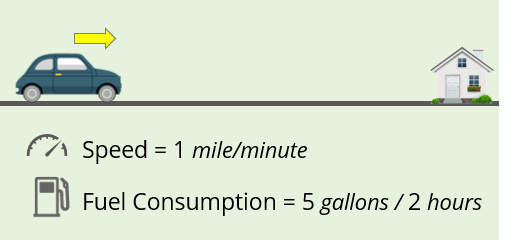
During a certain time period, Car X travelled north along a straight road at a constant rate of 1 mile per minute and used fuel at a constant rate of 5 gallons every 2 hours. During this time period, if Car X used exactly 3.75 gallons of fuel, how many miles did Car X travel?
Common approach used by students – 1
In this question, we need to find out how many miles did Car X travel.
To find the distance covered, we have the following information given:
We already know the fuel consumption rate and the total fuel consumption of the car. Therefore, we can divide the total fuel consumption by the rate of fuel consumption to find out the time taken to complete the journey.
If you have got 0.75 miles as the answer, then you have solved it incorrectly.
Let’s see another approach done by students while solving this question:
Common approach used by students – 2
In this question, we need to find out how many miles did Car X travel.
To find the distance covered, we have the following information given:
We already know the fuel consumption rate and the total fuel consumption of the car. Therefore, we can divide the total fuel consumption by the rate of fuel consumption to find out the time taken to complete the journey.
• The journey time = \(\frac{3.75}{2.5}\) = 1.5 hrs
Multiplying the journey time by the speed, we can calculate the distance
• Journey distance = \(1.5 * 1 = 1.5\) miles
If you have got 1.5 miles as the answer, then you have solved it incorrectly.

The mistakes and the correct approach
If we observe closely, there have been no difference in terms of the procedures of both the solutions – conceptually both the processes are correct. However, the answers are different because of wrong interpretation of the given values.
Error 1: Given that the Car used fuel at a constant rate of 5 gallons every 2 hours, first we need to calculate the fuel consumption rate per hour.
• As the Car used 5 gallons every 2 hours, the rate of fuel consumption (i.e. fuel consumption in every hour) = \(\frac{5}{2}\) gallons per hour = 2.5 gallons per hour
• Therefore, the journey time = \(\frac{3.75}{2.5}\) hrs = 1.5 hrs
Error 2: In the 2nd approach, the rate of fuel consumption has been calculated correctly. But while calculating the distance, the speed of the car is applied incorrectly in both the methods.
We need to convert the speed into miles per hour, as the journey time has been calculated in hours.
In an opposite way, we could have taken the speed in mile per minute also, in that case we need to convert the total journey time in minutes.
Final Answer: As we have already calculated the speed as 60 miles per hour and the journey time as 1.5 hrs,
Important takeaway
Common mistake type 2: Calculation of Average Speed, without considering everything into account
e-GMAT Example 2 with explanation
Last Sunday, Archie visited his friend Veronica who lives at 90 miles from his place. He divided his onward and return journey in different manner. He reached Veronica’s place by dividing the total distance in two equal part, at a speed of 15 mph and 30 mph respectively. He stayed there for 2 hours and took the return journey via the same path by dividing the total journey time in three equal parts, at a speed of 5 mph, 10 mph, and 15 mph respectively. If x, y, and z denote the average speed of his onward, return, and overall journey respectively, what is the value of x + y + z?
Solution
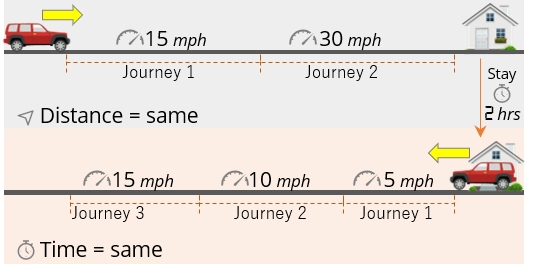
In this question, we need to find out Archie’s average speed in his onward journey, return journey, and his whole journey. For that, we need to know the following:
Now as it is given that Veronica lives at a distance of 90 miles from Archie’s place, we can say for the to-and-fro journey, total distance covered = (90 + 90) miles = 180 miles, whereas the individual distances at onward and return journey will be 90 miles each.
As we already have the value of the total distance, we need to find out the total travel time only.
Common approach used by students – 1
If you have got 22.5 mph and 16.25 mph as the average speed in the onward journey and overall journey respectively, then you have solved it incorrectly.
Common approach used by students – 2
It is given that, in the onward journey the distance is divided into two equal parts.
As the total onward journey distance is 90 miles, each part has a distance of 45 miles.
Similarly, in the return journey, the time taken is divided into 3 equal parts.
Again, if you have calculated 20 mph as the average speeds, then your answer is incorrect.

The mistakes and the correct approach
In both the examples given above, the calculation of average speed is done with some wrong interpretation of the concept and formula. Let us look at the important formula first which are related to average speed, and the conditions applicable behind the validity of those formula:
We know that, if the journey distance is divided into two equal parts, with each part is divided in individual speeds a and b respectively, then the overall average speed of the journey = \(\frac{2ab}{(a+b)}\)
Similarly, If the journey time is divided into n number of equal time slots, with each time slot is being covered at different individual speed, then the average speed of the journey is calculated by the arithmetic mean of all the individual speeds.
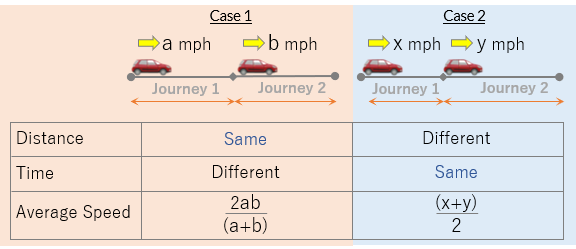
With these understandings, let’s look at the errors mentioned in the demonstrated examples:
Error 1: In the 1st onward journey, the onward distance is covered in two equal journey distances, at a speed of 15 mph and 30 mph respectively. Therefore, the average speed should not be calculated by taking the average of their individual speeds. As per point 2 above, we can calculate the average speed by using the \(\frac{2ab}{(a+b)\)} formula.
Also, one cannot calculate the overall average speed by taking the arithmetic mean of the individual average speeds.
Error 2: Although it was mentioned that the return journey is divided into 3 equal time slots, it was incorrectly assumed that the total time taken in the return journey was same as that of onward journey.
Error 3: While calculating the overall average speed, none of the time the stay time of 2 hours is taken into account.
Final Answer: Rectifying all the errors mentioned above, we can say:
As Archie had a stay of 2 hours at Veronica’s place, the overall journey time = (4.5 + 2 + 9) hours = 15.5 hours
Note that, while calculating the overall average speed, we must consider the 2 hours’ stoppage time also. However, if we consider the onward journey and the return journey separately, we don’t need to consider the stoppage time as there were no stoppages during the onward or journey.
Hence, the value of x + y + z = 20 + 10 + 11.6 = 41.6
Common mistake type 3: Missing the detail information in the question
e-GMAT Example 3 with explanation
Two buses A and B are of length 15 m and 10 m respectively, and the speed of bus A is 72 kph. If bus A takes \(\frac{1}{2}\) second to cross the sole passenger sitting inside bus B when they are moving towards each other from opposite direction, find the time taken by bus A to overtake bus B?
Solution
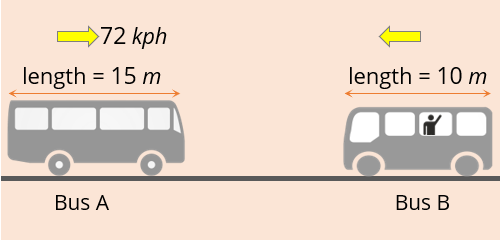
In this question, we need to find out the time taken by bus A to overtake bus B.
In order to find that out, we need the following information:
Now, from the information given in the question, we already have length of both A and B as well as speed of A.
Let’s assume speed of B is x m/s
Common approach used by students
It is given that bus A takes \(\frac{1}{2}\) second to cross the sole passenger sitting inside bus B when they are moving towards each other from opposite direction.
We know that if two bodies are moving from opposite direction towards each other, their relative speed should be the sum of their individual speed.
• We know, speed = \(\frac{distance}{time}\)
If you also have the same value for the speed of bus B, then your answer is incorrect. You have missed a very small detail in the question statement.
The mistakes and the correct approach
Error: If you look at the question carefully, you can see it asks the time taken for bus A to overtake bus B. It clearly indicates the speed of bus A must greater than the speed of bus B.
Therefore, speed of bus B cannot be equal to 30 m/s, as it is already given that speed of bus A is 20 m/s.
The error lies in the interpretation of the question statement: “If bus A takes ½ second to cross the sole passenger sitting inside bus B…”.
Understand that here bus A is not crossing the whole bus B, but it is only crossing the sole passenger sitting inside bus B. The length of the passenger is negligible compared to bus’s length, but the passenger is moving at the same speed as bus B’s speed.
Therefore, when we are calculating the value of x, we need to consider only the length of bus A, and we do not need to consider the length of bus B.
Hence, the correct equation will be as follows:
Therefore, speed of bus B is 10 m/s
So, the time taken by bus A to overtake bus B = (15 + 10) / (20 – 10) secs = 25/10 secs = 2.5 secs
Important takeaway

Takeaways from this article
• While solving a question, one must look into the units of all the given parameters. In the question, units may be given in different measures, one must convert all of them in same measure before doing the calculation.
• While calculating average speed of a journey, one must consider the stoppage or halt times, if any, within the journey time. The final journey time should include all those components of time within the journey.
• While solving a question, one must look into the details of the given information. Ignoring details may lead into wrong interpretation of the question stem, which may result in incorrect answer.
What next in this series of article?
Next week we will come up with a new article in the Time and Work topic.
In that article, we are going to discuss The application of LCM to solve Time and Work problems
Did you enjoy this article?
If you have enjoyed the article, then try the practice questions given below.
3 common mistakes you must avoid in Distance questions
This is the 2nd and the final article on the topic Distance, Speed, and Time. If you have not read the previous article, we recommend you read that first before going through this article.
To read the article: Application of Average Speed in Distance problems
Highlights of the previous article
In the previous article, we discussed:
- • Theoretical concepts of Average Speed
• Relevant examples to reinforce the learning of theoretical concepts
• Important formulas and takeaways
Objective of this article
The primary objective of this article is to cite 3 most common mistakes done by students while solving problems on Distance, Time and Speed. We will demonstrate them with different examples on each type.
Common mistake type 1: Incorrect or missing unit conversion
e-GMAT Example 1 with explanation
During a certain time period, Car X travelled north along a straight road at a constant rate of 1 mile per minute and used fuel at a constant rate of 5 gallons every 2 hours. During this time period, if Car X used exactly 3.75 gallons of fuel, how many miles did Car X travel?
Common approach used by students – 1
In this question, we need to find out how many miles did Car X travel.
To find the distance covered, we have the following information given:
- • The Car used exactly 3.75 gallons of fuel in this time period
• The Car used fuel at a constant rate of 5 gallons every 2 hours
• Also, the Car travelled at a constant rate of 1 mile per minute
We already know the fuel consumption rate and the total fuel consumption of the car. Therefore, we can divide the total fuel consumption by the rate of fuel consumption to find out the time taken to complete the journey.
- • The journey time = \(\frac{3.75}{5} = 0.75\) hrs
- • Journey distance = \(0.75 * 1 = 0.75\) miles
If you have got 0.75 miles as the answer, then you have solved it incorrectly.
Let’s see another approach done by students while solving this question:
Common approach used by students – 2
In this question, we need to find out how many miles did Car X travel.
To find the distance covered, we have the following information given:
- • The Car used exactly 3.75 gallons of fuel in this time period
• The Car used fuel at a constant rate of 5 gallons every 2 hours
- This indicates, the rate of consumption is 2.5 gallons per hour
We already know the fuel consumption rate and the total fuel consumption of the car. Therefore, we can divide the total fuel consumption by the rate of fuel consumption to find out the time taken to complete the journey.
• The journey time = \(\frac{3.75}{2.5}\) = 1.5 hrs
Multiplying the journey time by the speed, we can calculate the distance
• Journey distance = \(1.5 * 1 = 1.5\) miles
If you have got 1.5 miles as the answer, then you have solved it incorrectly.
The mistakes and the correct approach
If we observe closely, there have been no difference in terms of the procedures of both the solutions – conceptually both the processes are correct. However, the answers are different because of wrong interpretation of the given values.
Error 1: Given that the Car used fuel at a constant rate of 5 gallons every 2 hours, first we need to calculate the fuel consumption rate per hour.
• As the Car used 5 gallons every 2 hours, the rate of fuel consumption (i.e. fuel consumption in every hour) = \(\frac{5}{2}\) gallons per hour = 2.5 gallons per hour
• Therefore, the journey time = \(\frac{3.75}{2.5}\) hrs = 1.5 hrs
Error 2: In the 2nd approach, the rate of fuel consumption has been calculated correctly. But while calculating the distance, the speed of the car is applied incorrectly in both the methods.
- • Given that the speed of the car is 1 mile per minute
• It means the speed of the car is 60 miles per hour
We need to convert the speed into miles per hour, as the journey time has been calculated in hours.
In an opposite way, we could have taken the speed in mile per minute also, in that case we need to convert the total journey time in minutes.
Final Answer: As we have already calculated the speed as 60 miles per hour and the journey time as 1.5 hrs,
- • The total distance traveled = \(60 * 1.5\) miles = 90 miles
Important takeaway
- • While considering any of the values of speed, distance, and time for calculation, make sure the units of all of them are same. Otherwise, it will lead to incorrect calculation.
Common mistake type 2: Calculation of Average Speed, without considering everything into account
e-GMAT Example 2 with explanation
Last Sunday, Archie visited his friend Veronica who lives at 90 miles from his place. He divided his onward and return journey in different manner. He reached Veronica’s place by dividing the total distance in two equal part, at a speed of 15 mph and 30 mph respectively. He stayed there for 2 hours and took the return journey via the same path by dividing the total journey time in three equal parts, at a speed of 5 mph, 10 mph, and 15 mph respectively. If x, y, and z denote the average speed of his onward, return, and overall journey respectively, what is the value of x + y + z?
Solution
In this question, we need to find out Archie’s average speed in his onward journey, return journey, and his whole journey. For that, we need to know the following:
- • Total distance traveled, and the total time taken
• Individual distances for both onward and return journey
• Individual time taken for both onward and return journey
Now as it is given that Veronica lives at a distance of 90 miles from Archie’s place, we can say for the to-and-fro journey, total distance covered = (90 + 90) miles = 180 miles, whereas the individual distances at onward and return journey will be 90 miles each.
As we already have the value of the total distance, we need to find out the total travel time only.
Common approach used by students – 1
- • In the onward journey, the whole distance is covered in two parts, at a speed of 15 mph and 30 mph respectively
- Therefore, the average speed in the onward journey = \(\frac{(15 + 30)}{2}\) mph = 22.5 mph
- Therefore, the average speed of the return journey = \(\frac{(5 + 10 + 15)}{3}\) mph = 10 mph
If you have got 22.5 mph and 16.25 mph as the average speed in the onward journey and overall journey respectively, then you have solved it incorrectly.
Common approach used by students – 2
It is given that, in the onward journey the distance is divided into two equal parts.
As the total onward journey distance is 90 miles, each part has a distance of 45 miles.
- • The first half of 45 miles distance is covered at a speed of 15 mph, therefore, the time taken to cover that distance = \(\frac{45}{15}\) hrs = 3 hrs
• The second half of 45 miles distance is covered at a speed of 30 mph, therefore, the time taken to cover that distance = \(\frac{45}{30}\) hrs = 1.5 hrs
- • Therefore, total journey time in the onward travel = (3 + 1.5) hrs = 4.5 hrs
• So, the average speed in the onward journey = \(\frac{90}{4.5}\) mph = 20 mph
Similarly, in the return journey, the time taken is divided into 3 equal parts.
- • Therefore, total time of 4.5 hrs is divided into 1.5 hrs each, which is covered at an individual speed of 5 mph, 10 mph, and 15 mph respectively.
• So, the average speed in the return journey = \(\frac{90}{(1.5 + 1.5 + 1.5)}\) mph = 20 mph
• And, also the average speed of the overall journey = \(\frac{(90 + 90)}{(4.5 + 4.5)}\) mph = 20 mph
Again, if you have calculated 20 mph as the average speeds, then your answer is incorrect.
The mistakes and the correct approach
In both the examples given above, the calculation of average speed is done with some wrong interpretation of the concept and formula. Let us look at the important formula first which are related to average speed, and the conditions applicable behind the validity of those formula:
- • Average speed = (total distance travelled)/(total time taken)
We know that, if the journey distance is divided into two equal parts, with each part is divided in individual speeds a and b respectively, then the overall average speed of the journey = \(\frac{2ab}{(a+b)}\)
Similarly, If the journey time is divided into n number of equal time slots, with each time slot is being covered at different individual speed, then the average speed of the journey is calculated by the arithmetic mean of all the individual speeds.
With these understandings, let’s look at the errors mentioned in the demonstrated examples:
Error 1: In the 1st onward journey, the onward distance is covered in two equal journey distances, at a speed of 15 mph and 30 mph respectively. Therefore, the average speed should not be calculated by taking the average of their individual speeds. As per point 2 above, we can calculate the average speed by using the \(\frac{2ab}{(a+b)\)} formula.
Also, one cannot calculate the overall average speed by taking the arithmetic mean of the individual average speeds.
Error 2: Although it was mentioned that the return journey is divided into 3 equal time slots, it was incorrectly assumed that the total time taken in the return journey was same as that of onward journey.
Error 3: While calculating the overall average speed, none of the time the stay time of 2 hours is taken into account.
Final Answer: Rectifying all the errors mentioned above, we can say:
- • Average speed in the onward journey = x = \(\frac{(2 * 15 * 30)}{(15 + 30)}\) mph = 20 mph
• Average speed in the return journey = y = \(\frac{(5 + 10 + 15)}{3}\) mph = 10 mph
• Total travel time in the onward journey = \(\frac{45}{15} + \frac{45}{30}\) hrs = 3 + 1.5 hrs = 4.5 hrs
• Total travel time in the return journey = \(\frac{(90 * 3)}{(5 + 10 + 15)}\) hrs = 9 hrs
As Archie had a stay of 2 hours at Veronica’s place, the overall journey time = (4.5 + 2 + 9) hours = 15.5 hours
- • Therefore, the average speed in the overall journey = z = \(\frac{180}{(4.5 + 2 + 9)}\) mph = \(\frac{180}{15.5}\) mph = 11.6 mph
Note that, while calculating the overall average speed, we must consider the 2 hours’ stoppage time also. However, if we consider the onward journey and the return journey separately, we don’t need to consider the stoppage time as there were no stoppages during the onward or journey.
Hence, the value of x + y + z = 20 + 10 + 11.6 = 41.6
Common mistake type 3: Missing the detail information in the question
e-GMAT Example 3 with explanation
Two buses A and B are of length 15 m and 10 m respectively, and the speed of bus A is 72 kph. If bus A takes \(\frac{1}{2}\) second to cross the sole passenger sitting inside bus B when they are moving towards each other from opposite direction, find the time taken by bus A to overtake bus B?
Solution
In this question, we need to find out the time taken by bus A to overtake bus B.
In order to find that out, we need the following information:
- • Length of bus A
• Speed of bus A
• Length of bus B
• Speed of bus B
Now, from the information given in the question, we already have length of both A and B as well as speed of A.
- • Length of A = 15 m
• Length of B = 10 m
• Speed of A = 72 kph = 20 m/s
Let’s assume speed of B is x m/s
Common approach used by students
It is given that bus A takes \(\frac{1}{2}\) second to cross the sole passenger sitting inside bus B when they are moving towards each other from opposite direction.
We know that if two bodies are moving from opposite direction towards each other, their relative speed should be the sum of their individual speed.
- Therefore, the relative speed of bus A and B = (20 + x) m/s
- Distances covered by them = sum of their individual lengths = (15 + 10) m = 25 m
• We know, speed = \(\frac{distance}{time}\)
- So, we can write, 20 + x = \(\frac{25}{(1/2)}\)
Or, 20 + x = 50
Or, x = 30 m/s
If you also have the same value for the speed of bus B, then your answer is incorrect. You have missed a very small detail in the question statement.
The mistakes and the correct approach
Error: If you look at the question carefully, you can see it asks the time taken for bus A to overtake bus B. It clearly indicates the speed of bus A must greater than the speed of bus B.
Therefore, speed of bus B cannot be equal to 30 m/s, as it is already given that speed of bus A is 20 m/s.
The error lies in the interpretation of the question statement: “If bus A takes ½ second to cross the sole passenger sitting inside bus B…”.
Understand that here bus A is not crossing the whole bus B, but it is only crossing the sole passenger sitting inside bus B. The length of the passenger is negligible compared to bus’s length, but the passenger is moving at the same speed as bus B’s speed.
Therefore, when we are calculating the value of x, we need to consider only the length of bus A, and we do not need to consider the length of bus B.
Hence, the correct equation will be as follows:
- • Relative speed of bus A and B = (20 + x) m/s
• Distances covered by them = length of bus A = 15 m
• Speed = distance/time
- Or, 20 + x = \(\frac{15}{(1/2)}\)
Or, 20 + x = 30
Or, x = 10 m/s
Therefore, speed of bus B is 10 m/s
So, the time taken by bus A to overtake bus B = (15 + 10) / (20 – 10) secs = 25/10 secs = 2.5 secs
Important takeaway
- • Interpretation of every statement given in the question needs to be done very carefully, as not looking into detailing may lead to different results.
Takeaways from this article
• While solving a question, one must look into the units of all the given parameters. In the question, units may be given in different measures, one must convert all of them in same measure before doing the calculation.
• While calculating average speed of a journey, one must consider the stoppage or halt times, if any, within the journey time. The final journey time should include all those components of time within the journey.
• While solving a question, one must look into the details of the given information. Ignoring details may lead into wrong interpretation of the question stem, which may result in incorrect answer.
What next in this series of article?
Next week we will come up with a new article in the Time and Work topic.
In that article, we are going to discuss The application of LCM to solve Time and Work problems
Did you enjoy this article?
If you have enjoyed the article, then try the practice questions given below.
Attachments
 3 common mistakes you must avoid in Distance questions.pdf [1.1 MiB]
Downloaded 351 times
Updated on: 13 Aug 2018, 06:03
Originally posted by EgmatQuantExpert on 16 May 2018, 07:44.
Last edited by EgmatQuantExpert on 13 Aug 2018, 06:03, edited 3 times in total.
Last edited by EgmatQuantExpert on 13 Aug 2018, 06:03, edited 3 times in total.
Kudos
Bookmarks
Here is a list of questions specifically designed to help you apply the learnings from this article.
Exercise Questions
Question 1
Question 2
Question 3
Detailed solutions will be posted soon.
Happy Learning!
Exercise Questions
Question 1
Question 2
Question 3
Detailed solutions will be posted soon.
Happy Learning!
18 May 2018, 21:51
Kudos
Bookmarks






