Last visit was: 23 Apr 2026, 19:38 It is currently 23 Apr 2026, 19:38
Close
GMAT Club Daily Prep
Thank you for using the timer - this advanced tool can estimate your performance and suggest more practice questions. We have subscribed you to Daily Prep Questions via email.

Customized
for You

we will pick new questions that match your level based on your Timer History

Track
Your Progress

every week, we’ll send you an estimated GMAT score based on your performance

Practice
Pays

we will pick new questions that match your level based on your Timer History
Not interested in getting valuable practice questions and articles delivered to your email? No problem, unsubscribe here.
Close
Request Expert Reply
Confirm Cancel
User avatar
EgmatQuantExpert
User avatar
e-GMAT Representative
Joined: 04 Jan 2015
Last visit: 02 Apr 2024
Posts: 3,657
Own Kudos:
20,872
 [41]
Given Kudos: 165
Expert
Expert reply
Posts: 3,657
Kudos: 20,872
 [41]
Kudos
Add Kudos
41
Bookmarks
Bookmark this Post
User avatar
EgmatQuantExpert
User avatar
e-GMAT Representative
Joined: 04 Jan 2015
Last visit: 02 Apr 2024
Posts: 3,657
Own Kudos:
20,872
 [3]
Given Kudos: 165
Expert
Expert reply
Posts: 3,657
Kudos: 20,872
 [3]
Kudos
Add Kudos
3
Bookmarks
Bookmark this Post
User avatar
PKN
Joined: 01 Oct 2017
Last visit: 11 Oct 2025
Posts: 809
Own Kudos:
1,636
 [2]
Given Kudos: 41
Status:Learning stage
WE:Supply Chain Management (Energy)
Posts: 809
Kudos: 1,636
 [2]
1
Kudos
Add Kudos
1
Bookmarks
Bookmark this Post
User avatar
Kem12
Joined: 18 Apr 2018
Last visit: 01 Feb 2021
Posts: 67
Own Kudos:
34
 [1]
Given Kudos: 211
Posts: 67
Kudos: 34
 [1]
Kudos
Add Kudos
1
Bookmarks
Bookmark this Post
PKN
EgmatQuantExpert
Solving inequalities- Number Line Method - Practice Question #2

Find the range of values of x such that \((x+1) (12-3x)^5 (x+3) (5-x) < 0.\)
A. \(x > 5\)
B. \(4 < x < 5\)
C. \(-3 < x < -2\)
D. \((-3< x < -1) and (4 < x < 5)\)
E. \((x < -3) and (x > 5)\)

\((x+1) (12-3x)^5 (x+3) (5-x) < 0\)
Or, \(243\left(x-4\right)^5\left(x-5\right)\left(x+1\right)\left(x+3\right)<0\)

using wavy curve method:-
\(-3<x<-1\quad \mathrm{or}\quad \:4<x<5\)

Ans. (D)


Hello PKN hope you are having a good day. I attempted this question using the wavy line method as well but didn't answer correctly. To rearrange the expressions in the (x-a)(x-b) form and i multiplied through by -1 and this changed the inequality sign to >0 but I didn't arrive at the right answer anyway. Could you please elaborate on how you rearranged 5-x to x-5 without changing the sign of the inequality. Thanks. I'm not a Math guru, just pushing hard for a 700 score.

Posted from my mobile device
User avatar
PKN
Joined: 01 Oct 2017
Last visit: 11 Oct 2025
Posts: 809
Own Kudos:
1,636
 [3]
Given Kudos: 41
Status:Learning stage
WE:Supply Chain Management (Energy)
Posts: 809
Kudos: 1,636
 [3]
2
Kudos
Add Kudos
1
Bookmarks
Bookmark this Post
Kem12
PKN
EgmatQuantExpert
Solving inequalities- Number Line Method - Practice Question #2

Find the range of values of x such that \((x+1) (12-3x)^5 (x+3) (5-x) < 0.\)
A. \(x > 5\)
B. \(4 < x < 5\)
C. \(-3 < x < -2\)
D. \((-3< x < -1) and (4 < x < 5)\)
E. \((x < -3) and (x > 5)\)

\((x+1) (12-3x)^5 (x+3) (5-x) < 0\)
Or, \(243\left(x-4\right)^5\left(x-5\right)\left(x+1\right)\left(x+3\right)<0\)

using wavy curve method:-
\(-3<x<-1\quad \mathrm{or}\quad \:4<x<5\)

Ans. (D)


Hello PKN hope you are having a good day. I attempted this question using the wavy line method as well but didn't answer correctly. To rearrange the expressions in the (x-a)(x-b) form and i multiplied through by -1 and this changed the inequality sign to >0 but I didn't arrive at the right answer anyway. Could you please elaborate on how you rearranged 5-x to x-5 without changing the sign of the inequality. Thanks. I'm not a Math guru, just pushing hard for a 700 score.

Posted from my mobile device

Hi Kem12,
Greetings of the day!!
Given f(x)<0.
Notice that two of the factors of f(x) are not in the form of \((x-a)^n\) rather they are in the form of \((a-x)^n\).
Our requirement:- All factors must present in the form \((x-a)^n\), If not, then we have to convert to \((a-x)^n\).
So, odd forms are: \((12-3x)^5\) & (5-x)
1) \((12-3x)^5\) can be written as:\((-(3x-12))^5\) or, \((-1)^5*(3x-12)^5\) or, \((-3)^5*(x-4)^5\) Or, \(-243(x-4)^5\)
2) (5-x) can be written as : -(x-5)

Now f(x)= \((x+1) (12-3x)^5 (x+3) (5-x)\)=\((x-(-1))*{-243(x-4)^5}*(x-(-3))*{-(x-5)}=243(x-(-1))*(x-4)^5*(x-(-3))*(x-5)\)
Now simplified expression as per desired form:
\(243(x-(-1))*(x-4)^5*(x-(-3))*(x-5)<0\) Or, \((x-(-1))*(x-4)^5*(x-(-3))*(x-5)<0\)

Step-1
critical points: -1, 4,-3,5
Step-2
Arrange the critical points in ascending fashion:-3,-1,4,5
Step-3
Draw the curve.

Please revert in case of any difficulty in step-3.

All the best. I am no expert, I am at learning stage. :-)
User avatar
Kem12
Joined: 18 Apr 2018
Last visit: 01 Feb 2021
Posts: 67
Own Kudos:
Given Kudos: 211
Posts: 67
Kudos: 34
Kudos
Add Kudos
Bookmarks
Bookmark this Post
Hi PKN, thanks for the explanation. But I just want to confirm whether in the 3rd step, the negative in -(x-5) and -243(x-4)^5 canceled because of even number of negatives, right?

If the inequality were just (x+1) (x-4) -(x-5) <0 how will we go about this? Thanks.

Posted from my mobile device
User avatar
PKN
Joined: 01 Oct 2017
Last visit: 11 Oct 2025
Posts: 809
Own Kudos:
1,636
 [1]
Given Kudos: 41
Status:Learning stage
WE:Supply Chain Management (Energy)
Posts: 809
Kudos: 1,636
 [1]
1
Kudos
Add Kudos
Bookmarks
Bookmark this Post
Kem12
Hi PKN, thanks for the explanation. But I just want to confirm whether in the 3rd step, the negative in -(x-5) and -243(x-4)^5 canceled because of even number of negatives, right?

If the inequality were just (x+1) (x-4) -(x-5) <0 how will we go about this? Thanks.

Posted from my mobile device
Hi Kem12,
You know , multiplying negative sign an even number of times results positive polarity.

1) (-)*(-)=(+)
2) (-)*(+)=(-)
3) (-)*(-)*(-)=(-)

flip of sign in inequalities:-
1. Whenever you multiply or divide an inequality by a positive number, you must keep the inequality sign.
2. Whenever you multiply or divide an inequality by a negative number, you must flip the inequality sign.

Refer note(2) above, '
(x+1) (x-4) {-(x-5)} <0
Or, (-1)(x+1) (x-4) (x-5)<0
Or, (-1)*(-1)(x+1) (x-4) (x-5)>0*(-1) (flip of sign occurs , multiplying both side of inequality by (-1))
Or, (x+1) (x-4) (x-5)>0 ((-1)*(-1)=+1 and 0*(-1)=0)

Hope it helps.
User avatar
Kem12
Joined: 18 Apr 2018
Last visit: 01 Feb 2021
Posts: 67
Own Kudos:
Given Kudos: 211
Posts: 67
Kudos: 34
Kudos
Add Kudos
Bookmarks
Bookmark this Post
Totally clear now. Thanks PKN

Posted from my mobile device
User avatar
PKN
Joined: 01 Oct 2017
Last visit: 11 Oct 2025
Posts: 809
Own Kudos:
Given Kudos: 41
Status:Learning stage
WE:Supply Chain Management (Energy)
Posts: 809
Kudos: 1,636
Kudos
Add Kudos
Bookmarks
Bookmark this Post
Kem12
Totally clear now. Thanks PKN

Posted from my mobile device

Need not to mention. :thumbup: (blue color) depicts everything. :-)

You are always welcome.
User avatar
MHIKER
Joined: 14 Jul 2010
Last visit: 24 May 2021
Posts: 939
Own Kudos:
Given Kudos: 690
Status:No dream is too large, no dreamer is too small
Concentration: Accounting
Posts: 939
Kudos: 5,814
Kudos
Add Kudos
Bookmarks
Bookmark this Post
EgmatQuantExpert

Solution


Given:
    • An inequality, \((x+1) (12-3x)^5 (x+3) (5-x) < 0\)

To find:
    • The range of x, that satisfies the above inequality

Approach and Working:
    • So, if we observe carefully, the inequality given to us can be written as,
      o \((x+1) (12-3x) (12-3x)^4 (x+3) (5-x) < 0\)
    • We know that, any number of the form \(N^2\) is always positive, expect for N = 0.
      o So, we can say that, \((12-3x)^4\) is always positive, expect for x = 4,
      o Thus, the inequality can be written as (x+1) (12-3x) (x+3) (5-x) < 0
    • Now, let’s multiply the inequality by -1, twice, to make the coefficients of x, in 12-3x and 5-x, positive
      o And, note that the inequality sign does not change as we are multiplying it by -1, twice
    Thus, the inequality becomes, (x+1) (3x - 12) (x+3) (x - 5) < 0
    • The zero points of this inequality are x = -1, x = 4, x = -3 and x = 5
    • Plot these points on the number line.
      o Since, 5 is the greatest among all, the inequality will be positive, for all the points to the right of 5, on the number line
      o And, it is negative, in the region, between 4 and 5
      o It is again positive in the region, between -1 and 4
      o And, it is again negative in the region, between -3 and -1
      o And, it is positive for all the values of x, less than -3
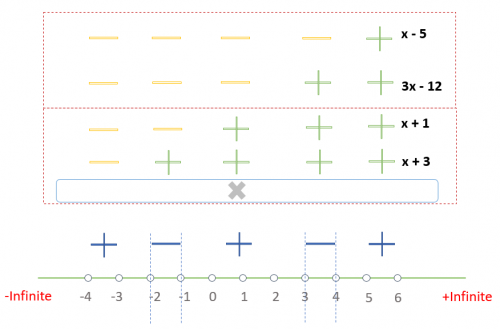


Therefore, the range of x is 5 < x < 4 and -3 < x < -1

Hence, the correct answer is option D.

Answer: D


Why wasn't the sign of equality flipped after mulplying both side by -1?
User avatar
Doer01
Joined: 19 Sep 2017
Last visit: 28 Oct 2021
Posts: 215
Own Kudos:
Given Kudos: 160
Location: United Kingdom
GPA: 3.9
WE:Account Management (Other)
Posts: 215
Kudos: 166
Kudos
Add Kudos
Bookmarks
Bookmark this Post
Baten80
EgmatQuantExpert

Solution


Given:
    • An inequality, \((x+1) (12-3x)^5 (x+3) (5-x) < 0\)

To find:
    • The range of x, that satisfies the above inequality

Approach and Working:
    • So, if we observe carefully, the inequality given to us can be written as,
      o \((x+1) (12-3x) (12-3x)^4 (x+3) (5-x) < 0\)
    • We know that, any number of the form \(N^2\) is always positive, expect for N = 0.
      o So, we can say that, \((12-3x)^4\) is always positive, expect for x = 4,
      o Thus, the inequality can be written as (x+1) (12-3x) (x+3) (5-x) < 0
    • Now, let’s multiply the inequality by -1, twice, to make the coefficients of x, in 12-3x and 5-x, positive
      o And, note that the inequality sign does not change as we are multiplying it by -1, twice
    Thus, the inequality becomes, (x+1) (3x - 12) (x+3) (x - 5) < 0
    • The zero points of this inequality are x = -1, x = 4, x = -3 and x = 5
    • Plot these points on the number line.
      o Since, 5 is the greatest among all, the inequality will be positive, for all the points to the right of 5, on the number line
      o And, it is negative, in the region, between 4 and 5
      o It is again positive in the region, between -1 and 4
      o And, it is again negative in the region, between -3 and -1
      o And, it is positive for all the values of x, less than -3


Therefore, the range of x is 5 < x < 4 and -3 < x < -1

Hence, the correct answer is option D.

Answer: D


Why wasn't the sign of equality flipped after mulplying both side by -1?

Hi Baten80 ,

It was. It was flipped twice. So it became what it was initially.
User avatar
armaankumar
Joined: 10 Jun 2020
Last visit: 07 Feb 2026
Posts: 101
Own Kudos:
72
 [2]
Given Kudos: 104
Location: India
GMAT 1: 610 Q41 V33 (Online)
GMAT 2: 650 Q47 V33 (Online)
GPA: 3.4
GMAT 2: 650 Q47 V33 (Online)
Posts: 101
Kudos: 72
 [2]
1
Kudos
Add Kudos
1
Bookmarks
Bookmark this Post
\((x+1) (12-3x)^5 (x+3) (5-x) < 0.\)
=>\((x+1) 3^5(4-x)^5 (x+3) (5-x) < 0.\)
=>\((x+1)(4-x)^5 (x+3) (5-x) < 0.\)
=>\((x+1)(4-x)^4 (4-x)(x+3) (5-x) < 0.\)
=>\((x+1)(4-x)(x+3) (5-x) < 0.\)

We can test each option,
A. \(x > 5\) Doesn't Work
B. \(4 < x < 5\) Works
C. \(-3 < x < -2\) Works
D. \((-3< x < -1) and (4 < x < 5)\) Works
E. \((x < -3) and (x > 5)\) Doesn't Work

Since, both B. and C. work, We check for D as it also includes the inequality of B.
D satisfies the equation
User avatar
bv8562
Joined: 01 Dec 2020
Last visit: 01 Oct 2025
Posts: 415
Own Kudos:
Given Kudos: 360
GMAT 1: 680 Q48 V35
GMAT 1: 680 Q48 V35
Posts: 415
Kudos: 505
Kudos
Add Kudos
Bookmarks
Bookmark this Post
EgmatQuantExpert

Solution


Given:
    • An inequality, \((x+1) (12-3x)^5 (x+3) (5-x) < 0\)

To find:
    • The range of x, that satisfies the above inequality

Approach and Working:
    • So, if we observe carefully, the inequality given to us can be written as,
      o \((x+1) (12-3x) (12-3x)^4 (x+3) (5-x) < 0\)
    • We know that, any number of the form \(N^2\) is always positive, expect for N = 0.
      o So, we can say that, \((12-3x)^4\) is always positive, expect for x = 4,
      o Thus, the inequality can be written as (x+1) (12-3x) (x+3) (5-x) < 0
    Now, let’s multiply the inequality by -1, twice, to make the coefficients of x, in 12-3x and 5-x, positive
      o And, note that the inequality sign does not change as we are multiplying it by -1, twice
    • Thus, the inequality becomes, (x+1) (3x - 12) (x+3) (x - 5) < 0

    • The zero points of this inequality are x = -1, x = 4, x = -3 and x = 5
    • Plot these points on the number line.
      o Since, 5 is the greatest among all, the inequality will be positive, for all the points to the right of 5, on the number line
      o And, it is negative, in the region, between 4 and 5
      o It is again positive in the region, between -1 and 4
      o And, it is again negative in the region, between -3 and -1
      o And, it is positive for all the values of x, less than -3


Therefore, the range of x is 5 < x < 4 and -3 < x < -1

Hence, the correct answer is option D.

Answer: D


I got the part that when we multiply the given inequality twice by -1 the inequality would not change but I did not understand how 5-x became x-5 after multiplying the given inequality twice by -1 because this what I get when I do the same:

5-x < 0 multiplying it by -1
-1*(5-x) < -1*0
x-5 > 0 again multiplying it by -1
-1*(x-5) > -1*0
5-x < 0 I arrive at the same expression

What am I doing wrong please help me understand? EgmatQuantExpert
avatar
Dhwanii
Joined: 16 Mar 2021
Last visit: 04 Feb 2023
Posts: 72
Own Kudos:
Given Kudos: 96
Posts: 72
Kudos: 13
Kudos
Add Kudos
Bookmarks
Bookmark this Post
EgmatQuantExpert, gone through your wavy line method, really helpful but just wanted to understand what if on the other side of expression we don't have a 0 then we will still use wavy line method but by bringing that articular number (with sign changed) on other side of inequality sign and put a 0 and then solve right ? Basically for us to use wavy line method we need to have 0 on one side of inequality sign right?
User avatar
bumpbot
User avatar
Non-Human User
Joined: 09 Sep 2013
Last visit: 04 Jan 2021
Posts: 38,964
Own Kudos:
Posts: 38,964
Kudos: 1,117
Kudos
Add Kudos
Bookmarks
Bookmark this Post
Automated notice from GMAT Club BumpBot:

A member just gave Kudos to this thread, showing it’s still useful. I’ve bumped it to the top so more people can benefit. Feel free to add your own questions or solutions.

This post was generated automatically.
Moderators:
Math Expert
109785 posts
Tuck School Moderator
853 posts