Last visit was: 24 Apr 2026, 14:43 It is currently 24 Apr 2026, 14:43
Close
GMAT Club Daily Prep
Thank you for using the timer - this advanced tool can estimate your performance and suggest more practice questions. We have subscribed you to Daily Prep Questions via email.

Customized
for You

we will pick new questions that match your level based on your Timer History

Track
Your Progress

every week, we’ll send you an estimated GMAT score based on your performance

Practice
Pays

we will pick new questions that match your level based on your Timer History
Not interested in getting valuable practice questions and articles delivered to your email? No problem, unsubscribe here.
Close
Request Expert Reply
Confirm Cancel
User avatar
EgmatQuantExpert
User avatar
e-GMAT Representative
Joined: 04 Jan 2015
Last visit: 02 Apr 2024
Posts: 3,657
Own Kudos:
20,880
 [36]
Given Kudos: 165
Expert
Expert reply
Posts: 3,657
Kudos: 20,880
 [36]
Kudos
Add Kudos
36
Bookmarks
Bookmark this Post
Most Helpful Reply
User avatar
chetan2u
User avatar
GMAT Expert
Joined: 02 Aug 2009
Last visit: 24 Apr 2026
Posts: 11,229
Own Kudos:
45,009
 [7]
Given Kudos: 335
Status:Math and DI Expert
Location: India
Concentration: Human Resources, General Management
GMAT Focus 1: 735 Q90 V89 DI81
Products:
Expert
Expert reply
GMAT Focus 1: 735 Q90 V89 DI81
Posts: 11,229
Kudos: 45,009
 [7]
2
Kudos
Add Kudos
5
Bookmarks
Bookmark this Post
General Discussion
User avatar
Archit3110
User avatar
Major Poster
Joined: 18 Aug 2017
Last visit: 24 Apr 2026
Posts: 8,629
Own Kudos:
5,190
 [1]
Given Kudos: 243
Status:You learn more from failure than from success.
Location: India
Concentration: Sustainability, Marketing
GMAT Focus 1: 545 Q79 V79 DI73
GMAT Focus 2: 645 Q83 V82 DI81
GPA: 4
WE:Marketing (Energy)
Products:
GMAT Focus 2: 645 Q83 V82 DI81
Posts: 8,629
Kudos: 5,190
 [1]
Kudos
Add Kudos
1
Bookmarks
Bookmark this Post
User avatar
EgmatQuantExpert
User avatar
e-GMAT Representative
Joined: 04 Jan 2015
Last visit: 02 Apr 2024
Posts: 3,657
Own Kudos:
20,880
 [1]
Given Kudos: 165
Expert
Expert reply
Posts: 3,657
Kudos: 20,880
 [1]
Kudos
Add Kudos
1
Bookmarks
Bookmark this Post

Solution


Given:
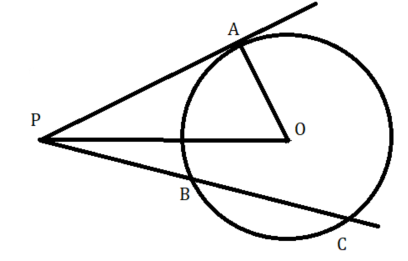
    • O is the center of the circle
    • BC is a chord
    • Radius of the circle = 10
    • PA is the tangent, whose length = 24
    • Lengths of PB and PC are integers, and PB < PC

To find:
    • The sum of all possible lengths of PB

Approach and Working:
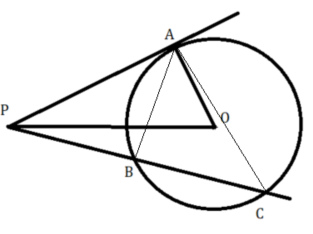
    • Let us draw lines from A to B and from A to C


Now, if we observe in triangles PAB and PAC,
    • ∠APB = ∠APC (common angle)
    • ∠PAB = ∠PCA (angles in alternate segments)

Therefore, we can say that the two triangles are similar,
    • Thus, \(\frac{PA}{PB} = \frac{PC}{PA}\)
    • \(PA^2 = PB * PC\)

Implies, PB * PC = \(24^2\) (substituting the value of PA)
    • Since, PB < PC, PB must be less than 24, and the minimum value that PB can take is when B is the intersection point of line PO and the circle.
    • In such case, \(PB = PO – OB = √(PA^2 + OA^2) – 10 = √676 – 10 = 26 – 10 = 16\)
    • Thus, 16 ≤ PB < 24, and PB must contain only 2 or 3 as its prime factors, since PB is a factor of \(24^2\) and \(24^2 = 2^6 * 3^2\)

Therefore, the only possible values of PB that satisfies the above two conditions are PB = 16 or 18.

So, the sum of all possible lengths of PB = 16 + 18 = 34

Hence the correct answer is Option C.

Answer: C

User avatar
warrior1991
Joined: 03 Mar 2017
Last visit: 03 Feb 2022
Posts: 540
Own Kudos:
Given Kudos: 596
Location: India
Concentration: Operations, Technology
Products:
Posts: 540
Kudos: 438
Kudos
Add Kudos
Bookmarks
Bookmark this Post
chetan2u
EgmatQuantExpert


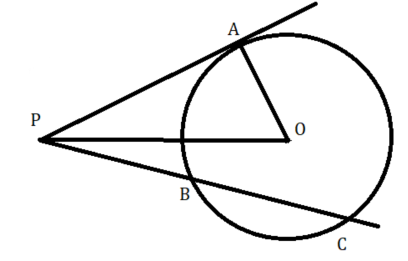
In the figure above, O is the center of the circle, with radius 10 units and PA is a tangent, whose length is equal to 24 units. If the lengths of PB and PC are distinct positive integers, and PB < PC, then find the sum of all possible lengths of PB?

    A. 16
    B. 18
    C. 34
    D. 58
    E. 126


It will be maximum when Pb~PC, that is PB is the tangent, and at that time it will be 24, so PB<24..
Now for Min, when PC lies on the hypotenuse itself...
So PO = √(24^2+10^2)=√676= 26, PB will be 26-10=16..
So min value is 16 and max is less than 24..

Now the property that will be useful here is (PA)^2=PB*PC...
So PB will be a factor of 24^2 but less than 24 and greater than or equal to 16..
So PB can be only 16 and 18..
Sum is 16+18=34

C


That was a very comprehensive approach Chetan Sir.

:ok :ok :ok
User avatar
eabhgoy
Joined: 12 Apr 2011
Last visit: 14 Jan 2021
Posts: 112
Own Kudos:
Given Kudos: 85
Location: United Arab Emirates
Concentration: Strategy, Marketing
GMAT 1: 670 Q50 V31
GMAT 2: 720 Q50 V37
GPA: 3.2
WE:Marketing (Telecommunications)
GMAT 2: 720 Q50 V37
Posts: 112
Kudos: 289
Kudos
Add Kudos
Bookmarks
Bookmark this Post
EgmatQuantExpert

Solution


Given:
    • O is the center of the circle
    • BC is a chord
    • Radius of the circle = 10
    • PA is the tangent, whose length = 24
    • Lengths of PB and PC are integers, and PB < PC

To find:
    • The sum of all possible lengths of PB

Approach and Working:
    • Let us draw lines from A to B and from A to C


Now, if we observe in triangles PAB and PAC,
    • ∠APB = ∠APC (common angle)
    • ∠PAB = ∠PCA (angles in alternate segments)

Therefore, we can say that the two triangles are similar,
    • Thus, \(\frac{PA}{PB} = \frac{PC}{PA}\)
    • \(PA^2 = PB * PC\)

Implies, PB * PC = \(24^2\) (substituting the value of PA)
    • Since, PB < PC, PB must be less than 24, and the minimum value that PB can take is when B is the intersection point of line PO and the circle.
    • In such case, \(PB = PO – OB = √(PA^2 + OA^2) – 10 = √676 – 10 = 26 – 10 = 16\)
    • Thus, 16 ≤ PB < 24, and PB must contain only 2 or 3 as its prime factors, since PB is a factor of \(24^2\) and \(24^2 = 2^6 * 3^2\)

Therefore, the only possible values of PB that satisfies the above two conditions are PB = 16 or 18.

So, the sum of all possible lengths of PB = 16 + 18 = 34

Hence the correct answer is Option C.

Answer: C


I have a doubt :)

In the figure we know:

Triangle PAO = Right Angled Triangle
PA = 24
AO = 10
=> PO = 26

Now lets look at Triangle POC:

PO = 26
OC = 10
=> PC<PO + OC
=> PC < 26+10
=> PC < 36

Since PA*PA = PB*PC

For PC = 36
=> 24*24= 36*PB => PB = 16
Hence PB != 16

That leaves us with only 1 value i.e. PB = 18

Please let me know where I went wrong.

Thanks in advance.
User avatar
EgmatQuantExpert
User avatar
e-GMAT Representative
Joined: 04 Jan 2015
Last visit: 02 Apr 2024
Posts: 3,657
Own Kudos:
20,880
 [1]
Given Kudos: 165
Expert
Expert reply
Posts: 3,657
Kudos: 20,880
 [1]
1
Kudos
Add Kudos
Bookmarks
Bookmark this Post
eabhgoy


I have a doubt :)

In the figure we know:

Triangle PAO = Right Angled Triangle
PA = 24
AO = 10
=> PO = 26

Now lets look at Triangle POC:

PO = 26
OC = 10
=> PC<PO + OC
=> PC < 26+10
=> PC < 36

Since PA*PA = PB*PC

For PC = 36
=> 24*24= 36*PB => PB = 16
Hence PB != 16

That leaves us with only 1 value i.e. PB = 18

Please let me know where I went wrong.

Thanks in advance.

Hi eabhgoy,

PC can be equal to OC + OP, when C is one of the end points of the diameter.

In that case PC = 36 and PB will be 36 - 20 = 16.

Regards,
User avatar
eabhgoy
Joined: 12 Apr 2011
Last visit: 14 Jan 2021
Posts: 112
Own Kudos:
Given Kudos: 85
Location: United Arab Emirates
Concentration: Strategy, Marketing
GMAT 1: 670 Q50 V31
GMAT 2: 720 Q50 V37
GPA: 3.2
WE:Marketing (Telecommunications)
GMAT 2: 720 Q50 V37
Posts: 112
Kudos: 289
Kudos
Add Kudos
Bookmarks
Bookmark this Post
EgmatQuantExpert
eabhgoy


I have a doubt :)

In the figure we know:

Triangle PAO = Right Angled Triangle
PA = 24
AO = 10
=> PO = 26

Now lets look at Triangle POC:

PO = 26
OC = 10
=> PC<PO + OC
=> PC < 26+10
=> PC < 36

Since PA*PA = PB*PC

For PC = 36
=> 24*24= 36*PB => PB = 16
Hence PB != 16

That leaves us with only 1 value i.e. PB = 18

Please let me know where I went wrong.

Thanks in advance.

Hi eabhgoy,

PC can be equal to OC + OP, when C is one of the end points of the diameter.

In that case PC = 36 and PB will be 36 - 20 = 16.

Regards,

Thank you

So since OC is radius then it is always a part of a diameter chord.
User avatar
Balkrishna
Joined: 17 Aug 2018
Last visit: 13 May 2022
Posts: 48
Own Kudos:
Given Kudos: 308
Status:Chartered Accountant
Location: India
WE:Accounting (Consulting)
Posts: 48
Kudos: 50
Kudos
Add Kudos
Bookmarks
Bookmark this Post
EgmatQuantExpert
eabhgoy


I have a doubt :)

In the figure we know:

Triangle PAO = Right Angled Triangle
PA = 24
AO = 10
=> PO = 26

Now lets look at Triangle POC:

PO = 26
OC = 10
=> PC<PO + OC
=> PC < 26+10
=> PC < 36

Since PA*PA = PB*PC

For PC = 36
=> 24*24= 36*PB => PB = 16
Hence PB != 16

That leaves us with only 1 value i.e. PB = 18

Please let me know where I went wrong.

Thanks in advance.

Hi eabhgoy,

PC can be equal to OC + OP, when C is one of the end points of the diameter.

In that case PC = 36 and PB will be 36 - 20 = 16.

Regards,


Hi EgmatQuantExpert, Bunuel, VeritasKarishma

Lets say line segment PO intersect the circle at point X. PX=16.

It is clear cut from the diagram that PB>PX. Now, there has been shown a possibility that PC might pass from the center of the circle. However, if PC had passed from O, then line segment PC would have been the extension of the line segment PO. But that is not the case here.

How can PB be 16? PB has to be greater than 16.

Would you please help clear this doubt?

Thank you.
User avatar
KarishmaB
Joined: 16 Oct 2010
Last visit: 23 Apr 2026
Posts: 16,442
Own Kudos:
79,404
 [2]
Given Kudos: 485
Location: Pune, India
Expert
Expert reply
Active GMAT Club Expert! Tag them with @ followed by their username for a faster response.
Posts: 16,442
Kudos: 79,404
 [2]
2
Kudos
Add Kudos
Bookmarks
Bookmark this Post
Balkrishna
EgmatQuantExpert
eabhgoy


I have a doubt :)

In the figure we know:

Triangle PAO = Right Angled Triangle
PA = 24
AO = 10
=> PO = 26

Now lets look at Triangle POC:

PO = 26
OC = 10
=> PC<PO + OC
=> PC < 26+10
=> PC < 36

Since PA*PA = PB*PC

For PC = 36
=> 24*24= 36*PB => PB = 16
Hence PB != 16

That leaves us with only 1 value i.e. PB = 18

Please let me know where I went wrong.

Thanks in advance.

Hi eabhgoy,

PC can be equal to OC + OP, when C is one of the end points of the diameter.

In that case PC = 36 and PB will be 36 - 20 = 16.

Regards,


Hi EgmatQuantExpert, Bunuel, VeritasKarishma

Lets say line segment PO intersect the circle at point X. PX=16.

It is clear cut from the diagram that PB>PX. Now, there has been shown a possibility that PC might pass from the center of the circle. However, if PC had passed from O, then line segment PC would have been the extension of the line segment PO. But that is not the case here.

How can PB be 16? PB has to be greater than 16.

Would you please help clear this doubt?

Thank you.

Note that PB > PX is a not a constraint given in our question. The line PBC shown in the diagram is just one example of various cases (and hence the question asks you for all possible values of PB)

The actual constraints on PB are just these two:
- the lengths of PB and PC are distinct positive integers,
- PB < PC

So PX = PB is a valid case.
User avatar
hadimadi
Joined: 26 Oct 2021
Last visit: 03 Dec 2022
Posts: 113
Own Kudos:
Given Kudos: 94
Posts: 113
Kudos: 31
Kudos
Add Kudos
Bookmarks
Bookmark this Post
chetan2u
one thing I don't get is:

The sum of two sides of a triangle has to be greater than the third side.

If PO=26, PB= 16, and we know that BO=10=radius of circle, then

BO+PB=26 !> 26.

How can this be?

Thanks
User avatar
chetan2u
User avatar
GMAT Expert
Joined: 02 Aug 2009
Last visit: 24 Apr 2026
Posts: 11,229
Own Kudos:
45,009
 [1]
Given Kudos: 335
Status:Math and DI Expert
Location: India
Concentration: Human Resources, General Management
GMAT Focus 1: 735 Q90 V89 DI81
Products:
Expert
Expert reply
GMAT Focus 1: 735 Q90 V89 DI81
Posts: 11,229
Kudos: 45,009
 [1]
1
Kudos
Add Kudos
Bookmarks
Bookmark this Post
hadimadi
chetan2u
one thing I don't get is:

The sum of two sides of a triangle has to be greater than the third side.

If PO=26, PB= 16, and we know that BO=10=radius of circle, then

BO+PB=26 !> 26.

How can this be?

Thanks


Hi,
Which triangle are you looking for?
POB need not be a triangle, here PBO is a straight line. We are just looking at different values of PB.
User avatar
hadimadi
Joined: 26 Oct 2021
Last visit: 03 Dec 2022
Posts: 113
Own Kudos:
Given Kudos: 94
Posts: 113
Kudos: 31
Kudos
Add Kudos
Bookmarks
Bookmark this Post
chetan2u

Are you sure? POB looks like a triangle to me, or am I looking at point B wrongly? According to the drawing it isn't on a line?
User avatar
hadimadi
Joined: 26 Oct 2021
Last visit: 03 Dec 2022
Posts: 113
Own Kudos:
Given Kudos: 94
Posts: 113
Kudos: 31
Kudos
Add Kudos
Bookmarks
Bookmark this Post
chetan2u

POB doesn't look like a straight line, rather, B is below P and O according to the drawing?

I somehow get (B) as a result:

We already know that PB < 24 and PB<PC.
We use Pythagorean to get PO=26. Let the intersect between the circle and the line PO be called X. So PX+XO=26.
We know XO=10, so PX=16. Because for a triangle, we have that the sum of two sides is always greater than the third side, and because we have the lengths of PO, PB, and BO, we can take a look at the triangle PBO to and say that:

PB+BO>PO -> PB+10>26 -> PB >16
In total we have 16<PB<24.
Now we know from the Power of Point Theorem that PA^2=(PB)(PC). Because PA=24 it follows
24^2=(2)^6(3)^2
All factors of 24^2 can be depicted by possible combinations of 2^6 and 3^2. But 16<PB<24, and so, the only factor we can depict is 18, which is 3^2*2.

Where did I go wrong?
User avatar
chetan2u
User avatar
GMAT Expert
Joined: 02 Aug 2009
Last visit: 24 Apr 2026
Posts: 11,229
Own Kudos:
45,009
 [1]
Given Kudos: 335
Status:Math and DI Expert
Location: India
Concentration: Human Resources, General Management
GMAT Focus 1: 735 Q90 V89 DI81
Products:
Expert
Expert reply
GMAT Focus 1: 735 Q90 V89 DI81
Posts: 11,229
Kudos: 45,009
 [1]
1
Kudos
Add Kudos
Bookmarks
Bookmark this Post
hadimadi
chetan2u

Are you sure? POB looks like a triangle to me, or am I looking at point B wrongly? According to the drawing it isn't on a line?

Hi

The question nowhere mentions that POB is a triangle. What it tells us is that PB and PC are distinct, B and C cannot be the same point.

The question wants us to draw different possible lines PBC, so the situation you are talking of PB=16, the radius is 10, so when you extend PBO further to meet the circumference at C, you get line PBC, where PB = 16 and PC = PB+BO+OC=16+10+10 = 36
Next such point is when PB is 18, then PC= PB+BC
24^2=18*PC or PC=32

What they have shown in the sketch is just one of the possible layout of line PBC. It can be anywhere on the sketch. Nothing to do with triangle POB. There may or may not be a triangle POB.
User avatar
hadimadi
Joined: 26 Oct 2021
Last visit: 03 Dec 2022
Posts: 113
Own Kudos:
Given Kudos: 94
Posts: 113
Kudos: 31
Kudos
Add Kudos
Bookmarks
Bookmark this Post
chetan2u
I think I understood it:

My answer is correct were the line PC drawn as is on the picture and the line was fixed. But the line isn't fixed, and could also just be straight (like POB).

That explains why PO=PB=16 is possible.

Now I got it. But to be quite frank, I find it irritating the way it's drawn ...

Thanks a lot for your time chetan
User avatar
mpobisetty
Joined: 06 Dec 2021
Last visit: 27 Oct 2025
Posts: 65
Own Kudos:
Given Kudos: 5
GMAT 1: 690 Q49 V36
GMAT 1: 690 Q49 V36
Posts: 65
Kudos: 30
Kudos
Add Kudos
Bookmarks
Bookmark this Post
chetan2u
Now the property that will be useful here is \((PA)^2=PB*PC\)...
Does GMAT expect us to know this property? Can you confirm if you have seen this property being used in any official question?

chetan2u and other experts.
User avatar
bumpbot
User avatar
Non-Human User
Joined: 09 Sep 2013
Last visit: 04 Jan 2021
Posts: 38,974
Own Kudos:
Posts: 38,974
Kudos: 1,117
Kudos
Add Kudos
Bookmarks
Bookmark this Post
Automated notice from GMAT Club BumpBot:

A member just gave Kudos to this thread, showing it’s still useful. I’ve bumped it to the top so more people can benefit. Feel free to add your own questions or solutions.

This post was generated automatically.
Moderators:
Math Expert
109818 posts
Tuck School Moderator
853 posts