Events & Promotions
| Last visit was: 14 Sep 2026, 09:26 |
It is currently 14 Sep 2026, 09:26 |
|
|

GMAT Club Daily Prep
Thank you for using the timer - this advanced tool can estimate your performance and suggest more practice questions. We have subscribed you to Daily Prep Questions via email.
Customized
for You
Track
Your Progress
Practice
Pays
Not interested in getting valuable practice questions and articles delivered to your email? No problem, unsubscribe here.
 Sep 15
07:00 PM EDT
-09:00 PM EST
Elite scores are possible when you enroll in a powerful GMAT course, taught live online + 6 months access to TTP OnDemand video courses included! Class starts Tues/Thurs Sept. 15, 2026 - Nov. 15, 2027, 7:00pm-9:00pm EST Sep 18
08:00 PM PDT
-09:00 PM PDT
Video explanations + diagnosis of 10 weakest areas + 150+ short videos + study plan! Sep 21
07:00 PM EDT
-10:00 PM EDT
Boost your GMAT score in less than one month in a live online class + 6 months access to TTP OnDemand video courses included! Class starts Mon, Tues, Wed, Thur, Fri Sept. 21, 2026 - Oct. 9, 2027, 7:00pm-10:00pm EST


 17 Jul 2019, 04:51
Kudos
Bookmarks


C
Be sure to select an answer first to save it in the Error Log before revealing the correct answer (OA)!
Difficulty:
 55%
(hard)
55%
(hard)
Question Stats:
64% (01:56) correct 36%
(02:08)
wrong
based on 392
sessions
36%
(02:08)
wrong
based on 392
sessions
History
Date
Time
Result
Not Attempted Yet
In a multiplex 3 shows A, B, and C run in 3 auditoriums. One day, 1000 people visited the multiplex and watched at least one of the 3 shows. If 420 people watched A, 250 watched B, 450 watched C, what is the maximum number of people who watched all of the 3 shows?
A. 0
B. 50
C. 60
D. 100
E. 250
A. 0
B. 50
C. 60
D. 100
E. 250

 18 Jul 2019, 05:54
Kudos
Bookmarks
For sets consists of three elements we know the formulae
Total - None = A + B + C - In Exactly two - 2(In Exactly 3)
as we have given in stem that 1000 people visited the multiplex and watched at least one of the 3 shows so None part in above formula will be Zero
1000 - 0 = 420 + 250 + 450 - In Exactly two - 2(In Exactly 3)
120 = Exactly two + 2(In Exactly 3)
to maximize exactly three we have to take exactly two as Zero
120 = 2(In Exactly 3)
60 = Exactly 3
Option C is the correct answer
Total - None = A + B + C - In Exactly two - 2(In Exactly 3)
as we have given in stem that 1000 people visited the multiplex and watched at least one of the 3 shows so None part in above formula will be Zero
1000 - 0 = 420 + 250 + 450 - In Exactly two - 2(In Exactly 3)
120 = Exactly two + 2(In Exactly 3)
to maximize exactly three we have to take exactly two as Zero
120 = 2(In Exactly 3)
60 = Exactly 3
Option C is the correct answer
General Discussion
 18 Jul 2019, 04:18
Kudos
Bookmarks
This is a very good question on Venn diagrams, wherein some regions of the diagram have to be maximized.
In questions on maximization in Venn diagrams, remember that it is not about taking the biggest value all the time; it is about taking the biggest possible value.
Also remember that investing time on getting the Venn diagram right is equivalent to half the job done.
So, let us now draw the Venn diagram first:
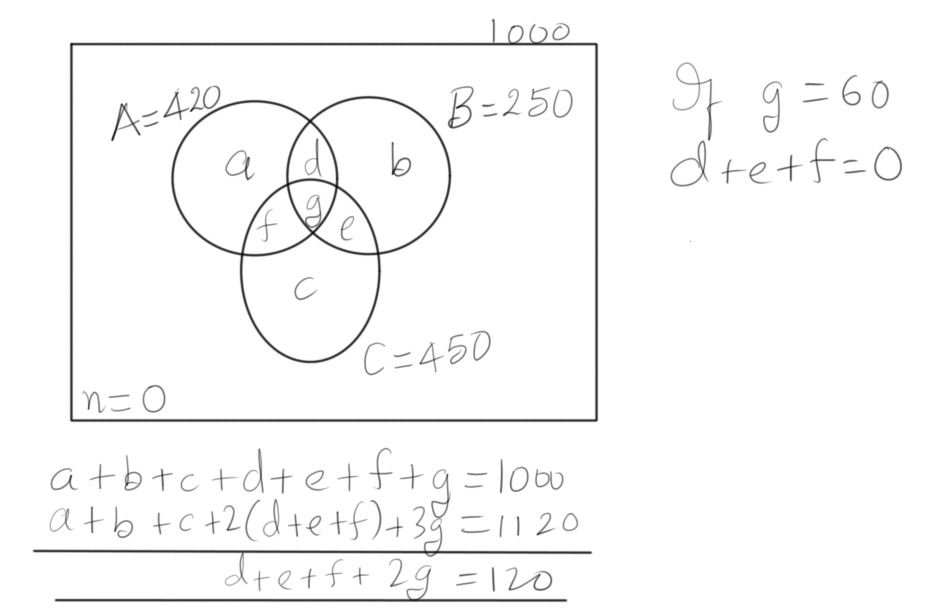
18th July - Reply 4 - 1.JPG [ 46.79 KiB | Viewed 5819 times ]
Since the question mentions that all of the 1000 people watched at least one of the shows, n = 0.
To find the maximum number of people watching all the 3 shows, we need to maximize the value of g.
As we see in the diagram, the maximum value of g = 60. A smart way of checking if this is indeed the biggest POSSIBLE value, is by plugging it back in the Venn diagram and seeing if it satisfies all conditions.
Substituting the value of g=60, we get a Venn diagram that looks like this:
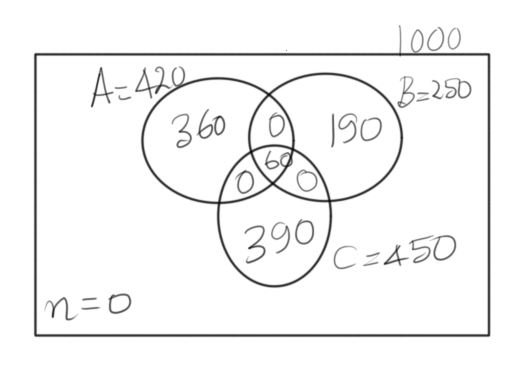
18th July - Reply 4 - 2.JPG [ 25.97 KiB | Viewed 5752 times ]
So, 60 is the maximum value of g.
The correct answer option is C.
Hope this helps!
In questions on maximization in Venn diagrams, remember that it is not about taking the biggest value all the time; it is about taking the biggest possible value.
Also remember that investing time on getting the Venn diagram right is equivalent to half the job done.
So, let us now draw the Venn diagram first:
Attachment:
18th July - Reply 4 - 1.JPG [ 46.79 KiB | Viewed 5819 times ]
Since the question mentions that all of the 1000 people watched at least one of the shows, n = 0.
To find the maximum number of people watching all the 3 shows, we need to maximize the value of g.
As we see in the diagram, the maximum value of g = 60. A smart way of checking if this is indeed the biggest POSSIBLE value, is by plugging it back in the Venn diagram and seeing if it satisfies all conditions.
Substituting the value of g=60, we get a Venn diagram that looks like this:
Attachment:
18th July - Reply 4 - 2.JPG [ 25.97 KiB | Viewed 5752 times ]
So, 60 is the maximum value of g.
The correct answer option is C.
Hope this helps!
 30 Jan 2021, 11:20
Kudos
Bookmarks
Just a question crossed in my mind... generally in such questions.... we have a tendency to pick the the minimum of A,B,C which is B=250 as maximum. The venn diagram will look as attached
Why we did not take this approach here?
if the maximum is indeed 60.... how will the venn diagram look like?
Why we did not take this approach here?
if the maximum is indeed 60.... how will the venn diagram look like?
Attachments
Capture.PNG [ 9.93 KiB | Viewed 4863 times ]





