Last visit was: 26 Apr 2026, 16:51 It is currently 26 Apr 2026, 16:51
Close
GMAT Club Daily Prep
Thank you for using the timer - this advanced tool can estimate your performance and suggest more practice questions. We have subscribed you to Daily Prep Questions via email.

Customized
for You

we will pick new questions that match your level based on your Timer History

Track
Your Progress

every week, we’ll send you an estimated GMAT score based on your performance

Practice
Pays

we will pick new questions that match your level based on your Timer History
Not interested in getting valuable practice questions and articles delivered to your email? No problem, unsubscribe here.
Close
Request Expert Reply
Confirm Cancel
User avatar
MathRevolution
User avatar
Math Revolution GMAT Instructor
Joined: 16 Aug 2015
Last visit: 27 Sep 2022
Posts: 10,063
Own Kudos:
20,007
 [14]
Given Kudos: 4
GMAT 1: 760 Q51 V42
GPA: 3.82
Expert
Expert reply
GMAT 1: 760 Q51 V42
Posts: 10,063
Kudos: 20,007
 [14]
Kudos
Add Kudos
14
Bookmarks
Bookmark this Post
User avatar
GMATGuruNY
Joined: 04 Aug 2010
Last visit: 02 Apr 2026
Posts: 1,347
Own Kudos:
3,906
 [2]
Given Kudos: 9
Schools:Dartmouth College
Expert
Expert reply
Posts: 1,347
Kudos: 3,906
 [2]
2
Kudos
Add Kudos
Bookmarks
Bookmark this Post
User avatar
Mo2men
Joined: 26 Mar 2013
Last visit: 09 May 2023
Posts: 2,426
Own Kudos:
Given Kudos: 641
Concentration: Operations, Strategy
Schools: Erasmus (II)
Products:
Schools: Erasmus (II)
Posts: 2,426
Kudos: 1,508
Kudos
Add Kudos
Bookmarks
Bookmark this Post
User avatar
GMATGuruNY
Joined: 04 Aug 2010
Last visit: 02 Apr 2026
Posts: 1,347
Own Kudos:
3,906
 [2]
Given Kudos: 9
Schools:Dartmouth College
Expert
Expert reply
Posts: 1,347
Kudos: 3,906
 [2]
1
Kudos
Add Kudos
1
Bookmarks
Bookmark this Post
Mo2men
GMATGuruNY
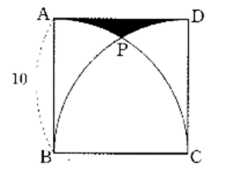
Perimeter of shaded region = AD + (AP+DP) = 10 + (more than 10)

Dear GMATGuruNY

Can you please elaborate how you deduce the highlighted part?

Thanks

The shortest distance between two points is a STRAIGHT LINE, implying that AD=10 is the shortest distance between A and D.
Since AP and PD link A to D but do not form a straight line, their combined length must be MORE THAN 10.
User avatar
MathRevolution
User avatar
Math Revolution GMAT Instructor
Joined: 16 Aug 2015
Last visit: 27 Sep 2022
Posts: 10,063
Own Kudos:
20,007
 [1]
Given Kudos: 4
GMAT 1: 760 Q51 V42
GPA: 3.82
Expert
Expert reply
GMAT 1: 760 Q51 V42
Posts: 10,063
Kudos: 20,007
 [1]
1
Kudos
Add Kudos
Bookmarks
Bookmark this Post
=>

Attachment:
7.29ps.png
7.29ps.png [ 8.99 KiB | Viewed 3364 times ]

Since triangle \(PBC\) is equilateral, angle \(ABP\) has measure \(30°\) and the length of arc \([m]AP\) is 2π*10*(\frac{30}{360}) = (\frac{5}{3}) π.[/m]

Thus, the perimeter of the shaded area is \((\frac{5}{3}) π *2 + 10 = (\frac{10}{3}) π + 10.\)

Therefore, A is the answer.
Answer: A
User avatar
Mo2men
Joined: 26 Mar 2013
Last visit: 09 May 2023
Posts: 2,426
Own Kudos:
Given Kudos: 641
Concentration: Operations, Strategy
Schools: Erasmus (II)
Products:
Schools: Erasmus (II)
Posts: 2,426
Kudos: 1,508
Kudos
Add Kudos
Bookmarks
Bookmark this Post
MathRevolution
=>

Attachment:
7.29ps.png

Since @triangle \(PBC\) is equilateral, angle \(ABP\) has measure \(30°\) and the length of arc \([m]AP\) is 2π*10*(\frac{30}{360}) = (\frac{5}{3}) π.[/m]

Thus, the perimeter of the shaded area is \((\frac{5}{3}) π *2 + 10 = (\frac{10}{3}) π + 10.\)

Therefore, A is the answer.
Answer: A

MathRevolution

How the triangle is equilateral? Can you explain please to help us understand your solution?
avatar
chetansood
Joined: 02 Jun 2014
Last visit: 24 Apr 2020
Posts: 58
Own Kudos:
Given Kudos: 39
Location: India
GMAT 1: 720 Q49 V40
GMAT 1: 720 Q49 V40
Posts: 58
Kudos: 25
Kudos
Add Kudos
Bookmarks
Bookmark this Post
I am putting in a proper geometrical solution, which is lengthy.

The question could be answered by eliminating choices as only one option is a value that is 10 + 10 more.

Now since AB is a straight line AB will be shortest distance so APB has to greater than AB hence the logic that the answer choice should be 10 + more than 10.

Posted from my mobile device
Attachments

Screenshot_20190729-082103_Samsung Notes.jpg
Screenshot_20190729-082103_Samsung Notes.jpg [ 461.08 KiB | Viewed 3301 times ]

avatar
chetansood
Joined: 02 Jun 2014
Last visit: 24 Apr 2020
Posts: 58
Own Kudos:
Given Kudos: 39
Location: India
GMAT 1: 720 Q49 V40
GMAT 1: 720 Q49 V40
Posts: 58
Kudos: 25
Kudos
Add Kudos
Bookmarks
Bookmark this Post
Part 2

Posted from my mobile device
Attachments

Screenshot_20190729-082115_Samsung Notes.jpg
Screenshot_20190729-082115_Samsung Notes.jpg [ 349.83 KiB | Viewed 3279 times ]

avatar
chetansood
Joined: 02 Jun 2014
Last visit: 24 Apr 2020
Posts: 58
Own Kudos:
Given Kudos: 39
Location: India
GMAT 1: 720 Q49 V40
GMAT 1: 720 Q49 V40
Posts: 58
Kudos: 25
Kudos
Add Kudos
Bookmarks
Bookmark this Post
[quote="MathRevolution"]=>

[attachment=0]7.29ps.png[/attachment]

Since triangle [m]PBC[/m] is equilateral, angle [m]ABP[/m] has measure [m]30°[/m] and the length of arc [m][m]AP[/m] is 2π*10*([fraction]30/360[/fraction]) = ([fraction]5/3[/fraction]) π.[/m]

Thus, the perimeter of the shaded area is [m]([fraction]5/3[/fraction]) π *2 + 10 = ([fraction]10/3[/fraction]) π + 10.[/m]

Therefore, A is the answer.
Answer: A[/quote]

How can we deduce it to be equilateral ?

[size=80][b][i]Posted from my mobile device[/i][/b][/size]
User avatar
Sayon
Joined: 08 Jan 2018
Last visit: 03 Jan 2023
Posts: 73
Own Kudos:
273
 [2]
Given Kudos: 374
Posts: 73
Kudos: 273
 [2]
1
Kudos
Add Kudos
1
Bookmarks
Bookmark this Post
Given:
ABCD is a square with side 10.

We need to find: Arc (AxP) + Arc (PyD) + DA -> (a)

Since BAPCB and CDPBC are Quarter Circles, BP and PC are radii of the circles.
Thus, BP = PC = BC ->(b)

As shown in the figure: Triangle PBC can form an Equilateral Triangle -> From (b)
Thus, Angle (PBC) = Angle (PCB) = 60 degrees.

Hence, Angle (ABP) = Angle (DCP) = 90 - 60 = 30 degrees

Therefore, Arc (AxP) = Arc (PyD) = \(\frac{30}{360} * 2 * \pi * 10\) = \(\frac{5 * \pi}{3}\) -> (c)

The required perimeter is: \(\frac{5 * \pi}{3}\) + \(\frac{5 * \pi}{3}\) + 10 = \(\frac{10 * \pi}{3} + 10\) -> [From (a) and (c)]

Answer A
Attachments

Figure A.png
Figure A.png [ 20.46 KiB | Viewed 3184 times ]

User avatar
bumpbot
User avatar
Non-Human User
Joined: 09 Sep 2013
Last visit: 04 Jan 2021
Posts: 38,991
Own Kudos:
Posts: 38,991
Kudos: 1,118
Kudos
Add Kudos
Bookmarks
Bookmark this Post
Automated notice from GMAT Club BumpBot:

A member just gave Kudos to this thread, showing it’s still useful. I’ve bumped it to the top so more people can benefit. Feel free to add your own questions or solutions.

This post was generated automatically.
Moderators:
Math Expert
109910 posts
Tuck School Moderator
852 posts